E. W. Bullinger Appendix to the Companion Bible
- The Structure of the Books of the Old Testament according to the Hebrew Canon.
- Genesis: The Foundation of Divine Revelation
- Genesis: Finds its Complement in the Apocalypse
- The Devine Names and Titles
- Creation versus Evolution
- Figures of Speech
- Italic Type in the Revised Version
- The So-called “Creation Tablets”
- The Usage of “Ruach”; Spirit
- The Spiritual Significance of Numbers
- The Word” Day” in Genesis 1
- “The Stars Also”
- The Use of “Nephesh” in the Old Testament
- The Synonymous Words Used for “Man”
- Laws Before Sinai
- The Occurrences of “Neshamah”, Breath
- The Genitive Case
- “In the Day” (Genesis 6:9)
- The Serpent of Genesis 3
- The prosperity of Cain
- Enos (Genesis 4:26): “Calling on the Name of the Lord”
- The Antediluvian Patriarchs, and the Flood Date
- “The Sons of God” in Genesis 6:2,4
- The 120 Years of Genesis 6:3
- The “Nephilim”, or “Giants” of Genesis 6, etc.
- Noah “Perfect” (Genesis 6:9)
- Wine
- Nimrod
- The generations of Terah, Issaac and Jacob
- The Massorah
- The Fifteen Extraordinary Points of the Sopherim
- The passages where the Sopherim altered “Jehovah” to “Adonia”
- The “Eighteen Emendations” of the Sopherim
- The Readings Called “Severin”
- “Sheol”
- “The Salvation” (Genesis 49:18)
- The Pharaohs of Genesis and Exodus
- “Leaven”
- The Decalogue (Exodus 20:2-17)
- The Names of the Tabernacle
- The Cherubim
- The Asherah
- “Offer” and “Offerings”
- Sin, Trespass. Iniquity, &c.
- The Order and Groupings of the Twelve Tribes
- Deuteronomy
- “The Book of the Law”
- The Use of Various Types in the English Bible
- “The Man of God”
- Chronological Charts and Tables
- Money and Coins, Weights and Measures
- Proper Names
- The Sieges of Jerusalem
- The Moabite Stone
- The Dynasty of Omri
- Parallel Passage of the Historical Books
- The Geology of the Persian Kings
- The Harmony of Ezra-Niamiah History
- The Twelve Gates of Jerusalem
- The Name of Jehovah in the Book of Esther
- Quotations from the Book of Job in the Other Books of the Bible
- The Septuagint Ending of the Book of Job
- The Book of Psalms: Miscellaneous Phenomena +
- “To the Chief Musician”
- The Psalms-Titles, and Words Employed in Them
- Hebrew Words in the Text of Psalms
- The Song of Degrees
- Zion +
- Trust
- Psalms 15 and “The Sermon on the Mount”
- “The Suffering, and the Glory”
- The Parenthesis of the Present Dispensation
- The Ten Words in Psalms 119
- The Book of Proverbs: Introduction and Analysis
- Special Passengers in the Book of Proverbs Acquiring New Light
- Supposed “Later” Hebrew Words in Ecclesiastes
- The Chronological Order of the Prophets
- The Inner-Relation of the Prophetical Books
- Isiah: The Evidence of One Authorship
- Isiah: Quotations and Allusions in the New Testament
- The “Alter to Jehovah in the Land of Egypt
- The Formulae of Prophetic Utterance
- Jeremiah: The Chronological Order of His Prophecies
- The Septuagint Version of Jerimiah
- Jeremiah, a type of the Messiah
- “The Fourth Year of Jehoiakim” (Jeremiah 25:1-3)
- “Pharaohs House in Tahpanhes” (Jeremiah 43:9)
- The Millennia “Sanctuary “and “Oblation” of Ezekiel 40-48
- The Vision of Daniel (Chs. 7-12) are Synchronous
- The “Times”, and Numbered “Days” of Daniel 7:25; 8:14; 12:7, 11, 12
- The “Seventy Weeks” of Daniel 9:24-27
- References to the Pentateuch in the Prophets
- The Alleged “Corruptions” of the Hebrew Text
- The Greek Text of the New Testament
- The New Testament and the Order of its Books
- The Diversity of the Four Gospels
- The Unity of the Four Gospels
- The Devine Names and Titles in the New Testament
- The Two Genealogies of Mathew 1 and Luke 3
- The Six Marys
- The Usage of “Pheuma” in the New Testament
- The Synonymous Words for “Will” and “Wish”
- The First Fulfilment of Prophecy in the New Testament (Mathew 1:22,23 Isaiah 7:14)
- Prepositions
- The usage of Negatives in the New Testament
- The Synonymous Words for “Appear”, “Appearing”, &c.
- The Principle Underlying the Quotations from the Old Testament in the New
- The Synonymous Words for “Child”, Children”, &c.
- The Herods of the New Testament
- The Use of “Psuche” in the New Testament
- The Synonymous Word for “Repent”, “Repentance”
- The Synonymous Expression for Kingdom
- The “Kingdom” and the “Church”
- The “Kingdom of Heavon” and the “Kingdom of God”
- “Baptize”, “Baptism”, &c.
- The Temptations of Our Lord
- The Lords Knowledge
- “If”: The Various Conditions Conveyed by Its Use
- The Fourfold Ministry of Our Lord
- The Synagogue; and the Jewish Sects
- The Synonymous Words for “Preach”, &c.
- The Synonymous Words for “Judge”, “Condemn”, &c.
- The Synonymous Words for “Man”, “Men”, &c.
- The Synonymous Words for “Other”, “Another”, &c.
- The Synonymous Words for “Perfect” (Adj. and Verb)
- The Eight Beatitudes of Mathew 5, and the Eight wows of Mathew23
- The Synonymous Words for “Poor”, &c.
- The Synonymous Words Used for “Sin”, “Wickedness”, “Evil”, &c.
- The Synonymous Words for “World”, Earth”, &c.
- The Synonymous Words for “Light”
- THE SYNONYMOUS WORDS FOR “HELL”, ETC.
- THE SYNONYMOUS WORDS FOR “KNOW”, “KNOWLEDGE”, ETC
- THE SYNONYMOUS WORDS FOR “SEE”, “LOOK”, “BEHOLD”, ETC.
- THE SYNONYMOUS WORDS FOR “PRAY” AND “PRAYER”.
- THE SYNONYMOUS WORDS FOR “LOVE”
- THE SYNONYMOUS WORDS FOR “WASH”.
- THE SYNONYMOUS WORDS FOR “WORSHIP”
- THE DOUBLE MIRACLES OF Mt 9:18; Mk 5:22; AND Lk 8:41
- “DEAD” AND “THE DEAD”.
- “THE GOSPEL OF THE KINGDOM” AND OTHER “GOSPELS”
- The “Three Days” and “Three Nights” of Matt. 12:40
- “The Third Day”
- The Transfiguration (Matt. 17:1-8; Mark 9:2-8; Luke 9:28-36)
- “Believe”: The Use of the Word in Various Connections, etc.
- “Everlasting”, “Eternal”, “For Ever”, etc.
- The Healing of the Blind Men at Jericho (Luke 18:35-43; Mark 10:46-52; Matt. 20:29-34)
- The Two Entries into Jerusalem
- “What Think Ye of Christ?”
- The Three Suppers
- The Two Anointings
- “This Is My Body” (Matt. 26:26)
- The Denials of Peter
- THE PURCHASE OF “THE POTTER’S FIELD” (Mt 27:6-8 and Ac 1:18,19) AND THE FULFILLMENT OF THE PROPHECY (Mt 27:9,10)
- The Cross and the Crucifixion
- The “Others” Crucified with the Lord (Matt. 27:38 and Luke 23:32)
- The Hours of the Lord’s Last Day
- Parallel Datings of the Times of Our Lord, etc. 179A. Map Illustrating the Missionary Journeys and Last Voyage of the Apostle Paul
- Chronology, etc. of the “Acts” Period
- The Dispensational Position of the Book of Acts
- The Lord’s Brethren
- “This Is That” (Acts 2:16)
- Synonymous Words for “Grace”, etc.
- The Formulae of Baptism in Acts and the Epistles (In relation to Matt. 28:19, 20)
- Church (Gr. Ekklesia)
- The Burying of the Patriarchs (Acts 7:15, 16)
- “Another King” (Acts 7:17, 18)
- Apostles, Elders, Prophets
- Synonymous Words for “Servant”, “Serve”, etc.
- “Just”, “Justify”, etc.
The Different Ages and Dispensations of God’s Dealings with Men
Appendix 1
THE STRUCTURE OF THE BOOKS OF THE OLD TESTAMENT
ACCORDING TO THE HEBREW CANON
I. THE LAW (Torah).
A. GENESIS. The beginning. All produced by the Word of God (Ge 1:3).
Israel as a “family” (Ge 15:1)
B. EXODUS. History. Israel emerging from Families and Tribes to a
Nation. Called “Hebrews” according to their “tongue.”
C. LEVITICUS. Worship. Jehovah in the midst. He, Israel’s God;
and they, His People.
B. NUMBERS. History. Israel, now a “Nation,” numbered, and blessed
as such (23, 24).
A. DEUTERONOMY. The end. All depending on the Word of Jehovah.
Israel regarded as in the “Land.”
II. THE PROPHETS (Nebi’im).
The Former Prophets
(Zec 7:7)
A. JOSHUA. “The Lord of all the earth” giving possession of the Land. Government under Priests.
B. JUDGES. Isreal forsaking and returning to God; losing and regaining their position in the Land. “No King” Bethlehem. Failure under Priest.
C. Samuel. Man’s king “rejected”; God’s king (David) “established.”
D. KINGS. Decline and Fall under the king.
The latter prophets.
D. ISAIAH. Final blessing under God’s King.
C. JEREMIAH. Human kings “rejected.” David’s “righteous Branch” “raised up.”
B. EZEKIEL. God forsaking Israel, and returning in glory, to say for ever of His Land and city “Jehovah-Shammah.”
A. MINOR PROPHETS. “The Lord of all the earth” giving restored possession of the Land, and foretelling final and unending possession.
III. THE PSALMS (Kethubim, Writings).
A. PSALMS. Tehilim. “Praises.” God’s purposes and counsels as to His
doings in the future.
B. PROVERBS, i.e. Rules: Words which govern or rule man’s life.
God’s moral government set forth.
C. JOB. “The end of the Lord” shown in Satan’s defeat, and the
saints deliverance from tribulation.
D. CANTICLES. Virtue rewarded. Read by the Jews at the
Passover: the Feast which commemorates the deliverance
from Pharaoh, the Jews’ oppressor.
The five Megilloth.
E. RUTH. The stranger gathered in to hear of, and share in, God’s goodness in Redemption. Read at Pentecost, which commemorates God’s goodness in the Land.
F. LAMENTATIONS. “Alas!” The record of Israel’s woes. Read at the Fast of the ninth of Abib.
E. ECCLESIASTES. “The Preacher.” The People collected to hear of man’s vanity. Read at the Feast of Tabernacles, which commemorates God’s goodness in the wilderness.
D. ESTHER. Virtue rewarded. Read at the Feast of Purim, which commemorates the deliverance from Haman, “the Jews’ enemy.”
C. DANIEL. “God’s judgment.” Here are shown the final defeat of
Antichrist, and the deliverance out of “the Great Tribulation.”
B. EZRA-NEHEMIAH. Men who governed and ruled God’s People in
their resettlement in the Land.
A. CHRONICLES. Dibrae hayyamim. “Words of the Days”; or, God’s
purposes and counsels as to Israel’s doings in the past, and until the
time of the end.
Appendix 2
GENESIS: THE FOUNDATION OF DIVINE REVELATION
Genesis is the seed-plot of the whole Bible. It is essential to the true
understanding of its every part. It is the foundation on which Divine Revelation
rests; and on which it is built up. It is not only the foundation of all Truth, but it
enters into, and forms part of all subsequent inspiration; and is at once the
warp and woof of Holy Writ.
Genesis is quoted or referred to sixty times in the New Testament; and
Divine authority is set like a seal on its historical facts. See Mt 19:4-6;
24:37-39. Mk 7:4,10; 10:3-8. Lk 11:49-51; 17:26-29,32. Jn 1:51; 7:21-23;
8:44-56.
It, and the Book of the Law, of which it forms part, are ascribed to Moses.
See Dt 31:9,10,24-26. Jos 1:7; 8:32,35; 23:6. 1 Ki 2:3. 2 Ki 14:6; 23:25. 2 Ch 23:18;
30:16; 34:14. Ezr 3:2; 7:6. Ne 8:1. Da 9:11,
13. Mal 4:4. Mk 12:26. Lk 2:22. Jn 7:23. Ac 13:39; 15:5; 28:23. 1 Co
9:9. Heb 10:28.
Appendix 3
GENESIS FINDS ITS COMPLEMENT IN THE APOCALYPSE
Genesis
Apocalypse
- Genesis, the book of the beginning.
- The Earth created (1:1).
- Satan’s first rebellion.
- Sun, moon, and stars for Earth’s government (1:14-16).
- Sun to govern the day (1:16).
- Darkness called night (1:5).
- Waters called seas (1:10).
- A river for Earth’s blessing (2:10-14).
- Man in God’s image (1:26).
- Entrance of sin (3).
- Curse pronounced (3:14,17).
- Death entered (3:19).
- Cherubim, first mentioned in connection with man (3:24).
- Man driven out from Eden (3:24).
- Tree of life guarded (3:24).
- Sorrow and suffering enter (3:17).
- Man’s religion, art, and science, resorted to for enjoyment, apart from God (4).
- Nimrod, a great rebel and king, and hidden anti-God, the founder of Babylon (10:8,9).
- A flood from God to destroy an evil generation (6-9).
- The Bow, the token of God’s covenant with the Earth (9:13).20.
- Sodom and Egypt, the place of corruption and temptation (13; 19).
- A confederacy against Abraham’s people overthrown (14).
- Marriage of first Adam (2:18-23).
- A bride sought for Abraham’s son (Isaac) and found (24).
- Two angels acting for God on behalf of His people (19).
- A promised seed to possess the gate of his enemies (22:17).
- Man’s dominion ceased and Satan’s begun (3:24).
- The old serpent causing sin, suffering, and death (3:1).
- The doom of the old serpent pronounced (3:15).
- Sun, moon, and stars, associated with Israel (37:9).
- Apocalypse, the book of the end.
- The Earth passed away (21:1).
- Satan’s final rebellion (20:3,7-10).
- Sun, moon, and stars, connected with Earth’s judgment (6:13; 8:12; 16:8).
- No need of the sun (21:23).
- “No night there” (22:5).
- “No more sea” (21:1).
- A river for the New Earth (22:1,2).
- Man headed by one in Satan’s image (13).
- Development and end of sin (21; 22).
- “No more curse” (22:3).
- “No more death” (21:4).
- Cherubim, finally mentioned in connection with man (4:6).
- Man restored (22).
- “Right to the Tree of Life” (22:14).
- No more sorrow (21:4).
- Man’s religion, luxury, art, and science, in their full glory, judged and destroyed by God (18).
- The Beast, the great rebel, a king and manifested anti-God, the reviver of Babylon (13-18)
- A flood from Satan to destroy an elect generation (12).
- The Bow, betokening God’s remembrance of His covenant with the Earth (4:3; 10:1).
- Sodom and Egypt again: (spiritually representing Jerusalem) (11:8).
- A confederacy against Abraham’s seed overthrown (12).
- Marriage of last Adam (19).
- A Bride made ready and brought to Abraham’s Son (19:9). See Mt 1:1.
- Two witnesses acting for God on behalf of His People (11).
- The promised seed coming into possession (11:18).
- Satan’s dominion ended, and man’s restored (22).
- The old serpent bound for 1,000 years (20:1-3).
- The doom on the old serpent executed (20:10).
- Sun, moon, and stars, associated again with Israel (12).
Appendix 4
THE DIVINE NAMES AND TITLES
I. ELOHIM occurs 2.700 times. Its first occurrence connects it with creation,
and give it its essential meaning as the Creator. It indicates His relation to
mankind as His creatures (see note on 2 Chron 18:31, where it stands in contrast
with Jehovah as indicating covenant relationship). ‘Elohim is God the Son, the
living “WORD” with creature form to create (Jn 1:1. Col 1:15-17. Rv 3:14); and
later, with human form to redeem (Jn 1:14). “Begotten of His Father before all
worlds; born of His mother, in the world.” In this creature form He appeared to
the Patriarchs, a form not temporarily assumed. ‘Elohim is indicated (as in
A.V.) by ordinary small type, “God”. See table on page 7.
II. JEHOVAH . While Elohim is God as the Creator of all things, Jehovah is
the same God in covenant relation to those whom He has created (Cp. 2 Ch
18:31). Jehovah means the Eternal, the Immutable One, He Who WAS, and IS,
and IS TO COME. The Divine definition is given in Ge 21:33. He is especially,
therefore, the God of Israel; and the God of those who are redeemed, and are
thus now “in Christ”. We can say “My God,” but not “My Jehovah”, for Jehovah is
“MY God.”
Jehovah is indicated (as in A.V.) by small capital letters, “LORD”‘ and by
“GOD” when it occurs in combination with Adonai, in which case LORD GOD =
Adonai Jehovah. The name Jehovah is combined with ten other words, which
form what are known as “the Jehovah Titles.” in the Hebrew Canon (Ap. 1). All
are noted in the margin, in all their occurrences:—
1. JEHOVAH-JIREH = Jehovah will see, or provide. Ge 22:14.
2. JEHOVAH-ROPHEKA = Jehovah that healeth thee. Ex 15:26.
3. JEHOVAH-NISSI = Jehovah my banner. Ex 17:15.
4. JEHOVAH-MeKADDISHKEM = Jehovah that doth sanctify you. Ex
31:13. Lev 20:8; 21:8; 22:32. Eze 20:12.
5. JEHOVAH-SHALOM = Jehovah [send] peace. Jdg 6:24.
6. JEHOVAH-ZeBA’OTH = Jehovah of hosts. 1 Sa 1:3, and frequently.
7. JEHOVAH-ZIDKENU = Jehovah our righteousness. Jer 23:6; 33:16.
8. JEHOVAH-SHAMMAH = Jehovah is there. Eze 48:35.
9. JEHOVAH-ELYON = Jehovah most high. Ps 7:17; 47:2; 97:9.
10. JEHOVAH-RO’I = Jehovah my Shepherd. Ps 23:1.
We have seven of these, experimentally referred to, in Ps 23, inasmuch as
Jehovah, the “Good,” “Great,” and “Chief Shepherd,” is engaged, in all the
perfection of His attributes, on behalf of His sheep:-
In verse 1, we have No. 1 above. In verse 2, we have No. 5. In verse 3, we
have Nos. 2 and 7. In verse 4, we have No. 8. In verse 5, we have Nos. 3 and 4.
III. JAH is Jehovah in a special sense and relation. Jehovah as having BECOME
our Salvation (first occ. Ex 15:2), He Who IS, and WAS, and IS TO COME. It
occurs 49 times (7 x 7. See Ap. 10). Compare Ps 68. 4, 18.
IV. EL is essentially the Almighty, thought the word is never so rendered
(see below, “Shaddai”). EL is Elohim in all His strength and power. It is
rendered “God” as Elohim is, but El is God the Omnipotent. Elohim is God the
Creator putting His omnipotence into operation. Eloah (see below) is God Who
wills and orders all, and Who is to be the one object of the worship of His
people. El is the God Who knows all (first occ. Ge 14:18-22) and sees all (Ge
16:13) and that performeth all things for His people (Ps 57:2); and in Whom all
the Divine attributes are concentrated.
El is indicated in this edition by type in large capital letters, thus: “GOD.” It is
sometimes transliterated in proper names Immanue-‘el, Beth-‘el, &c., where it
is translated, as explained in the margin.
V. ELOAH is Elohim, Who is to be worshipped. Eloah is God in connection
with His Will rather than His power. The first occurrence associates this name
with worship (Dt 32:15,17). Hence it is the title used whenever the contrast
(latent or expressed) is with false gods or idols. Eloah is essentially “the living
God” in contrast to inanimate idols. Eloah is rendered “God”, but we have
indicated it by type thus: GOD.
VI. ELYON first occurs in Ge 14:18 with El, and is rendered “the most high
(God)”. It is El and Elohim, not as the powerful Creator, but as “the possessor of
heaven and earth.” Hence the name is associated with Christ as the Son of “the
Highest” (Lk 1:35). It is Elyon, as possessor of the earth, Who divides the
nations “their inheritance”. In Ps 83:18, He is “over all the earth”. The title
occurs 36 times (6 x 6 or 62 See Ap. 10).
Elyon is the Dispenser of God’s blessings in the earth; the blessings
proceeding from a Priest Who is a King upon His throne (cp. Ge 14:18-22 with
Zec 6:13; 14:9).
VII. SHADDAI is in every instance translated “Almighty”, and is indicated by
small capital letters (“ALMIGHTY”). It is God (El), not as the source of strength,
but of grace; not as Creator, but as the Giver. Shaddai is the All-bountiful. This
title does not refer to His creative power, but to His power to supply all the
needs of His people. Its first occurrence is in Ge 17:1, and is used to show
Abraham that He Who called him out to walk alone before Him could supply all
his need. Even so it is the title used in 2 Co 6:18, where we are cal 1000 led to
“come out” in separation from the world. It is always used in connection with El
(see above).
VIII. ADON is one of the three titles (ADON, ADONAI, and ADONIM), all
generally rendered “Lord”; but each has its own peculiar usage and association.
They all denote headship in various aspects. They have to do with God as
“overlord.”
1. Adon is the Lord as Ruler in the earth. We have indicated this in
type by printing the preceding article or pronouns in small
capitals, not because either are to be emphasized, but to
distinguish the word “Lord” from Adonai, which is always so
printed in the A.V.
2. Adonai is the Lord in His relation to the earth; and as carrying out
His purposes of blessing in the earth. With this limitation it is
almost equivalent to Jehovah. Indeed, it was from an early date so
used, by associating the vowel points of the word Jehovah with
Adon, thus converting Adon into Adonai. A list of 134 passages
where this was deliberately done is preserved and given in the
Massorah (107-115). (See Ap. 32) We have indicated these by
printing the word like Jehovah, putting an asterisk, thus: LORD*.
3. Adonim is the plural of Adon, never used of man. Adonim carries
with it all that Adon does, but in a greater and higher degree; and
more especially as owner and proprietor. An Adon may rule others
who do not belong to him. Hence (without the article) it is often
used of men. But Adonim is the Lord Who rules His own. We have
indicated it by type, thus: LORD.
The three may be thus briefly distinguished:—
Adon is the Lord as overlord or ruler. Adonim is the Lord as owner. Adonai
is the Lord as blesser.
IX. The TYPES used to indicate the above titles, in the text, are as follows:—
· God = Elohim.
· GOD = Jehovah (in combination with Adonai, “Lord”).
· GOD* = Jehovah in the Primitive Texts, altered by Sopherim to
Elohim as the Printed Text. (See Ap. 32.)
· GOD = El.
· GOD = Eloah.
· LORD = Jehovah.
· THE LORD = Jah.
· LORD* = Jehovah in the Primitive Texts, altered by Sopherim to
Adonai as in the Printed Text. (See Ap. 32.)
· Lord = Adonai.
· LORD = Adonim.
· ALMIGHTY = Shaddai.
· MOST HIGH = Elyon.
X. The Combinations are indicated as follows:—
Adonai Jehovah = Lord GOD.
Jehovah Elohim = LORD God.
Elyon El = MOST HIGH GOD.
El Shaddai = GOD ALMIGHTY.
Appendix 5
CREATION VERSUS EVOLUTION
The Introduction to Genesis (and to the whole Bible) Ge 1:1-2:3, ascribes
everything to the living God, creating, making, acting, moving, and speaking.
There is no room for evolution without a flat denial of Divine revelation. One
must be true, the other false. All God’s works were pronounced “good” seven
times (see Ap. 10), viz. Ge 1:4,10,12,18,21,25,31. They are “great,” Ps 111:2.
Rv 15:3. They are “wondrous,” Job 37:14. They are “perfect,” Dt 32:4.
Man starts from nothing. He begins in helplessness, ignorance, and
inexperience. All his works, therefore, proceed on the principle of evolution.
This principle is seen only in human affairs: from the hut to the palace; from
the canoe to the ocean liner; from the spade and ploughshare to machines for
drilling, reaping, and binding, &c. But the birds build their nests to-day as at the
beginning. The moment we pass the boundary line, and enter the Divine
sphere, no trace or vestige of evolution is seen. There is growth and
development within, but no passing, change, or evolution out from one into
another. On the other hand, all God’s works are perfect.
In the Introduction to Genesis (ch. 1:1-2:3) forty-six times everything is
ascribed to direct acts and volitions on the part of God as the Creator (see Ap.
4. I.):—
God (or He) created6 times (1:1,21,27 [3 x]; 2:3)
God moved1 once (1:2)
God said10 times (1:3,6,9,11,14,20,24,26,28,29)
God saw7 times (1:4,10,12,18,21,25,31)
God divided2 twice (1:4,7)
God (or He) called5 times (1:5,8,10)
God (or He) made7 times (1:7,16,25,31; 2:2,3)
God set1 once (1:17)
God blessed3 times (1:22,28; 2:3)
God ended1 once (2:2)
God rested2 twice (2:2,3)
He sanctified1 once (2:3)
46
It will be noted that the word “God” (Elohim, see Ap. 4. I.) occurs in this
Introduction thirty-five times (7 x 5), the product of 7 and 5, the numbers of
spiritual perfection, and grace. (See Ap. 10.)
There are also ten words connected with the word “God”; this is the number
of ordinal perfection (Ap. 10).
There is only one verb used alone with the pronoun “He”, instead of “God”,
and that is the verb “rested”. This makes eleven in all; for the significance of
which see Ap. 10.
The word “and” is repeated 102 times: thus by the figure Polysyndeton (Ap.
6), marking and emphasizing each separate act as being equally independent
and important.
Evolution is only one of several theories invented to explain the phenomena
of created things. It is admitted by all scientists that no one of these theories
covers all the ground; and the greatest claim made for Evolution, or Darwinism,
is that “it covers more ground than any of the others.”
The Word of God claims to cover all the ground: and the only way in which
this claim is met, is by a denial of the inspiration of the Scriptures, in order to
weaken it. This is the special work undertaken by the so-called “Higher
Criticism”, which bases its conclusions on human assumptions and reasoning,
instead of on the documen 4 e tary evidence of manuscripts, and Textual
Criticism does.
Appendix 6
FIGURES OF SPEECH
It is most important to notice these. It is absolutely necessary for true
interpretation. God’s Word is made up of “words which the Holy Ghost
teacheth” (1 Co 2:13. 1 Th 2:13. 2 Ti 3:16. 2 Pe 1:21, &c.).
A “Figure of speech ” relates to the form in which the words are used. It
consists in the fact that a word or words are used out of their ordinary sense,
or place, or manner, for the purpose of attracting our attention to what is thus
said. A Figure of speech is a deigned and legitimate departure from the laws of
language, in order to emphasize what is said. Hence in such Figures we have
the Holy Spirit’s own marking, so to speak, of His own words.
This peculiar form or unusual manner may not be true, or so true, to the
literal meaning of the words; but it is more true to their real sense, and truer to
truth. Figures are never used but for the sake of emphasis. They can never,
therefore, be ignored. Ignorance of Figures of speech has led to the grossest
errors, which have been caused either from taking literally what is figurative,
or from taking figuratively what is literal.
The Greeks and Romans named some hundreds of such figures. They may be
divided into three classes: Figures which involve: –
1. omission;
2. the addition; or
3. the alteration or change, of a word, or words, or their sense.
The 181 which follow are arranged in alphabetical order for the sake of
reference.
In Ge 3:14,15 we have some of the earliest examples. By interpreting these
figures literally as meaning “belly”, “dust”, “heel”, “head”, we lose the volumes of
precious and mysterious truth which they convey and intensify. It is the truth
which is literal, while the words employed are figurative. (See under Ap. 19.)
In the marginal notes will be found the names of most of these figures; and we
append a list with their pronunciation and English definitions (giving one or
more references as examples):—
Ac-cis’-mus; or, Apparent Refusal (Mt 15:22-26). So named because it is an
apparent or assumed refusal.
Ac-ro’-stichion; or, Acrostic (Ps 119). Repetition of the same or successive
letters at the beginnings of words or clauses.
Æ-nig’-ma; or, Dark Saying (Ge 49:10. Jdg 14:14). A truth expressed in
obscure language.
Æ’-ti-o-log’-ia; or Cause Shown (Ro 1:16). Rendering a reason for what is
said or done.
Affirmatio; or, Affirmation (Philppians 1:18). Emphasising words to affirm
what no one has disputed.
Ag’-an-ac-te’-sis; or Indignation (Ge 3:13. Ac 13:10). An expression of feeling
by way of indignation.
Al’-le-go-ry; or, Continued Comparison by Reprensentation (Metaphor) (Ge
49:9. Gal 4:22,24), and Implication (Hypocatastasis) (Mt 7:3-5). Teaching a truth
about one thing by substituting another for it which is unlike it.
Am-oe-bae’-on; or, Refrain (Ps 136). The repetition of the same phrase at
the end successive paragraphs.
Am’-phi-di-or-tho’-sis; or, Double Correction (1 Co 11:22). A correction
setting right both hearer and speaker.
Am’-pli-a’-tio; or, Adjournment (Ge 2:23. 1 Sa 30:5). A retaining of an old
name after the reason for it has passed away.
An-ab’-a-sis; or, Gradual Ascent (Ps 18:37,38). An increase of emphasis or
sense in successive sentences.
An-acho’-re-sis; or, Regression (Eph 3:14). A return to the original subject
after a digression.
An’-a-coe-no-sis; or, Common Cause (1 Corithians 4:21). An appeal to
others as having interests in common.
An’-a-co-lu’-thon; or, Non-Sequence (Ge 35:3. Mk 11:32). A breaking off the
sequence of thought.
An’-a-di-plo’-sis; or, Like Sentence Endings and Beginnings (Ge 1:1,2. Ps
121:1,2). The word or words concluding one sentence are repeated at the
beginning of another.
An’-a-mne’-sis; or, Recalling (Ro 9:3). An expression of feeling by way of
recalling to mind.
An-a’-pho-ra; or, Like Sentence Beginnings (Dt 28:3-6). The repetition of the
same word at the beginning of successive sentences.
An-a’-stro-phe; or, Arraignment (Ac 7:48). The position of one word
changed, so as to be out of its proper or usaul place in a sentence.
An’-e-sis; or Abating (2 Ki 5:1). The addition of a concluding sentence which
diminishes the effect of what has been said.
Ant-eis’-a-go-ge; or, Counter Question (Mt 21:23-25). The answering of one
quetion by asking another.
An-throp’-o-path-ei’-a; or, Condescension (Ge 1:2; 8:21. Ps 74:11. Jer 2:13.
Hos 11:10). Ascribing to God what belongs to human and rational beings,
irrational creatures, or inanimate things.
Ant-i-cat’-e-gor’-ia; or, Tu Quoque (Eze 18:25). Retorting upon another the
very insinuation or accusation he has made against us.
Ant’-i-me’-rei-a; or, Exchange of Parts of Speech.
1. Of the Verb. The Verb used istead of some other part of speech
(Ge 32:24. Lk 7:21).
2. Of the Adverb. The Adverb used instead of some other part of
speech (Ge 30:33. Lk 10:29).
3. Of the Adjective. The Adjective used instead of some other part
of speech (Ge 1:9. Heb 6:17).
4. Of the Noun. The Noun used instead of some other part of speech
(Ge 23:6. Jas 1:25).
Ant-i-me-tab’-o-le; or, Counterchange (Ge 4:4,5. Isa 5:20). A word or words
repeated in a revers order, with the object of opposing them to one another.
Ant-i-met-a-the’-sis; or, Dialogue (1 Co 7:16). A transference of speakers; as
when the reader is addressed as if actually present.
Ant-i’-phras-is; or, Permutation (Ge 3:22). The use of a word or phrase in a
sense opposite to its original signification.
Ant’-i-pros-o’-po-poe-i-a; or Anti-Personification (2 Sa 16:9). Persons
represented as inanimate things.
Ant’-i-ptos’-is; or, Exchange of Cases (Ex 19:6, compare to 1 Pe 2:9). One
Case is put for another Case, the governing Noun being used as the Adjective
instead of the Noun in regimen.
Ant-i’-stro-phe; or, Retort (Mt 15:26,27). Turning the words of a speaker
against himself.
Ant-i’-thes-is; or, Contrast (Pr 15:17). A setting of one phrase in contrast
with another.
Ant’-o-no-ma’-si-a; or, Name Change (Ge 31:21). The putting of a proper
name for a Appellative or common Noun, or the reverse.
Aph-aer’-e-sis; or, Front Cut (Jer 22:24). The cutting off of a letter or
syllable from the beginning of a word.
Ap’-o-di-ox’-is; or, Detestation (Mt 16:23). An expression of feeling by way
of destestation.
Ap-o’-phas-is; or, Insinuation (Phm 19.). When, professing to suppress certain
matters, the writer adds the insinuation negatively.
A-po’-ria; or, Doubt (Lk 16:3). An expression of feeling by way of doubt.
Ap-o-si-opes’-is; or, Sudden Silence It may be associated with:
1. Some great promise (Ex 32:32).
2. Anger and threatening (Ge 3:22).
3. Grief and complaint (Ge 25:22. Ps 6:3).
4. Inquiry and deprecation (Jn 6:62).
Ap-o’-stro-phe; or, Apostrophe When the speaker turns away from the real
auditory whom he is addressing to speak to another, who may be
1. God (Ne 6:9).
2. Men (2 Sa 1:24,25).
3. Animals (Joel 2:22).
4. Inanimate things (Jer 47:6).
Association; or, Inclusion (Ac 17:27). When the speaker associates himself
with those whom he addresses, or of whom he speaks.
As’-ter-is’-mos; or, Indicating (Ps 133:1). Employing some word which
directs special attention to some paticular point or subject.
A-syn’-de-ton; or, No-Ands (Mk 7:21-23. Lk 14:13). The usual conjunction is
omitted, so that the point to be emphasised may be quickly reached and
ended with an emphatic climax (compare to Polysyndeton, and Lk 14:21).
Bat-to-log’-i-a; or, Vain Repetition (1 Ki 18:26). Not used by the Holy Spirit:
only by man.
Ben’-e-dic’-ti-o; or, Blessing (Ge 1:22,28. Mt 5:3-11). An expression of
feeling by way of benediction or blessing.
Bra-chy’-lo-gi-a; or, Brachyology A special form of Ellipsis (Ge 25:32). See
Ellipsis I.3.
Cat-a’-bas-is; or, Gradual Descent (Php 2:6-8). The opposite of Anabasis.
Used to emphasise humiliation, sorrow, etc.
Cat’-a-chres-is; or, Incongruity One word used for another, contrary to the
ordinary usage and meaning of it.
1. Of two words, where the meanings are remotely akin (Lev 26:30).
2. Of two words, where the meanings are different (Ex 5:21).
3. Of one word, where the Greek receives its real meaning by
permutation from another language (Ge 1:5. Mt 8:6).
Cat’-a-ploc’-e; or, Sudden Exclamation (Eze 16:23). This name is given to a
parenthesis when it takes the form of a sudden exclamation.
Chleu-as’-mos; or, Mocking (Ps 2:4). An expression of feeling by mocking
and jeering.
Chron’-o-graph’-i-a; or, Description of Time (Jn 10:22). The teaching of
something important by mentioning the time of an occurrence.
Climax; or, Gradation (2 Pe 1:5-7). Anadiplosis repeated in successive
sentences (see “Anadiplosis”, above).
Coe’-no-tes; or, Combined Repetition (Ps 118:8,9). The repetition of two
different phrases, one at the beginning, and the other at the end of successive
paragraphs.
Correspondence. This term is applied to repetition of a subject or subjects,
which reappear in varying order, thus determing the “Structure” of any portion
of the Sacred Text. This Correspondence is found in the folowing forms:-
1. Alternate. Where the subjects of the alternate members
correspond with each other, either by way of similarity or
contrast.
a. Extended. Where there are two series, but each consisting of
several members (Ps 72:2-17. Ps 132.).
b. Repeated. Where there are more than two series of subjects,
either consisting of two members each (Ps 26. Ps 145.), or
consisting of more than two members each (Ps 24).
1. Introverted. Where the first subject of the one series of
members corresponds with the last subject of the second (Ge
43:3-5. Lev 14:51,52).
2. Complex or Combined. Where both Alternation and Introversion
are combined together in various ways (Ex 20:8-11. Ps 105).
Cy-clo-id’-es; or, Circular Repetition (Ps 80:3,7,19). The repetition of the
same phrase at regular intervals.
De’-i-sis; or, Adjuration (Dt 4:26). An expression of feeling by oath or
asseveration.
Dep-re-ca’-ti-o; or, Deprecation (Ex 32:32). An expression of feeling by the
way of deprecation.
Di’-a-log-is-mos; or, Dialogue (Isa 63:1-6). When one or more persons are
represented as speaking about a thing, instead of saying it oneself.
Di’-a-syrm-os; or, Raillery (Mt 26:50). Tearing away disguise, and showing up
a matter as it really is.
Di-ex’-od-os; or, Expansion (Jude 12,13). A lengthening out by copious
exposition of facts.
Ec’-pho-ne’-sis; or, Exclamation (Ro 7:24). An outburst of words, prompted
by emotion.
Ei’-ron-ei-a; or, Irony. The expression of thought in a form that naturally
conveys its opposite.
1. Divine Irony. Where the speaker is Divine (Ge 3:22. Jdg 10:14).
2. Human Irony. Where the speaker is a human being ( Job 12:2).
3. Peirastic Irony. By way of trying or testing (Ge 22:2).
4. Simulated Irony. Where the words are used by man in
dissimulation (Ge 37:19. Mt 27:40).
5. Deceptive Irony. Where words are clearly false as well as
hypocritical (Ge 3:4,5. Mt 2:8).
E-jac’-u-la’-ti-o; or, Ejaculation (Hos 9:14). A parenthesis which consists of
a short wish or prayer.
El-eu’-ther-i’-a; or, Candour (Lk 13:32). The speaker, without intending
offence, speaks with perfect freedom and boldness.
El-lips’-is; or, Omission When a gap is purposely left in a sentence through
the omissiion of some word or words.
I. Absolute Ellipsis. Where the omitted word or words are to be
supplied from the nature of the subject.
1. Noun and Pronouns (Ge 14:19,20. Ps 21:12).
2. Verbs and participles (Ge 26:7. Ps 4:2).
3. Certain connected words in the same member of a passage (Ge
25:32. Mt 25:9). Called Brachyology.
4. A whole clause in a connected passage (Ge 30:27. 1 Ti 1:3,4).
II. Relative Ellipsis.
1. Where the omitted word is to be supplied from a cognate word
in the context (Ps 76:11).
2. Where the omitted word is to be supplied from a related or
contrary word (Ge 33:10. Ps 7:11).
3. Where the omitted word is to be supplied from analogous or
related words (Ge 50:23. Isa 38:12).
4. Where the omitted word is contained in another word, the one
word comprising the two significations (Ge 43:33).
III. Ellipsis of Repitition.
1. Simple; where the Ellipsis is to be supplied from a preceding or a
succeding clause (Ge 1:30. 2 Co 6:16).
2. Complex; where the two clauses are mutually involed, and the
Ellipsis in the former clause is to be supplied from the latter; and,
at the same time, an Ellipsis in the latter clause it be supplied
from the former (Heb 12:20).
E-nan-ti-o’-sis; or, Contraries (Lk 7:44-46). Affirmatation or negation by
contraries.
En’-thy-me-ma; or, Omission of Premiss (Mt 27:19). Where the conclusion is
stated, and one or both of the premisses are omitted.
Ep-i-dip’-lo-sis; or, Double Encircling (Ps 47:6). Repeated Epanadiplosis (see
below).
Ep’-an-a-di-plo’-sis; or, Encircling (Ge 9:3. Ps 27:14). The repetition of the
same word or words at the beginning and end of a sentence.
Ep’-an-a-leps’is; or, Resumption (1 Co 10:29. Php 1:24). The repetition of
the same word after a break or parenthesis.
Ep-an’-od-os; or, Inversion (Ge 10:1-31. Isa 6:10). The repetition of the same
word or words in an inverse order, the sense being unchanged.
Ep’-an-or-tho-sis; or, Correction (Jn 16:32). A recalling of what has been
said in order to substitute something stronger in its place.
Ep-i’-bo-le; or, Overlaid Repetition (Ps 29:3,4,5,7,8,9). The repetition of
the same phrase at irregular intervals.
Ep’-i-cri’-sis; or, Judgement (Jn 12:33). A short sentence added at the end by
way of an additional conclusion.
Ep’-i-mo-ne; or, Lingering (Jn 21:15-17). Repetition in order to dwell upon,
for the sake of impressing.
Ep’-i-pho-ne’-ma; or, Exclamation (Ps 135:21). An exclamation at the
conclusion of a sentence.
Ep-i’-pho-za; or, Epistrophe in Argument (2 Co 11:22). The repetition of the
same word or words at the end of successive sentences used in argument.
Ep-i-stro-phe; or, Like Sentence-Endings (Ge 13:6. Ps 24:10). The repetition
of the same word or words at the end of successive sentences.
Ep-i’-ta-sis; or, Amplification (Ex 3:19). Where a concluding sentence is
added by way of increasing the emphasis.
Ep’-i-ther-a-pei’-a; or, Qualification (Php 4:10). A sentence added at the end
to heal, soften, mitigate, or modify what has been before said.
Ep-i’-the-ton; or, Epithet (Ge 21:16. Lk 22:41). The naming of a thing by
describing it.
Ep’-i-ti-me’-sis; or, Reprimand (Lk 24:25). An expression of feeling by way of
censure, reproof, or reproach.
Ep’i-tre-chon; or, Running Along (Ge 15:13. Jn 2:9). A sentence, not
complete in itself, thrown in as an explanatory remark. A form of Parenthesis
(see below).
Ep’-i-troch-as’-mos; or Summarising (Heb 11:32). A running lightly over by
way of summary.
Ep-i’-trop-e; or, Admission (Ecc 11:9). Admission of wrong, in order to gain
what is right.
Ep’-i-zeux’-is; or, Duplication (Ge 22:11. Ps 77:16). The repetition of the
same word in the same sense.
Er’-o-te-sis; or, Interrogating (Ge 13:9. Ps 35:10). The asking of questions,
not for information, or for an answer. Such questions may be asked (1) in
positive affirmation, (2) in negative affirmation, (3) in afffirmative negation,
(4) in demonstration, (5) in wonder and admiration, (6) in rapture, (7) in
wishes, (8) in refusals and denials, (9) in doubts, (10) in admonition, (11), in
expostulation, (12) in prohibition or dissuasion, (13) in pity and commiseration,
(14) in disparagement, (15) in reproaches, (16) in lamentation, (17) in
indignation, (18) in absurdities and impossibilities, (19) double questions.
Eth’-o-poe’-i-a; or, Description of Manners (Isa 3:16). A description of a
person’s peculiarities as to manners, caprices, habits, etc..
Eu’-che; or, Prayer (Isaih 64:1,2). An expression of feeling by way of
prayer,curse, or imprecation.
Eu’-phem-is’-mos; or, Euphemy (Ge 15:15). Where a pleasing expression is
used for one that is unpleasant.
Exemplum; or, Example (Lk 17:32). Concluding a sentence by employing an
example.
Ex-er-gas’-i-a; or Working Out (Zec 6:12,13). A repetition so as to work out
or illustrate what has already been said.
Ex’-ou-then-is’-mos; or, Contempt (2 Sa 6:20). An expression of feeling by
way of contempt.
Gno’-me; or, Quotation The citation of a well-known saying without quoting
the author’s name.
1. Where the sense originally intended is preserved, though the
words may vary (Mt 26:31).
2. Where the original sense is modified in the quotation or
reference (Mt 12:40).
3. Where the sense is quite different from that which was first
intended (Mt 2:15).
4. Where the words are from the Hebrew or from the Septuagint
(Lk 4:18).
5. Where the words are varied by omission, addition, or
transposition (1 Co 2:9).
6. Where the words are changed by a reading, or an inference, or in
number, person, mood, or tense. (Mt 4:7).
7. Where two or more citations are amalgamated (Mt 21:13).
8. Where Quotations are from books other than the Bible (Ac 17:28).
Hen-di’-a-dys; or, Two for One (Ge 2:9. Eph 6:18). Two words used, but one
thing meant.
Hen-di’-a-tris; or, Three for One (Da 3:7). Three words used, but one thing
meant.
Her-men’-ei-a; or, Interpretation (Jn 7:39). An explanation immediately
following a statement to make it more clear.
Het’-er-o’-sis; or, Exchange of Accidence. Exchange of one voice, mood,
tense, person, number, degree, or gender for another.
1. Of forms and voices (1 Pe 2:6).
2. Of moods (Ge 20:7. Ex 20:8).
3. Of tenses (Ge 23:11. Matthew 3:18 ).
4. Of persons (Ge 29:27. Da 2:36).
5. Of adjectives (degree) and adverbs (2 Ti 1:18).
6. Of nouns (number), adjectives, and pronouns (Ge 3:8. Heb 7:7).
Ho-moe-o’-pto-ton; or, Like Inflections (2 Ti 3:2,3). Similar endings arising
from the same inflection of verbs, nouns, etc. . This figure belongs peculiarly to
the original languages.
He-moe-o-pro’-pher-on; or, Alliteration (Jdg 5). The repetiton of the same
letter or syllable at commencement of successive words.
Heo’-moe-o-tel-eu’-ton; or, Like Endings (Mk 12:30). The repetition of the
same letters or syllables at the end of successive words. Used also of an
omision in the text caused by such-like endings: the scribe’s eye going back to
the latter of such similar words, instead of the former. See Jos 2:1.
Hyp-al’-la-ge; or, Interchange (Ge 10:9. 1 Ki 17:4). A word logically
belonging to one connection is grammatically united with another.
Hyp-er’bat-on; or, Transposition (Ro 5:8). The placing of a word out of its
usual order in a sentence.
Hy-per’-bo-le; or Exaggeration (Ge 41:47. Dt 1:28). When more is said than
is literally meant.
Hy’-po-cat-as’-ta-sis; or, Implication (Mt 15:13; 16:6). An implied
resemblance or representation.
Hy-po-ti-me’-sis; or, Under Estimating (Ro 3:5). Parenthetic addition by way
of apology or excuse.
Hy’-po-ty-po’-sis; or, Word Picture (Isa 5:26-30). Representation of objects
or actions by words.
Hys’-ter-e-sis; or, Subsequent Narration (Ge 31:7,8. Ps 105:8). When later
record gives supplemental or new particulars, not inserted in the historical
record.
Hys’-ter-o-log’-ia; or, The First Last (Ge 10 and 11. 2 Sa 24). A prior mention
of a subsequent event.
Id-i-o’-ma; or, Idiom The peculiar usage of words and phrases, as illustrated
in the language peculiar to one nation or tribe, as opposed to other languages or
dialects.
1. Idiomatic usage of verbs (Ge 42:38. 1 Jn 1:10).
2. Special idiomatic usages of nouns and verbs (Ge 33:11. Jer 15:16).
3. Idiomatic degrees of comparison (Lk 22:15).
4. Idiomatic use of prepositions (Lk 22:49).
5. Idiomatic use of numerals (Ps 103:2).
6. Idsiomatic forms of quotations (Ps 109:5).
7. Idiomatic forms of question (Lk 22:49).
8. Idiomatic phrases (Ge 6:2,4. Mt 11:25).
9. Idioms arising from other figures of speech (see notes in margin).
10. Chages of usage of words in the Greek language (Ge 43:18. Mt
5:25).
11. Changes of usage of words in the English language (Ge 24:21. 2 Ki
3:9).
In’-ter-jec’-ti-o; or, Interjection (Ps 42:2). Parenthetic addition by way of
feeling.
Mal’-e-dic’-ti-o; or, Imprecation (Isa 3:11). Expression of feeling by way of
malediction and execration.
Mei-o’-sis; or a Belittleing (Ge 18:27. Nu 13:33). A belittleing of one thing to
magnify another.
Me-ris’-mos; or, Distribution (Ro 2:6-8). An enumeration of the parts of a
whole which has been just previously mentioned.
Mes-ar-chi’-a; or, Beginning and Middle Repetition (Ecc 1:2). The repetition
of the same word or words at the beginning and middle of successive
sentences.
Mes-o-di-plo’-sis; or, Middle Repetition (2 Co 4:8,9). The repetition of the
same word or words in the middle of successive sentences.
Mes-o-tel-eu’-ton; or, Middle and End Repetition (2 Ki 19:7). The repetition
of the same word or words in the middle and at the end of successive
sentences.
Met-a’-bas-is-; or, Transition (1 Co 12:31). A passing from one subject to
another.
Met’-a-lep’-sis; or, Double Metonymy (Ge 19:8. Ecc 12:6. Hos 14:2). Two
metonymies, one contained in the other, but only one expressed.
Met-al’-la-ge; or, a Changing Over (Hos 4:18). A different subject of thought
substituted for the original subject.
Met’-a-phor’; or, Representation (Mt 26:26). A declaration that one thing is
(or represents) another: while Simile resembles it, and Hypocatastasis implies
it.
Met-a-sta-sis; or, Counter-Blame (1 Ki 18:17,18). A transferring of the blame
from one’s self to another.
Met-o’-ny-my; or, Change of Noun When one name or noun is used instead
of another, to which it stands in a certain relation.
1. Of the Cause. When the cause is put for the effect (Ge 23:8. Lk
16:29).
2. Of the Effect. When the effect is put for the cause producing it
(Ge 25:23. Ac 1:18).
3. Of the Subject. When the subject is put for something pertaining
to it (Ge 41:13. Deutronomy 28:5).
4. Of the Adjunct. When something pertaining to the subject is put
for the subject itself (Ge 28:22. Job 32:7).
Mi-me-sis; or, Description of Sayings (Ex 15:9). Used when the sayings and
etc., of another are described or imitated by way of emphasis.
Neg-a’-ti-o; or, Negattion (Gal 2:5). A denial of that which has not been
affirmed.
Oe’-on-is’-mos; or, Wishing (Ps 55:6). An expression of feeling by way of
wishing or hoping for a thing.
Ox’-y-mor-on; or Wise-Folly (1 Ti 5:6). A wise saying that seems foolish.
Pae-sn’-si’-mos; or, Exultation (Zep 3:14). Calling on others to rejioce over
something.
Pal’-in-od’-i-a; or, Retracting (Rv 2:6). Approval of one thing after reproving
for another thing.
Par-a-bol-a; or, Parable i.e., Continued Simile (Lk 14:16-24). Comparison by
continued resemblance.
Par’-a-di-a’-stol-e; or, Neithers and Nors (Ex 20:10. Ro 8:35,38,39). The
repetition of the disjunctives niether and nor, or, either and or.
Par’-ae-net’-ic-on; or, Exhortation (1 Ti 2). An expression of feeling by way
of exhortation.
Par-a-leips-is; or, a Passing By (Heb 11:32). When a wish is expressed to pass
by a subject, which is, notwithstanding, briefly alluded by subsequently.
Parallelism; or Parallel Lines The repetition of similar, synonymous, or
opposite thoughts or words in parallel or successive lines. Compare to
“Correspondence”.
1. Simple synonymous, or gradational. When the lines are parallel in
thought, and in the use of synonymous words (Ge 4:23,24. Ps 1:1).
2. Simple antithetic, or opposite. When the words are contrasted in
the two or more lines, being opposed in sense the one to the
other (Pr 10:1).
3. Simple synthetic, or constructive. When the parallelism consists
only in the similar form of construction (Ps 19:7-9).
4. Complex alternate. When the lines are placed alternately (Ge
19:25. Pr 24:19,20).
1. Complex repeated alternation. The repetition of two parallel
subjects in several lines (Isa 65:21,22).
2. Complex extended alternation. Alternation extended so as to
consist of three or more lines (Jdg 10:17).
3. Complex introversion. When the parallel lines are so placed that
the first corresponds with the last, the second with the last but
one, etc. (Ge 3:19. 2 Ch 32:7,8).
Par-ec’-bas-is; or, Digression (Ge 2:8-15). A temporary turning aside from
one subject to another.
Par-e-che’-sis; or, Foreign Paronomasia (Ro 15:4). The repetition of words
similar in sound, but different in language.
Par-eg’-men-on; or, Derivation (Mt 16:18). The repetition of words derived
from the same root.
Par-em’-bol’-e; or, Insertion (Php 3:18,19). Inseration of a sentence
between others which is independent and complete in itself.
Par-en’-the-sis; or, Parenthesis (2 Pe 1:19). Insertion of a word or sentence,
parenthetically, which is necessary to explain the context.
Par-oe’-mi-a; or Proverb (Ge 10:9. 1 Sa 10:12). A wayside-saying in common
use.
Par’-o-moe-o’-sis; or, Like-Sounding Inflections (Mt 11:17). The repetition of
inflections similar in sound.
Par-o-no-ma’-si-a: or, Rhyming Words (Ge 18:27). The repetition of words
similar in sound, but not necessarily in sense.
Path’-o-poe’-i-a; or, Pathos (Lk 19:41,42). The expression of feeling or
emotion.
Per-i’-phras-is; or, Circumlocution (Ge 20:16. Jdg 5:10). When a description
is used instead of the name.
Per-i’-stas-is; or, Description of Circumstances (Jn 4:6).
Ple’-on-asm; or, Redundancy Where what is said is, immediately after, put
in another or opposite way to make it impossible for the sense to be missed.
The Figure may affect (1) words (Ge 16:8); or (2) sentences (Ge 1:20. Dt
32:6).
Plok’-e; or, Word-Folding (Jer 34:17). The repetition of the same word in a
different sense, implying more than the first use of it.
Po-ly-o-ny’-mi-a; or, Many Names (Ge 26:34,35. 2 Ki 23:13). Persons or
places mentioned under different names.
Po-ly-pto’-ton; or, Many Inflections The repetition of the same part of
speech in different inflections.
1. Verbs (Ge 50:24. 2 Ki 21:13).
2. Nouns and pronouns (Ge 9:25. Ro 11:36).
3. Adjectives (2 Co 9:8).
Po’ly-syn’de-ton; or, Many Ands (Ge 22:9,11. Jos 7:24. Lk 14:21). The
repetition of the word “and” at the beginning of successive clauses, each
independent, important, and emphatic, with no climax at the end (Compare
Aysndeton and Lk 14:13).
Prag’-mato-graph-i-a; or Description of Actions (Joel 2:1-11).
Pro-ec’-the-sis; or Justification (Mt 12:12). A sentence added at the end by
way of justification.
Pro-lep’s-is, (Ampliatio); or, Anticipation (Heb 2:8). Anticipating what is
going to be, and speaking of future things as present.
Pro-lep’s-is, (Occupatio); or, Anticipation. Answering an argument by
anticipating it before it is used.
1. Open. When the anticipated objection is both answered and
stated (Mt 3:9).
2. Closed. When the anticipated objection is either not plainly stated
or not answered (Ro 10:18).
Pros-a-po’-do-sis; or, Detailing (Jn 16:8-11). A return to previous words or
subjects for purposes of definition or explanation.
Pros’-o-po-graph’-i-a; or, Description of Persons (Mt 3:4). A vivid
description of a person by detailed delineation.
Pros’-o-po-poe’-i-a; or, Personification Things represented as persons.
1. The members of the human body (Ge 48:14. Ps 35:10).
2. Animals (Ge 9:5. Job 12:7).
3. The products of the earth (Na 1:4).
4. Inanimate things (Ge 4:10).
5. Kingdoms, countries, and states (Ps 45:12).
6. Human actions, etc., attributed to things, etc. (Ge 18:20. Ps 85:10).
Pro’-ther-a-pei’-a; or, Conciliation (Mt 19:16). Conciliating others, by way
of precaution, because of something we are about to say.
Pro’-ti-me-sis; or, Description of Order (1 Co 15:5-8). The enumeration of
things according to their places of honour or importance.
Repeated Negation; or Many Noes (Jn 10:28). The repetition of divers
negatives.
Repetitio; or, Repetition (2 Ch 20:35-37. Jn 14:1-4). Repetition of the same
word or words irregularly in the same passage.
Sim’-i-le; or, Resemblance (Ge 25:25. Mt 7:24-27). A declaration that one
thing resembles another. (Compare Metaphor, above.)
Sim’-ul-ta’-ne-um; or Insertion (Rv 16:13-16). A kind of historical
parenthesis, an event being put out of its historical place between two others
which are simultaneous.
Syl-leps’-is; or, Combination (2 Ch 31:8). The repetition of the sense without
the repetition of the word.
Syl-leps’-is; or, Change in Concord (Jn 21:12). A change in the grammatical
concord in favour of a logical concord.
Syl’-lo-gis’-mus; or, Omission of the Conclusion (1 Sa 17:4-7). The conclusion,
though implied, is unexpressed, in order to add emphasis to it.
Symbol (Isa 22:22). A material object substituted for a moral, or spiritual
truth.
Sym’-per-as’-ma; or, Concluding Summary (Mt 1:17). When what has been
said is briefly summed up.
Sym’-plo-ke; or, Interwining (1 Co 15:42-44). The repetition of different
words in successive sentences in the same order and the same sense.
Syn’-ath-roes’-mos; or, Enumeration (1 Ti 4:1-3). The enumeration of the
parts of a whole which has not been mentioned.
Syn’-cho-re’-sis; or, Concession (Hab 1:13). Making a concession of one point
in order to gain another.
Syn’-cri-sis; or, Repeated Simile (Isa 32:2). Repetition of a number of
resemblances.
Syn-ec’-do-che; or, Transfer The exchange of one idea for another
associated idea.
1. Of the Genus. When the genus is put for the species, or universals
for particulars (Ge 6:12. Mt 3:5).
2. Of the Species. When the species is put for the genus, or
particulars for universals (Ge 3:19. Mt 6:11).
3. Of the Whole. When the whole is put for a part (Ge 6:12).
4. Of the Part. When a part is put for the whole (Ge 3:19. Mt 27:4).
Syn’-oe-cei-o’-sis; or, Cohabitation (Mt 19:16,17). The repetition of the
same word in the same sentence with an extended meaning.
Syn-o-ny-mi-a; or, Synonymous Words (Pr 4:14,15). The repetition of words
similar in sense, but different in sound and origin.
Syn’-the-ton; or, Combination (Ge 18:27). A placing together of two words
by usage.
Ta-pei-no’-sis; or, Demeaning (Ge 27:44. Ro 4:19). The lessoning of a thing
in order to increase and intensify that same thing. (Compare Meiosis.)
Thau-mas’-mos; or, Wondering (Ro 11:33). An expression of feeling by way
of wonder.
Tme’-sis; or, Mid-Cut (Eph 6:8). A change by which one word is cut in two,
and another word put in between.
Top’-o-graph’-i-a; or, Description of Place (Isa 10:28-32). Throwing light on
the subject dealt with by alluding to locality.
Type (Ro 5:14). A figure or ensample of something future, and more or less
prophetic, called the Anti-type.
Zeug’-ma; or, Unequal Yoke When one verb is yoked on to two subjects,
while grammatically a second verb is required.
1. Proto-zeugma, or, Ante-yoke or Fore-yoke (Ge 4:20. 1 Ti 4:3).
2. Meso-zeugma, or, Middle yoke (Lk 1:64).
3. Hypo-zeugma, or End yoke (Ac 4:27,28).
4. Syne-zeugmenon, or, Joint yoke (Ex 20:18).
Appendix 7
ITALIC TYPE IN THE REVISED VERSION
The Revisers ill-advisedly decided that “all such words, now printed in italics, as are plainly implied in the Hebrew,
and necessary in English, be printed in common type.”
One of the consequences of this decision is that the very “to be” is not distinguished from the verb “to become”, so
that the lessons conveyed by the A. V. “was” and “was” in Ge 1:2; 3 and 4; 9 and 10; 11 and 12, are lost. See the notes on
Gen 1:2.
For the general uses of various types in the English Bible see Ap. 48.
Appendix 8
THE SO-CALLED “CREATION TABLETS”
The Cosmogony of Genesis is in flat, contradiction to that of the so-called “Creation Tablets ,” preserved in an epic
poem in honor of Merodach, the patron god of Babylon. If Genesis looks back to Creation, it is to put on record the
profound contrast between them, and to give, instead of the corruption of primitive truth, which had been handed
down by tradition, the Divine account by Him Who created all things, by the hand and pen of Moses.
The word “without form” (Heb. tohu) is used of a subsequent event which, we know not how long after the
Creation, befell the primitive creation of Ge 1:1. It occurs in Ge 1:2. Dt 32:10. 1 Sa 12:21 (twice). Job 6:18; 12:24;
26:7. Ps 107:40. Isa 24:10; 29:21; 34:11; 40:17,23; 41:29; 44:9; 45:18,19; 49:4; 59:4. Jer 4:23. The Heb. bohu, rendered
“void”, means desolate, and occurs in Ge 1:2. Isa 34:11. Jer 4:23. The two words together occur in Ge 1:2. Isa 34:11. Jer
4:23.
1. The Tablets begin with chaos. The Bible with perfection (Ge 1:1).
2. The Tablets make the heavenly bodies to be gods. Genesis makes them created matter.
3. The Tablets are all polytheistic mythology. Genesis is a monotheistic truth.
4. The Tablets make all the work of a craftsman. In Genesis, God speaks, and it is done.
5. In the Tablets we meet everywhere with the puerilities of a grotesque superstition. In Genesis we find the
grand and solemn realities of righteousness and holiness.
Appendix 9
THE USAGE OF RUACH, SPIRIT
The word ruach occurs 389 times in the Hebrew O.T. n the A.V. it is rendered spirit in 237 passages (and no other
word is rendered spirit except neshamah, “breath”, in Job 26:4 and Pr 20:27. See Ap. 16). In the remaining 152 places it
is translated in 22 different ways, which are to be carefully distinguished.
[In the R.V. ruach is rendered spirit 224 times, and in the remaining 165 passages is rendered in many different
ways.] The meaning of the word is to be deduced only from its usage. The one root idea running through all the
passages is invisible force. As this force may be exerted in varying forms, and may be manifested in divers ways, so
various renderings are necessitated, corresponding thereto.
Ruach, in whatever sense it is used, always represents that which is invisible except by its manifestations. These are
seen both externally to man, as well as internally within man. As coming from God, it is the invisible origin of life. All
apart from this is death. It comes from God, and returns to God (Ecc 3:19,20). Hence, ruach is used of:
I. GOD, as being invisible. “The Spirit of Jehovah” is Jehovah Himself, in His manifestation of invisible power. 2 Sa
23:2. Ps 139:7 ( = Thee). Isa 40:13.
II. THE HOLY SPIRIT: the Third Person of the Trinity. 2 Sa 23:2. 1 Ki 18:12; 22:24. 2 Ki 2:16. 2 Ch 18:23. Ne 9:20,30. Job
26:13; 33:4. Isa 40:13; 48:16; 59:19,21; 61:1; 63:10,1
4. Eze 3:12,14 (1 st); 8:3; 11:1, 24; 37:1; 43:5. Mic 2:7; 3:8. Zec 4:6; 6:8; 7:12. Mal 2:15.
III. INVISIBLE DIVINE POWER MANIFESTING ITSELF In creation. Ge 1:2. In giving life. Eze 37:14. In executing
judgment–“blast.” Ex 15:8. Isa 37:7. “breath.” 2 Sa 22:16. 2 Ki 19:7. Job 4:9; 15:30. Ps 18:15; 33:6. Isa 11:4; 30:28.
“spirit.” Isa 4:4; 28:6; 34:16; 40:7.
IV. INVISIBLE “POWER FROM ON HIGH”, MANIFESTING ITSELF AS DIVINE POWER in giving spiritual gifts . Spoken of as
coming upon, clothing, falling on, and being poured out. Rendered “Spirit”, but should be “spirit”. Ge 41:38. Ex 28:3;
31:3; 35:31. Nu 11:17,25,26,29; 24:2; 27:8. Dt 34:9. Jdg 3:10; 6:34; 11:29; 13:25; 14:6,19; 15:14. 1 Sa 10:6,10; 11:6;
16:13,14; 19:20,23. 2 Ki 2:9,15. 1 Ch 12:18; 28:12. 2 Ch 15:1; 20:14; 24:20. Ps 51:11,12; 143:10. Pr 1:23. Isa 11:2; 30:1;
32:15; 42:1,5; 44:3; 59:21; 61:1; 63:11. Eze 2:2; 3:24; 11:5,19; 36:27; 39:29. Da 4:8; 9:18; 5:11,12,14. Joel 2:28,29. Hag
2:5. Zec 12:10.
V. THE INVISIBLE PART OF MAN (Psychological). Given by God at man’s formation at birth, and returning to God at his
death. “Breath.” Ge 6:17; 7:15,22. Job 9:18; 12:10; 17:1. Ps 104:29; 135:17; 146:4. Ecc 3:19. Jer 10:14; 51:17. Lam
4:20. Eze 37:5,6,8,9,10. Hab 2:19. Zec 12:1. “spirit.” Ge 6:3. Nu 16:22; 27:16. Job 27:3; 34:14. Ps 31:5; 104:30. Ecc
3:21; 8:8; 11:5; 12:7. Isa 42:5. “Wind.” Eze 37:9.
VI. THE INVISIBLE CHARACTERISTICS OF MAN; manifesting themselves in states of mind and feeling (by the Fig.
Metonymy. See Ap. 6, p.11). “Mind.” Ge 26:35. Pr 29:11. Eze 11:5; 20:32. Da 5:20. Hab 1:11. “Breath.” Job 19:17 ( =
manner). “Courage.” Jos 2:11. “Anger.” Jdg 8:3. “Blast.” Isa 25:4. “Spirit.” Ge 41:8; 45:27. Ex 6:9; 35:21. Nu 5:14,30;
14:24. Jos 5:1. Jdg 15:19. 1 Sa 1:15; 30:12. 1 Ki 10:5; 21:5. 1 Ch 5:26. 2 Ch 9:4; 21:16; 36:22. Ezr 1:1,5. Job 6:4; 7:11;
10:12; 15:13; 20:3; 21:4; 32:8,18. Ps 32:2; 34:18; 51:10,11,12,17; 76:12; 78:8; 142:3; 143:4,7. Pr 11:13; 14:29; 15:4,13;
16:2,18,19,32; 17:22,27; 18:14; 25:28; 29:23. Ecc 1:14,17; 2:11,17,26; 4:4,6,16; 6:9; 7:8,9; 10:4. Isa 19:3,14; 26:9;
29:10,24; 33:11; 38:16; 54:6; 57:15,16; 61:3; 65:14; 66:2. Jer 51:11. Eze 13:3. Da 7:15. Hos 4:12; 5:4. Mic 2:11 (by
Hendiadys (Ap. 6), for a false of lying spirit).
Appendix 10
THE SPIRITUAL SIGNIFICANCE OF NUMBERS
Numbers are used in Scripture, not merely as in Nature, with supernatural design, but with spiritual significance,
which may be summarized as follow (The whole subject may be studied in Dr. Bullinger’s work on Number in
Scripture):—
ONE . Denotes unity, and commencement. The first occurrences of words or utterances denote their essential
significance, in interpretation. Words that occur only once, in the originals, are emphatic and important. First day,
Light. The first occurrences of all important words and expressions are noted in the margin.
TWO . Denotes difference. If two different persons agree in testimony it is conclusive. Otherwise two implies
opposition, enmity, and division, as was the work of the Second day. Compare the use of the word “double” applied to
“heart”, “tongue”, “mind”, &c.
THREE . Denotes completeness, as three lines complete a plane figure. Hence, three is significant of Divine
perfection and completeness. The third day completes the fundamentals of creation-work. The fourth, fifth, and sixth
days are the counterpart and repetition of the first, second, and third, and correspond respectively. (See the structure
of Ge 1, p. 3.) The number, three, includes resurrection also; for on the third day the earth rose up out of the deep,
and the fruit rose up out of the earth.
FOUR . Denotes creative works (3+1), and always has reference to the material creation, as pertaining to the earth,
and things “under the sun”, and things terrestrial.
FIVE . Denotes Divine grace. It is 4+1. It is God adding His gifts and blessing to the works of His hands. The Heb.
Ha’aretz (the earth), by “Gematria” (i.e. the addition of the numerical value of the letters together) is a multiple of
four, while Hashamayim (the heavens) is a multiple of five. The Gematria of Caris (charis), the Greek for Grace, is
also a multiple of five. It is the leading factor in the Tabernacle measurements.
SIX . Denotes the human number. Man was created on the sixth day; and this first occurrence of the number makes it
(and all multiples of it) the hall-mark of all connected with man. He works six days. The hours of his day are a multiple
of six. Athaliah usurped the throne of Judah six years. The great men who have stood out in defiance of God (Goliath
and Nebuchadnezzar and Antichrist) are all emphatically marked by this number.
SEVEN . Denotes spiritual perfection. It is the number or hall-mark of the Holy Spirit’s work. He is the Author of God’s
Word, and seven is stamped on it as the water-mark is seen in the manufacture of paper. He is the Author and Giver of
life; and seven is the number which regulates every period of Incubation and Gestation, in insects, birds, animals, and
man.
EIGHT . Denotes resurrection, regeneration; a new beginning or commencement. The eighth is a new first. Hence
the octave in music, color, days of the week, &c. It is the number which has to do with the LORD, Who rose on the
eighth, or new “first-day”. This is, therefore, the Dominical number. By Gematria (see above),
<START GREEK> )Ihsou=$
<END GREEK> (Jesus) makes
the number 888. It, or its multiple is impressed on all that has to do with the Lord’s Names, the Lord’s People, the Lord’s
works.
NINE . Denotes Finality of judgment. It is 3 x3, the product o 989 f Divine completeness. The number nine, or its
factors or multiples, is seen in all cases when judgment is the subject.
TEN . Denotes Ordinal perfection. Another new first; after the ninth digit, when numeration commences anew.
ELEVEN . Denotes disorder, disorganization, because it is one short of the number twelve (see below).
Appendix 11
THE WORD “DAY” IN Ge 1
The word “day”, when used without any limiting words, may refer to a long or prolonged period: as, the “day of
grace”, the “day of visitation”, the “day of salvation”, the “day of judgment”, the “day of the Lord”, “man’s day”, &c. But
when the word “day” is used with a numeral (cardinal or ordinal), as one, two, three, &c., or first, second, third, &c.,
“evening and morning” (Ge 1), or the “seventh day” (Ex 20:9,11, &c.), it is defined, limited, and restricted to an ordinary
day of twenty-four hours.
The word “day” is never used for a year. Sometimes a corresponding number of days is used for a corresponding
number of years, but in that case it is always expressly stated to be so used; as in Nu 14:33,34. But, even in these cases,
the word “day” means a day, and the word “year” means a year. It is not said that a day means a year; but the number
of the forty years is said to be “after the number of the days in which ye searched the land, even forty days”.
It is the same in Eze 4:5, where the years of Israel’s iniquity were laid on Ezekiel “according to the number of the
days”. In this case also, the word “days” means days, and the word “years” means years.
There is no Scriptural warrant for arbitrarily assuming this to be a general principle in the absence of any statement to
that effect.
Appendix 12
“THE STARS ALSO”
In the first mention of the heavenly bodies , the purpose of the Creator is clearly stated. Ge 1:14-19 reveals the fact
that they were created, not only “to divide the day from the night, and to give light upon the earth”; but, they were
set “for SIGNS, and for SEASONS, and for days and years”.
The figure Polysyndeton (see Ap. 6) emphasizes these four purposes, and bids us single them out and consider them
separately and independently.
They are “for SIGNS”.
Heb. ‘oth, from ‘athah, to come. Signs, therefore, of something or some One to come. Those who understand them
are enlightened by them. Those who do not may well be “dismayed” (Jer 10:2). The stars are numbered and named.
There are twelve signs of the Zodiac, called “the stars” in Ge 37:9 (eleven of which bowed down to Joseph’s, the
twelfth). The word Zodiac means the degrees or steps, which mark the stages of the sun’s path through the heavens,
corresponding with the twelve months.
The stars were all named by God (Ps 147:4). Most of these names have been lost; but over 100 are preserved
through the Arabic and Hebrew, and are used by astronomers to-day, though their meaning is unknown to them. Many of
them are used in Scripture as being well known, though the translations are somewhat speculative: e.g. Job 9:9. Heb.
‘ash (Arcturus, R.V. the Bear), kesil (A.V. Orion), kimah (Pleiades). Job 38:31,32, mazzaroth (margin, Zodiac). Cp. 2 Ki
23:5, ‘ash (Arcturus with her sons, R.V. the Bear with her train, both versions being incorrect as to the names). See
also Isa 13:10. Am 5:8.
These names and the twelve “signs” go back to the foundation of the world. Jewish tradition, preserved by Josephus,
assures us that this Bible astronomy was invented by Adam, Seth, and Enoch.
We see evidence of it as early as Ge 11:4, where we read of the Tower of Babel having “his top with the heavens”.
There is nothing about the wrongly supplied italics “may reach unto”. The words, doubtless, refer to the signs of the
Zodiac, pictured at the top of the Tower, like the Zodiacs in the Temples of Denderah, and Esneh in Egypt.
The Babylonian “Creation Tablets” refer to them, though their primitive meaning had been either corrupted or lost.
It is the same with the Greek mythology, which is a corruption of primitive truth which had been lost and perverted.
We have to remember that our written Scriptures began with Moses, say in 1490 B.C.: and thus, for more that 2,500
years, the revelation of the hope which God gave in Ge 3:15 was preserved in the naming of the stars and their
grouping in Signs and Constellations.
These groupings are quite arbitrary. There is nothing in the positions of the stars to suggest the pictures originally
drawn around them. The Signs and Constellations were first designed and named; then, the pictures were drawn
around them respectively. Thus the truth was enshrined and written in the heavens, where no human hand could touch
it. In later years, when Israel came into the possession of the written “Scriptures of truth”, there was no longer any
need for the more ancient writing in the heavens. Hence, the original teaching gradually faded away and the heathen,
out of the smattering they had heard by tradition, evolved their cosmogonies and mythologies.
Ps 19 contains a vivid reference to these two Books of revelation. That is why there is the very sudden change of
subject at verse 7; a change which still perplexes and baffles all the skill of commentators. he teaching is preserved in
the structure of the Psalm, where we have
A | 1-4-. The Heavens.
B | -4-6. “In them, the sun”.
A | 7-10. The Scriptures.
B | 11-14. “In them (the same Heb. as in v. 4.), Thy servant”.
In this structure every line emphasizes the elaboration of the design: for, while, in the first half, all the terms are
literary, in the latter half they are all astronomical, thus welding the two portions of the Psalm into one harmonious
whole.
For the meaning of the words, reference must be made to the Psalm itself. We can only note here that the first part
does not refer to the wonders of creation, but to the eloquence of its teaching and revelation: they “declare”, tell, or
narrate (Ge 24:66. Ps 71:15), they “utter speech”, but without words (omit “where” in v. 3); they prophesy “day by
day”, “night by night”. The question is: What do they prophesy? What knowledge do they show forth? What glory do
they tell of?
The answer is — Ge 3:15. The one great central truth of all prophecy — the coming of the One, Who, though He
should suffer, should in the end crush the head of the old serpent, the Devil. But, where are we to open this book?
Where are we to break into this circle of the Zodiacal signs?
Through the “precession of the Equinoxes” the sun gradually shifts its position a little each year, till in about every
2,000 years it begins the year in a different sign. This was foreseen; and it was also foreseen that succeeding
generations would not know when and where the sun began its course, and where the teaching of this Heavenly Book
commenced, and where we were to open its first page. Hence the “Sphinx” was invented as a memorial. It had the head
of a woman and the body and tail of a lion, to tell us that this Book, written in the Heavens, began with the sign
“Virgo”, and will end with the sign “Leo”. The word “sphinx” is from the Greek sphingo, to join; because it binds
together the two ends of this circle of the heavens.
The number of the Signs is twelve, the number of governmental perfection or “rule”: cp. Ge 1:18 (Ap. 10). They are
divided into three books of four chapters (or signs) each: twelve being the product of 3 x4, i.e. of Divine truth working
in the heavens and in the earth (see Ap. 10).
Each book, therefore, consists of four signs; and these are all arranged, by structure, in exactly the same way. Each
is an introversion. Thus we have the three books:
First Book. The Redeemer. (His first coming) A | VIRGO. The prophecy of the promised seed. B | LIBRA. The
Redeemer’s work (grace). B | SCORPIO. The Redeemer’s conflict. A | SAGITTARIUS. The prophecy fulfilled.
Second Book. The Redeemed. (His work and its results) C | CAPRICORNUS. The prophecy of deliverance. D |
AQUARIUS. Results of work bestowed. D | PISCES. Results of work enjoyed. C | ARIES. The prophesied deliverance
fulfilled.
Third Book. The Redeemer. (His Second Coming) E | TAURUS. The prophecy of coming judgment. F | GEMINI. The
Redeemer’s reign in glory. F | CANCER. The Redeemer’s position safe. E | LEO. The prophecy of triumph fulfilled.
Each of the four chapters in each of these three Books consists of three sections; and each section is represented by
a Constellation. There are thus thirty-six (3 x12) Constellations, which, with the twelve Signs, make forty-eight (4 x12)
in all.
They may thus be set forth:
The First Book. The Redeemer. “The sufferings of Christ.”
I. VIRGO (A) The prophecy of the promised seed.
1. COMA ( = The desired). The woman and child the desired of all nations (in the most ancient Zodiacs).
2. CENTAURUS (with two natures). The despised sin-offering.
3. BOOTES. The coming One with branch.
II. LIBRA (B). The Redeemer’s atoning work.
1. CRUX. The Cross endured.
2. LUPUS. The Victim slain.
3. CORONA. The Crown bestowed.
III. SCORPIO (B). The Redeemer’s conflict.
1. SERPENS. Assaulting the man’s heel.
2. OPHIUCHUS. The man grasping the serpent.
3. HERCULES. The mighty man victorious.
IV. SAGITTARIUS (A). The Redeemer’s triumph.
1. LYRA. Praise prepared for the Conqueror.
2. ARA. Fire prepared for His enemies.
3. DRACO. The dragon cast down.
The Second Book. The Redeemed.
I. CAPRICORNUS (C). The result of the Redeemer’s sufferings.
1. SAGITTA. The arrow of God sent forth.
2. AQUILLA. The smitten one falling.
3. DELPHINUS. The dead One rising again.
II. AQUARIUS (D). The Blessings assured.
1. PISCIS AUSTRALIS. The blessings bestowed.
2. PEGASUS. The blessings quickly coming.
3. CYGNUS. The Blesser surely returning.
III. PISCES (D). The Blessings in abeyance.
1. THE BAND. The great enemy, “Cetus.”
2. ANDROMEDA. The redeemed in bondage.
3. CEPHEUS. The Deliverer coming to loosen.
IV. ARIES (C). The Blessings consummated.
1. CASSIOPEIA. The captive delivered.
2. CETUS. The great enemy bound.
3. PERSEUS. The “Breaker” delivering.
The Third Book. The Redeemer. “The glory that should follow.”
I. TAURUS (E). Messiah coming to rule.
1. ORION. The redeemer breaking forth as Light.
2. ERIDANUS. Wrath breaking forth as a flood.
3. AURIGA. Safety for His redeemed in the day of wrath.
II. GEMINI (F). Messiah as Prince of princes.
1. LEPUS. The enemy trodden under foot.
2. CANIS MAJOR. The coming glorious prince.
3. CANIS MINOR. The exalted Redeemer.
III. CANCER (F). Messiah’s redeemed possessions.
1. URSA MINOR. The lesser sheepfold.
2. URSA MAJOR. The fold and the flock.
3. ARGO. The pilgrim’s arrival at home.
IV. LEO (E). Messiah’s consummated triumph.
1. HYDRA. The old serpent destroyed.
2. CRATER. The cup of wrath poured out.
3. CORVUS. The birds of prey devouring.
It will be noted that the modern names are used, but only for the purposes of readier identification. Some of these
names were given in ignorance, by those who had lost the primitive signification of the twelve Signs and of the
thirty-six Constellations.
The Hebrew and Arabic names of these, and of the principal stars contained in them, are full of truth, and eloquent
in their teaching. Thus:
VIRGO (the Virgin). Here we have the star Al Zimach. Heb. Zemach, the branch. Isa 4:2. Jer 23:5,6. Zec 3:8; 6:12.
All the other stars have cognate meanings.
· COMA. The Desired (Hag 2:7). Nu 24:17. (Egyptian Shes-nu = the desired son.)
· CENTAURUS, Al Beze, the despised (Isa 53:3).
· BOOTES (Heb. bo’, to come), Ps 96:13. Heb. Arcturus (Job 9:9 = He cometh). Egyptian = Smat, one who
rules.
LIBRA was anciently the Altar (accadian = Tulki). The two bright stars are today called in Arabic Zuben al Genubi =
the price which is deficient, and Zuben al Chemali = the price which covers.
· CRUX. Heb. karath, cut off (Da 9:26).
· LUPUS. Greek name Thera, a beast. Lat. Victima. Heb. sabah, slain. In the Zodiac of Denderah = Sura, a
lamb.
· CORONA. Heb. ‘atarah, a royal crown. Arab. Al iclil, a jewel. Its brightest star = Al phena, the shining one.
SCORPIO. Heb. ‘akrab (Ps 91:13). Coptic name = Isidis = the attack of the enemy. Arabic = Al aterah, the wounding of
the coming One. The brightest star is Antares (Arab. = wounding). Heb. Lezuth, perverseness.
· SERPENS. The brightest star is called (Heb.) ‘anak = encompassing. Heb. kelalah = the accursed. Arab. Al
hay, the reptile.
· OPHIUCHUS is from Arab. Afeichus = the serpent held. The brightest star is Ras al hagus = the head of him
who holds. Other names are Megeras = contending. In the Zodiac of Denderah he is Api-bau = the chief
who cometh. Other stars are Triophas = treading under foot; Saiph = bruised; Carnebas = bruised.
· HERCULES. In the Zodiac of Denderah called Bau = who cometh. Arab. Al giscale, the strong one. The
brightest star, Ras al Gethi = the head of him who bruises.
SAGITTARIUS. Heb. kesheth (an archer) (Ge 21:20). The brightest star, Heb. channun = the gracious one (Ps 45:2).
Accadian, Nun-ki = Prince of the earth. In Zodiac of Denderah, Pi-maere = graciousness, and Knem, He conquers.
· LYRA. (Ps 65:1.) The brightest star Vega = He shall be exalted. In Zodiac of Denderah = Fent-kar = the
serpent ruled. Originally an eagle, from confusion between Heb. nesher, and shir (song, or music).
· ARA, and alter upside down, pointing to Tartarus (Isa 63:4,5). Arab. Al mugamra = the completing or
finishing (Ps 21:9-12).
· DRACO. Ends the first book. The dragon cast down. CETUS ends the second book. Leviathan bound.
HYDRA ends the third book. The old serpent destroyed. Draco = trodden on. (Ps 91:13; 74:12-14. Isa 27:1).
In Zodiac of Denderah it is a serpent under the fore-feet of Sagittarius and called Her-fent = the serpent
accursed. The brightest star c 1000 alled Thuban = the subtle.
CAPRICORNUS = the goat of atonement. In Zodiac of Denderah and Esneh, Hupenius = the place of the sacrifice.
Heb. Gedi, the kid, or Gada, cut off. The brightest star is Al-gedi = the kid. The next is Deneb al gedi = the sacrifice of
the kid.
· SAGITTA, the arrow. (Ps 38:2. Isa 53:4,5.) Heb. Shamad, or shamem = destroying.
· AQUILA, the eagle, pierced and wounded and falling. The brightest star, Al tair = wounding. All the others
are similar.
· DELPHINUS. Always a fish full of life, the head upwards. Heb. Dalaph = the pouring out of water. Arab.
Dalaph = coming quickly.
AQUARIUS. In the Zodiac of Denderah he has two urns. The fish seems to have come out of one of them. Heb. name
Dali = water-urn or bucket (Nu 24:7). Brightest star Sa’ad al Melik = the record of the pouring forth. The next Sa’ad al
Sund = who goeth and returneth (cp. Isa 32:1,2; 35:1,6; 41:18; 44:2-6; 51:3).
· PISCIS AUSTRALIS. The southern fish. Arab. Fom al haut = the mouth of the fish. Zodiac of Denderah = Aar,
a stream.
· PEGASUS. The winged horse. Zodiac of Denderah Pe and ka = Peka, or pega. Heb. pehah = the chief, and
sus, a horse; name thus come down. The brightest is Markab, Heb. merhak = returning from afar.
· CYGNUS. In the Zodiac of Denderah, Tes-ark = this from afar. A mighty bird, not falling dead like Aquila.
Brightest star Deneb = the Judge; called also Adige = flying swiftly. The second, Al Bireo = flying quickly.
Two others: Azel = who goes and returns quickly, and Fafage = gloriously shining forth.
PISCES. Egyptian name in the Zodiac of Denderah = Pi-cot Orion or Pisces Hori = the fishes (i.e. swarms and
multitudes) or Him Who cometh. Heb. Dagim, the fishes (Ge 48:16). Syr. name, Nuno = lengthened out (i.e. in
posterity). Cp. Isa 53:10. Ps 33:12; 37:22; 115:14,15. Isa 61:9; 65:23; 26:15; 9:3. Jer 30:19. Eze 36:10,11; 37:26. Note
the two fishes = the earthly and heavenly callings (one fish horizontal, the other looking upward). 113 stars much of
the same magnitude. The brightest star is Okda = the united. The next (Arabic) Al samaca = the upheld. (Isa 41:8-10.)
· THE BAND. Egyptian name U-or = He cometh binding them together (Hos 11:4); and breaking the band
which binds them to their old enemy Cetus.
· ANDROMEDA. Name in the Zodiac of Denderah is Set, which means seated as a queen. Also, Sirco = the
chained. The brightest star is Al Phiratz = the broken down. The next, Mirach = the weak. The next, Al
amok (Arab) = stuck down. (Isa 54:11-14; 51:21-52:3. Jer 14:17.)
· CEPHUS. The king. In the Zodiac of Denderah Pe-ku-hor = this one cometh to rule. Cepheus is Greek from
the Heb. zemah = the Branch. Ethiopian name, Hyh = a king. The brightest star is Al Deramin = coming
quickly. The next is Al Phirk – the Redeemer. The next, Al Rai’ = who bruises or breaks. (Jer 31:1.)
ARIES. The ram or lamb full of vigor. Not falling in death like Capricornus. The name in the Zodiac of Denderah
Tametouris Ammon = the reign of rule of Ammon. Heb. name Taleh = the lamb. Arab. Al 1000 Hamel = the sheep. Syr.
Amroo, as in Jn 1:29. The Accadian name was Bar-Ziggar = the altar making right = the sacrifice of righteousness. The
brightest star is El nath, or El natik = wounded, or slain. The next, Al Sharatan = the bruised, or wounded. Cp. Rv 5:9-12.
· CASSIOPEIA. The enthroned woman. Arabic name El seder = the freed. In the Zodiac of Denderah Set =
seated as queen. Arabic Ruchba = the enthroned. The brightest star is Schedir = the freed. The next, Kaph
(Heb.) = the branch. (Isa 54:5-8; 62:3-5. Jer 31:3-12. Ps 45:9-17. Isa 61:10,11.)
· CETUS. The sea monster. The great enemy bound (Rv 20:10; cp. 20: 1-3). The name in the Zodiac of
Denderah is Knem = subdued. The brightest star is Menkar = the enemy chained. The next is Diphda, or
Deneb Kaitos = overthrown, or thrustdown. Another is Mira = the rebel. (Job 41:1-10. Isa 51:22,23;
26:21-27:1. Ps 74:12-14.)
· PERSEUS. The Breaker. Heb. Perez. Greek, Perses, or Perseus (Ro 16:12. Mic 2:12,13). Name in the Zodiac
of Denderah is Kar Knem = he who fights and subdues. The brightest star is Mirfak = who helps. The next,
Al Genib = who carries away. The next is Athik = who breaks.
TAURUS. Messiah coming in judgment. Chald. Tor. Hence, Arabic Al thaur; Greek, Tauros; Lat. Taurus. The common
Heb. name is Shur = coming and ruling, and Re’em = pre-eminence. The brightest star is Al Debaran = The Leader or
Governor. The next is El nath = wounded or slain. The group Pleiades is Kimah = heap or accumulation. (Job 9:9;
38:31,21. Am 5:8.) A bright star is Al Cyone = the centre. Heb. and Syr. name is Succoth = booths. Another group,
Hyades = the congregated. (Dt 33:17. Ps 44:5. Isa 13:11-15; 34:2-8; 26:21.)
· ORION. The coming Prince. Light breaking forth, through the Redeemer. In the Zodiac of Denderah it is
Ha-ga-t = this is He Who triumphs. Oarion = Heb. ‘Or, light; or coming forth as light (cp. Job 9:9; 38:31. Am
5:8). Heb. Kesil = a strong one (translated “Orion” in Job 9:9; 38:31. Am 5:8). The brightest star is
Betelgeuz = the coming of the Branch (Mal 3:2). The next is Rigel or Rigol = the foot of him that crusheth.
The next is Bellatrix = swiftly destroying. Another is Al Nitak = the wounded One. Many others with names
of cumulative meanings. (See Isa 42:13,14; 60:1-3.)
· ERIDANUS. the river of judgment. In the Zodiac of Denderah it is Pehta-t = the mouth of the river. The
brightest star is Achernar = the after part of the river. So with the other names, going forth, flowing on
(to the lower regions of the south). Da 7:9-11. Ps 97:3-5; 50:3. Hab 3:5. Isa 30:27-33. Na 1:5,6. Isa
66:15,16. 2 Th 1:7,8.
· AURIGA. The Shepherd. (Isa 40:10,11. Eze 34:22). Auriga = Charioteer. The brightest star is Alioth = a
she-goat. Modern Lat. name is Capella, same meaning. The next is Menkilinon = the band of the goats;
bound, never to be again lost. (Jn 10:11.) In the Zodiac of Denderah, the shepherd carries a sceptre
(Trun), the top with a goat, and bottom with a cross. (Mal 4:1-3. Ps 37:38-40).
GEMINI. The Twins. Name in the Zodiac of Denderah is Clusus, or Claustrum Hori = the place of Him Who cometh.
The old Coptic name was Pi-Mahi = the united. Heb. Thaumim (from ta’am) = double. The root used in Ex 26:24 (twinned
together). The brightest star is Apollo = ruler or judge. The next is Hercules = who cometh to labour and suffer. Another
is Al henah = hurt, wounded. (Isa 4:2; 32:1,2. Jer 23:5,6; 33:14,15.)
· LEPUS (the enemy trodden under foot). In the Zodiac of Denderah the name is Bashti-beki = falling
confounded. Aratus says “chased eternally”. The brightest star is Arnebo = the enemy of Him Who cometh.
Other stars are Nibal = the mad; Takis, the bound; Sugia, the deceiver. (Isa 63:3,4.)
· CANIS MAJOR. Sirius, the Prince. In Zodiac of Denderah it is Apes = the head. In Persian Planisphere = a
wolf (Heb. Ze’eb). The brightest star is Sirius = the Prince. In Persian Tistrya or Tistar = the chieftain. The
next is Mirzam = the prince. Another is Wesen = the shining, and another Adhara = the glorious. Many
other cognate names. (Isa 9:6; 55:4. Da 8:23,25.)
· CANIS MINOR. The second Dog. In the Zodiac of Denderah it is Sebak = conquering, victorious. The
brightest star is Procyon = Redeemer. The next is Gomeisa (Arabic) = the burdened, bearing for others.
Many other cognate names. (Isa 49:24-26; 59:19,20; 53:12.)
CANCER. The Crab. Messiah’s possessions held fast. In the Zodiac of Denderah and Esneh it is a sacred beetle. Its
name there give is Klaria = cattle-folds. Arabic name is Al Sarta’n = He Who holds or binds together (Ge 49:11). The
Greek name is Karkinos = encircling; the same as the Lat. Cancer, from Arabic Khan an Inn, and Ker, or Cer = encircling.
The ancient Accadian is Su-kul-na = the seizer, or possessor of seed. A bright cluster is called Praesepe = a multitude or
offspring. The brightest star is Tegmine = holding. Another is Acubene = the sheltering or hiding-place. Another,
Ma’alaph = assembled thousands. North and south of Praesepe are two bright stars, Assellus North and Assellus South;
their sign is 69, and called the two asses, thus connecting it with Cancer, which is the sign of Issachar (cp. Ge 49:14. Nu
2:5).
· URSA MINOR. The little Bear = the lesser sheep-fold. The brightest star of Ursa Minor is Dubheh = a herd.
Arabic Dubah means cattle. Heb. Dober = a fold, from dobe’ = rest or security, rendered “strength” in Dt
33:25. See R.V. marg. All points to this (cp. Jdg 5:16). The Heb. Dob = a bear. So Arabic Dub, and Persian
Deeb or Dob. Hence the mistake. The brightest star is Al riccaba = the turned or ridden on, denoting it as
the Polar star. The Greeks called it Kunosoura = Cynosure, but this word is Accadian. An-nas-sur-ra = high in
rising; or high in heavenly position. The next bright star is Kochab = waiting Him Who cometh.
· URSA MAJOR. The great Bear = the Fold and the Flock (Ob 17-19). In Job 9:9 and 38:31, 32 it is called ‘Ash
and her offspring. A.V. = Arcturus and her sons. R.V. = Bear and his train (marg., sons). Arabs still call it Al
Naish or Annaish = the assembled together as in a fold. The brightest star is D 1000 ubhe = a flock, which
gives its name to the two constellations. The next is Merach = the flock (Arabic = purchased). The next is
Phaeda or Pharda = numbered or guarded (Ps 147:4). Another is called Benet Naish = daughters of the
assembly. Another, Al Kaid = the assembled. Many other cognate names. (Cp. Eze 34:12-16.)
· ARGO. The Ship = the Pilgrims, safe at home. In the Egyptian Planisphere there are two ships (like the
two folds). they occupy one-half of the south meridians. The brightest star is Canopus = the possession of
Him Who cometh. Other names are Sephina = the multitude. Tureis = the possession. Asmidiska = the
released who travel, &c. (Jer 30:10,
11. Isa 60:4-9.)
LEO. The Lion. Messiah’s consummated triumph. In the Zodiac of Denderah it is Pi Mentikeon = the pouting out (of
Divine wrath). The tree constellations crystallize the truth:
1. Hydra = the old serpent destroyed.
2. Crater = the cup of wrath poured out on him.
3. Corvus = the bird of prey devouring him.
The Denderah picture exhibits all four in one. The Syr. name is Aryo = the rending lion. Arab. Al Asad = the lion
leaping forth as a flame. The brightest star is Regulus = treading under foot (as pictured). The next is Denebola = the
Judge or Lord Who cometh. The next is Al Giebha = the exaltation.
Another is Zosma = shining forth. All the others are cognate. (Ge 49:8,9. Nu 24:8,9. Am 3:4,8. Isa 42:13.)
· HYDRA. The Old Serpent. Hydra = he is abhorred. The brightest star is Cor Hydra = the heart of Hydra. Its
ancient name is Al phard = the put away. Another is Al Drian = the abhorred. Another is Minchar al Sugia =
the piercing of the deceiver.
· CRATER. The Cup [of wrath poured out]. (Ps 75:8; 11:6. Rv 14:10; 16:19.) The constellation has thirteen
stars, (cp. Ap. 10).
· CORVUS. The Raven. The birds of prey devouring. The name in the Zodiac of Denderah, Her-na = the
enemy breaking up. there are nine stars (see Ap. 10). The brightest star is Chiba (Nu 23:8) = accursed.
Another is Minchar al Gorab = the raven tearing to pieces.
Thus end the Scriptures of the Heavens. This is the story they tell forth. This is the “speech” they “utter”. This is the
“knowledge” they “shew forth”. There is no articulate speech or voice; and no words are heard; but, their sayings have
gone out into all the world (Ps 19:1-6).
They are “for SEASONS”.
Not only are the stars made for signs (‘othoth, from the root ‘athah = to come), but for Seasons. These are not the
four seasons of the year, but Cycles of time. The figure Polysyndeton (see Ap. 6) in gen. 1:14 emphasizes this: “and for
seasons, and for days, and years”. The word means appointed times. (Cp. Ge 17:21; 18:14; 21:2.) Thus the sun, moon,
and stars are for “signs” (things to come), and for “seasons” (appointed times).
There are no less that ten of these cycles, all of them different; not concentric, but yet all of them coinciding at
creation, but never since: like a number of hoops of different sizes hanging from a nail. This shows that they must
have had a given simultaneous start.
1. They cycle of 24 hours for the day, an evening and morning.
2. The revolution of the Moon round the earth.
3. The lunar cycle, which began at the same moment as the solar cycle.
4. The daily revolution of the Sun, which places him on the meridian at noon each day.
5. The Solar Cycle, coinciding with the first of the seven years of lunar motion and repeating itself every 365
days.
6. The beginning of a Week of seven days on the first day of the week, of the first month of the first year of
the first solar cycle.
7. The first Eclipse of a cycle of eighteen years and eleven days, to which the ancient astronomers gave the
name of Saros; each Saros containing an average of seventy eclipses, divided into two portions of 594
years and 666 years, making together 1,260 years.
8. Besides these, there is the period of the Heliacal rising of Sirius, in a cycle of 162 years.
9. The Transits of Venus.
10. And the grand cycle known as the Precession of the Equinoxes.
All these combine and unite in showing that the chronology of Archbishop Usher was substantially correct. And this
proves that the inflated chronology of modern historians and theologians is entirely un-scientific, being the hypothesis
of men who dabbled in things outside their own sphere, and of which they were incompetent to form a correct
judgment.
Appendix 13
THE USE OF NEPHESH IN THE OLD TESTAMENT
The word Nephesh occurs 754 times in the Hebrew Old Testament. Each occurrence is noted in the margin, but it
will be useful for the Bible student to have a complete list.
In the A.V. and R.V. it is translated “soul” 472 times, while in the other 282 places it is represented by forty-four
different words or phrases. In fifty-three of these places there is a marginal rendering which calls attention to the fact
that the word is “Nephesh”, while in 229 passages the English reader has hitherto been left in ignorance of the fact. The
English word “soul” is in every occurrence the rendering of the Hebrew Nephesh, except in Job 30:15 and Isa 57:16.
See the notes. the time has come to “open the book”, and let it speak for itself. Henceforth, every one who uses The
Companion Bible will have complete information as to the facts, and can use it in determining his definitions, making
his own classifications, and formulating his doctrines as to the Biblical use of the word.
Though, with these two exceptions, the English word “soul” always represents the Hebrew Nephesh, Nephesh is not
always translated “soul”.
This Appendix will exhibit all the varieties of translation; and, while it is not intended to teach either Theology or
Psychology, it will give such information as will enable every Bible reader to form his own views and come to his own
conclusions on an important subject, about which there is such great controversy. his can be done only by giving every
occurrence of the Hebrew word Nephesh.
Each occurrence is noted in the margin of The Companion Bible; but it is well to present a complete, separate, and
classified list of the recognized Lexical usages of the word; and the reader will be left to form his own judgment as to
how far the following classification is correct.
The usage of the word Nephesh by the Holy Spirit in the Word of God is the only guide to the true understanding of
it. It will be seen that the word “soul”, in its theological sense, does not cover all the ground, or properly represent the
Hebrew word “Nephesh”. The English word “soul” is from the Latin solus = alone or sole, because the maintenance of
man as a living organism, and all that affects his health and well-being, is the one sole or main thing in common with
every living thing which the LORD God has made. The correct Latin word for the theological term “soul” (or Nephesh)
is anima; and this is from the Greek anemos = air or breath, because it is this which keeps the whole in life and in
being.
[The usage of the corresponding New Testament word psuche will be presented in a later Appendix.] The first
occurrence of Nephesh is in Ge 1:20, “the moving creature that hath life (Nephesh)”. (*1)
The following are twelve classifications of Nephesh:
I. Nephesh is used of the lower animals only, in twenty-two passages, and is rendered in nine different ways:—
1. “creature” Ge 1:21,24; 2:19; 9:10,12. Lev 11:46.
2. “thing” Lev 11:10. Eze 47:9.
3. “life” Ge 1:20,30.
4. “the life” Ge 9:4. Dt 12:23. Pr 12:10.
5. “beast” Lev 24:18. (See margin.)
6. “the soul” Job 12:10. (See margin.)
7. “breath” Job 41:21.
8. “fish” Isa 19:10. (See margin.)
9. “her” Jer 2:24.
II. Nephesh is used of the Lower Animals and Man in seven passages, and rendered in three different ways:—
1. “creature” Ge 9:15,16.
2. “the life” Lev 17:11,14.
3. “soul” Nu 31:28.
III. Nephesh is used of Man, as an individual person, in 53 passages, and is rendered in six different ways:—
1. “soul” Ge 2:7; 12:5; 46:15,18,22,25,26,27. Ex 1:5; 12:4. Lev 22:11. Ps 25:20. Pr 10:3; 11:25,30; 14:25; 19:15;
22:23 (R.V. life); 25:25; 27:7. Jer 38:16. Lam 3:25. Eze 13:18,20; 18:4
2. “person” Ge 14:21; 36:6 (R.V. souls). Ex 16:16. Lev 27:2. Nu 31:40,46. Dt 10:22. Jer 43:6; 52:29,30. Eze
16:5; 27:13.
3. “persons” Nu 31:35.
4. “any” Dt 24:7.
5. “man” 2 Ki 12:4
6. “and” 1 Ch 5:21
Not rendered Nu 31:35 (Lit. “and the soul of man…were 32,000 souls.”)
IV. Nephesh is used of Man, as exercising certain powers, or performing certain acts (may be often well rendered by
emphatic pronouns), in ninety-six passages, and with eleven different renderings:—
1. “soul” Ge 27:4,19,25,31. Lev 4:2; 5:1,2,4,15,17; 6:2; 7:18,20,21,27; 16:29,31; 17:12,15; 20:6,25; 22:6;
23:27,30,32. Nu 15:27,28,30; 19:22; 29:7; 30:2,4,5,6,7,8,9,10,11,12,13. Dt 13:6. Jdg 5:21. 1 Sa 1:26; 17:55;
18:3; 20:3,17; 25:26. 2 Sa 11:11; 14:19. 2 Ki 2:2,4,6; 4:30. Job 16:4; 31:30 (R.V. life). Ps 35:13; 120:6. Pr
6:32; 8:36; 11:17; 13:2; 15:32; 16:17; 19:8,16; 20:2 (R.V. life); 21:23; 22:5; 29:24. Ecc 4:8; 6:2. Isa 51:23;
58:3,5. Jer 4:19. Eze 4:14. Mic 6:7.
2. “man” Ex 12:16.
3. “any” Lev 2:1.
4. “one” Lev 4:27.
5. “yourselves” Lev 11:43,44. Jer 17:21.
6. “person” Nu 5:6.
7. “themselves” Est 9:31. Isa 46:2.
8. “himself” Job 18:4 (R.V. thyself); 32:2.
9. “he” Ps 105:18.
10. “herself” Jer 3:11.
11. “Himself” Jer 51:14 &c; Am 6:8 (used of Jehovah).
V. Nephesh is used of Man, as possessing animal appetites and desires, in twenty-two passages, rendered in five
different ways:—
1. “soul” Nu 11:6 (dried away). Dt 12:15 (lusteth), 20 (longeth to eat flesh), 20 (lusteth after), 21 (lusteth);
14:26 (lusteth), 26 (desireth); 21:5 (loatheth). 1 Sa 2:16 (desireth). Job 6:7 (refused); 33:20 (abhorreth).
Ps 107:18 (abhorreth). Pr 6:30 (hunger); 13:25 (satisfying). Isa 29:8 (empty), 8 (hath appetite). Mic 7:1
(desired…figs).
2. “pleasure” Dt 23:24.
3. “lust” Ps 78:18.
4. “appetite” Pr 23:2. Ecc 6:7.
5. “greedy” Isa 56:11.
VI. Nephesh is used of Man, as exercising mental faculties, and manifesting certain feelings and affections and
passions, in 231 passages, and rendered in twenty different ways:—
1. “soul” Ge 34:3 (clave), 8 (longeth); 42:21 (anguish); 49:6 (come not). Lev 26:11 (not abhor), 15 (abhor), 30
(abhor), 43 (abhor). Nu 21:4 (discouraged). Dt 4:9 (keep), 29 (seek); 6:5 (love); 10:12 (serve); 11:13
(love), 18 (lay up in); 13:3 (love); 26:16 (keep); 30:2 (return), 6 (love), 10 (turn). Jos 22:5 (serve); 23:14
(know). Jdg 10:16 (Used of God) (grieved); 16:16 (vexed). 1 Sa 1:10 (bitterness of), 15 (poured out); 18:1
(knit with), 1 (loved as); 20:4 (desireth); 23:20 (desire); 30:6 (grieved). 2 Sa 5:8 (hated). 1 Ki 2:4 (walk);
8:48 (return); 11:37 (desired). 2 Ki 4:27 (vexed); 23:3 (keep), 25 (turned). 1 Ch 22:19 (seek). 2 Ch 6:38
(return); 15:12 (seek); 34:31 (keep). Job 3:20 (bitter); 7:11 (bitterness); 9:21 (know) (R.V. myself); 10:1
(weary), 1 (bitterness); 14:22 (mourn); 19:2 (vex); 21:25 (bitterness); 23:13 (Used of God) (desireth); 24:12
(wounded); 27:2 (vexed); 30:16 (poured out), 25 (grieved). Ps 6:3 (sore vexed); 11:5 (Used of God)
(hateth); 13:2 (take counsel); 19:7 (converting); 24:4 (not lifted up); 25:1 (lifted up), 13 (dwell at ease);
31:7 (in adversities), 9 (consumed with grief); 33:20 (waiteth); 34:2 (boast); 35:9 (be joyful); 42:1
(panteth), 2 (thirsteth), 4 (pour our), 5 (cast down), 6 (cast down), 11 (cast down); 43:5 (cast down);
44:25 (bowed down); 62:1 (waileth), 5 (wait); 63:1 (thirsteth), 5 (satisfied), 8 (followeth hard); 69:10
(chastened); 77:2 (refused comfort); 84:2 (longeth); 86:4 (rejoiced), 4 (lift up); 88:3 (full of troubles);
94:19 (delight); 103:1, 2, 22; 104:1, 35 (bless); 107:5 (fainted), 9 (satisfied), 9 (filled with goodness), 26
(melted); 116:7 (return to rest); 119:20 (longing), 25 (cleaveth unto the dust), 28 (melteth for heaviness),
81 (fainteth), 129 (keep), 167 (kept); 123:4 (filled with scorning); 130:5 (wait), 6 (waiteth); 131:2
(quieted); 138:3 (strengthened); 139:14 (knoweth); 143:6 (thirsteth), 8 (lifted up), 11 (bring out of
trouble), 12 (afflict); 146:1 (praise). Pr 2:10 (knowledge pleasant); 3:22 (be life to); 13:4 (desireth), 4
(made fat), 19; 16:24 (sweet to); 19:2 (without knowledge), 18 (spare) (R.V. heart); 21:10 (desireth);
22:25 (get a snare to); 24:14 (wisdom unto); 25:13 (refresheth); 29:17 (give delight). Ecc 2:24 (enjoy
good); 6:3 (not filled); 7:28 (seeketh). SS 1:7; 3:1,2,3,4 (loveth); 5:6 (failed); 6:12 (Used of God) (made
me like chariots). Isa 1:14 (hateth); 26:8 (desire), 9 (desire); 32:6 (made empty); 38:15 (bitterness of);
42:1 (Used of God); 55:2 (delight); 58:10 (drawn out), 10 (afflicted), 11 (satisfied); 61:10 (joyful); 66:3
(delighteth). Jer 4:31 (wearied); 5:9, 29 (avenged); 6:8 (depart), 16 (find rest); 9:9 (Used of God)
(avenged); 12:7 (dearly beloved of); 13:17 (shall weep); 14:19 (loathed); 31:12 (watered), 14, 25
(satiated), 25 (sorrowful); 32:41 (Used of God) (whole); 50:19 (satisfied). Lam 3:17 (removed), 20
(humbled), 24 (saith). Eze 7:19 (satisfied); 24:21 (pitieth). Jnh 2:7 (fainted). Hab 2:4 (not upright). Zec
11:8 (lothed), 8 (abhorred).
2. “mind” Ge 23:8 (your). Dt 18:6 (desire); 28:65 (sorrow). 1 Sa 2:35 (Used of God). 2 Sa 17:8 (chafed). 2 Ki
9:15. 1 Ch 28:9 (willing). Jer 15:1 (Used of God). Eze 23:17 (R.V. soul), 18 (Used of God) (R.V. soul), 18
(Used of God) (soul), 22 (R.V. soul), 28 (R.V. soul) (alienated); 24:25 (R.V. heart) (set); 36:5 (R.V. soul)
(despiteful).
3. “heart” Ex 23:9. Lev 26:16. Dt 24:15. 1 Sa 2:23 (grieve). 2 Sa 3:21 (desireth). Ps 10:3 (desire). Pr 23:7 (R. V.
himself); 28:25 (proud heart) (R.V. greedy spirit); 31:6 (heavy heart.) (R.V. bitter in soul). Jer 42:20
(dissembled) (R.V. souls). Lam 3:51 (affected) (R.V. soul). Eze 25:6 (rejoiced) (R.V. soul), 15 (despiteful)
(R.V. soul); 27:31 (bitterness). Hos 4:8 (set).
4. “hearty” Pr 27:9 (counsel).
5. “will” Dt 21:14 (she will). Ps 27:12; 41:2. Eze 16:27.
6. “desire” Ecc 6:9. Jer 22:27; 44:14. Mic 7:3 (R.V. soul). Hab 2:5.
7. “pleasure” Ps 105:22. Jer 34:16.
8. “lust” Ex 15:9.
9. “angry” Jdg 18:25.
10. “discontented” 1 Sa 22:2.
11. “thyself” Est 4:13.
12. “myself” Ps 131:2.
13. “he” Pr 16:26 (R.V. appetite)
14. “his own” Pr 14:10 (R.V. its own).
15. “Him” Pr 6:16 (Used of God)
16. “himself” Jnh 4:8.
17. “herself” Isa 5:14 (R.V. her desire).
18. “yourselves” Jer 37:9.
19. “man” Isa 49:7.
20. “so would we have it” Ps 35:25.
VII. Nephesh is used of Man, (a) as being “cut off” by God; (b) and as being slain of killed by man, in fifty-four
passages: and is rendered in eight different ways:—
(a) Soul cut off by God, in twenty-two passages, and rendered: “soul” Ge 17:14. Ex 12:15,19; 31:14. Lev
7:20,21,25,27; 17:10; 18:29; 19:8; 20:6; 22:3; 23:29,30. Nu 9:13; 15:30,31; 19:13,20. Eze 18:4,20.
22
(b) Slain or killed by man, in thirty-two passages, rendered in eight different ways:–
1. “soul” Jos 10:28,30,32,35,37,37,39; 11:11. Jer 2:34. Eze 13:19; 22:25,27.
2. “person” Dt 27:25. Jos 20:3,9. 1 Sa 22:22. Pr 28:17. Eze 17:17; 33:6.
3. “any” Lev 24:17.
4. “any person” Nu 31:19; 35:11,15,30,30.
5. “him” Ge 37:21. Dt 19:6; 22:26.
6. “mortally” Dt 19:11.
7. “life” 2 Sa 14:7.
8. “thee” Jer 40:14,15.
VIII. Nephesh is used of Man as being mortal, subject to death of various kinds, from which it can be saved and
delivered and life prolonged, in 243 passages, rendered in eleven different ways:—
1. “soul” Ge 12:13; 19:20. Ex 30:12,15,16. Lev 17:11,11 (R.V. life). Nu 16:38 (R.V. lives); 31:50. 1 Sa 24:11;
25:29,29,29; 26:21 (R.V. life). 2 Sa 4:9. 1 Ki 1:29; 17:21,22. Job 7:15; 27:8. Ps 3:2; 6:4; 7:2,5; 11:1; 17:13;
22:20,29; 23:3; 25:20; 26:9; 33:19; 34:22; 35:3,4,12,17; 40:14; 41:4; 49:8,15; 54:3,4; 55:18; 56:6,13; 57:4;
59:3; 63:9; 66:9,16; 69:1,18; 70:2; 71:10,13,23; 72:13,14; 74:19; 78:50; 86:2,14; 88:14; 94:21; 97:10;
106:15; 109:20,31; 116:4,8; 119:109,175; 120:2; 121:7; 124:4,5,7; 141:8; 142:4,7; 143:3. Pr 18:7; 24:12;
29:10. Isa 3:9; 10:18; 44:20; 53:10,11,12; 55:3. Jer 4:10; 20:13; 26:19; 38:17,20; 44:7; 51:6 (R.V. life), 45
(R.V. yourselves). Lam 1:11,16,19; 2:12; 3:58. Eze 3:19,21; 13:18,19; 14:14,20; 18:27; 33:5,9. Hos 9:4
(R.V. appetite). Jnh 2:5. Hab 2:10.
2. “life, lives” Ge 9:5,5; 19:17,19; 32:30; 35:18; 44:30,30. Ex 4:19; 21:23,23,30. Nu 35:31. Dt 19:21,21; 24:6.
Jos 2:13,14; 9:24. Jdg 5:18; 9:17; 12:3; 18:25,25. Ru 4:15. 1 Sa 19:5,11; 20:1; 22:23,23; 23:15; 26:24,24;
28:9,21. 2 Sa 1:9; 4:8; 16:11; 18:13; 19:5,5,5,5; 23:7. 1 Ki 1:12,12; 2:23; 3:11; 19:2,2,3,4,10,14;
20:31,39,39,42,42. 2 Ki 1:13,13,14; 7:7; 10:24,24. 1 Ch 1:11. Est 7:3,7; 8:11; 9:16. Job 2:4,6; 6:11 (R.V. be
patient); 13:14; 31:39. Ps 31:13; 38:12. Pr 1:18,19; 6:26; 7:23; 13:3,8. Isa 15:4 (R.V. soul); 43:4. Jer 4:30;
11:16; 19:7,9; 21:7,9; 22:25; 34:20,21; 38:2,16; 39:18; 44:30,40; 45:5; 46:26; 48:6; 49:37. Lam 2:19; 5:9.
Eze 32:10. Jnh 1:14; 4:3.
3. “ghost” Job 11:20. Jer 15:9.
4. “person” 2 Sa 14:14 (R.V. life).
5. “tablets” Isa 3:20 (R.V. perfume boxes) (Heb. “houses of the soul” = boxes of scent for the nose).
6. “deadly” Ps 17:9 (Heb. “enemies against my Nephesh”).
7. “himself” 1 Ki 19:4. Am 2:14,15.
8. “me” Nu 23:10. Jdg 16:30. 1 Ki 20:32.
9. “they” Job 36:14.
10. “themselves” Isa 47:14.
11. “yourselves” Dt 4:15. Jos 23:11.
IX. Nephesh is used of man, as actually dead, in thirteen passages, and is rendered in three different ways:—
1. “the dead” Lev 19:28; 21:1; 22:4. Nu 5:2; 6:11.
2. “dead body” Nu 9:6,7,10.
3. “body” Lev 21:11. Nu 6:6; 19:11,13. Hag 2:13.
X. Nephesh, in thirteen passages (all rendered “soul”), is spoken of as going to a place described by four different
words, rendered as shown below :–
i. “sheol” = THE grave (as distinct from keber, A grave), gravedom (or the dominion of death), in five passages,
rendered in this connection in two different ways:—
1. “grave”. Ps 30:3 (R.V. “Sheol”); 89:48 (R.V. “Sheol”, marg. grave). (Cp. Ps 49:15). (2)
2. “hell”. Ps 16:10 (R.V. “Sheol”); 86:13 (marg. grave. R.V. “pit”, marg. lowest Sheol). Pr 23:14 (R.V. “Sheol”,
marg. the grave). (3)
ii. “shachath” = a pit (for taking wild beasts); hence, a grave. The Septuagint and New Testament take it in the
sense of corruption; but, if so, not implying putridity, but destruction. Occurs in six passages, and is rendered
in two different ways:—
1. “pit”. Job 33:18,28,30. Ps 35:7. Isa 38:17. (5)
2. “grave”. Job 33:22 (R.V. “pit”).
iii. “shuchah” = a deep pit (cp. all the occurrences, Pr 22:14; 23:27. Jer 2:6; 18:20,22). In one passage only:—
1. “Pit.” Jer 18:20.
iv. “dumah” = silence. Ps 94:17.
Appendix 14
THE SYNONYMOUS WORDS USED FOR “MAN”
There are four principal Hebrew words rendered “man”, and these must be carefully discriminated. Every occurrence
is noted in the margin of The Companion Bible. They represent him from four different points of view:—
1. ‘Adam, denotes his origin, as being made from the “dust of the Adamah” ground (Lat. homo).
2. ‘Ish, has regard to sex, a male (Lat. vir).
3. ‘Enosh, has regard to his infirmities, as physically mortal, and as to character, incurable.
4. ‘Geber, has respect to his strength, a mighty man.
I.
°A~d¹m
, without the article, denotes man or mankind in general (Ge 1:26; 2:5; 5:1, followed by plural pronoun).
With the article, it denotes the man, Adam, though rendered “man” in Ge 1:27; 2:7 (twice), 8,15,16,19 (marg.), 22
(twice); 3:12, 22, 24; 5:1; 6:1 (rendered “men”), 2,3,4. After this, the Hebrew ‘Adam = man or men, is used of the
descendants of Adam. Hence, Christ is called “the son of Adam”, not a son of Enosh.
With the particle <START HEBREW>ta
<END HEBREW> (‘eth) in addition to the article it is very emphatic, and means self, very, this same, this very.
See Ge 2:7 (first occurrence), 8,15.
Rendered in the Septuagint (anthropos) 411 times; (aner) eighteen times (fifteen times in Proverbs); (brotos),
mortal (all in Job); once (gegenes), earth-born, Jer 32:20.
II.
°I~sh
. First occurrence in feminine, Ge 2:23, ‘ishah = woman. Therefore, ‘ish = male, or husband; a man, in contrast
with a woman. A great man in contrast with ordinary men (Ps 49:2, where “low” are called the children of Adam, and
the “high” = children of ‘ish. So Ps 62:9 and Isa 2:9; 5:15; 31:8). When God is spoken of as man, it is ‘ish (Ex 15:3. So Jos
5:13. Da 9:21; 10:5; 12:6,7. Zec 1:8, &c.). Also, in such expressions as “man of God”, “man of understanding”, &c. In the
early chapters of Genesis we have it in chapters 3:33, 34 and 4:1.
Translated in Septuagint 1,083 times by
<START GREEK>a)nh/r
<END GREEK> (aner), Latin vir, and only 450 by
<START GREEK>a&nqrwpo$
<END GREEK> (anthropos), Latin homo.
It is rendered “husband” sixty-nine times, “person” twelve times, and once or twice each in thirty-nine different
ways.
III.
°Enœsh
. First occurrence Ge 6:4, men of name. Always in a bad sense (Isa 5:22; 45:14. Jdg 18:25). Morally =
depraved, and physically = frail, weak. It is from ‘anash, to be sick, wretched, weak, and denotes inability, for
strength, physically; and for good, morally (cp. 2 Sa 12:15. Job 34:6. Jer 15:18; 17:9; 30:12,15. Mic 1:9). Note the
contrasts, Isa 2:11 and 17, “The lofty looks of man (‘Adam) shall be humbled, and the haughtiness of men (‘Enosh) shall be
bowed down” (Cp. Isa 13:12. Job 25:6. Ps 8:4; 90:3; 144:3. Job 4:17; 10:5; 7:17. Da 4:16). Other instructive passages are
Isa 8:1; 66:24. Eze 24:17 (afflicted, or mourners. Cp. Jer 17:16, “day of man”). In 1 Sa 4:9 it is probably plural of ‘Ish (so
probably Ge 18 and 19, where the indefinite plural must be interpreted by the context, because ‘Adam would have
denoted human, and ‘Ish, males).
It is rendered “man” 518 times, “certain” eleven times, and once or twice each in twenty-four other and different
ways.
IV.
Geber
. First occurrence in Ge 6:4 (*1), mighty men, and denotes man in respect of his physical strength, as ‘Enosh
does in respect of the depravity of his nature. It is rendered “man” sixty-seven times, “mighty” twice, “man-child” once,
“every one” once. In the Septuagint rendered fourteen times
<START GREEK>a&nqrwpo$
<END GREEK> (anthropos) and the rest by
<START GREEK>a)nh/r
<END GREEK> (aner).
For illustrative passages see Ex 10:11; 12:37. 1 Sa 16:18. 2 Sa 23:1. Nu 24:3,15. 1 Ch 26:12; 28:1. 2 Ch 13:3. Ezr 4:21;
5:4,10; 6:8.
V.
M®th£m
(plural) = adults as distinguished from children, and males as distinguished from females. Occurs Ge 34:30.
Dt 2:34; 3:6; 4:27; 26:5; 28:62; 33:6. 1 Ch 16:19. Job 11:3,11; 19:19; 22:15; 24:12; 31:31. Ps 17:14; 26:4; 105:12. Isa
3:25; 5:13; 41:14. Jer 44:28.
*1 In Ge 6:4, we have three out of the above four words: “daughters of men” ( = daughters of [the man] ‘Adam;
“mighty men” = (geber); “men of renown” = Heb. men (‘Enosh) of name, i.e. renowned for their moral depravity.
Appendix 15
LAWS BEFORE SINAI
The existence of Laws in the book of Genesis and Exodus is evident, though there is no formal record of their
delivery. Cp. Ex 18:16. Doubtless some were made known to mankind, as such, by God, e.g.
1. The Law of the Sabbath (Ge 2:3).
2. The days noted in connection with the flood are all sabbaths except one, Ge 8:5, Tuesday. See note on
gen. 8:10, 12, 14.
3. The law of the place to worship (Ge 4:3,4,16).
4. The law of offerings (Ge 4:4), &c.
But, side by side with these special Divine communications, the Babylonian laws were codified in the age of
Abraham. In A.D. 1901, the Code of Amraphel (Khammurabi), Ge 14:1, was discovered in Susa by M. J. de Morgan. The
latest date for this code is 2139 B.C. Eight hundred years before Moses, these laws governed the peoples from the
Persian Gulf to the Caspian Sea, and from Persia to the Mediterranean, and were in force throughout Canaan.
This discovery overthrew the two main pillars of the “higher critics”, one of which was that such writing was
unknown before Moses; the other, that a legal code was impossible before the Jewish kings. Hence, we have now
before us both codes; and are in a position to answer Jehovah’s question in Dt 4:8, “What nation is there so great, that
hath statutes and judgments so righteous as all this law, which I set before you this day?”
Khammurabi calls his laws the “judgments of righteousness”, but some of them, at least, are both unrighteous and
unequal, as the following brief contrast shows at a glance:—We see the laws of Khammurabi operating in Genesis in the
following instances:—
1. The law of adoption made Eliezer Abram’s heir (Ge 15). § 191.
2. The giving of Hagar to Abraham (Ge 16); and of Bilhah (Ge 30:4) and Zilpah (Ge 30:9) to Jacob, accorded
with this code. § 146.
3. The purchase of Machpelah by Abraham (Ge 23) was conducted in strict conformity with its commercial
enactments. § 7.
4. The taking of life for stealing, proposed by Jacob to Laban (Ge 31:32), was enacted by this code, which
punished sacrilege with death. § 6.
5. The taking of life by burning, with which Judah threatened his daughter-in-law Tamar (Ge 38:24), is also
according to the Babylonian code. § 110.
6. The proposal of Joseph’s steward, that the one with whom the cup was found should die (Ge 44:9),
harmonized with the law punishing with death any theft from a palace. § 6.
7. The giving of a special portion by Jacob to his favorite son Joseph (Ge 48:22) was provided for by this
code. § 165.
8. The cutting off of Reuben from his birthright (Ge 49:4) was the prescribed way of punishing his offense
according to Khammurabi’s law. § 158.
9. The inability of Abram to see Hagar (Ge 16:6). § 119.
The following is a list of thirty-four laws seen in force in Genesis, given by Jehovah, and subsequently confirmed in
the Mosaic code:—
· The law of the sabbath (Ge 2:3). Ex 16:23; 20:10; 31:13-17. Dt 5:14.
· The law of the place to worship (Ge 3:24; 4:3,4,16; 9:26,27). Ex 25:8. Dt 12:5-7. Lev 17:3,4.
· The law of the acceptance of sacrifice by fire from heaven (Ge 4:4,5). Cp. strange fire, Ex 30:9. Lev 6:9;
10:1.
· The law of sacrifices (Ge 4:4; 15:9; 22:2,13). Ex 29:36. Lev 1:2-5.
· The law of clean and unclean (Ge 7:2; 8:20). Lev 11. Dt 14:3-20.
· The law of the altar (Ge 8:20; 12:7,8; 13:4,18; 22:9; 26:25). Ex 20:24.
· The law of eating flesh (Ge 9:3). Dt 12:20.
· The law against eating blood (Ge 9:4). Lev 7:26; 17:10-14.
· The law against murder (Ge 9:5,6). Ex 20:13. Dt 5:17.
· The law of parental authority (Ge 9:25; 18:19; 22; 37:13). Ex 20:12. Lev 19:3. Dt 5:16.
· The law of monogamy (Ge 12:18; 16:1). Dt 24:1,2.
· The law against adultery (Ge 12:18; 20:3,9; 26:10,11; 38; 39:9; 49:4). Lev 20:10.
· The law as to (1) priesthood (Ge 14:18). Ex 28:1. (2) priestly garments (Ge 27:15; 37:3). Ex 28:4.
· The law of tithes (Ge 14:20; 28:22). Lev 27:30-32.
· The law as to covenant-making (Ge 15:10,18; 21:27,32). Ex 34:27; 19:5.
· The law of intercession (Ge 17; 18; 20:17; 24.)
· The law of righteousness (Ge 17:1). Dt 18:13.
· The law of circumcision (Ge 17:9,10). Lev 12:3.
· The law of hospitality (Ge 18). Lev 19:33,34. Dt 10:18,19.
· The law against licentiousness (Ge 18:20). Lev 18.
· The law against fornication (Ge 34:7).
· The law as to oaths (Ge 21:23; 24:41; 26:28). Ex 22:11. Nu 5:19.
· The law of binding sacrifices (Ge 22:9). Ps 118:27.
· The law of birthright (Ge 25:33). Dt 21:16,17.
· The law of anointing with oil (Ge 28:18; 31:13). Ex 40:15.
· The obligation of vows (Ge 28:20-22; 31:13). Dt 23:21. Nu 30:2.
· The law against idolatry (implied in the word “dominion”, Ge 1:26; 31:32,35). Ex 20:3-6. Dt 5:7-10.
· The law of uncleanness (Ge 31:35). Lev 15.
· The law against marriage between circumcised and uncircumcised (Ge 34:14). Dt 7:3.
· The law of ceremonial cleansing for worship (Ge 35:2). Ex 19:10.
· The law of drink offerings (Ge 35:14). Ex 29:40. Lev 23:18.
· The law of marrying the brother’s widow (Ge 38:8). Dt 25:5-10.
· The law of preaching (2 Pe 2:5). Lev 10:11. Dt 33:10.
· The law of dowry (Ge 34:12). Ex 22:16.
Appendix 16
THE OCCURRENCES OF <START HEBREW>hm*v*n+<END HEBREW> (N®sh¹m¹h), “BREATH”
Ge 2:7; 7:22. Dt 20:16. Jos 10:40; 11:11,14. 2 Sa 22:16. 1 Ki 15:29; 17:17. Job 4:9; 26:4; 27:3; 32:8; 33:4; 34:14;
37:10. Ps 18:15; 150:6. Pr 20:27. Isa 2:22; 30:33; 42:5; 57:16. Da 5:23; 10:17.
Appendix 17
THE GENITIVE CASE
“Of” is usually the sign of the Genitive Case, though it is used also to represent fourteen different Greek words, viz.,
from, around, away, under, beside, upon, over, in, into, down, through, towards, with, before. Where, however, it
represents the Genitive Case of a noun, the Holy Spirit uses it in a variety of different senses, the recognition of which
is necessary to an intelligent appreciation of the passage.
These several usages may be conveniently grouped in the following nine classes, it being borne in mind that
sometimes a Genitive may belong to more than one class; and also, that a study of the context will prove the surest way
of determining to which class a particular Genitive belongs, where, at first sight, it seem difficult to classify.
1. The Genitive of Character. Here the emphasis is always on the adjectival particle, which appears in the
original as a noun in the Genitive Case. Ps 2:6, Heb. “the hill of My holiness” = “My holy hill”. Eph 2:2,
“Children of disobedience” = “disobedient children”. 2 Th 1:7, Greek “angels of His might” = “His mighty
angels”.
2. The Genitive of Origin. This marks the source from which anything has its origin. Eze 1:1, “Visions of
God” = Visions proceeding from God. Ro 4:11,13, “Righteousness of faith” = Righteousness coming through
faith. 2 Co 11:26, “Perils of waters” = Perils occasioned by waters.
3. The Genitive of Possession. This is, perhaps, the most frequent, and is generally unmistakable; though
some occurrences are difficult to identify. It may be said to answer the question “Whose?” Lk 2:49, Greek
“The business of My Father” = My Father’s business. Rv 14:12, “The patience of the saints” = the patience
possessed by the saints. Eph 6:16, “The shield of faith” = faith’s shield, which is the living Word, Christ,
Ge 15:1. Eph 6:17, “The sword of the Spirit” = the Spirit’s sword, which is the written Word, the
Scriptures.
4. The Genitive of Apposition. Here the “of” is equivalent to “that is to say”, or, “consisting of”. Ge 2:7, “The
breath of life” = the breath, that is to say, life. Jn 2:21, “The temple of His body” = the temple, that is to
say, His body. Ro 4:11, “The sign of circumcision” = the sign, that is to say, circumcision. 2 Co 5:1, “The
house of our tabernacle” = the house, that is to say, our tabernacle. 2 Co 3:17,18, “The spirit of the Lord” =
the spirit, that is to say, the Lord (Christ) Who is the life of the old covenant, as the body without the
spirit is dead (Jas 2:26). 1 Pe 1:1, “Sojourners of the Dispersion” = sojourners, that is to say, the Dispersion.
5. The Genitive of Relation. This is, perhaps, the most interesting of all; and the manner of expressing the
particular relation must be gathered from the context. Frequently the “of” is the equivalent to “pertaining
to”. It may be objective, subjective, or both, e.g. 2 Co 5:14, “The love of Christ”, which may be the love
Christ bears to us (subjective); the love we bear to Christ (objective); or both may be true, and the
truth. Ge 2:9, “The tree of life” i.e. the tree which preserved life. Isa 55:3. Ac 13:34, “The sure mercies
of David” = pertaining, or made, to David. Mt 6:28, “Lilies of the field” = which grow in the field. Ro
8:36, “Sheep of slaughter” = sheep destined for slaughter. Heb 11:26, “Reproach of Christ” = reproach for
Christ’s sake.
6. The Genitive of Material. Denoting that of which anything is made, hence the “of” here is equivalent to
“made of”. Ge 6:14, “An ark of gopher wood”. Ps 2:9, “A rod of iron”. Da 2:38, “This head of gold”.
7. The Genitive of Contents. Denoting that with which anything is filled, or which it contains, hence the “of”
is equivalent to “filled with”, or “containing”. 1 Sa 16:20, “A bottle of wine”. Mt 10:42, “A cup of cold
water”. Mt 26:7, “An alabaster box of very precious ointment”. The Genitive of the contents always
follows the verb “to fill”, while the vessel filled takes the Accusative case, and the filler is put in the
Dative case, e.g. Ro 15:13, “Now the God of hope fill you (Accusative case) with all joy and peace
(Genitive case) in (or by) believing (Dative case)”. Eph 5:18, “Filled with the Spirit” is the Dative case,
and therefore = “by the Spirit” –the Filler. Therefore, not “with”, which would have required the Genitive
case.
8. The Genitive of Partition. Separation, where this denotes a part taken from the whole; the “of” being
equivalent to such expressions as “share in”, “part of”, or “from among”. Lk 20:35, Greek “To attain of that
world” = to attain a place in that world. 1 Co 15:9, “The least of the Apostles” = the least among the
Apostles.
9. Two Genitives depending on one another. Ac 5:32, “We are witnesses of (Genitive of possession) Him of
(i.e. in relation to, Genitive of relation) these things”. Ac 20:24, “The Gospel of (i.e. concerning, Genitive
of relation) the grace of (Genitive of origin or possession) God”.
Appendix 18
“IN THE DAY” (Ge 2:17)
B®yœm
= when. It is the figure Synecdoche, by which a part is put for the whole, or the whole for a part (see Ap.
6). What that “part” is must be determined by the context in each particular case.
· In Ge 2:4, it is put for the whole six days.
· In Nu 7:84, it is put for the whole twelve days of the dedication of the altar.
· In Lev 13:14, it is rendered “when”. R.V. whensoever. Nu 28:26, see notes.
· In Lev 14:57, it is rendered “when”, both in A.V. and R.V. Cp. Dt 21:16. 1 Sa 20:19. 2 Sa 21:12.
· In 1 Ki 2:37, it is rendered “on the day”, but v. 41 shows that Shimei had been to Gath and back before
Solomon executed the sentence (vv. 37, 42).
· In Ps 18:18, it is rendered “in the day”, but evidently means at the time when.
· In Isa 11:16, it includes the whole period of the Exodus.
· In Jer 11:4,7, it includes the Exodus and the whole time of giving the law at Sinai. Cp. ch. 7:22; 31:32;
34:13.
· In Eze 20:5,6 (*1), it includes the whole time of God’s choice of Israel.
· In Eze 36:33, it includes the whole time of rebuilding the waste places of Israel in the future restoration.
Cp. ch. 38:18 (*2). A.V. = at the same time. R.V. = in that day.
1. In verse 6 it has the definite article (bayom), and denotes the specific day when Jehovah delivered
them, in contrast with the indefinite past time of His choice.
2. Here the definite article is used to mark a specific occasion. See A.V.
Appendix 19
THE SERPENT OF Ge 3
In Ge 3 we have neither allegory, myth, legend, nor fable, but literal historical facts set forth, and emphasized by
the use of certain Figures of speech (see Ap. 6).
All the confusion of thought and conflicting exegesis have arisen from taking literally what is expressed by Figures,
or from taking figuratively what is literal. A Figure of speech is never used except for the purpose of calling attention
to, emphasizing, and intensifying, the reality of the literal sense, and the truth of the historical facts; so that, while the
words employed may not be so strictly true to the letter, they are all the more true to the truth conveyed by them, and
to the historical events connected with them.
But for the figurative language of verses 14 and 15 no one would have thought of referring the third chapter of
Genesis to a snake: no more than he does when reading the third chapter from the end of Revelation (ch. 20:2).
Indeed, the explanation added there, that the “old serpent” is the Devil and Satan, would immediately lead one to
connect the word “old” with the earlier and former mention of the serpent in Ge 3: and the fact that it was Satan
himself who tempted “the second man”, “the last Adam”, would force conclusion that no other than the personal Satan
could have been the tempter of “the first man, Adam”.
The Hebrew word rendered “serpent” in Ge 3:1 is Nachash (from the root Nachash, to shine), and means a shining
one. Hence, in Chaldee it means brass or copper, because of its shining. Hence also, the word Nehushtan, a piece of
brass, in 2 Ki 18:4. In the same way Saraph, in Isa 6:2,6, means a burning one, and, because the serpents mentioned in Nu
21 were burning, in the poison of their bite, they were called Saraphim, or Saraphs.
But with the LORD said unto Moses, “Make thee a fiery serpent” (Nu 21:8), He said, “Make thee a Saraph”, and, in
obeying this command, we read in v. 9, “Moses made a Nachash of brass”. Nachash is thus used as being interchangeable
with Saraph. Now, if Saraph is used of a serpent because its bite was burning, and is also used of a celestial or
spirit-being (a burning one), why should not Nachash be used of a serpent because its appearance was shining, and be
also used of a celestial or spirit-being (a shining one)?
Indeed, a reference to the structure of Ge 3 (on p. 7) will show that the Cherubim (which are similar celestial or
spirit-beings) of the last verse (Ge 3:24) require a similar spirit-being to correspond with them in the first verse (for
the structure of the whole chapter is a great Introversion). The Nachash, or serpent, who beguiled Eve (2 Co 11:3) is
not spoken of as “an angel of light” in v. 14. Have we not, in this, a clear intimation that it was not a snake, but a
glorious shining being, apparently as angel, to whom Eve paid such great deference, acknowledging him as one who
seemed to possess superior knowledge, and who was evidently a being of a superior (not of an inferior) order?
Moreover, in the description of Satan as “the king of Tyre” (*1) it is distinctly implied that the latter being was of a
supernatural order when he is called “a cherub” (Eze 28:14,16, read from vv. 11-19). His presence “in Eden, the garden
of ‘Elohim” (v. 13), is also clearly stated, as well as his being “perfect in beauty” (v. 12), his being “perfect in his ways
from the day he was created till iniquity was found in him” (v. 15), and as being “lifted up because of his beauty” (v.
17).
These all compel the belief that Satan was the shining one (Nachash) in Ge 3, and especially because the followin
1000 g words could be addressed to him :–“Thing heart was lifted up because of thy beauty, thou hast corrupted thy
wisdom by reason of thy brightness: I will cast thee to the ground, I will lay thee before kings, that they may behold
thee” (v. 17). Even supposing that these things were spoken to, and of, an exalted human being in later days (in Eze
28), still “the king of Tyre” is not compared to a being who was nonexistent; and facts and circumstances which never
happened are not introduced into the comparison.
There is more about “the king of Tyre” in Eze 28:11-19 than was literally true of “the prince of Tyre” (vv. 1-10). The
words can be understood only of the mightiest and most exalted supernatural being that God ever created; and this for
the purpose of showing how great would be his fall. The history must be true to make the prophecy of any weight.
Again, the word rendered “subtle” in Ge 3:1 (see note) means wise, in a good sense as well as in a bad sense. In Eze
28:12 we have the good sense, “Thou sealest up the sum, full of wisdom”; and the bad sense in v. 17, “thou hast
corrupted thy wisdom” (referring, of course, to his fall). So the word rendered “subtle” is rendered “prudent” in Pr 1:4;
8:12; 12:23; 14:8; and in a bad sense in Job 15:5. 1 Sa 23:22. Ps 83:3.
The word “beast” also, in Ge 3:1, chay, denotes a living being, and it is as wrong to translate zoa “beasts” in Rv 4, as
it is to translate chay “beast” in Ge 3. Both mean living creature. Satan is thus spoken of as being “more wise than any
other living creature which Jehovah Elohim had made”. Even if the word “beast” be retained, it does not say that
either a serpent or Satan was a “beast”, but only that he was “more wise” than any other living being. We cannot
conceive Eve as holding converse with a snake, but we can understand her being fascinated (*2) by one, apparently “an
angel of light” (i.e. a glorious angel), possessing superior and supernatural knowledge.
When Satan is spoken of as a “serpent”, it is the figure Hypocatastasis (see Ap. 6) or Implication; it no more means
snake than it does when Dan is so called in Ge 49:17; or an animal when Nero is called a “lion” (2 Ti 4:17), or when Herod
is called a “fox” (Lk 13:32); or when Judah is called “a lion’s whelp”. It is the same figure when “doctrine” is called
“leaven” (Mt 16:6). It shows that something much more real and truer to truth is impressively; and is intended to be a
figure of something much more real than the letter of the word.
Other Figures of speech are used in vv. 14, 15, but only for the same purpose of emphasizing the truth and the
reality of what is said. When it is said in v. 15, “thou shalt bruise His heel”, it cannot mean His literal heal of flesh and
blood, but suffering, more temporary in character. When it is said (v. 15), “He shall crush thy head”, it means something
more than a skull of bone, and brain, and hair. It means that all Satan’s plans and plots, policy and purposes, will one day
be finally crushed and ended, never more to mar or to hinder the purposes of God. This will be effected when Satan
shall be bruised under our feet (Ro 16:20). This again, will not be our literal feet, but something much more real.
The bruising of Christ’s heel is the most eloquent and impressive way of foretelling the most solemn events; and to
point out that the effort made by Satan to evade his doom, then threatened, would become the very means of insuring
its accomplishment; for it was through the death of Christ that he who had the power of death would be destroyed;
and all Satan’s power and policy brought to an end, and all his works destroyed (Heb 2:14. 1 Jn 3:8. Rv 20:1-3,10). What
literal words could portray these literal facts so wonderfully as these expressive Figures of speech?
It is the same with the other Figures used in v. 14, “On thy belly shalt thou go”. This Figure means infinitely more than
the literal belly of flesh and blood; just as the words “heel” and “head” do in v. 15. It paints for the eyes of our mind the
picture of Satan’s ultimate humiliation; for prostration was ever the most eloquent sign of subjection. When it is said
“our belly cleaveth unto the ground” (Ps 44:25), it denotes such a prolonged prostration and such a depth of submission
as could never be conveyed or expressed in literal words.
So with the other prophecy, “Dust shalt thou eat”. This is not true to the letter, or to fact, but it is all the more true
to truth. It tells of constant, continuous disappointment, failure, and mortification; as when deceitful ways are spoken
of as feeding on deceitful food, which is “sweet to a man, but afterward his mouth shall be filled with gravel” (Pr 20:17).
This does not mean literal “gravel”, but something far more disagreeable. It means disappointment so great that it would
gladly be exchanged for the literal “gravel”. So when Christians are rebuked for “biting and devouring one another” (Gal
3:14,15), something more heart-breaking is meant than the literal words used in the Figure.
When “His enemies shall lick the dust” (Ps 72:9) they will not do it on their knees with their literal tongues; but they
will be so prostrated and so utterly defeated, that no words could literally depict their overthrow and subjugation. If a
serpent was afterward called a nachash, it was because it was more shining than any other creature; and if it became
known as “wise”, it was not because of its own innate positive knowledge, but of its wisdom in hiding away from all
observation; and because of its association with one of the names of Satan (that old serpent) who “beguiled Eve” (2 Co
11:3,14).
It is wonderful how a snake could ever be supposed to speak without the organs of speech, or that Satan should be
supposed able to accomplish so great a miracle (*3). It only shows the power of tradition, which has, from the infancy
of each one of us, put before our eyes and written on our minds the picture of a “snake” and an “apple”: the former
being based on a wrong interpretation, and the latter being a pure invention, about which there is not one word said
in Holy Scripture.
Never was Satan’s wisdom so craftily used as when he secured universal acceptance of this traditional belief: for it
has succeeded in fixing the attention of mankind on the letter and the means, and thus blinding the eyes to the solemn
fact that the Fall of man had to do solely with the Word of God, and is centered in the sin of believing Satan’s lie
instead of Jehovah’s truth.
The temptation of “the first man Adam” began with the question “Hath God said?” The temptation of “the second man,
the Lord from heaven” began with the similar question “If thou be the Son of God”, when the voice of the Father had
scarcely died away, which said “This IS My beloved Son”. All turned on the truth of what Jehovah had said. The Word of
God being questioned, led Eve, in her reply, (1) to omit the word “freely” (3:2, cp. 2:16); then (2) to add the words
“neither shalt thou touch it” (3:3, cp. 2:17); and finally (3) to alter a certainty into a contingency by changing “thou
SHALT SURELY die” (2:17) into “LEST ye die” (3:3).
It is not without significance that the first Ministerial words of “the second Man” were “It is written”, three times
repeated; and that His last Ministerial words contained a similar threefold reference to the written Word of God (Jn
17:8,14,17). The former temptation succeeded because the Word of God was three times misrepresented; the latter
temptation was successfully defeated because the same Word was faithfully repeated.
The history of Ge 3 is intended to teach us the fact that Satan’s sphere of activities is in the religious sphere, and
not the spheres of crime and immorality; that his battlefield is not the sins arising from human depravity, but the
unbelief of the human heart. We are not to look for Satan’s activities to-day in the newspaper press, or the police
courts; but in the pulpit, and in professors’ chairs. Whenever the Word of God is called in question, there we see the
trail of “that old serpent, which is the Devil, and Satan”. This is why anything against the true interests of the Word of
God (as being such) finds a ready admission into the newspapers of the world, and is treated as “general literature”. This
is why anything in favor of its inspiration and Divine origin and its spiritual truth is rigidly excluded as being
“controversial”.
This is why Satan is quite content that the letter of Scripture should be accepted in Ge 3, as he himself accepted the
letter of Ps 91:11. He himself could say “It is written” (Mt 4:6) so long as the letter of what is “written” could be put
instead of the truth that is conveyed by it; and so long as it is misquoted or misapplied. This is his object in
perpetuating the traditions of the “snake” and the “apple”, because it ministers to the acceptance of his lie, the hiding
of God’s truth, the support of tradition, the jeers of the infidel, the opposition of the critics, and the stumbling of the
weak in faith.
1. Eze 28:11-19, who is quite a different being from “the Prince of Tyre”, in vv. 1-10, who is purely human.
2. It is remarkable that the verb nachash always means to enchant, fascinate, bewitch; or of one having and
using occult knowledge. See Ge 30:27; 44:5,15. Lev 19:26. Dt 18:10. 1 Ki 20:33. 2 Ki 17:17; 21:6. 2 Ch 33:6.
So also is the noun used in Nu 23:23; 24:1.
3. Greater than that wrought by God Himself, who opened the mouth of Balaam’s ass.
Appendix 20
THE POSTERITY OF CAIN
It is important to note that the posterity of Cain comes in the First Toledoth, vis., that of “the generations of the
heavens and the earth”; and not in “the book of the generations of Adam.”
The posterity of Seth commences with “the generations of Adam”: showing that the two accounts are distinct, and
deal with two different subjects. See the Structures on pp. 3 and 5 (Ge 2:4-4:26; 5:1-6:8).
The generations of the heavens and the earth (2:4-4:26).
J1 | 2:4-25. Before the Fall.
J2 | 3:1-34. The Fall.
J3 | 4:1-26. After the Fall.
The expansion of J3. “After the Fall” (4), p. 8.
L | 1-16. Adam’s sons: Cain and Abel.
M | 17-24. Cain’s son: Enoch.
L | 25. Adam’s son: Seth.
M | 26. Seth’s son: Enos.
There were 130 years before Seth was born and substituted for Abel in the line of the promised seed.
In those 130 years after Cain, Adam must have begotten “sons and daughters”, as in the 800 years after Seth.
If Abel dies in A.M. 125, and Abel and Cain had children before that year, even supposing they had no descendants
till they reach the age of sixty-five, Adam could have had 130 children. And if each of these could have a child at
sixty-five years of age, one in each successive year, there would have been 1,219 in A.M. 130. If we suppose Adam’s
earlier sons and daughters to have had children at the age of twenty-one instead of at sixty-five, there would have
been over half a million in the 130 years, without reckoning the old or young, and this at a very moderate rate of
increase.
It is generally assumed that Adam and Eve had no children beyond those named. But, as in the line of Seth, it is clear
from Ge 5:4 that they had, we may well conclude that the same was the case in the line of Cain. it is a gratuitous
assumption that Abel had no posterity.
It is manifest that the history assumes a considerable population; and the fact that there is no attempt to explain it
proves its genuineness, and shows that we are left to explain it for ourselves in the only natural way by which it can be
explained.
Appendix 21
ENOS. (Ge 4:26.) “CALLING ON THE NAME OF THE LORD.”
“Then began men to call upon the name of Jehovah.” If this refers to Divine worship it is not true: for Abel and Cain both began, and their descendants doubtless followed their example.
What was really begun was the profanation of the Name of Jehovah. They began to call something by the Name of Jehovah. The A. V. suggests “themselves”, in the margin. But the majority of the ancient Jewish commentators supply the Ellipsis by the words “their gods”; suggesting that they called the stars and idols their gods, and worshipped them.
The Targum of Onkelos explains it: “then in his days the sons of men desisted from praying in the Name of the Lord.”
The Targum of Jonathan says: “That was the generation in whose days they began to err, and to make themselves idols, and surnamed their idols by the Name of the Word of the Lord.”
Kimchi, Rashi, and other ancient Jewish commentators agree with this. Rashi says: “Then was there profanation in calling on the Name of the Lord.”
Jerome says that this was the opinion of many Jews in his days. Maimonides, in his Commentary on the Mishna (a constituent part of the Talmud), A.D. 1168, in a long treatise on idolatry, gives the most probably account of the origin of idolatry in the days of Enos. The name Enos agrees with this, for his name means frail, weak, sickly, incurable. The sons of men, as “Enosh”, are so called for a similar reason (Job 7:17; 15:14. Ps 9:20; 103:15. Da 2:43). See Ap. 14.
If Jonathan, the grandson of Moses, became the first idolatrous priest in Israel (see notes on Judg 18:30), what wonder that Enos, the grandson of Adam, introduced idolatry among mankind.
Moreover, what “ungodliness” did Enoch, “the seventh from Adam” have to prophesy about in Jude 14,15, if purity of worship was begun in the days of Enos, instead of profanation in calling on the Name of the Lord? Surely this is sufficient evidence that this profanation of the Name of the Lord was the reason why Enoch was raised up to prophesy against it.
Appendix 22
THE ANTEDILUVIAN PATRIARCHS, AND THE FLOOD-DATE
(Ge 5.)
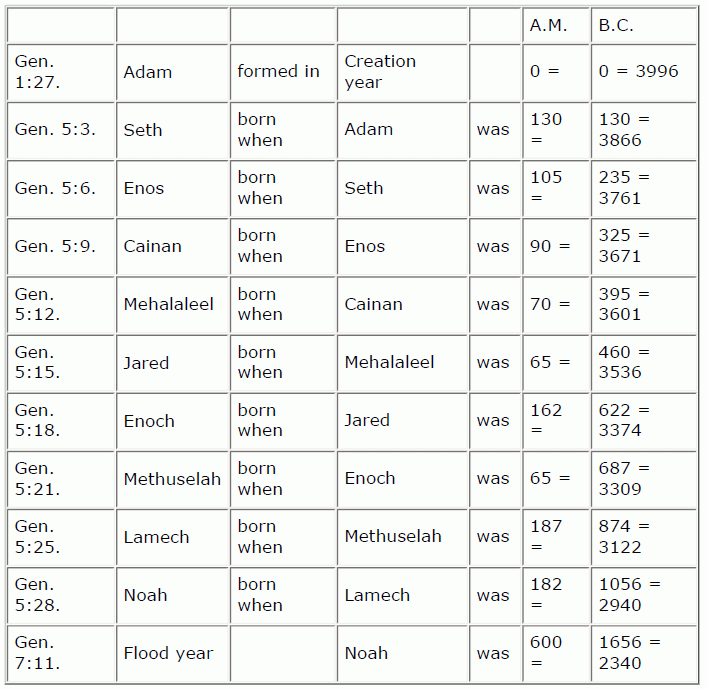
Appendix 23 “THE SONS OF GOD” IN Ge 6:2,4
It is only by the Divine specific act of creation that any created being can be called “a son of God”. For that which is “born of the flesh is flesh”. God is spirit, and that which is “born of the Spirit is spirit” (Jn 3:6). Hence Adam is called a “son of God” in Lk 3:38. Those “in Christ” having “the new nature” which is by the direct creation of God (2 Co 5:17. Eph 2:10) can be, and are called “sons of God” (Jn 1:13. Ro 8:14,15. 1 Jn 3:1). (*1)
This is why angels are called “sons of God” in every other place where the expression is used in the Old Testament. Job 1:6; 2:1; 38:7. Ps 29:1; 89:6. Da 3:25 (no art.). (*2) We have no authority or right to take the expression in Ge 6:2,4 in any other sense. Moreover, in Ge 6:2 the Sept. renders it “angels”. Angels are called “spirits” (Ps 104:4. Heb 1:7,14), for spirits are created by God.
That there was a fall of the angels is certain from Jude 6.
· The nature of their fall is clearly stated in the same verse. They left their own oiketerion. This word occurs only in 2 Co 5:2 and Jude 6, where it is used of the spiritual (or resurrection) body.
· The nature of their sin is stated to be “in like manner” to that of the subsequent sins of Sodom and Gomorrha, Jude 7.
· The time of their fall is given as having taken place “in the days of Noah” (1 Pe 3:20. 2 Pe 2:7), though there may have been a prior fall which caused the end of “the world that then was” (Ge 1:1,2. 2 Pe 3:6).
· For this sin they are “reserved unto judgment”, 2 Pe 2:4, and are “in prison”, 1 Pe 3:19.
· Their progeny, called Nephilim (translated “giants”), were monsters of iniquity; and, being superhuman in size and character, had to be destroyed (see Ap. 25). This was the one and only object of the Flood.
· Only Noah and his family had preserved their pedigree pure from Adam (Ge 6:9, see note). All the rest had become “corrupt” (shachath) destroyed [as Adamites]. the only remedy was to destroy it (de facto), as it had become destroyed (de jure). (It is the same word in v. 17 as in vv. 11, 12.) See further under Ap. 25 on the Nephilim.
This irruption of fallen angels was Satan’s first attempt to prevent the coming of the Seed of the woman foretold in gen. 3:15. If this could be accomplished, God’s Word would have failed, and his own doom would be averted.
As soon as it was made known that the Seed of the woman was to come through ABRAHAM, there must have been another irruption, as recorded in Ge 6:4, “and also after that” (i.e. after the days of Noah, more than 500 years after the first irruption). The aim of the enemy was to occupy Canaan in advance of Abraham, and so to contest its occupation by his seed. For, when Abraham entered Canaan, we read (Ge 12:6) “the Canaanite was then (i.e. already) in the land.”
In the same chapter (Ge 12:10-20) we see Satan’s next attempt to interfere with Abraham’s seed, and frustrate the purpose of God that it should be in “Isaac”. This attempt was repeated in 20:1-18.
This great conflict may be seen throughout the Bible, and it forms a great and important subject of Biblical study. In each case the human instrument had his own personal interest to serve, while Satan had his own great object in view. Hence God had, in each case, to interfere and avert the evil and the danger, of which his servants and people were wholly ignorant. The following assaults of the great Enemy stand out prominently:—
· The destruction of the chosen family by famine, Ge 50:20.
· The destruction of the male line in Israel, Ex 1:10,15, &c. Cp. Ex 2:5. Heb 11:23.
· The destruction of the whole nation in Pharaoh’s pursuit, Ex 14.
· After David’s line was singled out (2 Sa 7), that was the next selected for assault. Satan’s first assault was in the union of Jehoram and Athaliah by Jehoshaphat, notwithstanding 2 Ch 17:1. Jehoram killed off all his brothers (2 Ch 21:4).
· The Arabians slew all his children, except Ahaziah (2 Ch 21:17; 22:1).
· ? When Ahaziah died, Athaliah killed “all the seed royal” (2 Ch 22:10). the babe Joash alone was rescued; and, for six years, the faithfulness of Jehovah’s word was at stake (2 Ch 23:3).
· Hezekiah was childless, when a double assault was made by the King of Assyria and the King of Terrors (Isa 36:1; 38:1). God’s faithfulness was appealed to and relied on (Ps 136).
· In Captivity, Haman was used to attempt the destruction of the whole nation (Est 3:6,12,13. Cp. 6:1).
· Joseph’s fear was worked on (Mt 1:18-20). Notwithstanding the fact that he was “a just man”, and kept the Law, he did not wish to have Mary stoned to death (Dt 24:1); hence Joseph determined to divorce her. But God intervened: “Fear not”.
· Herod sought the young Child’s life (Mt 2).
· At the Temptation, “Cast Thyself down” was Satan’s temptation.
· At Nazareth, again (Lk 4), there was another attempt to cast Him down and destroy Him.
· The two storms on the Lake were other attempts.
· At length the cross was reached, and the sepulcher closed; the watch set; and the stone sealed. But “God raised Him from the dead.” And now, like another Joash, He is seated and expecting (Heb 10:12,13), hidden in the house of God on high; and the members of “the one body” are hidden there “in Him” (Col 3:1-3), like another Jehoshaba; and going forth to witness of His coming, like another Jehoiada (2 Ch 23:3).
The irruption of “the fallen angels” (“sons of God”) was the first attempt; and was directed against the whole human race.
· When Abraham was called, then he and his seed were attacked.
· When David was enthroned, then the royal line were attacked.
· And when “the Seed of the woman” Himself came, then the storm burst upon Him.
1. The word “offspring” in Ac 17:28 is quite different. It is genos, which means merely kin or kind, our genus as being originated by God.
*1 In Hos 1:10, it is not beni-ha-Elohim, as here, but beni-el-chai.
Appendix 24
THE 120 YEARS OF Ge 6:3
These are generally taken as meaning 120 years before the Flood. But this mistake has been made by not observing that the word for “men” in Ge 6:1,2 is in the singular number with the definite article, as in v. 3 “man”, and means THE MAN ADAM. The word “also” clearly refers to him. It has no meaning if “men” be read, in the plural. It means, and can mean, only that Adam himself, “also”, as well as the rest of mankind,. 1 If “men” be the meaning, then it may be well asked, who are the others indicated by the word “also”?
In Ge 2:17, the Lord God had declared that Adam should die. Here, in Ge 6, it was made more clear that though he had lived 810 years he should surely die; and that his breath, or spirit of life from God should not for ever remain in him. See the notes on Gen 6.
This fixes the chronology of v. 3, and shows that long before that time, A.M. 810, and even before Enoch, this irruption of fallen angels had taken place. This was the cause of all the “ungodliness” against which the prophecy of Enoch was directed in Jude 14, and which ultimately brought on the fulfillment of his prophecy in the Judgment of the Flood. See Ap. 23 and 25.
1. (bshaggam) because that also is so pointed in the Codex Hilleli. This makes it the Inf. Kal. of shagag, to transgress, go astray, and means, “because that in their going astray, he (Adam) also is flesh”.
Appendix 25 THE NEPHILIM, OR “GIANTS” OF Ge 6, &c
The progeny of the fallen angels with the daughters of Adam (see notes on Gen 6, and Ap. 23) are called in Ge 6, Ne-phil-im, which means fallen ones (from naphal, to fall). What these beings were can be gathered only from Scripture. They were evidently great in size, as well as great in wickedness. They were superhuman, abnormal beings; and their destruction was necessary for the preservation of the human race, and for the faithfulness of Jehovah’s Word (Ge 3:15).
This was why the Flood was brought “upon the world of the ungodly” (2 Pe 2:5) as prophesied by Enoch (Jude 14).
But we read of the Nephilim again in Nu 13:33: “there we saw the Nephilim, the sons of Anak, which come of the Nephilim”. How, it may be asked, could this be, if they were all destroyed in the Flood? The answer is contained in Ge 6:4, where we read: “There were Nephilim in the earth in those days (i.e. in the days of Noah); and also AFTER THAT, when the sons of God came in unto the daughters of men, and they bare children to them, the same became [the] mighty men (Heb. gibbor, the heroes) which were of old, men of renown” (lit. men of the name, i.e. who got a name and were renowned for their ungodliness).
So that “after that”, i.e. after the Flood, there was a second irruption of these fallen angels, evidently smaller in number and more limited in area, for they were for the most part confined to Canaan, and were in fact known as “the nations of Canaan”. It was for the destruction of these, that the sword of Israel was necessary, as the Flood had been before.
As to the date of this second irruption, it was evidently soon after it became known that the seed was to come through Abraham; for, when he came out from Haran (Ge 12:6) and entered Canaan, the significant fact is stated: “The Canaanite was then (i.e. already) in the land.” And in Ge 14:5 they were already known as “Raphain” and Emim”, and had established themselves at Asteroth Karnaim and Shaven Kiriathaim.
In ch. 15:18-21 they are enumerated and named among Canaanite Peoples: “Kenites, and the Kenizzites, and the Kadmonites, and the Hittites, and the Perizzites, and the Rephaims, and the Amorites, and the Girgashites, and the Jebusites” (Ge 15:19-21; cp. Ex 3:8,17; 23:23. Dt 7; 20:17. Jos 12:8).
These were to be cut off, and driven out, and utterly destroyed (Dt 20:17. Jos 3:10). But Israel failed in this (Jos 13:13; 15:63; 16:10; 17:18. Jdg 1:19,20,28,29,30-36; 2:1-5; 3:1-7); and we known not how many got away to other countries to escape the general destruction. If this were recognized it would go far to solve many problems connected with Anthropology.
As to their other names, they were called Anakim, from on Anak which came of the Nephilim (Nu 13:23), and Rephaim, from Rapha, another notable one among them. From Dt 2:10, they were known by some as Emim, and Horim, and Zamzummim (v. 20, 21) and Avim, &c.
As Rephaim they were well known, and are often mentioned: but, unfortunately, instead of this, their proper name, being preserved, it is variously translated as “dead”, “deceased”, or “giants”. These Rephaim are to have no resurrection. This fact is stated in Isa 26:14 (where the proper name is rendered “deceased,” and v. 19, where it is rendered “the dead”). It is rendered “dead” seven times (Job 26:5. Ps 88:10. Pr 2:18; 9:18; 21:16. Isa 14:8; 26:19). It is rendered “deceased” in Isa 26:14.
It is retained as a proper name “Rephaim” ten times (two being in the margin). Ge 14:5; 15:20. Jos 12:15 (marg.). 2 Sa 5:18,22; 23:13.& b31 nbsp; 1 Ch 11:15; 14:9; 20:4 (marg.). Isa 17:5. In all other places it is rendered “giants”, Ge 6:4; Nu 23:33, where it is Nephilim; and Job 16:14, where it is gibbor (Ap. 14. iv). By reading all these passages the Bible student may know all that can be known about these beings.
It is certain that the second irruption took place before Ge 14, for there the Rephaim were mixed up with the five nations or peoples, which included Sodom and Gomorrha, and were defeated by the four kings under Chedorlaomer. Their principal locality was evidently “Ashtaroth Karnaim”; while the Emim were in the plain of Kiriathaim (Ge 14:5).
Anak was a noted descendant of the Nephilim; and Rapha was another, giving their names respectively to different clans. Anak’s father was Arba, the original builder of Hebron (Ge 35:27. Jos 15:13; 21:11); and this Palestine branch of the Anakim was not called Arbahim after him, but Anakim after Anak. They were great, mighty, and tall (Dt 2:10,11,21,22,23; 9:2), evidently inspiring the ten spies with great fear (Nu 13:33). Og king of Bashan is described in Dt 3:11.
Their strength is seen in “the giant cities of Bashan” to-day; and we know not how far they may have been utilized by Egypt in the construction of buildings, which is still an unsolved problem. Arba was rebuilt by the Khabiri or confederates seven years before Zoan was built by the Egyptian Pharoahs of the nineteenth dynasty. See note on Num 13:22.
If these Nephilim, and their branch of Rephaim, were associated with Egypt, we have an explanation of the problem which has for ages perplexed all engineers, as to how those huge stones and monuments were brought together. Why not in Egypt as well as in “the giant cities of Bashan” which exist, as such, to this day?
Moreover, we have in these mighty men, the “men of renown,” the explanation of the origin of the Greek mythology. That mythology was no mere invention of the human brain, but it grew out of the traditions, and memories, and legends of the doings of that mighty race of beings; and was gradually evolved out of the “heroes” of Ge 6:4. The fact that they were supernatural in their origin formed an easy step to their being regarded as the demi-gods of the Greeks.
Thus the Babylonian “Creation Tablets”, the Egyptian “Book of the dead”, the Greek mythology, and heathen Cosmogonies, which by some are set on an equality with Scripture, or by others adduced in support of it, are all the corruption and perversion of primitive truths, distorted in proportion as their origin was forgotten, and their memories faded away.
Appendix 26
NOAH “PERFECT”. (Ge 6:9)
The Heb. word tamim means without blemish, and is the technical word for bodily and physical perfection, and not moral. Hence it is used of animals of sacrificial purity. It is rendered without blemish in Ex 12:5; 29:1. Lev 1:3,10; 3:1,6; 4:3,23,28,32; 5:15,18; 6:6; 9:2,3; 14:10; 22:19; 23:12,18. Nu 6:14; 28:19,31; 29:2,8,13,20,23,29,32,36. Eze 43:22,23,25; 45:18,23; 46:4,6,13.
Without Spot. Nu 19:2; 28:3,9,11; 29:17,26.
Undefiled. Ps 119:1.
This shows that Ge 6:9 does not speak of Noah’s moral perfection, but tells us that he and his family alone had preserved their pedigree and kept it pure, in spite of the prevailing corruption brought about by the fallen angels. See Ap. 23 and 25.
Appendix 27 WINE
There are eight Hebrew words translated wine. A careful observation of their use will tell us all that there is to be known on the subject
I. Yayin, from the root yayan, to ferment, used of every sort of wine. The word occurs 142 time, and includes fermented wine of all kinds.
The first occurrence is: Ge 9:21. “Noah planted a vineyard and drank yayin and was drunken.”
Ge 14:18. “Melchizedek … brought forth bread and wine.” 1 Sa 25:36,37. Nabal drank yayin and “was very drunken.” Isa 28:1. “The drunkards of Ephraim … are overcome (i.e. knocked down) with yayin.” Jer 23:9. “I am like a drunken man, and like a man whom yayin hath overcome”.
It is perfectly certain, therefore, from these passages, that yayin was fermented, and was intoxicating. Yayin was also used for sacred purposes and for blessing.
Ge 49:12. “His (Judah’s) eyes shall be red with yayin, and his teeth white with milk.” Am 9:13. “I will bring again the captivity of my people, and they shall plant vineyards and drink the yayin thereof.” (v. 14 is No. V.)
Ecc 9:7. “Drink thy yayin with a merry heart, for God now accepteth thy works.”
The Nazarite, at the expiration of his vow, drank yayin. See Nu 6:13-20. It was used at the Feasts of Jehovah (Dt 14:24-26), and was poured out as a drink-offering to Jehovah (Ex 29:40. Lev 23:13. Nu 15:5).
II. Tirosh, from yarash, to possess = must, or new wine, so called because it gets possession of the brain. It occurs thirty-four times in the Old Testament.
Hos 4:11. “Whoredom and yayin and tirosh take away the heart” (i.e. they blunt the feelings, derange the intellect).
Some say that tirosh means grapes, and is used as solid food, because in Ge 37:28 we read of “tirosh and corn”. We might as well say that when we speak of “bread and water”, that water is also a solid, because bread is a solid. On the contrary, “tirosh and corn” mean liquids and solids, by the figure of Synecdoche (of Genus), Ap. 6.
Pr 3:10. “Thy presses shall burst out with tirosh.”
Isa 62:8. “The sons of the stranger shall not drink thy tirosh.”
Joel 2:24. “The fats (vats) shall overflow with tirosh and oil.”
Mic 6:15. “Thou shalt tread … tirosh, but shalt not drink yayin.”
III. Chemer, from chamar, to ripen. Hence used of strong red wine. It occurs eight times.
Dt 32:14. “The pure chemer of the grape.”
Isa 27:2,3. “A vineyard of chemer. I the Lord do keep it”.
Ezr 6:9. Cyrus and Artaxerxes commanded that chemer should be given to the people of Israel for the service of the God of Heaven.
The Rabbins called it neat wine, because, unmixed with water, it disturbs the head and brain.
IV. Shekar = strong drink (from shakar, to get drunk), a very intoxicating drink made from barley, honey, or dates.
Nu 28:7. “In the holy place shalt thou cause the shekar (strong wine) to be poured unto the Lord for a drink offering.”
Dt 14:25,26. “Thou … shalt go unto the place which the Lord thy God shall choose: and thou shalt bestow that money for whatsoever thy soul lusteth after, for oxen, or for sheep, of for yayin (wine), or for shekar (strong drink), or for whatsoever thy soul desireth: and thou shalt eat there before the Lord thy God, and thou shalt rejoice, thou, and thine household”.
V. ‘Asis (from ‘asas, to tread) new or sweet wine of the vintage year.
Isa 49:26. “They shall be drunken with their own blood, as with ‘asis (sweet wine)”.
The drinking of this was held out by God as a blessing conferred by Him. Joel 3:17,18. Am 9:13.
VI. Sob’e, any kind of strong intoxicating drink: from sab’a, to drink to excess, become drunk: occurs twice.
Isa 1:22. “Thy silver is become dross, thy sob’e (wine) mixed with water”.
Hos 4:18. “Their sob’e (drinking bout or carouse) is over” (A. V. their drink is sour (marg. gone). (R.V. marg. their carouse is over).
VII. Mimsak, mixed or spiced wine.
Pr 23:30. “They that tarry long at the yayin; they that go to seek mimsak (mixed wine).”
Isa 65:11. “That prepare a table for Fortune, and that fill up mingled wine (mimsak) unto Destiny” (R.V.).
VIII. Shemarim, from shamar, to keep, preserve, lay up; hence, old wine, purified from the lees and racked off. Ps 75:8. “but the shemarim (dregs), all the wicked of the earth shall wring them out, and drink them.”
Isa 25:6. “Wines on the lees.”
Zep 1:12. “I will … punish the men that are settled on their shemarim (lees)”. Jer 48:11. “Moab … hath settled on his lees.”
N.B. The word translated “flagons of wine” is ‘ashishah, from ‘ashash, to press; hence a hardened syrup made of grapes, a sweet cake of dried grapes or pressed raisins. It occurs in 2 Sa 6:19. 1 Ch 16:3. SS 2:5. Hos 3:1.
With these data it will be seen that the modern expression, “unfermented wine”, is a contradiction of terms. If it is wine, it must have fermented. If it has not been fermented, it is not wine, but a syrup.
Leaven is sour dough, and not wine. It is that which causes the fermentation. There can be no leaven after the process of fermentation has ceased.
Appendix 28
NIMROD. Ge 10:8,9; 1 Ch 1:10
Josephus (Ant. Jud. i. c. 4. 2) says:
“Nimrod persuaded mankind not to ascribe their happiness to God, but to think that his own excellency was the source of it. And he soon changed things into a tyranny, thinking there was no other way to wean men from the fear of God, than by making them rely upon his own power.”
The Targum of Jonathan says:
“From the foundation of the world none was ever found like Nimrod, powerful in hunting, and in rebellions against the Lord.”
The Jerusalem Targum says:
“He was powerful in hunting and in wickedness before the Lord, for he was a hunter of the sons of men, and he said to them, ‘Depart from the judgment of the Lord, and adhere to the judgment of Nimrod!’ Therefore is it said: ‘As Nimrod [is] the strong one, strong in hunting, and in wickedness before the Lord.'”
The Chaldee paraphrase of 1 Ch 1:10 says:
“Cush begat Nimrod, who began to prevail in wickedness, for he shed innocent blood, and rebelled against Jehovah.”
Nimrod was the founder of Babylon, which partook of his character as being the great antagonist of God’s Truth and God’s People. We cannot fail to see, in Nimrod, Satan’s first attempt to raise up a human universal ruler of men. There have been many subsequent attempts, such as Nebuchadnezzar, Alexander, Napoleon, and others. He will finally succeed in the person of the Antichrist.
Appendix 29
THE GENERATIONS OF TERAH, ISAAC, AND JACOB
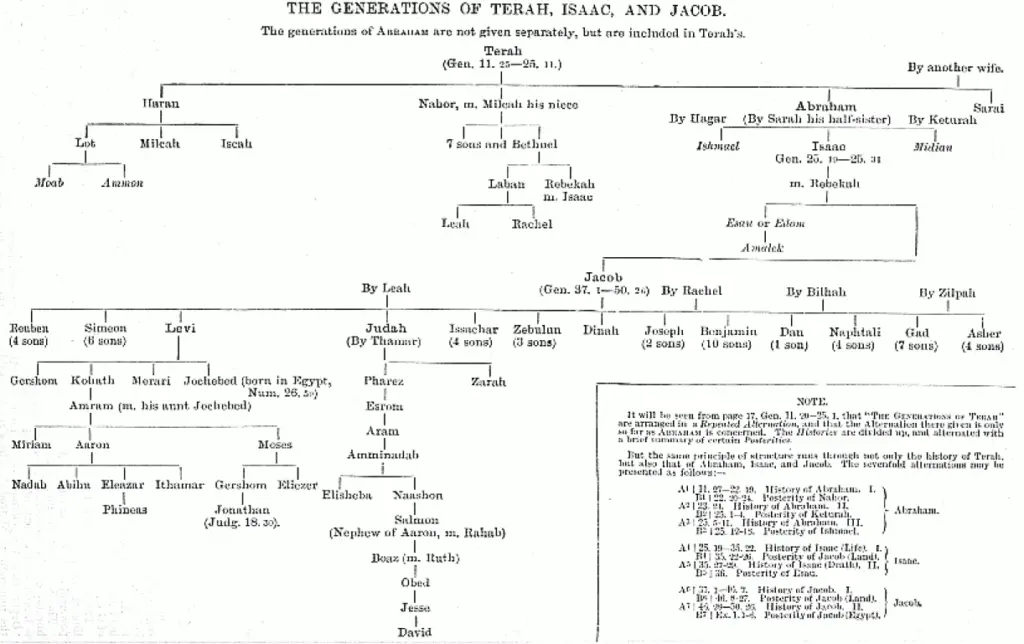
Appendix 30 THE MASSORAH
Al the oldest and best manuscripts of the Hebrew Bible contain on every page, beside the Text (which is arranged in two or more columns), a varying number of lines of smaller writing, distributed between the upper and lower margins. This smaller writing is called the Massorah Magna or Great Massorah, while that in the side margins between the columns is called the Massorah Parva or Small Massorah.
The illustration given on p. 32 is a reduced facsimile of a Hebrew MS. (16 1/4 inches x 12 3/8), written in a German hand, about the year A.D. 1120. The small writing in the margins in this particular MS. is seen to occupy seven lines in the lower margin, and four lines in the upper; while in the outer margins and between the three columns is the Massorah Parva.
The word Massorah is from the root masar, to deliver something into the hand of another, so as to commit it to his trust. Hence the name is given to the small writing referred to, because it contains information necessary to those who trust the Sacred Text was committed, so that they might transcribe it, and hand it down correctly.
The Text itself had been fixed before the Massorites were put in charge of it. This had been the work of the Sopherim (from saphar, to count, or number). Their work, under Ezra and Nehemiah, was to set the Text in order after the return from Babylon; and we read of it in Ne 8:8 1* (cp. Ezr 7:6,11). The men of “the Great Synagogue” completed the work. This work lasted about 110 years, from Nehemiah to Simon the first, 410 – 300 B.C.
The Sopherim were the authorized revisers of the Sacred Text; and, their work being completed, the Massorites were the authorized custodians of it. Their work was to preserve it. The Massorah is called “A Fence to the Scriptures,” because it locked all words and letters in their places. It does not contain notes or comments as such, but facts and phenomena. It records the number of times the several letters occur in the various books of the Bible; the number of words, and the middle word; the number of verses, and the middle verse; the number of expressions and combinations of words, &c. All this, not from a perverted ingenuity, but for the set purpose of safeguarding the Sacred Text, and preventing the loss of misplacement of a single letter or word.
This Massorah is not contained in the margins of any one MS. No MS. contains the whole, or even the same part. It is spread over many MSS., and Dr. C. D. Ginsburg has been the first and only scholar who has set himself to collect and collate the whole, copying it from every available MS. in the libraries of many countries. He has published it in three large folio volumes, and only a small number of copies has been printed. These are obtainable only by the original subscribers.
When the Hebrew Text was printed, only the large type in the columns was regarded, and the small type of the Massorah was left, unheeded, in the MSS. from which the Text was taken. When translators came to the printed Hebrew Text, they were necessarily destitute of the information contained in the Massorah; so that the Revisers as well as the Translators of the Authorized Version carried out their work without any idea of the treasures contained in the Massorah; and therefore, without giving a hint of it to their readers.
This is the first time that an edition of the A.V. has been given containing any of these treasures of the Massorah, that affect so seriously the understanding of the Text. A vast number of the Massoretic notes concern only the orthography, and matters that pertain to the Concordance. But many of those which affect the sense, or throw any additional light on the Sacred Text, are noted in the margin of The Companion Bible.
Some of the important lists of words which are contained in the Massorah are also given, viz. those that have the “extraordinary points” (Ap. 31); the “eighteen emendations” of the Sopherim (see Ap. 33); the 134 passages where they substituted Adonai for Jehovah (see Ap. 32); and the Various Readings called Severin (see Ap. 34). These are given in separate Appendixes; but other words of any importance are preserved in our marginal notes.
Readers of The Companion Bible are put in possession of information denied to former generations of translators, commentators, critics, and general Bible students. For further information on the Massorah see Dr. Ginsburg’s Introduction the the Hebrew Bible, of which only a limited edition was printed; also a small pamphlet on The Massorah published by the King’s Printers.
1* The Talmud explains that “the book” meant the original text; “distinctly” means explaining it by giving the Chaldee paraphrase; “gave the sense” means the division of words, &c. according to the sense; and “caused them to understand the reading” means to give the traditional pronunciation of the words (which were then without vowel points).
Appendix 31
THE FIFTEEN EXTRAORDINARY POINTS OF THE SOPHERIM
There are fifteen words which present an abnormal appearance in the printed Hebrew Bibles. These are of the utmost importance, as they represent the most ancient result of Textual Criticism on the part of the Sopherim.
Ten of these words are in the Pentateuch, and five occur in the Prophets and Hagiographa.
Some are without effect as to translation or interpretation; others are more important, and will be noted in the passages were they occur. The following is the list. (For further information see Dr. Ginsburg’s Introduction to the Hebrew Bible, pp. 318-34):
· Ge 16:5.
· Ge 18:9.
· Ge 19:33,35.
· Ge 33:4.
· Ge 37:12.
· Nu 3:39.
· Nu 9:10.
· Nu 21:30.
· Nu 29:15.
· Dt 29:29.
· 2 Sa 19:29.
· Isa 44:9.
· Eze 41:20.
· Eze 46:22.
· Ps 27:13.
Appendix 32 THE 134 PASSAGES WHERE THE SOPHERIM ALTERED “JEHOVAH” TO “ADONAI”
Out of extreme (but mistaken) reverence for the Ineffable Name “Jehovah”, the ancient custodians of the Sacred Text substituted in many places “Adonai” (see Ap. 4. viii. 2). These, in the A.V. and R.V., are all printed “Lord”. In all these places we have printed it “LORD*”, marking the word with an asterisk in addition to the note in the margin, to inform the reader of the fact.
The official list given in the Massorah (§§ 107-15, Ginsburg’s edition) contains the 134.
· Ge 18:3,27,30,32; 19:18; 20:4.
· Ex 4:10,13; 5:22; 15:17; 34:9,9.
· Nu 14:17.
· Jos 7:8.
· Jdg 6:15; 13:8.
· 1 Ki 3:10,15; 22:6.
· 2 Ki 7:6; 19:23.
· Isa 3:17,18; 4:4; 6:1,8,11; 7:14,10; 8:7; 9:8,17; 10:12; 11:11; 21:6,8,16; 28:2; 29:13; 30:20; 37:24; 38:14,16; 49:14.
· Eze 18:25,29; 21:13; 33:17,29.
· Am 5:16; 7:7,8; 9:1.
· Zec 9:4.
· Mic 1:2.
· Mal 1:12,14.
· Ps 2:4; 16:2; 22:19,30; 30:8; 35:3,17,22; 37:12; 38:9,15,22; 39:7; 40:17; 44:23; 51:15; 54:4; 55:9; 57:9; 59:11; 62:12; 66:18; 68:11,17,19,22,26,32; 73:20; 77:2,7; 78:65; 79:12; 86:3,4,5,8,9,12,15; 89:49,50; 90:1,17; 110:5; 130:2,3,6.
· Da 1:2; 9:3,4,7,9,15,16,17,19,19,19.
· Lam 1:14,15,15; 2:1,2,5,7,18,19,20; 3:31,36,37,58.
· Ezr 10:3.
· Ne 1:11; 4:14.
· Job 28:28.
(See Ginsburg’s ed. of The Massorah, §§ 107-115.)
To these may be added the following, where “Elohim” was treated in the same way:—
· 2 Sa 5:19-25. 2 Sa 6:9-17.
Where the A.V. has “LORD.”
· 1 Ch 13:12. 1 Ch 14:10,11,14,16. 1 Ch 16:1. Ps 14:1,2,5. Ps 53:1,2,4,5.
Where in A.V. and R.V. it still appears as “God”. It is printed “GOD*” in the Companion Bible.
Appendix 33 THE “EIGHTEEN EMENDATIONS” OF THE SOPHERIM
The Massorah (Ap. 30), i.e. the small writing in the margins of the standard Hebrew codices, as shown in the plate on p. 32, consists of a concordance of words and phrases, &c., safeguarding the Sacred Text. A note in the Massorah against several passages in the manuscripts of the Hebrew Bible state: “This is one of the Eighteen Emendations of the Sopherim,” or words to that effect.
Complete lists of these emendations are found in the Massorah of most of the model or standard codices of the Hebrew Bible, and these are not always identical; so that the total number exceeds eighteen: from which it would appear that these examples are simply typical. The Siphri (*1) adduces seven passages; the Yalkut (*2), ten; the Mechiltha (*3), eleven; the Tanchuma (*4), seventeen; while the St. Petersburg Codex gives two passages not included in any other list (Mal 1:12; 3:9; see below).
These emendations were made at a period long before Christ, before the Hebrew text had obtained its present settled form, and these emendations affect the Figure called Anthropopatheia. See. Ap. 6.
The following is a list of the eighteen “Emendations,” together with eight others not included in the official lists. Particulars will be found on consulting the notes on the respective passages.
· Ge 18:22.
· Nu 11:15.
· Nu 12:12.
· 1 Sa 3:13.
· 2 Sa 12:14.
· 2 Sa 16:12.
· 1 Ki 12:16.
· 1 Ki 21:10.
· 1 Ki 21:13.
· 2 Ch 10:16.
· Job 1:5.
· Job 1:11.
· Job 2:5.
· Job 2:9.
· Job 7:20.
· Job 32:3.
· Ps 10:3.
· Ps 106:20.
· Ecc 3:21.
· Jer 2:11.
· Lam 3:20.
· Eze 8:17.
· Hos 4:7.
· Hab 1:12.
· Zec 2:8 (12).
· Mal 1:13.
· Mal 3:9.
(*1) An ancient commentary on Leviticus (circa A.D. 219-47).
(*2) A catena of the whole Hebrew Scriptures, composed in the eleventh century, for ancient sources by Rabbi Simeon.
(*3) An ancient commentary on Exodus, compiled about A.D. 90 by Rabbi Ishmael ben Elisa.
(*4) A commentary on the Pentateuch, compiled from ancient sources by Rabbi Tanchuma ben Abba, about A.D. 380.
Appendix 33 THE “EIGHTEEN EMENDATIONS” OF THE SOPHERIM
The Massorah (Ap. 30), i.e. the small writing in the margins of the standard Hebrew codices, as shown in the plate on p. 32, consists of a concordance of words and phrases, &c., safeguarding the Sacred Text. A note in the Massorah against several passages in the manuscripts of the Hebrew Bible state: “This is one of the Eighteen Emendations of the Sopherim,” or words to that effect.
Complete lists of these emendations are found in the Massorah of most of the model or standard codices of the Hebrew Bible, and these are not always identical; so that the total number exceeds eighteen: from which it would appear that these examples are simply typical. The Siphri (*1) adduces seven passages; the Yalkut (*2), ten; the Mechiltha (*3), eleven; the Tanchuma (*4), seventeen; while the St. Petersburg Codex gives two passages not included in any other list (Mal 1:12; 3:9; see below).
These emendations were made at a period long before Christ, before the Hebrew text had obtained its present settled form, and these emendations affect the Figure called Anthropopatheia. See. Ap. 6.
The following is a list of the eighteen “Emendations,” together with eight others not included in the official lists. Particulars will be found on consulting the notes on the respective passages.
· Ge 18:22.
· Nu 11:15.
· Nu 12:12.
· 1 Sa 3:13.
· 2 Sa 12:14.
· 2 Sa 16:12.
· 1 Ki 12:16.
· 1 Ki 21:10.
· 1 Ki 21:13.
· 2 Ch 10:16.
· Job 1:5.
· Job 1:11.
· Job 2:5.
· Job 2:9.
· Job 7:20.
· Job 32:3.
· Ps 10:3.
· Ps 106:20.
· Ecc 3:21.
· Jer 2:11.
· Lam 3:20.
· Eze 8:17.
· Hos 4:7.
· Hab 1:12.
· Zec 2:8 (12).
· Mal 1:13.
· Mal 3:9.
(*1) An ancient commentary on Leviticus (circa A.D. 219-47).
(*2) A catena of the whole Hebrew Scriptures, composed in the eleventh century, for ancient sources by Rabbi Simeon.
(*3) An ancient commentary on Exodus, compiled about A.D. 90 by Rabbi Ishmael ben Elisa.
(*4) A commentary on the Pentateuch, compiled from ancient sources by Rabbi Tanchuma ben Abba, about A.D. 380.
Appendix 35 “SHEOL”. HEBREW, SHEOL.
The first occurrence of this word is in Ge 37:35, where it is rendered “grave”. It occurs sixty-five times in the Hebrew of the Old Testament; and only by studying each passage by itself can the student hope to gather the Biblical usage of the word. All heathen or traditional usages are not only worthless, but mischievous. The following are all the passages where the word “Sheol” occurs, with the rendering in each passage indicated thus:
1. Ge 37:35.1. Ge 42:38.1. Ge 44:29,31.2. Nu 16:30,33.3. Dt 32:22.1. 1 Sa 2:6.3. 2 Sa 22:6.1. 1 Ki 2:6,9.1. Job 7:9.3. Job 11:8.1. Job 14:13.1. Job 17:13.2. Job 17:16.1. Job 21:13.1. Job 24:19.3. Job 26:6.1. Ps 6:5.3. Ps 9:17.3. Ps 16:10.3. Ps 18:5.1. Ps 30:3.1. Ps 31:17.1. Ps 49:14,14,15.3. Ps 55:15 (marg. grave).3. Ps 86:13 (marg. grave).1. Ps 88:3.1. Ps 89:48.3. Ps 116:3.3. Ps 139:8.1. Ps 141.7.1. Pr 1:12.3. Pr 5.5.3. Pr 7:27.3. Pr 9:18.3. Pr 15:11,24.3. Pr 23:14.3. Pr 27:20.1. Pr 30:16.1. Ecc 9:10.1. SS 8:6.3. Isa 5:14.3. Isa 14:9 (marg. grave).1. Isa 14:11.3. Isa 14:15.3. Isa 28:15,18.1. Isa 38:10.1. Isa 38:18.3. Isa 57:9.1. Eze 31:15.3. Eze 31:16,17.3. Eze 32:21,27.1. Hos 13:14,14.3. Am 9:2.3. Jnh 2:2 (marg. grave).3. Hab 2:5.
1 = Grave 2 = Pit 3 = Hell
As meaning “THE grave,” it is to be distinguished from keber, A grave, or, burying-place (from kabar, to bury, first occurrence Ge 23:4): and bor, a pit, generally hewn in the rock, hence used of a cistern (Ge 37:20) or a dungeon, &c., when dry. (See note on the word “well” in Ge 21:19.)
Appendix 36
“THY SALVATION” (Ge 49:18).
“I have waited for Thy salvation, O Jehovah.”
These words are repeated three times (and in three different ways) by every pious Jew, morning and evening.
In the note on Gen 49:18 it is pointed out that by the Fig. Metonymy (of Effect), see Ap. 6, “salvation” is put for Him Who brings it. The meaning is beautifully put, thus, in the Jerusalem Targum:-
“Not to they salvation wrought by Gideon, the son of Joash, does my soul look, for it is temporal. Not to they salvation wrought by Samson, the son of Manoah, is my longing directed, for it is transient: but to the salvation, the completion of which Thou hast promised, by Thy everlasting Word, to bring to Thy people the descendants of Israel.
To Thy salvation, O Jehovah, to the salvation of Messiah the son of David, Who will one day redeem Israel and bring her back from the dispersion, to that salvation my soul looks forward; for Thy salvation is an everlasting salvation.”
Appendix 37
THE PHARAOHS OF GENESIS AND EXODUS.
It was intended to include a list of the Pharaohs mentioned in Genesis and Exodus, and an elaborate table had been drawn up. But, as the data are still incomplete, and scholars and explorers are not fully agreed, it is felt to be wiser to postpone a subject which is still a subject of controversy.
The title “Pharaoh,” being an appellative, leaves the dynasties and individuals referred to open to question and doubt.
Of only one thing we are assured; that, when all the real facts have been discovered, they will be confirmed and attested by “the scriptures of truth.”
[Note (1925). Inscriptions recently found by an American archaeological explorer at Bethshan (now Beisan) show that it was one time under Egyptian rule. One of these inscriptions confirms the view that the Bondage of Israel occurred under Rameses II, whose son, Meneptah, would be the Pharaoh of the Exodus.]
Appendix 38
“LEAVEN”
Its first occurrence in Ex 12:15 significantly marks it as something to be “put away.” There is no dispute as to the meaning of the word, which is sour or fermenting dough. The difference lies in its interpretation. This can be gathered only from its usage by the Holy Spirit.
1. It is used of its work in permeating the whole of that with which it is mixed (Mt 13:33; Lk 13:21; 1 Co 5:6; Gal 5:9; Hos 7:4).
2. It is used of the bread which is made from the meal so permeated (Ex 12:15,19,20,34,39; 13:7).
3. It is used in connection with sacrifices, as never to be offered to God with any offering made by fire (Lev 2:11; 6:17; 10:12).
4. It is used by Metaphor (see Ap. 6) for doctrine (Mt 16:12. Mk 8:15. Gal 5:9).
5. It is used of the effects of evildoers (1 Co 5:6-8; 15:33).
6. In Lev 23:17 it is used in that which symbolizes mankind, and in a proper sense of being corrupted. The sin-offering associated with the leaven in the two wave-loaves corresponds with this.
7. In Am 4:4,5 it is either the language or Figure of Irony (see Ap. 6); or, it shows that the “thanksgiving with leaven” is symbolical of the sin which is ever present even in the worshippers of God.
Thus in every instance it is associated with, and symbolical of, only that which is evil.
Appendix 39
THE DECALOGUE. Ex 20:2-17
The Ten Commandments have been divided in various ways. The table below exhibits the principal differences.
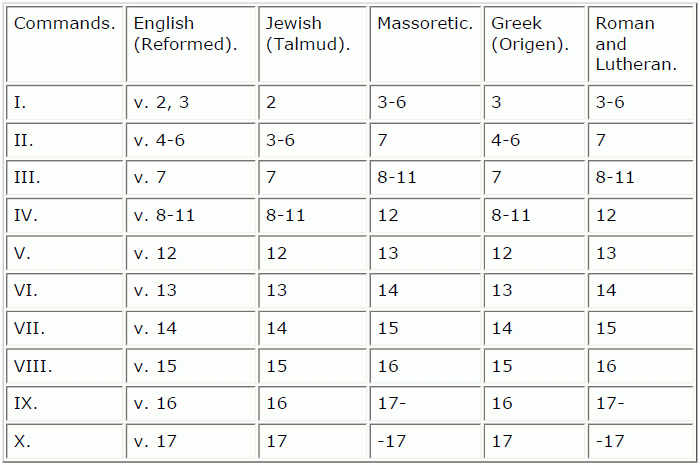
The difference between the Roman Catholic and Lutheran is this: that the Roman Catholic makes Commandment IX protect the wife, while the Lutheran makes it protect the house. The Massoretic divisions agree with the Roman Catholic. The English Reformed division agrees with the Jewish and Talmudical division in including v. 2, but differs in including v. 3 in Commandment I instead of in Commandment II. The Structure proves this to be correct.
It is interesting to note here, that Christ put His seal upon each one of the ten, in the following passages:—
I. Mt 22:37.
II. Jn 4:24.
III. Mt 5:34.
IV. Mk 2:27. Lk 13:14-16.
V. Mt 15:4-6; 19:19. Mk 7:10.
VI. Mt 5:21.
VII. Mt 5:28; 19:9,18.
VIII. Mt 15:19.
IX. Mt 12:34-37.
X. Mt 5:28.
In Mt 19:18, the Lord omitted Commandment X in order to convict His questioner, who said, “ALL these have I kept.” Upon which the Lord’s command in v. 21 convicted him of its breach, as shown by the man’s sorrow in v. 22.
Appendix 40
THE NAMES OF THE TABERNACLE.
It is important to distinguish the different words used by the Holy Spirit to describe the Tabernacle, and to express His design. They are variously translated in the A.V. They are distinguished severally in the notes; and are here brought together, so that the different shades of meaning may be compared and understood. It is called:
1. The House. (Beth).
2. The Tabernacle (Mishkan) = dwelling-place from shakan, to dwell: or, habitation, indicating it as containing the presence of Jehovah in the Light, called Shechinah, cp. Ex 25:8.
3. The Tent (‘Ohel). Erected as a special place of worship before the Tabernacle was set up. Hence to be always distinguished from the Tabernacle proper. Its full title was:
4. ‘Ohel Moh’ed = Tend of assembly, or of the congregation.
5. The Tabernacle of witness, ‘ohel ha-eduth. = The Tent as containing the tables of the Law, which were an abiding witness to their covenant with Jehovah. (See Ex 16:32-34; 25:21.)
6. Sanctuary. Heb. kodesh, or holy place.
In this connection it is well to notice that congregation is ‘edah, which is general; while assembly is kahal, which is more local and partial.
Appendix 41 THE CHERUBIM
It is hopeless to arrive at the meaning of the Cherubim from etymology. Only by the usage of the whole of Scripture can we form an approximately true idea. Their description is twice given (Eze 1:5-14; 10:20; and Rv 4:6-9). By a process of elimination we arrive at the fact that they are a celestial order of spirit-beings, and we can form no more notion of them than we can of other heavenly orders which are named, but not explained, and for the want of better words are called “Thrones,” “Dominions,” “Principalities,” “Powers,” &c. They are to be distinguished from the symbolic figures of them, which were made to represent them.
Negatively, we may note:
1. That they cannot be the Godhead, or Divine in their nature, for (1) likeness of any kind was strictly forbidden (Dt 4:15,16, &c.); and (2) the Godhead is distinguished from them by being mentioned at the same time.
2. Though heavenly, or celestial and spiritual in their nature and character, they are distinguished from the angels (who, as their name implies, were spirits used as messengers). Compare Rv 5:8,11 and 7:11, where, first the cherubim offer worship, and then the angels. They must therefore be real spirit-beings, for they could hardly be represented emblematically and really in the same verse. Moreover, they are never dismissed on errands as angels are, and are never seen apart from the Throne.
3. They cannot be merely symbols, for, though symbolic and emblematic representations of them were allowed to be made, they themselves are not symbolic, or we should have symbolic symbols of symbols, and no reality at all.
4. They cannot be a symbol of the “Church” or any portion of redeemed humanity, for they are distinguished from them in Rv 5:9,10, according to the best readings of the most ancient MSS. and critical Greek texts, where the “us” of v. 9 should be omitted, and the “us” and “we” of v. 10 should be “them” and “they.” Compare also Rv 7:9-11.
5. For the same reason they cannot be symbols of “the four gospels” or books of any kind, for the cherubim are ministers associated with wrath; and call for the judgment plagues. See Rv 6 and 15:7. Moreover, there is no connection between these and the presence of the cherubim in Eden, in the Tabernacle, in the Temple, and the Throne of God.
Positively, we may note:
1. That the three root letters of kerub, = b, are the root letters of the word KaRaB, which reappear in our GRiP, GRaB, GRiPe, GRasP. In a passive sense the notion would be that of holding something in safe keeping: and, as a matter of fact, the symbolic representation of them were held fast to the mercy-seat, being made out of the same piece of gold (Ex 25:18,23).
2. In Ge 3:24 they were placed to KEEP (or guard) the way to the tree of life, and preserve the hope of re-genesis for a ruined creation (cp. Ge 2:15, where we have the word “keep” in this sense).
3. Their presence on the mercy-seat binds this hope with atonement, and with Israel.
4. On the vail the hope is bound up with the coming of the Christ in incarnation and redemption.
5. They are four in number, and four is the number of Creation (see. Ap. 10).
6. They are represented by the symbolic heads of the four great divisions of animate creation: the lion (of wild beasts), the ox (of tame beasts), the eagle (of birds), man (of humanity).
7. They are beneath the Throne, for the earth is Jehovah’s footstool.
8. Their song, when they speak, is of creation (Rv 4:11), and is in connection with the earth. Redemption is a “new song” for them, relating to others.
9. We conclude therefore, that the cherubim are celestial or real spirit-beings, associated in some way with the embodiment of creation’s hope as expressed in Ro 8:19-23. The emblematic representations made of them connect that hope with “the hope of Israel” and associate it with the blood-sprinkled mercy-seat, and the rent vail (Heb 10:10,20.)
Appendix 42 THE ‘ASHERAH
The word ‘Asherah is from the root ‘ashar, to be straight, erect, or upright. From this comes the meaning, in a moral sense, to be upright, hence, to prosper or be happy. The ‘Asherah was so called because it was something set upright or erect in the ground, and worshiped. The word occurs forty times, and only a careful study of each passage will give a correct view.
Compared with this, all that men may think or say about the ‘Asherah is of little value. The word is always rendered grove or groves in the A.V.; and always left as a proper name in the R.V.
From a conspectus of the passages, we learn that it was either a living tree with the top cut off, and the stump or trunk fashioned into a certain shape (Dt 16:21); or it was artificially fashioned and set erect in the ground (Isa 17:8. 1 Ki 14:15; 16:33). It was made of wood (Jdg 6:26) or stone. What the shape was is indicated in 1 Ki 15:13, and 2 Ch 15:16, where in the A.V. “an idol in a grove”, should be (as in the R.V.) “an abominable image for an ‘Asherah”. It could be “cut down” (Ex 34:13, the first occurrence of the word); “plucked up” (Mic 5:14); “burnt” (Dt 12:3); or “broken in pieces” (2 Ch 34:4).
It is often coupled with mazzevoth, or stone “pillars” (R.V.) (and rendered images in A.V.), connected with Baal-worship. That it could not have been in a “grove” is clear from 2 Ki 17:10, where it is forbidden to set one up “under any green tree”. While it is distinguished from Ashtoreth the goddess, it is yet associated with that goddess, Ashtoreth being representative of the productive (or passive) principle of life; and Baal being representative of the generative (or active) principle.
The image which represents the Phoenician Ashtoreth of Paphos, as the sole object of worship in her temple, was an upright block of stone, anointed with oil, and covered with an embroidered cloth. Such stones are to be met with all over the Semitic world; especially in Babylonia, in Syria, Palestine and Arabia. Even the Mahommedan sacred stone (kaaba) at Mecca remains an object of reverence. The place Beth-el was so called because of its anointed stone. There was another Beth-el in Northern Israel.
Two columns of stone stood before every Phoenician temple. Those at Tyre are described by Herodotus (ii. 44); and the “pillars of the sun” are mentioned in 2 Ch 34:4. Isa 17:8, &c. Like every form of “religion,” it had to do with the “flesh;” and hence, by the law of evolution (which is seen operating only in human affairs) it soon became corrupted. Evolution is seen in the progress of man’s works, because he begins from ignorance, and goes on learning by his mistakes and failures. From the moment he ends his works devolution at once sets in and deterioration begins. This is specially true in the “religious” sphere. All religions have become corrupt.
So with the ‘Asherah. Originally a tree, symbolical of the “tree of life,” it was an object of reverence and veneration. Then came the perversion of the earlier idea which simply honored the origin of life; and it was corrupted and debased into the organ of procreation, which was symbolized by the form and shape given to the ‘Asherah. It was the Phallus image of Isa 57:8, and the “image of the male”, Eze 16:17. These symbols, in turn, became the incentive to all forms of impurity which were part of its libidinous worship, with the swarms of “devotees” involved in its obscene orgies.
The serpent was accepted as the symbol of the nexus, and was thus associated with the “pillar” and the “tree”. Hence, it too became an object of worship. The principal factor in this form of Canaanite idolatry is that it was not a primitive conception of a religious rite, but the corruption of an earlier idea which began with honoring the origin of life. All the ancient systems of idolatry, connected with Astrology and Mythology, &c., were, in the same way, not original inventions of what was new; but the corruption of what was old, and the perversion of primitive truth.
There can be no doubt about its being, in its essence, Phallic worship pure and simple, whatever may have been its origin. This abomination was common to all the ancient nations; and relics of it are found to-day in various forms, in India and elsewhere. The menhirs of the Celtic religion are the true descendants of the ‘Asherim.
At first it was created in the Canaanitish nations; and from them it spread to the others. It was the great abomination of Canaan, and that is one reason why the Canaanites, as the descendants of the Nephilim, had to be destroyed by the sword of Israel. The other reason was the origin of those nations themselves (see Ap. 23 and 25), with which it was closely connected. The first mention of the ‘Asherah stamps it as being the special object of Jehovah’s hatred. It is given to explain His name as “jealous”; for that is the name He takes in denouncing it. Compare His threats in 1 Ki 14:15; 15:13; 16:32,33; 2 Ch 36:14, &c. It led to Israel’s banishment from the land; and subsequently to that of Judah’s.
It is still preserved in veiled language in secret fraternities, Freemasonry, Theosophy 1, and in the Roman Church; language so conceals it that probably those who use it to-day have little idea of what they are perpetuating; while the ancient symbols I O proclaim “sex as the true God of Hosts,” as the Kabbala declares. A recrudescence of this is more than hinted at; and it will be better understood when “the abomination” of Antichrist shall stand once again 2 in the Temple at Jerusalem (Mt 24:15).
The following passages will show further the nature of this form of idolatry:—Jer 5:7; 7:30,31; 19:4,5; 37:34-35. Hos 4:12-14. Am 2:7-9. The word ‘Asherah is noted in the margin of each passage where it occurs in The Companion Bible, but the following complete list is given to put the student in possession of the whole of the data; and thus to enable him to form his own conclusions.
· Ex 34:14.
· Dt 7:5; 12:3; 16:21.
· Jdg 3:7; 6:25,26,28,30.
· 1 Ki 14:15,23; 15:13; 16:33; 18:19 (sing.).
· 2 Ki 13:6; 17:10,16; 18:4; 21:3,7; 23:4,6,7,14,15.
· 2 Ch 14:3; 15:16; 17:6; 19:3; 24:18; 31:1; 33:3,19; 34:3,4,7.
· Isa 17:8; 27:9.
· Jer 17:2.
· Mic 5:14.
1 See The Perfect Way, p. 2, and The Computation of 666, pp. 105-9.
2 Mt 24:15; cp. Da 9:27; 12:11.
Appendix 43 “OFFER” AND “OFFERINGS”.
There are some twenty-four Hebrew words, more or less synonymous, which are translated “offer” and “offering” in the Hebrew Old Testament. These Hebrew words are also translated in other ways, so that it is important for the truth-seeker to know, in every passage, which word is used.
The various words are noted in the margin, except when they are clearly translated by their distinctive meanings, such as burnt-offering, peace-offering, heave-offering, &c.
I. The VERB “to offer”.
1. Karab means to draw near, but in the Hiphil conjugation, to make to approach, or draw near: hence, to bring near. See Korban, No. 1 below.
2. Nagash = to come near, after having been so brought, i.e., to enjoy the presence which the Korban (see below II. i.) has secured. Cp. Jer 30:21 where we have both words. Hence used of coming near with offerings. Cp. Greek engizo, Heb 7:19, and prosphero, Mt 2:11; 5:23; 8:4. Mk 1:44. Lk 5:14. Jn 16:2. In the Epistle to the Hebrews it is used twenty times in a sacrificial sense, except Heb 12:7, “God brings you near as sons”. See also Heb 9:14,28. Used also of the sinner’s approach to God by offering, Heb 4:16; 7:25; 10:1,22; 11:6.
3. ‘Asah, to make ready or prepare a victim for sacrifice; to make a victim a specific offering. Hence, to offer. First occurrence in Ex 10:25 (sacrifice). Then Ex 29:36,38,39 (offer), &c.
4. Zabach, to slay [and offer up]; hence to offer what has been slain; to sacrifice. Hence No. xii. below.
5. Shahat, to kill or slay (as a butcher); used of men as well as of animals. Jdg 12:6. 1 Ki 18:40. First occurrence Ge 22:10; 37:31. Then Ex 12:6.
6. ‘Alah = to offer up, especially a burnt offering, form its name in II. ii. below.
7. Katar = to burn or turn into vapor. Used of the incense which = Kethoreth, but also of the ‘Olah (II. ii.) and parts of the Minchah (II. iii.) and the Zebach (II. xii.) because these ascended to Jehovah.
8. Saraph is used of burning up (or rather, down) the sin-offering, because nothing ascended up to God in that offering.
9. Rum, to offer up as a heave-offering.
II. The NOUN “offering”.
1. Korban = a gift, or an admittance-offering: from I. i. above. It is the present brought, to this day in the East, in order to secure an audience, or to see the face of the superior, and find access to his presence. Hence called to-day, “the face-offering”. When the admittance has been secured and entrance has been obtained, then the real offering or present has to be given. Hence Korban is essentially an admittance-offering; securing the entree. Cp. the verb, Jdg 3:18. Cp. its use in the New Testament, Mt 5:23; 8:4; 23:18. Mk 7:11. Heb 5:1.
2. ‘Olah = the burnt offering: so called from the Hiphil of the verb ‘alah, to cause the ascend [as the flame and smoke ascend by burning]. In Greek holocausta, which conveys its meaning as being wholly burnt.
3. Minchah = the Meal offering = a present, as such. Hence a gift-offering, not necessarily to secure admittance, but to secure favor. It might be sacrifice by blood, or more generally and later, without blood. It is used of the offerings of Cain and Abel (Ge 4:3,4,5), of Jacob’s present to Esau (Ge 32:13-21), &c. In Exodus and Leviticus it acquires a special limitation, and is the only word rendered “meat”, or better (with R.V.), “meal offering” (though it has a wider signification that literal “meal”).
4. Shelem = the Peace offering, from the root Shalam, which conveys the idea of peace on the ground of perfection of compensation of recompense. Hence connected with the thought of rendering payment of vows or praises because of peace enjoyed. Sometimes combined with Zebach (No. xii, below). It is eucharistic rather than propitiatory.
5. Chattath = the Sin offering, from chat’a, to sin by coming short of, by missing the mark in sins of commission. In the Piel it means to purge from such sin (Ps 51:7). In the ‘Olah (II. ii) the blood went upward, in the chattath it went downward and outward “without the camp”. The former was burnt up on the altar, the latter went down on the ground.
6. ‘Asam = the Trespass offering. Relates to sins of omission, while chattath, relates to sins of commission = sin in general; ‘Asham sin in relation to Mosaic Law; sins of error arising from ignorance or negligence.
7. Nedabah = Free-will or Voluntary offerings. See Lev 22:18, &c. It refers not to the nature or mode of the offering, but to the motive. Not the same as Lev 1:4, “voluntary will”, which = “for his acceptance”.
8. Terumah = the Heave offering. So called because it was lifted up on high in presentation to Jehovah for Himself alone. See I. ix. above and Ex 29:27.
9. Tenuphah = the Wave offering, because it was waved to and fro (not up and down like No. viii), and presented for the four quarters of the earth.
10. Nesek = the Drink offering. From nasak, to pour out. Cp. Ps 2:6 (set). Php 2:17. 2 Ti 4:6.
11. ‘Ishsheh = any offering made by fire (cp. Ex 29:18. Lev 24:7,9).
12. Zebach = any offering slain (from No. II. iv, above). The proper word for a victim, slain and offered. The Hebrew name for altar (mizbeah) is derived from the same root, and denotes the place of slaughter. Cp. Ge 22.
Appendix 44 SIN, TRESPASS, INIQUITY, &c
There are many synonymous words to represent the outworking of man’s fallen nature. As these are not always translated by the same English word, it is necessary that we should distinguish them. The student, by reference to the following list, will be able to do so:—
1. chat’a, to sin; to miss the mark (as in Jdg 20:16). Also of the feet, to stumble and fall (Pr 19:2). Hence, morally, a coming short, blameworthiness — not necessarily willful. An act of thought, word, or deed, not a condition. Usually (but by no means always) rendered sin, and other words also so rendered.
2. ‘asham, trespass, to sin through error or ignorance. Cp. Lev 4:13; 5:2. Nu 5:6,7. Jdg 21:22. 1 Ch 21:3. 2 Ch 19:10; 28:10,13. ‘Asham is a breach of commandment, done in ignorance, but, when the guilt is proved, requiring atonement.
3. ‘aven, iniquity, specially connected with idolatry. Used because an idol is nothing and vanity (cp. Hos 4:15; 5:8; 10:5,8. Am 5:5, marg.). Hence, ‘aven comes to mean vanity (cp. Job 15:35. Ps 10:7. Pr 22:8, &c.). The word has many renderings, which are pointed out in the passages when it occurs. ‘Aven is rather a course of bad conduct flowing from the evil desires of fallen nature, that breaches of the law as such.
4. ‘avah, perverseness, from the root to be bent, or crooked. English wrong, i.e. wrung out of course, expresses it (cp. 1 Sa 20:30. 2 Sa 19:19. 1 Ki 8:47. Job 33:37, &c.).
5. ‘amal, trouble, labor, toil. Sin viewed in the light of the trouble it causes; and of its burden; and its grievousness (Isa 10:1. Hab 1:3). Often rendered perverseness (Nu 23:21), also mischief (Job 15:35).
6. ‘aval, unjust, unfairness, sin in its nature as deceitful, dishonesty, that which is not equal and right, unfairness in dealings. Rendered unjust (Ps 43:1; 82:2. Pr 29:27. Isa 26:10), unrighteous (Lev 19:15,35).
7. ‘abar, to pass beyond, transgress. Hence, transgression (Ps 17:3. Hos 6:7; 8:1).
8. ra’a’, wicked, injurious. From its root, which indicates its nature as breaking up all that is good or desirable; injurious to all others. In Greek poneros, evil, or kakos, bad. Hence especially of moral depravity and corruption, and lewdness. English “good-for-nothing” (1 Sa 17:28), naughty (2 Ki 2:19. Pr 20:14. Jer 24:2).
9. pash’a, revolt, rebellion. Sin against lawful authority. Often rendered transgression (Ps 51:13. Pr 28:21. Isa 43:27). In Pr 10:12 the action of love or mercy shown stands in strong contrast to this character of the sin.
10. rasha’, wickedness, in the sense of the restless activity of fallen nature (Job 3:17. Isa 53:9; 57:20,21); where it refers to the activity of the impious and ungodly, or robbers.
11. ma’al, treachery, unfaithfulness, breach of trust, often rendered trespass and transgression. It is used of Achan (Jos 7:1; 22:20). Cp. Jos 22:16. 2 Ch 26:18; 28:22; 33:19. Ezr 9:2,4. Ne 13:27, &c.
12. shagag, erring from imprudence, rashness, being deceived, not willfully; and shagah, erring willfully through passion or wine, hence, to go astray. As sin it is to be distinguished from presumptuous or high-handed sin. Cp. Lev 4:13. Nu 15:22, &c., with Nu 15:30. Ps 119:21.
13. zimmah, meditated, wickedness, plotted, planned, and designed; wicked, or lewd purpose, especially of sins of unchastity.
14. chasad = shameful. A Homonym, meaning (1) Here, and Job 37:13 (where it is rendered “mercy” in A.V. and R.V.). But “lightning” is not “mercy” but chastisement. (2) The other meaning is mercy, lovingkindness, or grace. See note on Lev 20:14.
15. shal, fault, committed inadvertently through negligence.
Appendix 45
THE ORDER AND GROUPING OF THE TWELVE TRIBES
There are twenty different lists given of the Twelve Tribes. These vary according to the different objects with which they are given, and the different connection in which they stand, according to birth: mothers, encampment, numeration, blessing, geographical relation, &c. All are worthy of attention and study. They may be thus presented:—
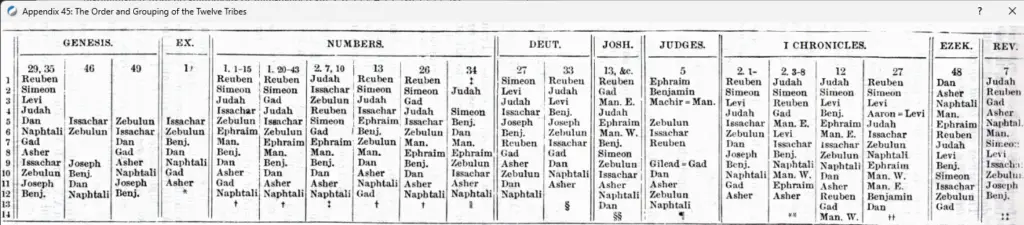
* Joseph omitted, he being in Egypt.
† Levi omitted.
‡ This is the only order which occurs three times. Levi mentioned in ch. 2:17 after Gad. The order is that of importance. || Eastern Tribes omitted.
§ Simeon omitted. Benjamin before Joseph, because the order is geographical. §§ Here the Tribes are in the four groups which are to furnish cities for the four classes of Priests.
¶ Judah and Simeon omitted. ** Zebulun and Dan omitted, unless Dan is read in 7:12.
†† Gad and Asher omitted.
‡‡ Dan omitted.
1 Two orders mentioned but not detailed. (1) The order “according to birth”, on the two stones of the High Priest’s shoulders (the place of strength). (2) The order on the twelve stones of the High Priest’s breastplate (the place of love). This was according to their tribes, as chosen by Jehovah’s love.
Appendix 46
DEUTERONOMY.
References to Deuteronomy in the New Testament, quoted by Jesus Christ in His conflict with Satan. Dt 6:13,16; 8:3; 10:20. Cp. Mt 4:4,7,10. The following important passages are referred to:—
1:31. Ac 13:18 (R.V. margin).
4:24. Heb 12:29.
4:35. Mk 12:32.
6:4,5. Mt 22:37,38. Lk 10:27.
10:17. Ac 10:34. Ro 2:11. Gal 2:6. Eph 6:9. Col 3:25. 1 Pe 1:17.
17:6. Mt 18:16. 2 Co 13:1. Heb 10:28.
18:15. Ac 3:22; 7:37.
19:15. Dt 17:6, above.
21:23. Gal 3:13.
24:1. Mt 5:31; 19:7.
25:4. 1 Co 9:9. 1 Ti 5:18.
27:26. Gal 3:10.
29:4. Ro 11:8.
29:18. Heb 12:15.
30:4. Mt 24:31.
30:11-14. Ro 10:6-8.
31:6-8. Heb 13:5 (cp. Jos 1:5).
32 and 33. Rv 15:3.
32:17. 1 Co 10:20.
32:21. Ro 10:19. 1 Co 10:22.
32:35,36. Heb 10:30.
32:43 (Sept.). Heb 1:6. Ro 15:10.
Any variations in the laws, as compared with those given nearly forty years before, are explained (1) either by reference to different events (cp. 1:13,18 with Ex 18 and Nu 11); (2) or, repeated with a different object, and from a different point of view (cp. 1:22 with Nu 13:1-3); (3) or, because wilderness laws were not suitable for the Land (cp. 12:15 with Lev 17:3,4); (4) or, modified for the same reason (cp. 1, 12 and 16 with Lev 23 and Nu 28 and 29). Other variations are complementary (1:45; 3:4; 25:17,18).
Appendix 47 “THE BOOK OF THE LAW”
It is an allegation of the “Higher” Criticism (which dispenses with documentary or MS. evidence, and therefore differs altogether from “Textual” Criticism) that the five books known as the Pentateuch were not written by, or during the time of Moses, but in the time of a king Manasseh, or even as late as Ezra.
But a definite “book” is spoken of throughout the Old Testament as being constantly written in, with directions how it was to be added to and kept up by the prophets raised up from time to time for that purpose, among others.
The first occurrence is in Ex 17:14. To this, in the margin, all the others are referred back. They are given below, so that the chain may be examined link by link and its completeness and perfection seen.
1. Ex 17:14. Written by Jehovah’s command (cp. Dt 25:19). Heb. “the book” (bassepher).
2. Ex 24:4,7. Written by Moses, and “the book of the covenant sprinkled”, with the people.
3. Ex 34:27. Jehovah’s command, “Write thou”.
4. Nu 33:1,2. Written by Moses “by the commandment of Jehovah”. From the first three months of the first year to last quarter of the fortieth year (cp. Dt 1:2,3 with 2:14).
5. Dt 1:5. The word “declare” = set forth plainly, and implies writing (the word occurs only in Dt 27:8 and Hab 2:2), and includes from Dt 1:6 to 33:29.
6. Dt 4:8 includes more than this book of Deuteronomy, and 4:2 must refer to what was then written (cp. 26:16; 29:21).
7. Dt 17:18. The book kept “before the priests the Levites”, and to be copied by the king. This was the standard copy (ch. 31:9, 25, 26); to be read at the Feast of Tabernacles in the Sabbatic years (ch. 31:10-13).
8. Dt 31:19,22,24. “The song of Moses” to be written (cp. the reason, vv. 16-18). Ascribed to Jehovah.
9. Jos 1:8. “This book of the law” came into custody of Joshua (cp. 1-8) as distinct from the book of Joshua, and containing, not Deuteronomy merely, but the whole “book of the law” as thus traced above (cp. Ps 1:2. Lk 24:44).
10. Jos 8:30-35. A copy of the law made from “the book” on the rocks in mount Ebal.
11. Jos 23:6,7 again referred to.
12. Jos 24:26. Joshua himself “wrote in the book”, and doubtlessly added Dt 34.
13. 1 Sa 10:25. Samuel continued the writing in “the book”. (So the Hebrew.)
14. 1 Ki 2:1-4. David charges Solomon with regard to this “written” law of Moses.
15. 2 Ch 17:7-9. Jehoshaphat sent the princes, Levites, and priests, and they “taught in Judah, and had the book of the law of Jehovah with them”.
16. 2 Ch 23:11 (2 Ki 11:12). It was given to Joash according to Dt 17:18.
17. 2 Ch 25:4 (2 Ki 14:6). Amaziah spared the children of his father’s murderers according to “that which was written in the book of the law of Moses” (cp. Dt 24:4).
18. 2 Ch 30:2,5,18. Hezekiah’s passover kept in second month as “it is written:. This was written in Nu 9:6-14.
19. 2 Ch 35:12. Josiah’s passover kept “as it is written in the book of Moses”.
20. 2 Ki 17:37. “The law … which He wrote for you”, i.e., Jehovah (cp. v. 35).
21. 2 Ki 22:8. “Hilkiah, the high priest … found the book of the law in the house of the Lord”. In v. 10, “Shaphan read it before the king” (Josiah). Huldah the prophetess confirms this reference (vv. 14-20). In 2 Ch 34:14 it is described as “the book of the law of Jehovah by the hand of Moses”.
22. Jeremiah refers to this event when he speaks, as in ch. 15:16.
23. Isaiah refers to this book as, in 574 his day, a “sealed” book (ch. 29:1113). The Lord Jesus refers to this as opposed to the “precepts of man” (Mt 15:1-9. Mk 7:1-13).
24. Ezra ascribes the law of Moses. Cp. 3:2 (Nu 28; 29); 6:18; 7:6, 10, 14, 21, 25. And all is to be done according to it (cp. 10:3 with 9:11, 12. Lev 18:24-30, and Dt 23:3-6).
25. In Est 3:8, the laws were extant, and known as “diverse from all people”.
26. Nehemiah (1:7-9) speaks to Jehovah of the “statutes and judgments He gave by Moses”.
27. Ne 8:8. The book is read according to its requirements.
28. Ne 8:14,17. The Feast of Tabernacles was kept according to Lev 23:39-43.
29. Ne 10:28,29. A solemn covenant was made “to walk in God’s law, which was given by Moses the servant of God”.
30. Ne 13:1. “They read in the book of Moses” concerning the law as written in Dt 23:3,4.
31. Daniel in his prayer (ch. 9:11) refers to the curse fulfilled on the nation as “written in the law of Moses the servant of God”.
32. Mal 4:4 completes the cycle, and refers all to Horeb where the people received the law (as distinct from Sinai, where Moses received it), and to Moses by whom it was given (not to Ezra or to some “Redactors” of a later day).
Appendix 48 THE USE OF VARIOUS TYPES IN THE ENGLISH BIBLE
The practice of indicating, by different types, words and phrases which were not in the Original Text, was, it is believed, first introduced by Sebastian Münster, of Basle, in a Latin version of the Old Testament published in 1534.
The English New Testament (published at Geneva, 1557) and the Geneva Bible (1560) “put in that word which, lacking, made the sentence obscure, but set it in such letters as may easily be discerned from the common text.” The example was followed and extended in the Bishops’ Bible (1568, 1572), and the roman and italic 1 types of these Bibles (as distinguished from the black letter and roman type of previous Bibles) were introduced into the A.V. (1611).
The following seem to have been the principles guiding the translators of the A. V.:—
1. To supply the omissions under the Figure Ellipsis, or what they considered to be Ellipsis.
2. To supply the words necessary to give the sense, when the Figure Zeugma is employed.
3. Once, at least, to indicate a word or words of doubtful MS. authority, 1 Jn 2:23 (first introduced in Cranmer’s Bible — doubtless from the Vulgate). Perhaps also Jdg 16:2 and 20:9.
4. Where the English idiom differs from that of the Originals, and requires essential words to be added, which are not necessary in the Hebrew or Greek.
For the use of italic type in the R.V. see Ap. 7.
The use of large capital letters for certain words and phrases originated with the A.V. None of the previous or “former translations” have them.
The revisers abandoned this practice, but have not been consistent in the plan they substituted for it. In most of the cases they have used small capital letters instead of the large capitals; but in three cases (Jer 23:6. Zec 3:8; 6:12) they have used ordinary roman type.
The use of large capitals by the translators of the A.V. is destitute of any authority, and merely indicates the importance which they attached to such words and phrases thus indicated.
The following is a complete list:—
· Ex 3:14. “I am that I am.”
· Ex 3:14. “I am.”
· Ex 6:3. “Jehovah.”
· Ex 28:36; 39:30. “Holiness (R.V. “Holy”) to the Lord.”
· Dt 28:58. “The Lord thy God.”
· Ps 68:4. “Jah.”
· Ps 83:18. “Jehovah.”
· Isa 26:4. “Jehovah.”
· Da 5:25-28. “Mene, Mene, Tekel, Upharsin.” (v. 28, “Peres”.)
· Zec 14:20. “Holiness (R.V. “Holy”) unto the Lord.”
· Mt 1:21. “Jesus.”
· Mt 1:25. “Jesus.”
· Mt 27:37. The inscriptions on the Cross. Also Mk 15:26. Lk 23:38. Jn 19:19.
· Lk 1:31; 2:21. “Jesus.”
· Ac 17:23. “To the (R.V. “an”) unknown God.”
· Rv 17:5. “Mystery, Babylon the Great, the Mother of (R.V. “the”) Harlots and (R.V. “the”) Abominations of the Earth.”
· Rv 19:16. “King of Kings, and Lord of Lords.”
Large capitals in A.V. Small roman letters in R.V.
· Jer 23:6. “The Lord our Righteousness.”
· Zec 3:8. “Branch.”
· Zec 6:12. “Branch.”
The word italic means relating to Italy, and is used of a kind of type dedicated to the States of Italy, by Aldus Manutius, about the year 1500.
Appendix 49 “THE MAN OF GOD”
The first occurrence of this expression is in Dt 33:1, and is used of Moses. Its use in connection with Moses (Ps 90, title), who was, par excellence, the prophet, like unto whom Christ was to be “raised up” (Dt 18:15-19), shows that it is to be understood of what Moses was, viz., “the prophet”. He was so called, not because he foretold, but because he spoke FOR God. This is the meaning of the word “prophet” as taught by its first occurrence in Ge 20:7. The prophet was God’s “spokesman” (Ex 4:16. Cp. Ex 7:1).
God’s spokesman could know what to speak for Him only (1) from His Spirit (Ne 9:30. Cp. Hos 9:7, margin, and see Nu 11:16,17,25-29); (2) from Jehovah making Himself known (Nu 12:6. Eze 3:17. Jer 15:19. Cp. 2 Ch 36:12); and (3) from God’s written word. This is why Timothy is the only one called a “man of God” in the New Testament (1 Ti 6:11), and why, today, one, and only one who knows “all scripture”, which is so profitable, can be called a “man of God” (2 Ti 3:17).
All such are God’s spokesmen because they alone know what He wishes to be spoken. They are His witnesses (Ac 1:8; 22:15). Christ was THE prophet because He spoke only those things which were give Him to speak (see note on Deut 18:18), and He alone is “the faithful Witness” (Rv 1:5).
It was for the above reasons that the expression “the man of God” (i.e. God’s man) became the general name for a prophet among the common people. See all the occurrences:—
· Dt 23:1.
· Jos 14:6.
· Jdg 13:6,8.
· 1 Sa 2:27.
· 1 Sa 9:6,7,8,10.
· 1 Ki 12:22.
· 1 Ki 13:1,4,5,6,7,8,11,12,14,14,21,26,29,31.
· 1 Ki 17:18,24.
· 1 Ki 20:28.
· 2 Ki 1:9,10,11,12,13.
· 2 Ki 4:7,9,16,21,22,25,25,27,27,40,42.
· 2 Ki 5:8,14,15,20.
· 2 Ki 6:6,9,10,15.
· 2 Ki 7:2,17,18,19.
· 2 Ki 8:2,4,7,8,11.
· 2 Ki 13:19.
· 2 Ki 23:16,17.
· 1 Ch 23:14.
· 2 Ch 8:14.
· 2 Ch 11:2.
· 2 Ch 25:7,9,9.
· 2 Ch 30:16.
· Eze 3:2,2.
· Ne 12:24,36.
· Ps 90, title.
· Jer 35:4.
Number of occurrences:—
Pentateuch 1 Prophets 65 Other books 12 78 = 6 x 13 (see Ap. 10).
New Testament 2
80 = 8 x 10 (see Ap. 10).
Appendix 50 CHRONOLOGICAL CHARTS AND TABLES
INTRODUCTION.
1. Systematic tabulation being the only satisfactory method, to eye and understand alike, of presenting Biblical, or any other numbers, this course has been adopted in the following charts. To ensure accuracy, “Section” paper has been used throughout. The importance of this is, that, for the first time, (it is believed) Bible readers will have placed in their hands a series of Chronological Tables of the main dated events in the Old Testament, which they can test and check for themselves. As a rule, the Chronological Charts already available are set before the reader, either on a scale so minute that they must be received or rejected as a whole, or else so encumbered with extraneous matter relating to Babylon, Egypt, Greece, Rome, &c., as to be hopelessly bewildering to the ordinary Bible reader.
2. The problems of Biblical Chronology cannot be solved by mere computation, after the manner of some. Neither must they be dealt with by arbitrarily adopting a particular date, and reckoning from that onward to Christ, and back to Adam. This is a position that cannot be maintained; as the charts will show.
3. Again, the use of the “Sothic cycles”, eclipses, and other astronomical methods for “settling” Biblical dates, has not been sought. On the contrary, any appeals for aid from such sources have been carefully avoided. If the record of the Scripture as to its own times and numbers is not self-contained, then it must be hopeless to supplement it by guesses and “explanations” as to the movements of the heavenly bodies, used mainly in support of human arguments and assumptions.
4. The position occupied in The Companion Bible is that all Scripture is “given by inspiration of God,” qeovpneusto (theopneustos) = God breathed. Therefore, the record of the dates and periods stated in the Bible are as much inspired as any other portion of it; and are as much to be relied on for accuracy as those statements upon which we rest in hope of eternal salvation. They must be as unreservedly received and believed as any other statements contained in its pages.
5. When it is stated that a certain king began to reign in such and such a year of the reign of another king, and that he reigned for so many years, it is accepted, and charted down accordingly.
6. One of the greatest difficulties which chronologers have to face is, and always has been, the apparent conflict between the record in 1 Ki 6:1, that Solomon’s temple was commenced “in the four hundred and eightieth year after the children of Israel were come out of the land of Egypt”; while in Ac 13:17-22 the same amounts to 573 years, a difference of ninety-three years.
In the majority of cases 1 Ki 6:1 has been adopted by chronologists as being correct, St. Paul’s reckoning being left to take care of itself; or, they say that he was “misinformed”, or “only speaking generally.” The simple fact is both are right. The solution of the difficulty is that St. Paul’s statement is according to Anno Mundi years (573) — the other, on the principle of what we may call Anno Dei reckoning (480). (See the “Lo-Ammi” periods chart, 50. vii. 11).
The charts show that, on the plain and straight-forwad statements of the Scriptures themselves, the actual Anno Mundi period from the Exodus to the commencement of Solomon’s temple was exactly 573 years, thus agreeing with St. Paul, and absolutely verifying the reckoning in Ac 13:17-22. But the four hundred and eightieth year of 1 Ki 6 is also as absolutely correct, only it is reckoned from the Exodus on a different principle — viz. according to God’s reckoning. The difference in years between the two statements is, as already said, the ninety-three years of the servitudes.
Now, to ignore ninety-three years in the lifetime of the world cannot be done without upsetting all other dates. Yet this is precisely what is generally done. Understanding the “four hundred and eightieth year” as being on Anno Mundi reckoning instead of according to Anno Dei reckoning, chronologers are compelled, in order to make things “agree”, to handle and compress the figures and facts of the Judges period in the most arbitrary manner.
St. Paul’s testimony is that “God gave (them) Judges about 450 years until Samuel the prophet”. (Ac 13:20.) The adverb of time here translated until (e]w”, heos, until, as long as), marks the completion of an action up to the time of the commencement of another. Here, it denotes the fulfilment of the times of the Judges, ending with the close of Samuel’s forty years, and the commencement of the kingdom. (Cp. the use of e] w”– heos — in Mt 1:25, “until she had brought forth her firstborn son.”)
The chart 50. iv. exactly coincides with St. Paul’s statement. The Judgeship period ends, and the kingdom time begins with Saul in 1000 B.C.
7. The advantage of the SECTIONAL LINES in the charts will be apparent to all students of the Word of God. The difficulty experienced in making the two lines of the kings of Judah and Israel “agree” is overcome quite simply by setting the Davidian dynasty, and those of the kings of Israel, on what may be termed and interlocking system, by the use of the parallel horizontal section lines.
When, for instance, it is stated in 2 Ki 8:16, “In the fifth year of Joram the son of Ahab king of Israel (Jehoshaphat being then king of Judah began to reign”: Chart 50. vii shows this; and, while vindicating the accuracy of the statement in the text — followed in the A.V. and R.V. (with a doubtful note in the latter) as to Jehoshaphat being at that time king of Judah — it shows further that Jehoshaphat had joined his son with him in associate-kingship in the third year before his death.
The extreme value to the student of this principle will be seen in this and other instances, especially in the Ezra-Nehemiah period. See Chart 50. vii. 5.
8. In Chart 50, vii. 7, 8, 9, 10, are given a few of the significant periods of 430, 450, 490, and 1,000 years. The Tables will enable others to follow up these figures on the same lines; and doubtless many other important periods will be noted by those who delight in searching into the wonders of the Word of Life. This, by means of the Section lines, can be done accurately.
9. In the Charts themselves the terminus a quo is the creation of Adam; while the terminus ad quem is the Crucifixion (although the charting is continued on to the destruction of Jerusalem by Titus). The unit of measurement is the number of years given as the lifetime of Adam: viz. 930. (Ge 5:5.)
Commencing with this, and taking each link as it follows, the chain is seen to extend in perfect sequence until it ends with the “cutting off of the Messiah” at the close of the sixty-ninth of the seventy sevens of Da 9:25,26 — in A.D. 29. That is 4,033 from the Creation. It shows also that the period from Adam to the Nativity was eighty jubilees (on Anno Mundi reckoning, but see note on p. 70) or 4,000 years. Each shaded column stands for 100 years (same in the detail charts) consisting of 10 sections of 10 years each. Every year, therefore, from beginning to end is shown, and nothing is left, in this respect, to chance or guesswork.
The figures to the left of this shaded column are B.C. dates: that is, they are reckoned from the common era of A.D. 0. But, all are agreed that the birth of Christ took place four years earlier :– therefore, for any date required from the Nativity itself, these four years must be deducted in each case.
On so small a scale it is almost humanly impossible to avoid some slight overlappings in connection with periods of the kings, owing to the use of the cardinal and ordinal numbers, and the absence in most cases of hints as to the time of year at which some of the reigns began or ended. But the “charting” has been done with the most careful and anxious exactitude, and the “interlocking” system, above referred to, has reduced such minutiae to (it is believed) the narrowest limits.
10. The principle employed in the Scriptures of this interlocking, or crosschecking, is of great significance and importance. On the charts these are set down exactly as they are given. No attempt is made to manipulate the figures, e.g. –
(a) When the record days “in the thirty and eighth year of Asa king of Judah began Ahab the son of Omri to reign over Israel, and Ahab … reigned over Israel in Samaria twenty and two years” (1 Ki 16:29), it is charted accordingly, and this shows that Ahaziah was joined in co-regency with his father Ahab two years before the death of the latter, in the seventeenth year of Jehoshaphat (1 Ki 22:51).
(b) In 2 Ki 14:23 it is stated — “in the fifteenth year of Amaziah, the son of Joash king of Judah Jeroboam (II) the son of Joash king of Israel began to reign in Samaria, (and reigned) forty and one years.”
Now, Amaziah’s twenty-nine years of reigning in Jerusalem (2 Ki 14:2) end, as the chart shows, in the fourteenth year of Jeroboam; and, as Uzziah, Amaziah’s son, began his reign in the twenty-seventh year of Jeroboam (2 Ki 15:1), it follows that a gap of thirteen years intervenes in the line of Judah between Amaziah and Uzziah. No attempt is made to bridge this gap, much less to curtail or ignore it. The Scriptures are silent as to the reason for this break. The interval stands there, a plainly recorded fact, and is charted down accordingly.
In the same way there is an interval of twenty-four years on the Israel side between Jeroboam II and his son Zechariah’s accession. But Scripture gives no detail as to how the intervening space was occupied. In the case of the Davidian dynasty, the periods omitted (shown in black) were not to be included in the Anno Dei reckoning.
11. The “LO-AMMI” periods. It will be noticed at once that, in many instances, from shortly after the entry into the Land and onwards, there are wide differences between the chart dates and the “received dates” for certain events. For instance, Jehoiakim’s fourth and Nebuchadnezzar’s first years (Jer 25:1) are charted as 496 B.C., whereas the generally “received” date is 606 B.C. (according to some, 605 or 604). This means a discrepancy of 108-110 years; and shortens the period between the year in which Judah became a tributary to Babylon, and the Gentile supremacy over the land of Jerusalem began, and the time of Christ, by those 108-110 years.
At once, it may be said, “Here is manifest error! We are told that leading chronologers are ‘agreed’ that the point of contact between sacred and profane chronology, and therefore the first certain date in Biblical history, is the accession of Nebuchadnezzar to the throne of Babylon in B.C. 625.” But the chart of the “Lo-Ammi” periods (50. VII. 11) shows that chronologists have mixed up Anno Mundi reckoning with the Anno Dei reckoning.
The black portions of the columns in the charts show the times when the children of Israel were in servitude or under usurped authority (as in Athaliah, &c.), and therefore such periods were not to be reckoned, while Israel was Lo-Ammi, “Not My People!”. Take, for example, from the Exodus to Jehoiachin’s Captivity. On “received” dates this period is 1491-599 = 892 years. According to the charts this period is 1491-489 = 1003 years. A difference of 110 years.
The explanation is in the charts, and shows that the Anno Mundi years include the ninety-three of servitude in the Judges, and the three intervals in the Kings (together twenty years), totaling 113 years. Deducting this 113 from 1002, or adding it to 892, we have 889 and 1005 respectively.
Allowing for the portions of years at the beginning and end of this period, and the overlapping at the intervals, it will be seen that these figures are practically identical.
The same Anno Dei reckoning removes the difficulty presented by “the four hundred and eightieth year,” and shows that every date from the time of Eli to the usurpation of Athaliah is ninety-three years out of place in the ordinary reckoning; from Joash to the end of Amaziah every date is ninety-nine years wrong; and from Uzziah’s death to the Captivity every date is 113 years wrong.
This is not inference but fact, as those who use the charts can test for themselves. This one date in 1 Ki 6:1, having been accepted by almost all the “leading chronologers” as representing literal Anno Mundi years, has become the pivot upon which all chronology, “sacred” and secular, has been made to turn, and all “received” dates gathered from “monumental” or other sources, as well as by “computation”, have been forced to “fit in” accordingly.
12. This also applies to the JUBILEE YEARS. On Anno Mundi reckoning, from the entry into the Land till the Nativity, there are exactly twenty-nine jubilees; but on Anno Dei reckoning there are only twenty-five jubilees (the number of grave again, 5 x 5, i.e., 52. See Ap. 10): and the Sabbatic years accordingly, as shown on the charts.
13. THE SCALES of the detailed charts explain themselves.
14. The EZRA-NEHEMIAH period (50. vi. and vii. 5). According to “received” dates, the building of the second Temple was begun in 536 B.C., and finished in 516-515 B.C., and the walls of Jerusalem were built by Nehemiah in 444 B.C., that is seventy-two years later, and ninety-one years from the going forth of the decree to build Jerusalem.
Now, in the second year of DARIUS HYSTASPES (Hag 1:1) the LORD’S HOUSE was not built. Hence the word of Jehovah: “Is it time for you to dwell in your ceiled houses, and this house lie waste?” (1:4). “Go up and BUILD the House” (v. 8). If this be so, we may ask — When was Jerusalem rebuilt? On “received” dates we are asked to believe that this was completed by Nehemiah in 444, i.e. seventy-two years later. According to this dating the Temple was finished and dedicated in 516 B.C., seventy-two years before the houses and walls of Jerusalem were built!
The key to this period — indeed, to the whole of Scripture chronology — is in Da 9:25, “From the going forth” of the decree to BUILD JERUSALEM. Not a word is said about the Temple in this important passage; whereas the decree of Cyrus is entirely concerned with the Temple, “the House of the LORD GOD of Israel … which is in Jerusalem.” Ezr 1:3.
The charts show that the going forth of the decree to build JERUSALEM was issued in the twentieth year of Artaxerxes (ASTEIAGES = “Darius the Median,” — the father of Cyrus), and in the forty-second year of Nebuchadnezzar’s reign. This was just at the close of the great king’s seven years of “madness.”&nbs 51 b p; (See the Structures of Ezra-Nehemiah, and Ap. 58.). This decree to build Jerusalem was in 454 B.C.; and the decree of Cyrus to build the Temple was issued in 426 B.C.; twenty-eight years later.
An illustration from the Book of Exodus may help to illustrate the principle on which the books of Ezra-Nehemiah are placed in the Jewish (and our own) Bible. The specification of the Tabernacle, its materials and furniture, is placed first (canonically), beginning with the ARK. Then the construction itself follows. The order is reversed in actual building; and the chronological order comes first.
It is the same here. The building of the House of God being paramount, the decree, &c., concerning it comes first (canonically), on the same Divine principle. Afterwards we have the detail of the setting for the gem, so to speak — the building of Jerusalem. Just as the Tabernacle was (chronologically) built first (Ex 36) to contain the ark, so here, this city was built first to contain, guard, and protect the “House of Jehovah”. Finally, the best explanation of the charts will be found in the charts themselves. For further information see Ap. 86.
VIII. SUMMARY OF PRINCIPAL EVENTS
B.C.4004 Adam created.3874 Seth b. “Adam begat a son in his own likeness” (Ge 5:3).3769 Enos b.3679 Cainan b.3609 Mahalaleel b.3544 Jared b.3382 Enoch b. “seventh from Adam” (Jude 14).3317 Methuselah b.3194 Adam’s “day of grace” begins when he is 810 (Ge 6:3).3130 Lamech b.3074 Adam d. (930).3017 Enoch translated, fifty-seven years after Adam’s d.2962 Seth d. (912).2948 Noah b.2864 Enos d. (905).2769 Cainan d. (910).2714 Mahalaleel d. (895).2582 Jared d. (962).2448 Japheth b.2447 Ham b.2446 Shem b. (Noah 502).2353 Lamech d. (777).2348 Methuselah d. (969) in the first month of the Flood year.2348-2347 The Flood year. (Noah’s 600 th year. Ge 7:6,11.)2346 Arphaxad b. “two years after the Flood”.2311 Salah b.2281 Eber b.2247 Peleg b. “In his days the earth was divided” (Ge 10:25). See note on 50. II.2217 Reu b.2185 Serug b.2155 Nahor b.2126 Terah b.2056 Terah’s “generations” begin with the b. of Haran.2008 Peleg d. (239).2007 Nahor d. (148).1998 Noah d. (950).1996 Abraham b. (1,992 years from the Nativity).1978 Reu d. (239).1955 Serug d. (230).1946? Abraham’s First “Call”, in Ur of the Chaldees (Ac 7:2-4)1921 Terah d. (205). Abraham’s Second “Call” (Haran). The 430 year sojourning begin. (See note on Gen 12:1, and Ap. 50. III).1920-1912 Abraham goes down into Egypt. Attempted destruction of the Seed (see note on Gen 12:10, and Ap. 23). Abraham returns from Egypt.1911 Abraham (85) marries Hagar (Ge 16:3).1910 Ishmael b. (Abraham 86).1897 Covenant of Circumcision. (Abraham 99).1896 Isaac b. (Abraham 100).1891 Isaac becomes “the Seed” (Ge 21:10; 12:7). Ishmael “cast out”. The 400 years of Ac 7:6 begin.1878 Salah d. (433).1863? Isaac (33) offered up.1859 Sarah d. (127). The only woman whose age is given in Scripture. For significance of this, cp. Gal 4. In Sarah’s age we have, allegorically, the period of duration of the Old Covenant.1856 Isaac (40) marries Rebekah.1846 Shem (Melchizedek?) d. (600). Abraham (150) marries Keturah?1836 Jacob b. (Isaac 60).1821 Abraham d. (Isaac 75. Jacob 15).1817 Eber d. (464), outlives Abraham by four years.1812? The famine of Ge 26:1. The cause of sale of the birthright?1796 Esau (40) marries Hittite wives.1773 Ishmael d. (137. Jacob 63).1759 Jacob (77) gets the Blessing, and flees to Padanaram.1758 His “servitude” begins.1752 His marriages.1751 Reuben b.1750 Simeon b.1749 Levi and Dan b.1748 Judah and Naphtali b.1747 Gad b.1746 Asher and Issachar b.1745 Zebulun and Dinah (twins?) and Joseph b.1742 Jacob’s bargain about the cattle.1739 Jacob flees from Padan-aram.1738 Jacob meets Esau.1737 Jacob at Succoth.1736 Jacob comes to Shechem.(1732-1727) (The six years of “Jacob’s trouble” in the Land.)1732 Dinah raped. Another attempt to destroy the “Seed”, by raising the country against the “tribe”. (Cp. Ge 34:30; 35:5; and see Ap. 23.)1731 Jacob at Beth-el.1728 Rachel d. Benjamin b. Reuben forfeits the birthright to Joseph (17), to whom it rightly belonged. (Cp. 1 Ch 5:1,2.)1727 Joseph sold (18).1726 Jacob (110) joins his father Isaac (170) at Hebron (after a separation of thirty-three years).1717 Joseph (28) in Egypt. Interprets butler’s dream.1716 Isaac d. (180. Jacob 120. Joseph 29).1715 Joseph (30) interprets Pharaoh’s dream.1707 First year of the famine.1706 Second year of the famine. Jacob (130) goes down into Egypt. The 215 years of the sojourning in Egypt begin. (Half of the 430 years from Ge 12:4.)1705 Third year of the famine.1704 Fourth year of the famine.1703 Fifth year of the famine.1702 Sixth year of the famine.1701 Seventh year of the famine.1689 Jacob d. (147), after seventeen years in Egypt. (Joseph 56. Benjamin 39.)1635 Joseph d. (110).1612 Levi d. (137).1635-1571 Gap of sixty-four years from d. of Joseph to b. of Moses.1571 Moses b.1544 Joshua b. (Moses 27).1529 Caleb b.1491 The Exodus. 430 years from Ge 12:4, and 400 years from Ge 21:10.1490 The Tabernacle set up. This year the people should have entered the Land.1452 Miriam, Aaron, and Moses d.1451 Entry into the Land.1444 The “Wars of the Lord” end (Jos 14:15). Caleb 85. Joshua hands over the leadership to Eleazar.1444-1443 First Sabbatic year.1434 Joshua d. (110).1431 First servitude. Mesopotamia 81423 Othniel. 401393-1392 First Jubilee year (Anno Dei reckoning).1383 Second servitude. Moab 181365 Ehud. 801285 Third servitude. Canaan 201265 Barak. 401225 Fourth servitude. Midian 71218 Gideon. 401178 Tola. 231155 Jair. 41151 Jephthah. 6 (*) 1145 Ibzan. 71138 Elon. 101128 Abdon. 81120 Fifth servitude. Philistine. 401080 Eli, 40 years.1040 Samuel, 40 years.1020 The “Reformation”. 1 Sa 7.1000 Ends the 45 years of Ac 13:20, and 490 years from the year they should have entered into the Land.1000 THE KINGDOM. Saul, 40 years.990 David b.974 David’s first anointing (16).960 David, 40 years. Second anointing (30).953 David’s third anointing (37).920 Solomon, 40 years.917 The Temple begun. 573 years after the Exodus. (Cp. Ac 13:20-23).910 The Temple finished.897 At the end of twenty years, the “two houses” finished (1 Ki 9:10).880 The Disruption. Rehoboam, 17 years.863 Abijam, 3 years.860 Asa, 41 years.819 Jehoshaphat, 25 years.796 Jehoram’s accession.794 Jehoshaphat d.789 Ahaziah’s accession.788 Ahaziah slain by Jehu.788-782 Gap, 6 years. Athaliah’s usurpation.782 Jehoash, 41 years.743 Amaziah, 29 years.714 Amaziah ends.714-701 Gap, 13 years.701 Uzziah, 52 years.687 Hosea’s prophecies begin?649 Gap. One year between Uzziah’s death and Jotham’s accession.647 Jotham, 16 years.634 Micah’s prophecies begin?632 Ahaz, 16 years.617 Hezekiah’s accession.616 Ahaz d.615 Hosea ends?613 Siege of Samaria begun.611 Samaria taken and Israel ends.603 Sennacherib invades Judah in the fourteenth year of Hezekiah (2 Ki 18:13).588 Manasseh, 55 years.584 Isaiah killed? (Cp. Isa 7:6).533 Amon, 2 years.531 Josiah, 31 years.530 Zephaniah?518 Jeremiah’s prophecies begin in Josiah’s thirteenth year.513 The Book “found” and the Passover in Josiah’s eighteenth year.500 Jehoahaz, 3 months.499 Jehoiakim, 11 years.497 Nebuchadnezzar’s first siege of Jerusalem.496 Jehoiakim’s fourth year, Nebuchadnezzar’s first. Daniel taken to Babylon.495 Jehoiakim burns the roll.494 Nebuchadnezzar’s second year. His dream of the Great Image. Daniel interprets.489 Jehoiachin, 3 months. Captivity begins in Nebuchadnezzar’s eighth year (second siege).488 Zedekiah, 11 years.484 Ezekiel’s prophecies begin.478 Nebuchadnezzar’s third siege of Jerusalem begins.477 Jerusalem taken and Temple destroyed in Nebuchadnezzar’s nineteenth year. Jeremiah ends.473 Punishment for the murder of Gedaliah (Jer 52:30).462 Ezekiel’s last dated prophecy.461-454 Nebuchadnezzar’s seven years of “madness”.454 Twentieth year of Asteiages (Artaxerxes). The commandment to rebuild Jerusalem. (See 50. VI, VII. 5, 12.) Nehemiah’s first visit to Jerusalem.452 Nebuchadnezzar d. after forty-four years’ reign.452 Evil-Merodach. Jehoiachin’s captivity ends.446 Nabonidus.429 Belshazzar, 3 years.426 Belshazzar slain. “Darius the Median” (Asteiages) takes the kingdom. Cyrus (Asteiages’ son) issues the Decree to rebuild the Temple. Daniel’s vision of the “seventy sevens”. The “seven sevens” begin. Foundations of the Temple laid. Nehemiah’s second visit to Jerusalem.421 Cyrus ends.418 Cambyses makes Nehemiah governor. Nehemiah’s third visit to Jerusalem.411 Darius Hystaspis re-enacts the decree of Cyrus.410 Haggai and Zechariah begin. The temple superstructure commenced and carried on to completion, from the second to the sixth year of Darius.408 Zechariah’s last date.405 The Temple finished and dedicated. The “seven sevens” end, and the “sixty-two sevens” commence.404 The Passover.403 Ezra’s last date : 1 st of Nisan.375? Darius Hystaspis d. (according to Herodotus, 63 years old).4 The Nativity.
A.D.0 The Common Era of A.D.29 The “sixty-nine sevens” end with the “cutting off of the Messiah”, 483 years from the “going forth of the commandment to build Jerusalem” in 454 B.C.69 Destruction of Jerusalem by Titus.
Appendix 51
MONEY AND COINS, WEIGHTS AND MEASURES
I. MONEY AND COINS.
1. Dram (Old Testament).
1. ‘Adarkon (Heb.). (1 Ch 29:7. Ezr 8:27.)
2. Darkemon (the Persian Daric). (Ezr 2:69. Ne 7:70,71,72.) A gold coin, value £1 28 0 d., or $5.28.
2. Farthing (New Testament).
1. Kodrantes (Mt 5:26. Mk 12:42). A bronze coin, value 3/4 of a farthing, or 3/8 of a cent.
2. Assarion (Mt 10:29. Lk 12:6). A bronze coin, value about 3 farthings, or 1.5 cents.
3. Mite (New Testament). (Mk 12:42. Lk 12:59; 21:2.) Lepton, a copper coin, value 3/8 of a farthing, or 3/16 of
a cent.
4. Penny (New Testament), so rendered in fourteen of the sixteen occurrences of Denarion. A silver coin, value 8
1/2 d., or 17 cents. Generally plural, is twice rendered “pennyworth.” (Mk 6:37. Jn 6:7.)
5. Piece of Money (Mt 17:27). Gr. Stater, a silver coin, value 28. 8 d., or 64 cents.
6. Piece of Silver. In Old Testament usually = a shekel of silver (see Weights), or may mean uncoined silver in 1 Sa
2:36. Ps 68:30. Jos 24:32. Job 42:11.
In New Testament:—
1. Argurion (Mt 26:15; 27:3,5,9. Ac 19:19). Value 28. 8 d., or 64 cents.
2. Drachme (Lk 15:8,9). Cp. IV, above. Value 8 1/2 d., or 17 cents.
7. Silver Piece. Gr. Argurion (Mt 27:6). See VI. 1, above.
8. Tribute Money. (New Testament.) (Mt 17:24.)
1. Didrachmon, a double Drachme, see VI. 2, above. A silver coin, value 18. 4 d., or 32 cents.
2. Kensos (Mt 22:19). Latin census = a poll-tax.
II. WEIGHTS.
1. Bekah. Heb. bek’a (Ex 38:26) = half a shekel (see V, below). Weight about 5 drams, Avoirdupois.
2. Gerah. Heb. gerath (Ex 30:13. Lev 27:25. Nu 3:47). Weight 1/20 of a shekel, or about 1/2 a dram,
Avoirdupois.
3. Maheh. Heb. maneh (Eze 45:12). See “Pound” (IV, 1), below.
4. Pound.
1. Maneh. Heb. maneh (1 Ki 10:17. Ezr 2:69. Ne 7:71,72). Weight = 100 shekels (cp. 1 Ki 10:17 with 2 Ch 9:16).
2. Mna. Gr. Lat. mina (Lk 19:13,16,16,18,18,20,24,24,25). Weight about 16 ozs., Avoirdupois.
3. Litra. Gr. Lat. libra (Jn 12:3; 19:39). Weight about 12 ozs., Avoirdupois.
5. Shekel. Heb. shekel (Ex 30:13, and frequently). Weight about 10 drams, Avoirdupois. There is a shekel of the
sanctuary (Ex 30:13), and the shekel of the king (2 Sa 14:26). Their precise relative weights unknown.
6. Talent (Ex 25:39, and frequently).
1. Heb. kikkar. Weight = 3,000 shekels of the sanctuary (Ex 38:25,26). Talent of the king = 158 lb. Troy.
Talent of gold = 131 lb. Troy. About £6,150; $290.85. Talent of silver = 117 lb. Troy.
2. Gr. talantos (in N.T.). About 114 lb. Avoirdupois.
III. MEASURES.
1. DISTANCE.
1. Day’s Journey. About 30 English miles.
2. Furlong. Gr. stadios (Lk 24:13. Jn 6:19; 11:18. Rv 14:20; 21:16). About 202 English yards.
3. Mile. Gr. mileon (Mt 5:41). About 1,616 English yards.
4. Pace. Heb. za’ad (2 Sa 6:13). Rather more than an English yard.
5. Sabbath day’s journey. About 2,000 English yards.
2. LENGTH.
1. Cubit. Length still in dispute.
a. Heb. ‘ammah. Ranging between 21 and 25 inches.
b. Heb. yomed (only in Jdg 3:16).
2. Fathom. Gr. orguia. The length of the arms outstretched = about six feet (Ac 27:28).
3. Reed. Heb. kaneh (Eze 40 and 41). About 6 cubits, or about 3 1/2 English yards.
4. Span. Heb. zereth (Ex 28:16; 39:9. 1 Sa 17:4. Isa 40:12. Eze 43:13). About half a cubit, or about 10 1/2
inches.
3. CAPACITY.
1. Bath. Heb. bath (1 Ki 7:26,38. 2 Ch 2:10; 4:5. Ezr 7:22. Isa 5:10. Eze 45:10,11,14). About 6 English gallons
(liquid).
2. Bushel. Gr. modios (Mt 5:15. Mk 4:21. Lk 11:33). About 1 peck English.
3. Cab. Heb kab (2 Ki 6:25). About 1 quart, English dry measure.
4. Cor. Heb. kor (Eze 45:14). About 8 bushels.
5. Ephah. Heb. ‘ephah (Ex 16:36. Lev 5:11; 6:20; 19:36. Nu 5:15; 28:5. Jdg 6:19. Ru 2:17. 1 Sa 1:24; 17:17. Isa
5:10. Eze 45:10,11,13,24; 46:5,7,11,14. Am 8:5. Zec 5:6,8). About 3 pecks, English.
6. Firkin. Gr. metretes (Jn 2:6). About 9 gallons, English liquid measure.
7. Half homer. Heb. letheh (Hos 3:2). About 4 bushels.
8. Hin. Heb. hin (Ex 29:40; 30:24. Lev 19:36; 23:13. Nu 15:4,5,6,7,9,10; 28:5,7,14. Eze 4:11; 45:24;
46:5,7,11,14). About 1 gallon, liquid measure.
9. Homer. Heb. chomer (Lev 27:16. Nu 11:32. Isa 5:10. Eze 45:11,11,11,13,13,14,14. Hos 3:2) = 10 ephahs.
Cp. No. 12. See No. 5, above. About 8 bushels, English.
10. Log. Heb. log (Lev 14:10,12,15,21,21). About 2/3 of a pint, liquid measure.
11. Measure. The rendering of six Hebrew and four Greek words:
1. ‘eyphah (Dt 25:14,15. Pr 20:10. Mic 6:10), measure. See No. 5, above.
2. Cor. Heb. kor (1 Ki 4:22; 5:11. 2 Ch 2:10; 27:5. Ezr 7:22). See No. 4, above.
3. Madad. Used of any hollow measure: of capacity as well as length = to mete out.
4. Mesurah (Lev 19:35. 1 Ch 23:29. Eze 4:11,16). A measure of liquids.
5. Se’ah (Ge 18:6. 1 Sa 25:18. 1 Ki 18:32. 2 Ki 7:1,16,18. Isa 27:8). About 1 peck.
6. Shalish (Ps 80:5. Isa 40:12) = a third. Probably the third part of an ephah. See No. 5, above.
7. Batos (Gr.), same as Heb. bath (Lk 16:6). About 6 gallons (liquid).
8. Koros (Gr.), same as Heb. cor (Lk 16:7). See No. 4, above.
9. Saton (Gr.), same as Heb. se’ah (Mt 13:33. Lk 13:21.) See No. 7, above.
10. Choenix (Gr.), (Rv 6:6). An Attic dry measure: the daily allowance of corn for a slave, about 1 quart
(dry).
12. Omer. Heb. ‘omer (Ex 16:16,18,22,32,33,36). The 1/10 of ephah. Cp. Eze 45:11.
13. Tenth deal. Heb. ‘isaron (Ex 16:36; 29:40. Lev 14:10,21; 23:13,17; 24:5. Nu 15:4,6,9; 28:9,13,20,28;
29:3,4,9,10,14,15). About 1/2 a gallon (dry).
IV. TIME.
1. Beginning of the Watches (Lam 2:19). About 9 p.m.
2. Cock-crowing (Mk 13:35). There were two: one after midnight, and one before dawn. Both are mentioned
in Mk 14:30. The latter was “THE” cock-crowing.
3. Cool of the Day (Ge 3:8). From about 2 to about 6 p.m.
4. Day. Reckoned from sunset to sunset.
5. Eleventh Hour (Mt 20:6,9). About 5 p.m.
6. Fourth Watch (Mt 14:25). From about 3 a.m. till about 6 a.m.
7. Heat of the Day (Ge 18:1). From about 10 a.m. till 2 p.m.
8. Middle Watch (Jdg 7:19). From about midnight till about 3 a.m.
9. Morning Watch (Ex 14:24). From about 3 a.m. till 6 a.m.
10. Night. The natural night was from sunset to sunrise.
11. Ninth hour (Mt 20:5; 27:45,46. Mk 15:33,34. Lk 23:44. Ac 3:1; 10:3,30). About 3 p.m.
12. Second Watch (Lk 12:38). About 9 to 12 p.m.
13. Seventh hour (Jn 4:52). About 1 p.m.
14. Sixth hour (Mt 20:5; 27:45. Mk 15:33. Lk 1:26,36; 23:44. Jn 4:6; 19:14. Ac 10:9). About 12 midday.
15. Tenth hour (Jn 1:39). About 4 p.m.
16. Third hour (Mt 20:3. Mk 15:25. Ac 2:15; 23:23). About 9 a.m.
17. Third Watch (Lk 12:38). From about midnight till about 3 a.m.
18. Watch. Three hours.
Old Testament. First Watch, 9 p.m. till midnight. Middle Watch, midnight till 3 a.m. Morning Watch, 3
a.m. till 6 a.m.
New Testament. First Watch, 6 p.m. to 9 p.m. Second Watch, 9 p.m. to midnight. Third Watch, midnight
to 3 a.m. Fourth Watch, 3 a.m. to 6 a.m.
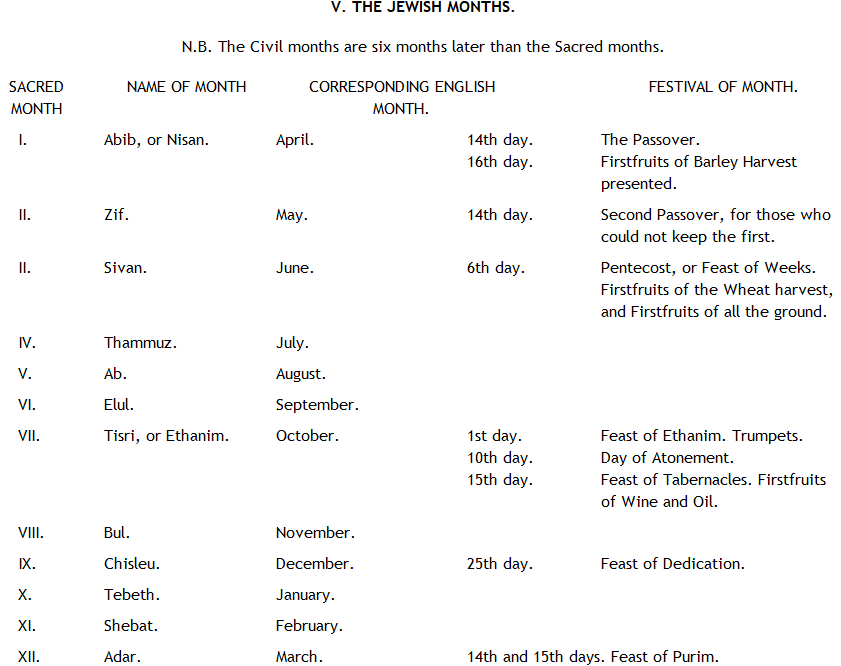
Appendix 52
PROPER NAMES
A great latitude has to be allowed in any attempt to indicate the correct pronunciation of the Proper Names in the
Bible. Our knowledge of their original pronunciation is imperfect; and names have undergone changes in becoming
transliterated from one language into another. Custom also has in many cases sanctioned a pronunciation which, while
incorrect according to the original languages, is yet so universal that any interference with it would be pedantic, not to
say intolerable. Again, we sometimes meet with a varying pronunciation of the same name in different English-speaking
countries. Thus, an exhaustive list of Biblical names, with a perfect and final system of syllabification and pronunciation,
is not practicable.
There are, however, a certain number of names too uncommon for custom to have fixed their pronunciation, and
hence, generally acknowledged to present difficulties to the general reader. Some 250 of these are here gathered
together, and presented in alphabetical order, with such division of syllables and accentuation as approximate to the
original tongues, and will serve as a guide to their more or less correct pronunciation.
The hyphen ( -) marks the division of syllables, and the accent ( ‘) the syllable to be emphasized. It has been thought
better to present them in an Appendix, and in one list, than to burden the text with an innumerable variety of hyphens
and accents, which, while attempting to remove one difficulty, would introduce a greater.
Ab-i-sha’lom
A-cel’da-ma
A-chai’a
A-cha’i-cus
Ada’dah
A-da’iah
Ad-i-tha’im
A-do’ni-be’zek
A-do’ni-ze’dek
Ad’ram-me’lech
Ad-ra-myt’ti-um
A-gee’
A-has-u-e’rus
A-hi-e’zer
A-hi-sa’mach
A-hi-sha’har
A-hi-tho’phel
A’iah
A’lmon-dib-la-tha’im
A’lam-me’lech
Am-mi-shad’dai
Am-mi-za’bad
A-na’har’ath
A’nam-me’lech
A-pel’les
A-phar’sa-chites
A-phar
A-phar-sath’chites
Ap’phi-a
Aq’ui-la
Ar’che-vites
A-re-o-pa’gus
Ar-is-to-bu’lus
Ar-tax-er’xes
A-sar-e’lah
As-nap’per
A-syn’cri-tus
Ba-ase’iah
Bak’bu-kiah
Ba’rach-el
Be-el-ia’da
Be’er-la-hai’-ro’i
Bel-te-shaz’zar
Ber-ni’ce
Be-ro’dach-ba’la-dan
Be-so’de-iah
Beth-bi’re-i
Bo’che-ru
Appendix 53
THE SIEGES OF JERUSALEM
The first occurrence of the name “Jerusalem”, as a city (*1), is in Jdg 1:8, and confirms the fact that the first
occurrence contains an epitome of its subsequent history. The history of the city has been a record of its sieges. No
fewer than twenty-seven go to complete the list. This number is striking in the light of Appendix No. 10; being
composed of 3 x 9, the factors being those of Divine completeness (3), and judgment (9) respectively ( = 33).
A cycle of ordinal completeness is marked by the 10 th and 20 th (2 x 10) sieges. These were the two characterized
by the destruction of the Temple by fire, which is accord with the number 10, being that of ordinal perfection. (See
Ap. 10.) Both also were foretold: the former by Jer. and Ezek.; the latter by our Lord.
Seven is the number of spiritual perfection, and it is worthy of note that the 7 th, 14 th (2 x 7), and the 21 st (3 x 7)
sieges were each the subject of Divine prophecy. Further, a 28 th (4 x 7) siege, yet future, is foretold in Zec 14, &c.
While 14 (2 x 7) of the sieges are recorded in Holy Scripture, 13 are recorded in profane history.
The following is a complete list of the sieges:
1. By the tribe of Judah against the Jebusites, about 1443 B.C. This was some 700 years before Rome was
founded. It was only partial, for in David’s reign we still find the Jebusites occupying the citadel (the
future Zion). The solemn words in Jdg 1:8, describing this first siege, vividly portray the after history of
the city.
2. By David against the Jebusites (2 Sa 5:6-10; 1 Ch 11:4-7), about 960 B.C.
3. By Shishak king of Egypt, against Rehoboam (1 Ki 14:25,26. 2 Ch 12:2-12), about 875 B.C. To this there was
only a feeble resistance; and the Temple was plundered.
4. By the Philistines, Arabians, and Ethiopians, against Jehoram (2 Ch 21:16,17), about 794 B.C. In this siege
the royal palace was sacked, and the Temple again plundered.
5. By Jehoash king of Israel, against Amaziah king of Judah (2 Ki 14:13,14), about 739 B.C. The wall was
partially broken down, and the city and Temple pillaged.
6. By Rezin king of Syria, and Pekah king of Israel, against Ahaz (2 Ch 28), about 630 B.C. The city held out,
but Ahaz sought the aid of Tiglath-Pileser king of Assyria, for whom he stripped the Temple.
7. By Sennacherib king of Assyria, against Hezekiah (2 Ki 24:10-16), about 603 B.C. In this case the siege was
raised by a Divine interposition, as foretold by Isaiah the prophet.
8. By Nebuchadnezzar king of Babylon, against Jehoiakim (2 Ch 36:6-7), about 496 B.C., when the Temple
was partly pillaged.
9. By Nebuchadnezzar again, against Jehoiachin (2 Ch 36:10), about 489 B.C., when the pillage of the
Temple was carried further, and 10,000 people carried away.
10. By Nebuchadnezzar, against Zedekiah (2 Ch 36:17-20), 478-477 B.C. In this case the Temple was burnt with
fire, and the city and the Temple lay desolate for fifty years.
11. By Ptolemy Soter king of Egypt, against the Jews, 320 B.C. More that 100,000 captives were taken to
Egypt.
12. By Antiochus the Great, about 203 B.C.
13. By Scopus, a general of Alexander, about 199 B.C., who left a garrison.
14. By Antiochus IV, surnamed Epiphanes, 168 B.C. This was the worst siege since the 10 th. The whole city
was pillaged; 10,000 captives taken; the walls destroyed; the altar defiled; ancient manuscripts perished;
the finest buildings were burned; and the Jews were forbidden to worship there. Foretold Da 11.
15. By Antiochus V, surnamed Eupator, against Judas Maccabaeus, about 162 B.C. This time honorable terms
were made, and certain privileges were secured.
16. By Antiochus VII, surnamed Sidetes king of Syria, against John Hyrcanus, about 135 B.C.
17. By Hyrcanus (son of Alex. Jannaeus) and the priest Aristobulus. The siege was raised by Scaurus, one of
Pompey’s lieutenants, about 65 B.C.
18. By Pompey against Aristobulus, about 63 B.C. The machines were moved on the Sabbath, when the Jews
made no resistance. Only thus was it then reduced; 12,000 Jews were slain. [Antigonus, son of Aristobulus,
with a Parthian army, took the city in 40 B.C.; but there was no siege, the city was taken by a sudden
surprise.]
19. Herod with a Roman army besieged the city in 39 B.C. for five months.
20. By Titus, A.D. 69 (See Ap. 50. VI, p. 61). The second Temple (Herod’s) was burnt, and for fifty years the
city disappeared from history, as after the 10 th siege (Jer 20:5).
21. The Romans had again to besiege the city in A.D. 135 against the false Messiah, Bar-Cochebas, who had
acquired possession of the ruins. The city was obliterated, and renamed AElia Capitolina, and a temple
was erected to Jupiter. For 200 years the city passed out of history, no Jews being permitted to
approach it. This siege was foretold in Lk 19:43,44; 21:20-24.
22. After 400 years of so-called Christian colonization, through the country; thousands were massacred, and
the Church of the Holy Sepulchre was destroyed. The Emperor Heraclius afterwards defeated him, and
restored the city and the church.
23. The Caliph Omar, in A.D. 636-7, besieged the city against Heralius. It was followed by capitulation on
favorable terms, and the city passed into the hands of the Turks, in whose hands it remains to the present
day.
24. Afdal, the Vizier of the Caliph of Egypt, besieged the two rival factions of Moslems, and pillaged the city
in 1098.
25. In 1099 it was besieged by the army of the first Crusade.
26. In 1187 it was besieged by Saladin for seven weeks.
27. The wild Kharezmian Tartar hordes, in 1244, captured and plundered the city, slaughtering the monks and
priests.
28. There will be a 28 th according to Zec 14, which will be raised by Messiah, even as the 7 th was by
Jehovah.
*1 The king of Jerusalem had been mentioned in Jos 10:1, &c. but not the city as such.
Appendix 54
THE MOABITE STONE
This ancient monument was discovered by the Rev. F. Klein in 1868 at Diban (the Dibon of the O.T.) in Moab. The
inscription consists of thirty-four lines (the last two being undecipherable), and was written by Mesha king of Moab to
commemorate his successful revolt from the yoke of Israel, recorded in 2 Ki 1:1 and chapter 3; and to honor his god
Chemosh, to whom he ascribed his successes.
The writing is in the ancient Hebrew characters, which continued in use down to quite 140, 139 B.C., but was
gradually replaced by the modern square Hebrew characters which are in use to-day. The inscription is proved to be
genuine by the Bible account, the two throwing light on each other. See the notes on 2 Kings 3.
The following translation, by Dr. Neubauer, is taken from Records of the Past (New Series), Vol. II, pp. 200, &c.:
1. “I, Mesha son of Chemosh-Melech king of Moab, the Di-
2. bonite. My father reigned over Moab thirty years and I reign-
3. ed after my father. I made this monument to Chemosh at Korkhah. A monument of sal-
4. vation, for he saved me from all invaders, and let me see my desire upon all my enemies. Om-
5. ri [was] king of Israel, and he oppressed Moab many days, for Chemosh was angry with his
6. land. His son followed him, and he also said: I will oppress Moab. In my days Che[mosh] said;
7. I will see my desire on him and his house. And Israel surely perished for ever. Omri took the land of
8. Medeba (*1) and [Israel] dwelt in it during his days and half the days of his son (*2), altogether forty years.
But there dwelt in it
9. Chemosh in my days. I built Baal-Meon (*3) and made therein the ditches; I built
10. Kirjathaim (*4). The men of Gad dwelt in the land of Ataroth (*5) from of old, and built there the king of
11. Israel Ataroth; and I made war against the town and seized it. And I slew all the [people of]
12. the town, for the pleasure of Chemosh and Moab: I captured from thence the Arel (*6) of Dodah and tore
13. him before Chemosh in Kerioth (*7): And I placed therein the men of Sh (a)r(o)n, and the men
14. of M(e)kh(e)rth. And Chemosh said to me: Go, seize Nebo (*8) upon Israel; and
15. I went in the night and fought against it from the break of dawn till noon: and I took
16. it, and slew all, 7,000 men, [boys?], women, [girls?]
17. and female slaves, for to Ashtar-Chemosh I devoted them. And I took from it the Arels (*6) of Yahveh,
and tore them before Chemosh. And the king of Israel built
18. Jahaz (*9), and dwelt in it, while he waged war against me; Chemosh drove him out before me. And
19. I took from Moab 200 men, all chiefs, and transported them to Jahaz, which I took,
20. to add to it Dibon. I built Korkhah, the wall of the forests and the wall
21. of the citadel: I built its gates, and I built its towers. And
22. I built the house of Moloch, and I made sluices of the water-ditches in the middle
23. of the town. And there was no cistern in the middle of the town of Korkhah, and I said to all the people,
Make for
24. yourselves every man a cistern in his house. And I dug the canals for Korkhah by means of the prisoners
25. of Israel. I built Aroer (*10), and I made the road in [the province of] the Arnon. [And]
26. I built Beth-Bamoth (*11), for it was destroyed. I built Bezer (*12), for in ruins
27. [it was. And all the chiefs] of Dibon were 50, for all Dibon is subject; and I placed
28. one hundred [chiefs] in the towns which I added to the land: I built
29. Beth-Medeba and Beth-diblathaim (*13), and Beth-Baal-Meon (*14), and transported thereto the
[shepherds]?…
30. and the pastors] of the flocks of the land. And at Horonaim (*15) dwelt there
31. …And Chemosh said to me, Go down, make war upon Horonaim. I went down [and made war]
32. …And Chemosh dwelt in it during my days. I went up from thence…”
(*1) Nu 21:30; Isa 15:2. (*2) “son” = successor. (*3) Now, Tell M’ain, Nu 32:38. Jos 13:17. (*4) Nu 32:37. Jos
13:19. (*5) Nu 32:3. Jos 16:2. (*6) Arel, two lions, or, lion-like men (?) Cp. 2 Sa 23:20. (*7) Now, Khan el Kureitin
(?); Jer 48:24. Am 2:2. (*8) Nu 32:3,38. Isa 15:2. (*9) Isa 15:4. (*10) Now, ‘Ar’air, Dt 2:36; 3:12; 4:48. (*11) Nu
21:19. Isa 15:2. (A.V. “high places”), cp. Jos 13:17. (*12) Dt 4:43. (*13) Jer 48:22. (*14) Jos 13:17. Jer 48:23.
(*15) Isa 15:5. Jer 48:3,5,34.
Appendix 55
THE DYNASTY OF OMRI

Athaliah was thus the granddaughter of Omri, king of Israel (2 Chron. 22:20 ), and daughter of Jezebel. The marriage
between Jehoram and Athaliah was part of Satan’s design to introduce idolatry into Judah, so that Athaliah might do for
Judah what her mother Jezebel had done for Israel, and thus secure the same result.
Jehoshaphat began by strengthening himself against Israel (2 Ch 17:1), but married his son to the daughter (an
idolatress) of Ahab, the worst of Israel’s kings. The leaven worked, morally and politically; and was then used by Satan
for the destruction of the line by which “the seed of the woman” was to come into the world. See Ap. 23 and 25.
Jehoram, king of Judah, began by killing off all his brethren (2 Ch 21:4). The Arabians came and slew all his sons, save
the youngest, Ahaziah (2 Ch 22:1), called also Joash, Jehoahaz (2 Ch 21:17), and Azariah (2 Ch 22:6).
Athaliah slew all the sons of Ahaziah on his death (2 Ki 11:1. 2 Ch 22:10), or thought she did; but the infant Joash was
rescued.
Joash (called also Jehoash) was hid for six years, while the faithfulness of Jehovah’s word hung upon the Divine
preservation of that infant’s life. Hence Jehoiada’s text (2 Ch 23:3). See, on the whole subject, Ap. 23. And, note the
parallel in the history of England, by James I marrying his son Charles to (an idolatress) Henrietta of France, with similar
political results.
Appendix 56
PARALLEL PASSAGES OF THE HISTORICAL BOOKS
The following table, showing one hundred and eleven parallel passages between the books of Samuel and Kings on
the one hand, and the books of Chronicles on the other, will be useful.
1. It will show the mutual relation of the selections, and will enable the reader to find at a glance the corresponding
portions, and thus serve the purpose of ordinary and ready reference.
2. It will help to exhibit the special design of the two great principles governing the whole of these books. In the
former (Samuel and Kings) we have the history from the exoteric point of view; in the latter (Chronicles) we have,
for the most part, the same history, but from the esoteric point of view. In the former we have the events viewed
from the human standpoint, as they would be seen by the natural eye; in the latter we have the same events viewed
from the Divine standpoint, and as seen and understood by the spiritual mind.
Consequently, while in the former we have the event in its historical aspect; in the latter we have it in its moral
aspect. In the former we have the historic record; in the latter we have the Divine reason for it, or the Divine
“words” and judgment on it. (Cp. Saul’s death, 1 Sa 31:6, and 1 Ch 10:13,14).
It is this principle which determines the amount of literary space accorded to the same historic event. For example:
in the former books we have three chapters (or 88 verses) given to the secular events of Hezekiah’s reign (2 Ki 8; 19,
and 20), and only three verses (2 Ki 18:4-6) given to his great religious reformation. In Chronicles this is exactly
reversed. Three chapters (or 84 verses) are devoted to his reformation (2 Ch 29-31), while one chapter (or 32 verses)
suffices for the secular events of his reign.
In the same way Jehoshaphat’s three alliances with Ahab can be spiritually and morally understood only from 2 Ch 17,
of which there is not a word in Kings.
3. This principle determines also the order in which the events are treated. In the books of Kings the events are
recorded in chronological order; while in Chronicles this order is sometimes ignored, in order to bring the moral causes
or consequences of the two events together, for the purposes of comparison or contrast. (Cp. the list of David’s
mighty men; David’s numbering the People, and the account of the plague).
4. The object of these two great principles is further seen in the fact that in the design of the former is to give the
whole history of Israel’s kingdom complete; while the design of the latter is to give only that which pertains to the
house of David and the tribe of Judah, as being founded on Jehovah’s covenant in 2 Sa 7 and 1 Ch 17.
5. The conclusion is that the book of Chronicles is entirely independent of the books of Samuel and Kings; and that
the differences between them are independent and designed. The critics create their own difficulties by first assuming
that the books ought to be alike; and then, because they are not what they are assumed to be, treating the variations
as “discrepancies,” or “corruptions of the text:, instead of as being full of Divine instruction “written for our learning”.
The following is the table:
1 Sa 27. 1 Ch 12:1-7.
29:1-3. 12:19-22.
31. 10.
2 Sa 5:1-5. 11:1-3.
5:6-10. 11:4-9.
5:11-16. 14:1-7.
5:17-25. 14:8-17.
6:1-11. 13.
6:12-23. 15 & 16.
7. 17.
8:18.
10. 19.
11. 20:1.
12:29-31. 20:1-3.
23:8-39. 11:10-47.
24:1-9. 21:1-6.
24:1-9. 27:23,24.
24:10-17. 21:7-17.
24:18-24. 21:18-22:1.
1 Ki 2:1. 23:1.
2:1-4. 28:20,21.
2:10-12. 29:23-30.
2:46. 2 Ch 1:1.
3:4-15. 1:2-13.
5. 2.
6. 3:1-14; 4:9.
7:15-21. 3:15-17.
7:23-26. 4:2-5.
7:38-46. 4:6,10,17.
7:47-50. 4:18-22.
7:51. 5:1.
8. 5:2-7:10.
9:1-9. 7:11-22.
9:10-28. 8.
10:1-13. 9:1-12.
10:14-25. 9:13-24.
10:26-29. 9:25-28; 1:14-17.
11:41-43. 9:29-31.
12:1-19. 10.
12:21-24. 11:1-4.
12:25. 11:5-12.
12:26-31. 11:13-17.
14:22-24. 12:1.
14:25-28. 12:2-12.
14:21,29-31. 12:13-16.
15:1. 13:1,2.
15:6. 13:2-21.
15:7,8. 13:22; 14:1.
15:11,12. 14:1-5.
15:13-15. 15:16-18.
15:16-22. 16:1-6.
15:23,24. 16:11-14.
22:1-20,44. 18.
22:41-43. 17:1; 20:31-33.
22:45. 20:34.
22:47-49. 20:35-37.
22:50. 21:1.
2 Ki 1:1; 3:4,5. 20:1-3.
8:16-19. 21:2-7.
8:20-22. 21:8-15.
8:23,24. 21:18-20.
8:25-27. 22:1-4.
8:28,29; 9:1-28. 22:5-7,9.
10:11-14. 22:8.
11:1-3. 22:10-12.
11:4-20. 23.
11:21; 12:1-3. 24:1-3.
12:6-16. 24:4-14.
12:17,18. 24:23,24.
12:19-21. 24:25-27.
14:1-6. 25:1-4.
14:7. 25:11-16.
14:8-14. 25:17-24.
14:17-20. 25:25-28.
14:21,22; 15:1-4. 26:1-15.
15:6,7,27,28. 26:22,23.
15:32-35. 27:1-8.
15:38. 27:9.
16:1,2. 28:1,2.
16:3,4,6. 28:2-8.
16:7. 28:16-19.
15:29. 28:20.
16:8-18. 28:21-25.
16:19,20. 28:26,27.
18:1-3. 29:1,2.
18:13. Isa 36:1.
18:14-16. 2 Ch 32:2-8.
20:1-11. 2 Ch 32:24.
Isa 38.
20:12-19. Isa 39.
18:17-37. 2 Ch 32:9-19.
Isa 36:2-22.
19:1-5. 2 Ch 32:20.
Isa 37:1-4.
19:6,7. Isa 37:6,7.
19:8-19. 2 Ch 32:17.
Isa 37:8-20.
19:20-37. 2 Ch 32:21.
Isa 37:21-38.
20:20,21. 2 Ch 32:32,33.
21:1-16. 33:1-9.
21:17,18. 33:18-20.
21:19-26. 33:21-25.
22:1,2. 34:1-7.
22:3-20. 34:8-28.
23:1-3. 34:29-32.
23:21-23. 35:1-19.
23:24-26. 34:33.
23:28-30. 35:20-27.
23:30-33. 36:1-3.
23:34-37. 36:4,5.
24:8,9. 36:9.
24:15-17. 36:10.
24:18,19. 36:11,12.
24:20. 36:13-16.
25:8-21. 36:18-21.
Appendix 57
THE GENEALOGY OF THE PERSIAN KINGS
The main sources of information on this subject are Herodotus, Xenophon, Ctesias, Nicolas of Damascus (all B.C.); and
Arrian (cent. 2 A.D.). The writers of a former generation were occupied in unraveling and piecing together the varying
accounts of these ancient historians without the knowledge of the still more ancient Inscriptions recently discovered,
which were caused to be written by the persons concerned in the events recorded.
In 1846 Major (afterward Sir Henry) Rawlinson published a complete translation of the trilingual Persian text on the
isolated rock of Behistun, (or more correctly Bahistun) which rises 1,700 feet out of the Plain, on the high road from
Babylonia to the East; in which DARIUS HYSTASPIS gives his own genealogy.
This famous rock (of which a view is given on page 82 by the kind permission of Messrs. Longmans & Co., the
publishers of Canon Rawlinson’s Memoir of Major-General Sir H.C. Rawlinson) derives its name from the village of
Bisitun or Bisutun, near its foot. It is on the high road from Baghdad to Teheran, about sixty-five miles from Hamadan
(on the site of the ancient Ecbatana). On this rock, on a prepared surface about 500 feet from the level of the plain,
and most difficult of access, DARIUS HYSTASPIS caused to be carved the principal events of his reign; and he
commences with an account of his genealogy.
The following is the translation of the Persian text (*1):—
§ I. “I am Darius, the great king, the king of kings, the king of Persia, the king of the provinces, the son of
Hystaspes, the grandson of Arsames the Achaemenian.
§ II. (Thus) saith Darius the king: My father is Hystaspes; the father of Hystaspes was Arsames; the father of
Arsames was Arkyaramnes; the father of Ariyaramnes was [Teispes]; the father of Teispes was Achaemenes.
§ III. (Thus) saith Darius the king: On that account are we called Achaemenians; from antiquity are we
descended; from antiquity hath our race been kings.
§ IV. (Thus) saith Darius the king: Eight of my race were kings before (me); I am the ninth (*2). In two lines
(*3) have we been kings”, &c.
It must be noted that the confusion which has hitherto been experienced arises from the fact that appellatives have
been mistaken for proper names; to say nothing of the confusion arising from their transliteration or translation into
other languages. These appellatives are, like Pharaoh and Abimelech, the general titles of a line of kings, such as the
modern Czar, Sultan, Shah, &c. Hence
AHASUERUS means “the Mighty”, and “is the name, or rather the title, of four Median and Persian monarchs” (Kitto,
Bib. Encycl. I, p. 91). “In every case the identification of the person named is a matter of controversy”. See The Encycl.
Brit., 11 th (Cambridge) edn., vol. i, p. 429.
ARTAXERXES means Great King, or Kingdom, and is synonymous with Artachshast (Arta = Great, and Kshatza =
Kingdom, preserved in the modern “Shah”). According to Prideaux he is identified with the Ahasuerus of Est 1:1 (vol. i,
p. 306).
DARIUS means the Restrainer (Her. VI. 98); or, according to Professor Sayce, the Maintainer. DARIUS “appears to be
originally an appellative meaning ‘king’, ‘ruler'”, (Herbelot, Biblioth. Orient., Article ‘Dara’); Herodotus (VI. 98) renders it
Erxeies = Coercer. “It was assumed as his throne-name by Ochus ( = Darius Nothus), son and successor of Artaxerxes
Longimanus (Ctesias, de Reb. Pers., 48, 57, Muller)”. See Kitto, Bib. Cycl., vol. i, p. 625. XERXES, in his inscription at
Persepolis, actually calls himself “DARIUS”; one paragraph begi 1000 nning “XERXES the great king,” and the next
beginning “DARIUS the king.” This is why DARIUS HYSTASPIS is thus called, to denote him as DARIUS the son of
HYSTASPES; and to distinguish him from “Darius the Mede”, who was ASTYGES his grandfather.
ASTYAGES.
is the Persian monarch with which this Appendix is concerned. According to Herodotus, ASTYAGES was the son of
CYAXARES, who was the son of PHRAORTES (II), who was the son of DEIOKES (Bk. I. 73), who, again, was the son of
PHRAORTES (I). (Bk. I. 96.) In the genealogy given by CYRUS on the Cuneiform Cylinder, he calls his great-grandfather
TEISPES (see below). This TEISPES is to be identified with TEISPES the son of ARCHAEMENES in the Behistun Rock
genealogy of DARIUS HYSTASPIS.
The ACHAEMENES of DARIUS, identified with DEIOKES of Herodotus (I. 96), was the real founder of the Achaemenian
dynasty of which Darius speaks, although his father (PHRAORTES I) was the first of the line. Herodotus describes him
(DEIOKES) as a man “famous for wisdom”, of great ambition, “aiming at the aggrandisement of the Medes and his own
absolute power” (I. 96).
PHRAORTES I. would therefore be the first of the eight kings before DARIUS HYSTASPIS, who speaks of himself as the
ninth. See translation given above.
ARSAMES.
As the grandfather of DARIUS HYSTASPIS, he is (according to the Behistun Inscription) to be identified with the
ASTYAGES of Herotodus. At the close of the Lydio-Median War “Syannesis the Cilician and Labynetus (or Nabonnedus) the
Babylonian (identified by Prideaux, vol. i, p. 82 note, and pp. 135, 136, 19 th edn., with Nebuchadnezzar) persuaded
ALYATTES to give his daughter ARYENIS in marriage to ASTYAGES, son of KYAXARES” (Her. 1. 74). Of this marriage came
HYSTASPES and DARIUS his son.
CYRUS.
In the Cuneiform Cylinder account of the capture of Babylon, CYRUS states:—
“I am CYRUS the king … the great king, the mighty king, king of Tintir (Babylon), king of Sumir, and Akkad,
king of the regions of the earth, the son of CAMBYSES the great king, king of the city of Anzan, grandson of
CYRUS, the great king, king of the city of Anzan, great-grandson of TEISPES, the great king of the city of
Anzan, of the ancient seed of royalty, whose dominion (reign, i.e. of Cyrus himself) Bel and Nebo had exalted
according to the beneficence of their hearts” (E. Wallis Budge, Babylonian Life and History, p. 87).
Here wa have the statement of Cyrus that his father was known as CAMBYSES, his grandfather as CYRUS, and his
great-grandfather under the name (or title), common to the Behistun Inscription and the Cylinder alike, of TEISPES.
TEISPES.
If TEISPES’ grandson was ARSAMES (according to the Behistun Inscription), and this TEISPES and the TEISPES of Cyrus’s
Cylinder are one and the same, — then, it follows that the CAMBYSES of the Cylinder and the ARSAMES of the Inscription
must be one and the same person, well known under different names, titles, or appellatives (*4).
Moreover, if the TEISPES of the Behistun Inscription and the one of the Cylinder of Cyrus are to be identified with
the PHRAORTES (II) of Herodotus (I. 73), then the grandson of this PHRAORTES (II) must be ASTYAGES.
Consequently we have, under these three names, titles, or appellatives, from Greek, Median, and Persian sources,
three persons, called by Herodotus ASTYAGES, by Daruis ARSAMES, and by Cyrus CAMBYSES (*5), who are in reality one
and the same. But, if the father of CYRUS was CAMBYSES, by Esther (see the Table of the Genealogy, below), then it
follows that not only does CAMBYSES = ARSAMES = ASTYAGES, but = also the AHASUERUS of the book of Esther (Prideaux
i, p. 306).
Therefore in the presence of all these identifications from independent sources and authorities, we have:—all one
and the same person.
We now give the Genealogy, according to the Inscription of DARIUS HYSTASPIS on the Behistun rock, referred to
above. The names in large capitals are the Greek names given by HERODOTUS. Those in small capitals are the
corresponding Persian names as given by DARIUS HYSTASPIS on the Behistun rock, and by CYRUS on his Cylinder; while
the names in ordinary small type are the appellatives.
THE LINE OF THE PERSIAN KINGS ACCORDING TO THE ROCK OF BEHISTUN, IN PERSIA, SHOWING THE INSCRIPTION OF DARIUS HYSTASPIS (see pages 79-81).
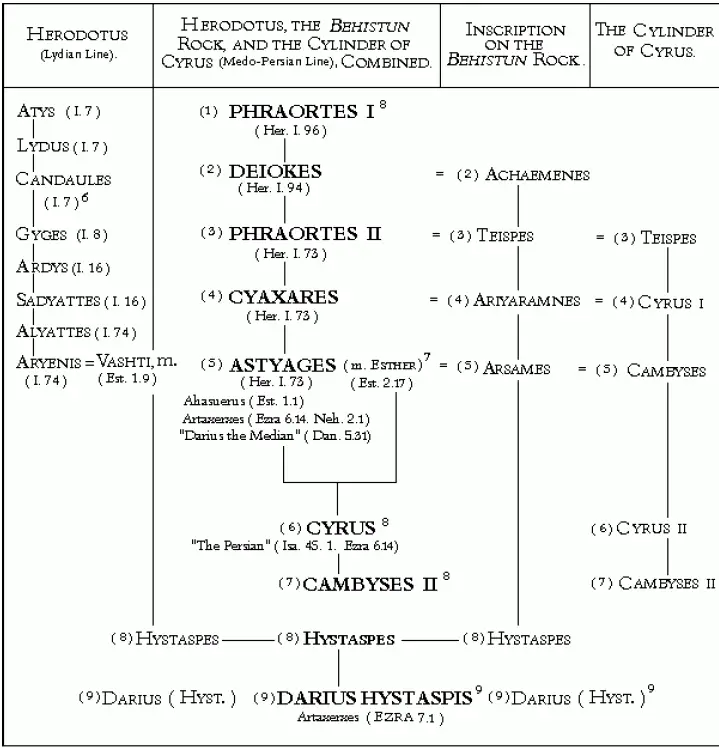
(*1) For full particulars see the handsome volume published by the Trustees of the British Museum, The Sculptures
and Inscription of Darius the Great on the Rock of Behistun, in Persia. London, 1907. (Price 21 S.)
(*2) We have indicated this enumeration by placing the figures against the names on p. 81.
(*3) The “two lines” are the Lydian and the Medo-Persian, as shown in the Table on p. 81.
(*4) “Dareios the son of Hystaspes, who traces his descent through Arsames and Ariaramnes to Teispes the son of
Akhaemenes probably refers to the same Teispes” (Sayce, Ancient Empires of the East, p. 243).
(*5) “The names Kyros and Kambyses seem to be of Elamite derivation. Strabo, indeed, says that Kyros was
originally called Agradates, and took the name of Kurus or Kyros from the river that flows past Pasargadoe”
(Sayce, id. p. 243). Cyrus and Cambyses both seem to be territorial titles rather than names.
(*6) Herodotus says the ancestors of Candaules reigned for twenty-two generations, covering a period of 505
years (I. 7).
(*7) This marriage resulted in the birth of Cyrus, in fulfillment of Isa 44:25-45:4. And the part taken by Esther
and Mordecai in his training, explains all that we read of Cyrus in Ezra and Nehemiah.
(*8) Darius, in giving his own direct line, omits the names of Phaortes I, Cyrus, and Cambyses II, but he includes
them in the numbering of his eight predecessors. There was a still later “Cyrus” (the Cyrus of Xenophon). See
Her. VII. 11.
(*9) When Darius (Hyst.) says “in two lines we have been kings”, he must refer to the Lydian and Medo-Persian
lines.
Appendix 58
THE HARMONY OF THE EZRA-NEHEMIAH HISTORY
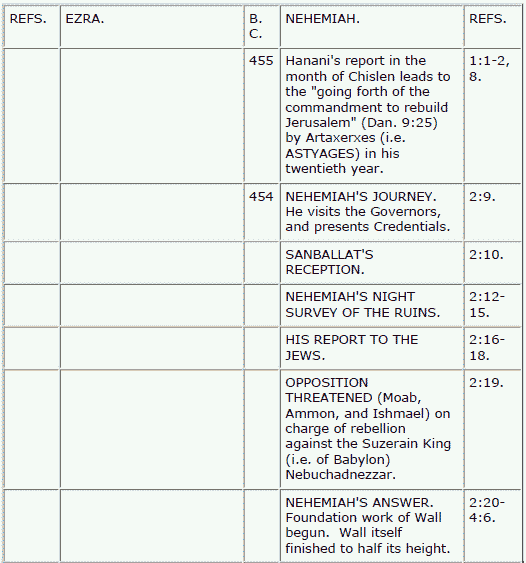
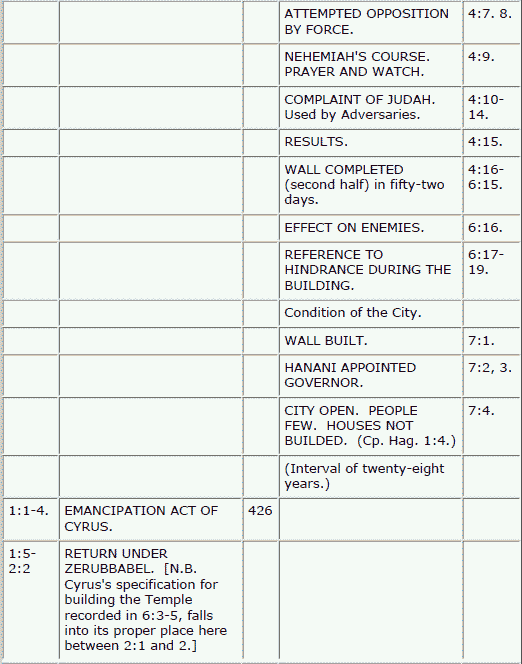
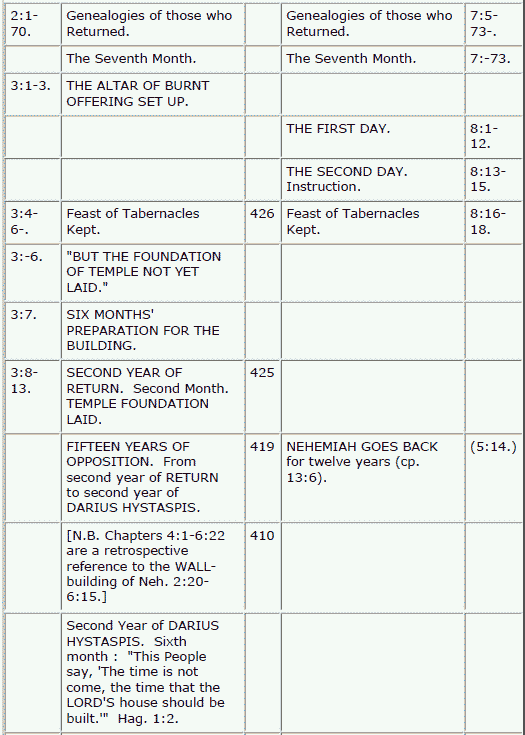
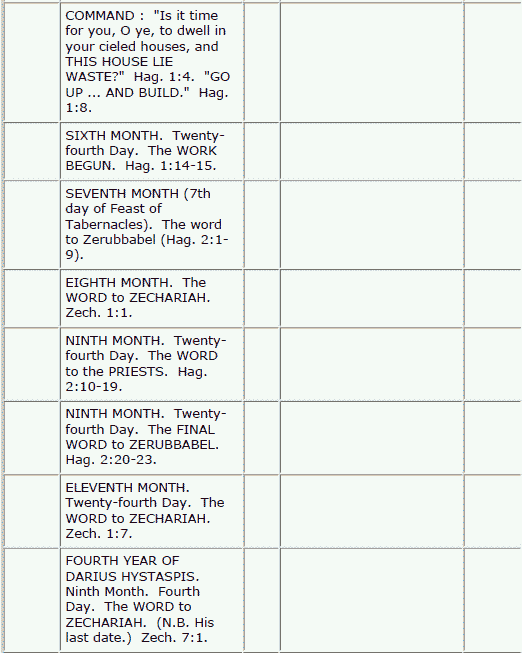
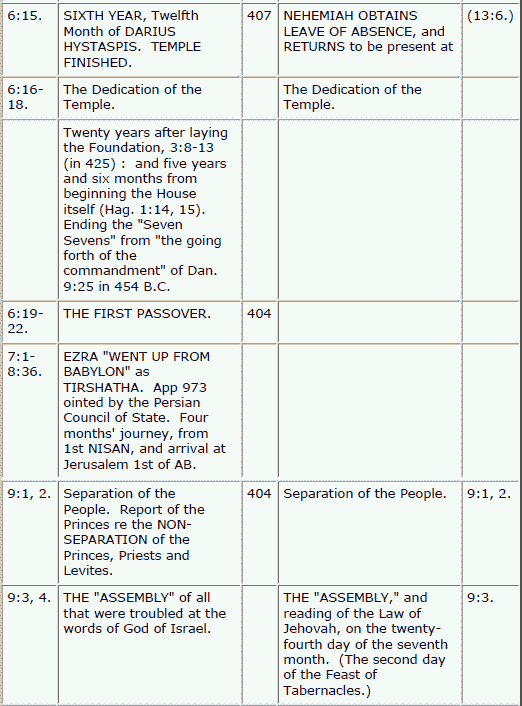
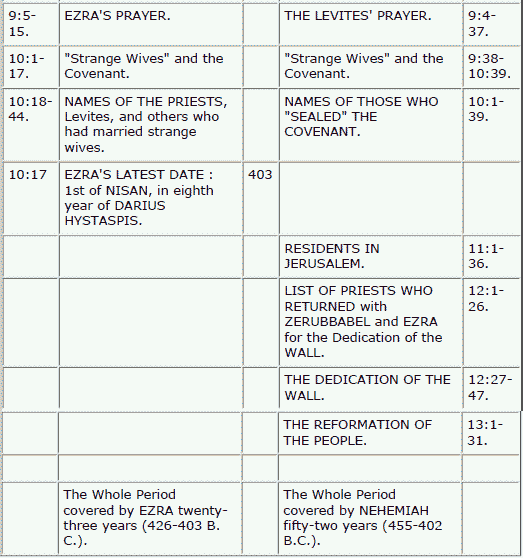
Appendix 59
THE TWELVE GATES OF JERUSALEM
(Nehemiah, chs. 3 and 12)
1. The Valley Gate (2:13; 3:13). Cp. 2 Ch 26:9.
2. The Gate of the Fountain (2:14; 3:15; 12:37), on Ophel at the Gihon spring (that mentioned in 2 Ki 25:4. Jer 39:4).
3. The Sheep Gate (3:1; 12:39). North of the Temple.
4. The Fish Gate (3:3; 12:39). Cp. 2 Ch 33:14. Zep 1:10.
5. The Old Gate (3:6; 12:39). Cp. 2 Ch 33:14, and 2 Ki 22:14, “college”. Called also the “First Gate” (Zec 14:10).
6. The Dung Gate (2:14; 3:14; 12:31). Probably same as Harsith Gate (Jer 19:2); sometimes rendered the Gate of Potsherds, from heres, a potter’s vessel. (N.B. Better = Pottery Gate) Leading to Hinnom. See Ap. 68 VIII, where the positions of the gates differ from the above and are more probably correct.
7. The Water Gate (3:25, 26).
8. The Horse Gate (3:28). Cp. 2 Ki 11:16. 2 Ch 23:15. Jer 31:40. South-east of the Temple, and close to the city and house of David.
9. The East Gate (3:29). East of the Temple, and connected with it.
10. The Gate of Miphkad (3:31). Probably north-east of Temple. ( = The Registry Gate.)
11. The Gate of Ephraim (8:16; 12:39). Cp. 2 Ch 25:23.
12. The Prison Gate (12:39), or Gate of the Guard (2 Ki 11:6,19).
(*1) In Ne 3. the first sixteen verses refer to Jerusalem, and the latter sixteen verses to Zion (or the city of David), south of Moriah. A study of these, and a comparison with ch. 12, will explain most of the difficulties connected with the topography of the city. See also the Plan of Zion, and Solomon’s buildings. Ap. 68, where the positions of the gates differ from the above and are more probably correct.
Appendix 60
THE NAME OF JEHOVAH IN THE BOOK OF ESTHER
It has been observed by many that no Divine Name or Title is found in the book of Esther. This is the more remarkable, since, in this short book of only 167 verses, the Median King is mentioned 192 times, his kingdom is referred to 26 times, and his name (*1) “Ahasuerus” is given 29 times.
Jehovah had declared (Dt 31:16-18) (*2), that if His People forsook Him, He would hide His face from them. Though the book reveals Him as overruling all, His Name is hidden. It is there for His People to see, not for His enemies to see or hear.
Satan was at work, using Haman to blot out the Nation, as once before he had used Pharaoh for the same purpose (see Ap. 23 and 25). Jehovah’s counsel must stand. His promise of Messiah, the coming “Seed” of the woman (Ge 3:15), must not fail. Therefore He must overrule all for the preservation of His People, and of the line by which that “Seed” was to come into the world.
His working was secret and hidden: hence, the name of “JEHOVAH” is hidden secretly four times in this book, and the name “EHYEH” (I am that I am) once. The Massorah (Ap. 30) has a rubric calling attention to the former fact; and (at least) (*3) three ancient manuscripts are known in which the Acrostic (*4) letters in all five cases are written Majuscular (or, larger than the others) so that they stand out boldly and prominently, showing the four consonant letters of the mane JeHoVaH. In the Hebrew <START HEBREW>y, h, w, h,<END HEBREW> or, as written in Hebrew from right to left, <START HEBREW>h, w, h, y<END HEBREW>. In English, L, O, R, D. Also the four letters of the fifth Acrostic, “EHYH”.
THE FOUR ACROSTICS.
The following phenomena are noticed in examining the four Acrostics which form the name “Jehovah”:
1. In each case the four words forming the Acrostic are consecutive.
2. In each case (except the first) the form a sentence complete in itself.
3. There are no other such Acrostics in the whole book, except the fifth Acrostic at the end; though there is
one other, forming another Divine Title, in Ps 96:11. (See note there.)
4. In their construction there are not two alike, but each one is arranged in a manner quite different from
the other three.
5. Each is uttered by a different speaker. The first by Memucan (1:20); the second by Esther (5:4); the third
by Haman (5:13); the fourth by the inspired writer (7:7).
6. The first two Acrostics are a pair, having the name formed by the Initial letters of the four words.
7. The last two are a pair, having the name formed by the Final letters of the four words.
8. The first and third Acrostics are a pair, having the name spelt backward.
9. The second and fourth are a pair, having the name spelt forward. They thus form an alternation:
A | Backward.
B | Forward.
A | Backward.
B | Forward.
10. The first and third (in which the name is formed backward) are a pair, being spoken by Gentiles.
11. The second and fourth (in which the name is spelt forward) are a pair, being spoken by Israelites. They
thus form an Alternation:—
C | Spoken by a Gentile (Memucan).
D | Spoken by an Israelite (Esther).
C | Spoken by a Gentile (Haman).
D | Spoken by and Israelite (the inspired writer).
12. The first and second form a pair, being connected with Queens and Banquets.
13. The third and fourth are a pair, being connected with Haman.
14. The first and fourth are a pair, being spoken concerning the Queen (Vashti) and Haman respectively.
15. The second and third are a pair, being spoken by the Queen (Esther) and Haman respectively. They thus
form and Introversion:—
E | Words concerning a Queen.
F | Words spoken by a Queen.
E | Words spoken by Haman.
F | Words concerning Haman.
16. It is remarkable also that, in the two cases where the name is formed by the initial letters, the facts
recorded are initial also, and are spoken of an even in which Jehovah’s overruling was initiated; while in
the two cases where the name is formed by the final letters, the events are final also, and lead rapidly up
to the end toward which Jehovah was working.
Thus in the two cases where the name is spelt backward (*5), Jehovah is seen overruling the counsels of Gentiles for
the accomplishment of His own; and where the name is spelt forward (*5), He is ruling directly in the interests of His
own People unknown to themselves.
THE FIRST ACROSTIC (1:26).
is formed by the initial letters, for the even was initial; and the name is spelt backward because Jehovah was turning
back and overruling the counsels of man. The whole clause reads as follows; the words forming the Acrostic being put
in italic type:—
“And when the king’s decree which he shall make, shall be published throughout all his empire, (for it is great,) all
the wives shall give to their husbands honor, both to great and small.” The four words we give, 1 st, in the Hebrew type
(with the Majuscular letters at the beginning of each word); 2 nd, with the Transliteration; and 3 rd, in English
paraphrase, reproducing the sentence in the word LORD with the initial letters backward:—
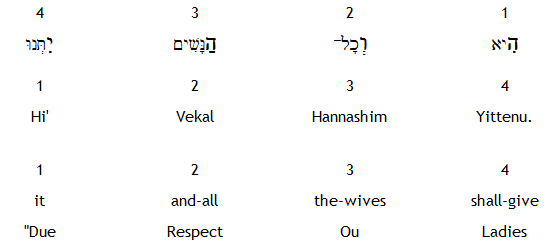
shall give to their husbands, both to great and small.”
THE SECOND ACROSTIC (5:4).
is formed, as before, by the initial letters, for Jehovah is initiating His action; but the name is spelt forward because
He is ruling and causing Esther to act; and take the first step, which was to lead up to so great an end.
The four words are:
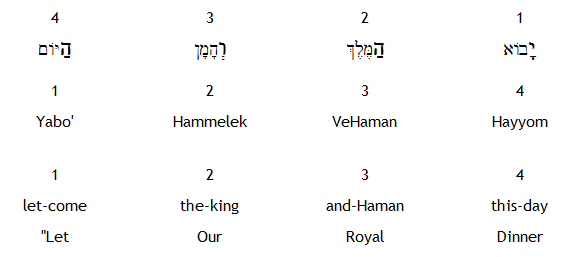
this day be graced by the king and Haman.”
The name of Jehovah is read in the invitation, intimating that there would be a fourth at that banquet.”
THE THIRD ACROSTIC (5:13).
is the beginning of the end; for Haman had gone forth from that banquet “joyful and with a glad heart” (5:9) “that day.”
Yet it was to be his last. Hence the third Acrostic is formed with the final letters, for the end was approaching; and the
name is spelt backward, for Jehovah was overruling Haman’s gladness, and turning back Haman’s counsel.
The four words are:
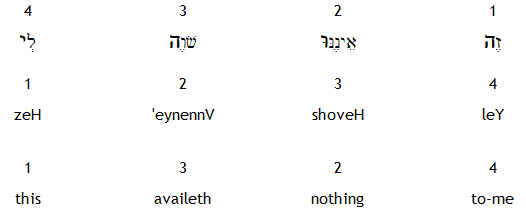
The English may be freely rendered “Yet am I

THE FOURTH ACROSTIC (7:7).
is formed, like the third, by the final letters, for Haman’s end had come. But it is spelt forward like the first, for
Jehovah was ruling and bringing about the end He had determined. Haman saw there was cause for fear. A fourth is
there –Jehovah Himself! And when Esther pleads for her life (7:3), the king asks “Who is he and where is he?” which
brings in Jehovah’s own ineffable name — the Acrostic of the five final letters spelling in Hebrew “I am” (see the fifth
Acrostic below). Esther replies: “The adversary and enemy is this wicked Haman.” The king, filled with wrath, rises, and
goes forth into the palace garden. Haman, filled with fear, rises, “to make request for his life to Esther the queen, for he saw
that evil was determined against him
by the king.”
This was the climax, the end had come. Hence the name is spelt by the final letters:
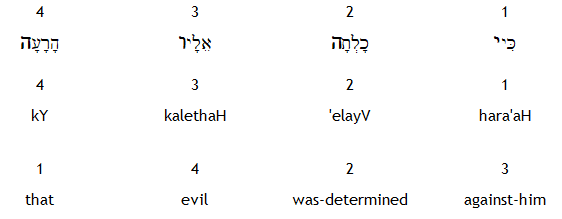
Translated, as before, the Acrostic appears in English thus: “For he saw that there was

against him by the king.”
THE FIFTH ACROSTIC (7:5).
in this book does not form the name “Jehovah,” but the remarkable name E H Y H which means
“I AM.”
It is noted in some manuscripts by Majuscular letters, which have Massoretic authority (see Ap. 30). The Acrostic is
formed by the final letters, and the name is spelt backward. The king asks “Who is he, and where is he, that durst
presume in his heart to do so?”: i.e. to sell for destruction Queen Esther and her People. In saying this he unconsciously
gives the name of Him who came down to deliver His People out of the hand of Pharaoh, and had then come down to
deliver them again out of the hand of Haman, “the Jews’ enemy”, who, like Pharaoh, sought to destroy the whole
nation (cp. Ex 2:23-25 with 3:14, 15). The great enemy of the Messiah — the living Word — was seeking to destroy all
hope of His promised coming (Ge 3:15), and make void the repeated promise of Jehovah.
Ahasuerus only pointed to human agency, but his words point us to the Satanic agency which was behind it. The
Acrostic is in the final letters of his question “Who is he, and where is he?” Only the great “I am that I am” could know
that, and could answer that question. Esther and Mordecai knew the human instrument, but none could know who was
directing him but the One Who sees the end from the beginning. The words forming the Acrostic are
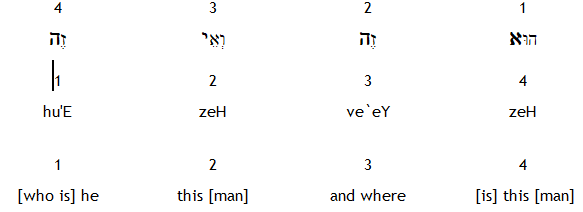
“who durst presume in his heart to do so”: that is to say, to conspire against the life of the Queen and her People.
We may English it thus:

presume in his heart to do this thing?”
Thus was the name of the great “I AM” of Ex 3:14 presented to the eye, to reveal the fact that He who said of E H Y
H “this is My Name for ever, and this is My Memorial unto all generations” (v. 15), was there to remember His People.
Here was a “generation” in Persia who experienced the truth and the power of this Name, as a former “generation” had
done in Egypt.
The same “I AM” had indeed come down to deliver them from Haman; as He had from Pharaoh, and from the great
“enmity” (of Ge 3:15) which instigated both to accomplish the Satanic design of exterminating the Nation of Israel.
In these five Acrostics we have something far beyond a mere coincidence; we have design. When we read the
denunciation in Dt 31:16-18, and see it carried out in Persia, we learn that though God was not among His people
there, He was for them. Though He was not acting as Jehovah, “that dwelleth between the Cherubim,” He was “the God
of Heaven, ruling and over-ruling all in the Heaven above and in the Earth beneath” for the fulfillment of His purposes,
and in the deliverance of His People. Hence, though His name, as well as His presence, is HIDDEN, yet, it is there, in
the Word; and so wonderfully interwoven that no enemy will ever know how to put it out.
(*1) In the note on Est 1:1 this Ahasuerus is identified with Astyages, who is the same as Darius the Mede. See
notes on p. 618, and Ap. 57.
(*2) The Talmud (Kelim 139) says “Where do we get Esther in the Law?” And the answer is “Dt 31:18, ‘and I will
surely hide my face'”. So here, the outward form of the revelation takes on the form of its inward and spiritual
meaning. For the same reason we have the Divine Title “the God of heaven” as characterizing the book
Exra-Nehemiah. See note on 2 Chron 36:23.
(*3) How many more there may be will be ascertained only when all the special scrolls of Esther shall be examined.
(*4) Fo 116 r other examples of Acrostics in the Hebrew text, see Ap. 63. vii.
(*5) In the use of these terms, “backward” and “forward” the English reader must bear in mind that Hebrew is read
from right to left both in the spelling and wording.
Appendix 61
QUOTATIONS FROM THE BOOK OF JOB IN THE OTHER BOOKS OF THE BIBLE
The quotations from, and references to, the book of Job in the other books of the Bible show that it was well known
and read in the days of David and Solomon and the Prophets, and cannot be referred to as late a period as the 7 th-4 th
centuries B.C., as most of the “higher” critics do.
The following table will enable the reader to judge for himself. There are 65 passages referred to: 37 in the Psalms;
18 in Proverbs; 9 in the Prophets; and 1 in the N.T.
JOB. Quoted or referred to in other books.
3:16. Ps 58:8.
3:21. Pr 2:4.
5:3. Ps 37:35,36.
5:13. 1 Co 3:19.
5:14. Isa 59:10.
5:20. Ps 33:19; 37:19. Heb 12:5.
5:21. Ps 31:20.
5:25. Ps 72:16; 112:2.
6:4. Ps 38:2.
7:7. Ps 78:39.
7:10. Ps 103:16.
7:17. Ps 8:4; 144:3.
8:13. Pr 10:28.
8:22. Ps 35:26; 109:29.
9:34. Ps 39:10.
10:3. Ps 138:8.
10:8. Ps 119:73.
10:10,11. Ps 139:14-16.
10:20,21. Ps 39:5,13.
11:17. Ps 37:6.
11:18,19. Isa 17:2. Eze 34:28. Mic 4:4. Zep 3:13.
13:21,28. Ps 39:10,11.
14:1,2. Ps 90:3,5,6.
15:35. Ps 7:14. Isa 59:4.
16:10. Ps 22:13. Mic 5:1.
17:7. Ps 6:7; 31:9.
18:5. Pr 13:9; 24:20.
19:5-9,13. Ps 38:16; 88:8; 89:44.
19:13,14. Ps 88:8,18.
19:26. Ps 17:15.
19:29. Ps 58:10,11.
21:30. Pr 16:4. Zep 1:15-18. 2 Pe 2:9.
23:10. Ps 66:10.
23:11. Ps 44:18.
24:14,15. Ps 10:8,11; 11:4.
24:23. Pr 15:3.
26:8. Pr 30:4.
28:13, &c. Pr 3:13, &c.
28:15. Pr 3:14,15.
28:28. Pr 1:7; 9:10. Ps 111:10.
29:18. Ps 30:6.
30:9. Ps 69:12.
30:16. Ps 42:4.
31:7. Ps 44:18,21.
32:8. Pr 2:6.
32:21. Pr 24:23.
34:11. Pr 24:12.
35:12. Pr 1:28.
36:19. Pr 11:4.
36:26,27,32. Ps 90:2; 147:8.
Appendix 62
THE SEPTUAGINT ENDING OF THE BOOK OF JOB
In the Septuagint translation of the Old Testament into Greek, there is a long subscription. A similar subscription is
found in the Arabic Version. It professes to be taken out of “the Syriac book”; but there is nothing to be found of it in
the Syriac Version as published in Walton’s Polyglot. It was doubtless written B.C. It is interesting, especially when
compared with the notes on p. 666, but what authority there is for it is not stated. The last verse of Job (42:17), “And
Job died, an old man, and full of days,” reads on as follows:
“And it is written that he will rise up again with those whom the Lord raises up.
“This man is described in the Syriac book as dwelling in the land of Ausis, on the borders of Idumea and Arabia; and
his name before was Jobab; and having taken an Arabian wife, he begat a son whose name was Ennon. He himself was
the son of his father Zara, a son of the sons of Esau, and of his mother Bosorrha, so that he was the fifth (*1) from
Abraham. And these were the kings who reigned in Edom, which country he also ruled over. First Balak the son of Beor,
(*2) and the name of his city was Dennaba. After Balak, Jobab, who is called Job: and after him, Asom, who was
governor out of the country of Thaeman; and after him Adad, the son of Barad, that destroyed Madiam in the plain of
Moab; and the name of his city was Gethaim. And the friends that came to him were Eliphaz of the sons of Esau, king
of the Thaemanites, Baldad sovereign of the Sauchaens, Sophar, king of the Minaeans”.
(*1) Fifth. If he was the son of Issachar this corresponds with what is said in the notes on p.666.
(*2) So the Sinaitic MS. The Alexandrian MS. reads “Semphor,” which is probably the same as “Zippor”.
Appendix 63
THE BOOK OF PSALMS. MISCELLANEOUS PHENOMENA
I. THE TITLE OF THE BOOK.
The name given to the Book of Psalms as a whole by the Jews is Tehillim; but it is not recognized by this name in
the Book itself. Our English name “Psalms” is a transliteration of the Greek Title of the Septuagint, “Psalmoi” (*1), which
means “songs”; while the word “Psalter” is from the Greek Psalterion, a harp, or other stringed instrument. There is no
correspondence between the Greek and the Hebrew in these cases. Only once does a Psalm bear this word in its title,
and that is Ps 145 (sing. Tehillah).
Tehillim is invariably rendered “praises”. It is a verbal noun from the root halal, to make a jubilant sound. To make
ellell means to rejoice. Cp. German hallen and English halloo, yell. Tehillim has, therefore, a wide meaning, and
includes all that is worthy of praise or celebration; and, especially the works and ways of Jehovah.
Hence, in this book, we have these Divine works and ways set forth as they relate to the Divine counsels of God (1)
as to Man, (2) as to Israel, (3) as to the Sanctuary, (4) as to the Earth, and (5) as to the Word of Jehovah. See the
Structure of the separate Books of the Psalms, p. 720. In those Structures light is thrown upon the “ways” of God. The
need for this instruction is seen from the meaning of halal, which in the Hithpael and Hithpolel means to praise of boast
of one’s self, hence to be foolish. Cp. 1 Ki 20:11; Job 12:17; Isa 44:25 (mad); Pr 20:14 (*2). This instruction is given
concerning God’s ways and works exhibited in the Word of God from the beginning to the end.
(*1) The word occurs seven times in the N.T. (Lk 20:42; 24:44. Ac 1:20; 13:33. 1 Co 14:26. Eph 5:19. Col 3:16),
four referring to the Book of Psalms, and the last three to Psalms in general.
(*2) As it is foolish to the glory in any object except in Jehovah (Jer 4:2; 9:23,24), so to boast of oneself is to be
foolish in this case (Ps 49:6. Pr 27:1. See Ps 5:5; 73:3; 75:4; and cp. 44:8).
II. THE QUOTATIONS FROM THE PSALMS IN THE NEW TESTAMENT.
(i) THE FORMULAS USED IN DIRECT QUOTATIONS.
“As it is written”; or “It is written”: Mt 4:6 (*1) (91:11). Jn 2:17 (69:9); 6:31 (78:24,25). Ac 13:33 (2:7). Ro 3:4 (51:4).
2 Co 4:13 (116:10). “David”, or “in David” (*2): Mt 21:43 (110:1). Ac 2:25 (16:8), 34 (110:1). Ro 4:6 (32:1,2); 11:9,10
(69:22,23). Heb 4:7 (95:7). “He (God) saith”, “said”, or “spake”: Ac 13:35 (16:10). Eph 4:8 (68:18). Heb 1:10-12
(102:25-27); 4:3 (95:11); 5:5 (2:4); 5:6 (110:4). “He (God) limiteth”: Heb 4:7 (95:7). “He (God) testifieth”: Heb 7:17
(110:4). “In the Scriptures”: Mt 21:42 (118:2,3). “In their law” (*3): Jn 15:25 (35:10; 69:4). “In your law” (*3): Jn 10:34
(82:6). “One in a certain place testified”: Heb 2:6 (8:4; 144:3). “Spoken by (or through) the prophet”: Mt 13:35 (78:2).
“The Book of Psalms”: Ac 1:20 (69:25). “The mouth of David” (*4): Ac 1:16 (41:9); 4:25, 26 (2:1,2). “The scripture”: Jn
7:42 (132:11); 13:18 (41:9); 19:24 (22:18), 28 (69:21), 36 (34:20), 37 (22:16,17). “The second Psalm”: Ac 13:33 (2:7).
(*1) This (with Ps 91:13) was Satan’s quotation, mutilated by significant suppression and omission. (*2) In David.
The Fig. Ellipsis (Ap. 6), i.e. “in [the Psalm] of David”; or “in [the person] of David”. (*3) “Law” is used by Fig.
Metonymy (of the Part) for the whole of the O.T. (*4) David’s “mouth”, but not David’s words.
(ii) THE ADAPTATION OF WORDS OF THE PSALMS, WITHOUT A SPECIFIC QUOTATION, OR REFERENCE TO FULFILLMENT.
2:7 (Heb 1:5).
2:9 (Rv 2:27).
4:4 (Eph 4:26).
6:8 (Mt 7:32).
8:2 (Mt 21:16).
8:6 (1 Co 15:25,27. Eph 1:20,22).
9:8 (Ac 17:31).
19:4 (Ro 10:18).
22:1 (Mt 27:46. Mk 15:34).
22:8 (Mt 27:43). The chief priests.
22:21 (2 Ti 4:17).
24:1 (1 Co 10:26,28).
27:1 (Heb 13:6). See 118:6, below.
34:8 (1 Pe 2:3).
40:6-8 (Heb 10:5-7).
41:9 (Mk 14:18). (*1)
48:2 (Mt 5:35).
50:14 (Heb 13:15).
55:22 (1 Pe 5:7).
56:4,11 (Heb 13:6).
69:9 (Jn 2:17).
69:21,27 (Mt 27:34,38. Mk 15:36).
74:2 (Ac 20:28).
78:24,25 (Jn 6:31).
79:6 (2 Th 1:8).
89:27,37 (Rv 1:5; 3:14).
91:13 (Lk 10:19).
102:25-27 (Heb 1:10-12).
106:20 (Ro 1:23).
110:1 (Mk 16:19. 1 Co 15:25,27. Col 3:1. Eph 1:20,22).
110:4 (Heb 5:10).
116:10 (2 Co 4:13).
116:11 (Ro 3:4).
118:6 (Heb 13:6). See 27:1, above.
118:22 (Ac 4:11. Mt 21:42. 1 Pe 2:4,7).
118:26 (Mt 21:9).
125:5 (Gal 6:16).
143:2 (Gal 2:16).
146:6 (Ac 14:15).
(*1) John (13:18; 19:28, 29) uses the formula “that it might be fulfilled” because of the object of his Gospel
(20:31).
III. QUOTATIONS AS BEING THE DIRECT FULFILLMENT OF PROPHECIES IN THE PSALMS.
22:18 (Jn 19:23,24).
34:20 (Jn 19:36).
35:19 (Jn 15:25).
41:9 (Jn 13:18. Ac 1:16).
69:4 (Jn 15:25).
78:2 (Mt 13:35).
97:7 (Heb 1:6).
109:3 (Jn 15:25).
119:161 (Jn 15:25).
IV. QUOTATIONS AS BEING THE DIRECT UTTERANCES OF THE FATHER, THE SON, AND THE HOLY SPIRIT,
RESPECTIVELY.
THE FATHER.
2:7 (Heb 1:5,6. Ac 13:33).
45:6,7 (Heb 1:8,9).
89:26,27 (Heb 1:5).
97:7 (Heb 1:6).
102:25-27 (Heb 1:10-12).
104:4 (Heb 1:7).
110:1 (Heb 1:13).
THE SON.
18:2 (Heb 2:13).
22:1 (Mt 27:46. Mk 15:34).
22:22,25 (Heb 2:12).
40:6-8 (Heb 10:5-7,8,9).
45:6 (Heb 1:8).
THE HOLY SPIRIT.
41:9 (Ac 1:16).
95:7-11 (Heb 3:7-11).
V. DIVINE TITLES APPLIED DIRECTLY TO CHRIST IN THE NEW TESTAMENT.
9:8 (Ac 17:31).
45:6 (Heb 1:8).
34:8 (1 Pe 2:3).
62:12 (Mt 16:27).
74:2 (1 Pe 1:19).
96:13 (Ac 17:31).
97:7 (Heb 1:6).
98:9 (Ac 17:31).
102:25-27 (Heb 1:10
104:4 (Heb 1:7).
VI. THE BEATITUDES IN THE PSALMS.
The word rendered “blessed” in the “Beatitudes” is not always “barak,” to bless; but ‘ashrey, happinesses. Its first
occurrence is Dt 33:29. It is the plural of majesty or accumulation, and means “O the happinesses”, or, “O the great
happiness”, or “O How happy”.
‘Ashrey occurs twenty-six times in the book of Psalms. It is translated “blessed” nineteen times, and “happy” seven
times. In the list below, these latter are marked with an asterisk (*).
The following is the complete list: Ps 1:1; 2:12; 32:1,2; 33:12; 34:8; 40:4; 41:1; 65:4; 84:4,5,12; 89:15; 94:12; 106:3;
112:1; 119:1,2; 127:5*; 128:1,2*; 127:8*, 9*; 144:15*, 15*; 146:5*.
The word is distributed in the five books of the Psalms as follows: Book I, eight times; Book II, once; Book III, four
times; Book IV, twice; Book V, eleven times; making twenty-six in all.
VII. THE ACROSTIC PSALMS.
There are nine examples of Acrostics in the Book of Psalms, while eleven other Acrostic Scriptures are found in the
Old Testament (*1).
i. Ps 9 and 10 are linked together by an Acrostic which, like “the times of trouble” (the great tribulation), of which
the two Psalms treat, is purposely broken, and is irregular and out of joint. This Acrostic tells us that the subject of the
two Psalms is one, and that they are to be connected together. See notes there on the many expressions common to
both.
ii. Ps 25. Here, again, the Acrostic is designedly incomplete, a proof of its genuineness instead of its “corruption”. No
writer would or could omit a letter from carelessness. The Psalm has the same phenomena as Ps 34, where the same
letter w (Vau = V) is omitted, and the same letter p (Pe = P) is duplicated, in the word Padah, “redeem:. The last verse
is thus, in each case, made to stand out prominently by itself.
iii. Ps 34. See under ii, above.
iv. Ps 37. In this Psalm the series is perfect and complete. Every letter has two verses of two lines each, except
three: vv. 7 (d, Daleth = D), 20 (k, Kaph = K), and 34 (q, Koph = K).
v. Ps 111. In this Psalm the series is complete. The Psalm has twenty-two lines, each line commencing with the
successive letters of the alphabet.
vi. Ps 112 is formed on the model of Ps 111, the two Psalms forming a pair (*2); Ps 111 being occupied with Jehovah,
and Ps 112 with the man that revereth Jehovah. See the notes there.
vii. Ps 119. This Psalm consists of twenty-two groups, consisting of eight verses each. The eight verses in each
group begin with the same letter. For example: the first eight verses begin with a (Aleph = A, the eight verses of the
second group with b (Beth = B), and so through the whole Psalm of 176 verses (8 x 22. See Ap. 10).
It is impossible to reproduce this (or any of the other alphabetical Acrostics), seeing that the Hebrew and English
alphabets do not correspond, either in equivalents, order, or number of the letters. It so happens that in the group
beginning with T (vv. 65-72), each verse in the A.V. does begin with T, except vv. 67 and 71. These can be readily
conformed by changing “Before” to “Till” in v. 67; and “It is” to “Tis” in v. 71.
The first two letters being the same in both alphabets can be thus presented:
Ah! the happinesses of the perfect in the way,
Such as walk by the Law of Jehovah.
Ah! the happinesses of the keepers of His testimonies,
Who seek Him with their whole heart.
Assuredly they have not worked iniquity:
In His ways they have ever walked.
As to Thy commandments — Thou hast commanded us,
That we should diligently keep them.
Ah Lord, that my ways were prepared
To keep Thy statutes;
Ashamed, then, should I never be,
While I have respect unto all Thy commandments.
All my heart shall praise Thee in uprightness,
While I learn the judgments of Thy righteousness.
All Thy statutes also I will keep:
Leave me not utterly.
By what means shall a young man cleanse his way?
By taking heed thereto according to Thy word.
By every means my heart hath sought Thee:
Let me not err from Thy commandments.
Besides, I have laid up Thy Word in my heart,
That I might not sin against Thee.
Blessed are Thou, O Jehovah:
Teach me Thy statutes.
By my lips have I recounted
All the judgments of Thy mouth.
By walking in Thy mandates’ way,
I found joy beyond all wealth.
By Thy precepts shall I guide my musings,
And shall pore over Thy paths.
By Thy statutes shall I be delighted:
Thy Word I shall not forget.
viii. Ps 145. In this Psalm the Acrostic is perfect, with the exception of the letter n (Nun = N), which should come
between vv. 13 and 14. See note there. Through the infirmity of some transcriber, the verse was probably omitted by
him. It must have been in the more ancient manuscripts, because it is preserved in the ancient Versions: viz. the Sept.,
Syr., Arabic, Ethiopic, and Vulgate. One Heb. Codex is know with contains it, as follows :
“The LORD is faithful in all His words,
And holy in all His works.”
Moreover, the Structure of the Psalm shows that it originally had its proper place in the Psalm. See the notes on Ps
145:13 Ps 145:14.
ix. For the other Acrostic in the Psalms, see the note on Ps 96:11.
(*1) There are five in the Book of Esther, each giving the Divine names in the form of an Acrostic. (See Ap. 60.)
One other Divine name in Ps 96:11. See note there. One perfect Acrostic in Pr 31:10-31. See note there.
In the Book of Lamentations, each of the first four chapters is characterized by an Acrostic. See notes there. (*2)
With the further peculiarity that the first three verses in each Psalm consist of two portions: the last two, of three
portions.
VIII. THE AUTHORS NAMED IN THE PSALMS.
1. The Psalms bearing the name of “DAVID” are seventy-three in all: thirty-seven in Book I (3, 4, 5, 6, 7, 8, 9,
11, 12, 13, 14, 15, 16, 17, 18, 19, 20, 21, 22, 23, 24, 25, 26, 27, 28, 29, 30, 31, 32, 34, 35, 36, 37, 38, 39,
40, 41); eighteen Psalms in Book II (51, 52, 53, 54, 55, 56, 57, 58, 59, 60, 61, 62, 63, 64, 65, 68, 69, 70);
one in Book III (Ps 86); two in Book IV (101 and 103); and fifteen in Book V (108, 109, 110, 122, 124, 131,
133, 138, 139, 140, 141, 142, 143, 144, 145).
2. By “Asaph”, twelve Psalms: one being in Book II (Ps 50), and eleven in Book III (73, 74, 75, 76, 77, 78, 79,
80, 81, 82, 83).
3. By “the sons of Korah”, eleven Psalms: seven being in Book II (42, 44, 45, 46, 47, 48, 49); and four in Book
III (84, 85, 87, 88), as set out in The Companion Bible. In Ps 46 and 88 it is repeated as the sub-scription of
Ps 45 and 87, and is not the super-scription of 46 and 88 as in all the Versions.
4. For, or of “Solomon”, two Psalms: one in Book II (Ps 72), and one in Book V (Ps 127).
5. “By Heman the Ezrahite”, one in Book III (Ps 88).
6. By “Ethan the Ezrahite”, one in Book III (Ps 89).
7. By “Moses the man of God”, one in Book IV (Ps 90).
IX. THE DISPENSATIONAL CHARACTER OF THE PSALMS.
In reading the Book of Psalms, we must constantly bear in mind the character of the Dispensation to which they
belong. The word “Dispensation” means “administration”: and God’s principles of administration varied according as man
was in a Dispensation of innocence, or mankind was “without Law”, or Israel was “under Law”, or as we are under grace
in this present Dispensation.
God’s principles of administration have varied with each of these: and in the future they will vary yet more: in the
coming Dispensation of judgment, and in the Dispensation of millennial glory by which it will be followed. If we read
what pertains to one Dispensation into another which is administered on different lines, we shall have only confusion.
Unless they be rightly divided, we shall not find “the truth” (2 Ti 2:15).
Much of what we read in the Psalms is truth for all time: but, some things are peculiar to that Dispensation of Law,
and are neither suitable nor appropriate for the present Dispensation of grace. That is why many readers stumble when
they judge “the imprecatory Psalms” from the standpoint of grace. Those Psalms were appropriate for the past
Dispensation of works, as they will be for the coming Dispensation of judgment; but they are not appropriate for the
present Dispensation, in which God’s administration is on the principles of grace (according to Mt 5:44-48). It was true,
in the former Dispensation of Law, that “when the wicked man turneth away from his wickedness, and doeth that
which is lawful and right, he shall save his soul alive” (Eze 18:27). But that is not the way of salvation now. The
Scriptures for this present Dispensation are written and contained in the Pauline Epistles (fulfilling the promise of the
Lord in Jn 16:13(; and these declare with one voice that we are not saved by works, but by grave (Ro 3:23,24; 11:6.
Eph 2:3-9. Tit 3:5-8).
Even so with the “imprecatory Psalms”, and similar expressions in other Psalms: they were true and appropriate for
that Dispensation, but are equally inappropriate for this.
X. THE DISTRIBUTION OF THE DIVINE TITLES IN THE FIVE BOOKS.
It may conduce to the completeness of the study of the usage of the Divine Titles, in relation to the Dispensational
character of the five Books of the Psalms, if we give a connected list. They are given under the Structure of each
Book separately. A comparison of these numbers will show that they correspond with the subject of each Book as
exhibited in the Structure prefixed to each Book. When “God” is used, the thought is of the Creator and His creatures.
When “Jehovah” is used, it speaks of a Covenant God, in covenant relation with His own People.
i. THE GENESIS BOOK. (Ps 1-41), p. 720.
Jehovah occurs 279 times, Elohim only forty-eight (nine of them connected with Jehovah).
ii. THE EXODUS BOOK. (Ps 42-72), p. 720. Jehovah occurs only thirty-seven times, Elohim occurs 262 times (twice in
connection with Jehovah). El occurs fourteen times, and Jah once.
iii. THE LEVITICUS BOOK. (Ps 73-89), p. 720. In the First Selection (A1) Jehovah occurs only fifteen times, while
Elohim occurs sixty-five times (twice with Jehovah). In the Second Selection (A2) Jehovah occurs fifty times, while
Elohim occurs only 28 times (four of which are connected with Jehovah). El occurs five times.
iv. THE NUMBERS BOOK. (Ps 90-106), p. 720. Jehovah occurs 126 times, and Elohim only thirty-one times (in ten of
which it is combined with Jehovah). El occurs six times.
v. THE DEUTERONOMY BOOK. (Ps 107-150), p. 720. Jehovah occurs 293 times, while Elohim occurs only forty-one
times (in four of which it is combined with Jehovah). Jah occurs thirteen times. El occurs ten times. Eloah twice.
XI. THE PRAYER BOOK VERSION OF THE PSALMS.
The Authorized Version of the Bible of 1611 was preceded by several other Versions made into the English tongue.
1. The earliest was that by John Wycliffe, about A.D. 1380. This existed only in MS. until 1831, when the
N.T. was printed for the first time, followed by the O.T. in 1848. The complete Bible was not published
till 1850.
2. Tyndale’s Version. The N.T. was published in 1525, and the Pentateuch in 1530.
3. Coverdale’s Version followed in 1535, and was the first complete printed English Bible.
4. Matthew’s Bible (largely based on Tyndale) was published under this assumed name in 1537 by John Rogers.
5. The Great Bible followed in 1539. It was Coverdale’s Version revised by himself, and was in large folio,
which gave it its name. In 1540 Cranmer wrote a preface; and hence this and subsequent editions (*1)
became known as “Cranmer’s Bible”. It was from this Version that the Psalms and other portions of Scripture
were taken, and used in the Prayer Book, from the edition of 1552 to the last revision in 1662.
When the A.V. was published in 1611, it was “authorized (or appointed) to be read in churches” (hence its name),
instead of the Versions which had preceded it, and which were thenceforth superseded. Extracts from it, such as the
opening sentences, and the Epistles and Gospels, were at the same time substituted for those previously in use (*2).
But it was found that, from the use of the Psalms in Public Worship, people had become so accustomed to the older
Version (many being able to sing or say them from memory), that when the last revision of the Prayer Book was made
in 1662 the Psalter was retained, it being deemed unwise to make a change which would be so revolutionary.
This is why the Prayer Book Version differs from the Bible Version. This is also the reason why a change in “the
names and order” of the Books of the Bible to the order of the Hebrew Canon is likewise now impossible. The
translators of the Septuagint arbitrarily adopted a different order, and gave the books different names. This was
followed by the Vulgate and all subsequent Versions (*1). No change in these respects would now be tolerated.
In comparing the two Versions, regard must be had:
1. To the NUMBERS OF THE VERSES, as these are not the same in each, and differ sometimes in the
numeration. For example, Ps 19:14 in A.V. is 19:14, 15 in the Prayer Book Version; and Ps 18:1,2 in A.V. is
18:1 in the Prayer Book Version. The reference to the Psalms in The Companion Bible and its Appendixes
is always to the A.V., not to the Prayer Book Version.
2. As to OBSOLETE WORDS in the Prayer Book Version, the following is a list of the more important, which
will show the extent of the changes made in 1611:
Abjects, worthless persons, 35:15. after (prep), according to, 90:15. apace, swiftly, 58:6. at large, loose, without
restraint, 118:5. brawn, muscle, boar’s flesh, 119:70. cast their heads, consult, conspire, 83:5. certify, to make certain,
39:5 (v. 4 in A.V.); to show knowledge, 19:2. comfortable, consoling, 54:6. conversation, mode of life, 50:23. darling,
favorite, A.S. dear-ling, 22:20; 35:17. discovereth, strippeth of leaves, 29:8 (v. 9 in A.V.). dragons, serpents, 74:14 (v.
13 in A.V.). due, appointed, 9:9. ensue, pursue, 34:14. eschew, avoid, shun, 34:14. fain, glad, 71:21 (v. 23 in A.V.).
fie, Lat. phy, an expression of disgust, 35:21; 40:18. flittings, wanderings, 56:8. froward, perverse, 18:26; 58:3; 64:2.
glory, tongue (which gives glory), 16:10. graven, dig, digged, 7:16. ground, bottom, 68:26. harnessed, armed, root =
made of iron, 78:10. health, salvation, 51:14; 67:2; 119:123. hell, grave, 49:14, 15. hold of, hold to, 31:7. holpen,
helped, 22:5; 86:17. horn, head, 75:5, 6, 12; 89:18. inditing, dictating, 45:1. inquisition, search, inquiry, 9:12.
knappeth, snappeth, 46:9. laud (Lat.), praise, 135:1. lay to, apply, 119:126. learn, teach, 25:4, 8; 119:66. leasing,
falsehood, 4:2; 5:6. lien, lain, 68:13. lighten, enlighten, 13:3; 34:5. make thou all his bed, nurse, 41:3. minished,
lessened, 12:1; 107:39. mistake, take wrongly, 56:5. nethermost, lowest, 86:13. noisome, noxious, 91:3. ordereth,
arrangeth, 40:6. pate, crown of the head, 7:17. pit, grave, 6:5; 9:15; 69:16. poor, oppressed, 34:6; 69:30. ports,
gates, 9:14. potsherd, broken pottery, 22:15. prevent, precede, anticipate, 18:18; 21:3; 119:148, &c. quick, living,
alive, 55:16. quicken, make alive, 119:25, &c. refrain, restrain, 76:12. reins, kidneys, 7:10, &c. require, ask, 27:4;
38:16. room, place, 18:36; 31:9. runagates, rebels, 68:6. set by, esteem highly, 15:4. set in, put in the way of, 38:17.
shawms, wind instruments, 98:7. simple, undesigning, artless, 72:4, 13. simpleness, artlessness, guilelessness, 69:5. still,
silent, 62:1. stomach, pride, 101:7. stool, seat, 94:20. strange, foreign, 18:45; 114:1. tell, count, 22:17; 56:8.
thereafter, according, 90:11. thievish, given to theft, 10:8. treadings, footsteps, 73:2. tush, an expression of
impatience, like pish, or tut, 10:6, &c. unto, in comparison with, 16:2. vengeance, vindication or avengement, 79:11.
water-pipes, cataracts or torrents, 42:9. weights (upon the), scales; i.e. when weighed, 62:9. whet, sharpen, 7:13.
wholesome, saving, 20:6; 28:9. within, within doors, 45:14. wont, accustomed, 119:156. worship, worthy of honor,
3:3.
(*1) The other Versions published between this and the A.V. were The Geneva Bible in 1557-60; and Archbishop
Parker’s in 1568, known as the Bishops’ Bible; the Rhemish N.T. in 1582; and the Douai Bible in 1610, both the
latter being of Roman Catholic origin.
(*2) Except the “comfortable words” in the Communion Service, which appear to be original translations and not
wholly from any preceding Version, and have never been changed.
Appendix 64
“TO THE CHIEF MUSICIAN.”
The key to the interpretation of these words has been lost for over twenty-two centuries. Commentators and critics
have confessed that they can make only conjectures as to the primitive meaning and use of the word (for it is only one
word in Hebrew) lamenazzeah. The Ancient Versions attempt a rendering. The Sept. has eis to telos = unto, for, or,
with a view to the end. The Arabic, Ethiopic, and Vulgate render it “at the end”. The Chald. renders it (Ps 45) “to the
praise”. The Talmudists hold that it related to Him Who is to come; while Aquila (one of the Sept. Revisers, A.D. 130)
renders it “to Nikopoio” = to the giver of victory.
It is clear that a Person was intended by these various renderings; but they appear to be interpretations rather than
translations. Regarded as the former, they may be useful in showing us how the Psalms point to Christ; for He is the
end. It is He Who giveth victory; it is He Who is the Coming One: and, while the book is called Sepher Tehillim, the
Book of Praises, it is He Who “inhabiteth the praises of Israel” (Ps 22:3).
All ancient Hebrew manuscripts, with the early and best later printed editions, show no break whatever between the
lines of one Psalm and another. The Septuagint translators had been many years in Babylon, and the oldest among them
must have been very young when carried away thither. There was none who had full knowledge and experience of the
ancient usages of the Temple worship. Consequently, when they came to their task some 197 years after the latest
carrying away to Babylon, there was nothing to show them where one Psalm ended and where the next began.
Hence, when they came to the word lamenazzeah, “To the chief Musician”, they took it as being the first line of a
Psalm, instead of the last line of the preceding Psalm which they had just translated. All subsequent Versions, in all
languages, have followed them in this mistake. For mistake it was, as we may see from the only two examples of
independent Psalms given us in the Scriptures: viz. Isa 38:9-20, and Hab 3. In each of these isolated Psalms we have
the true models on which all the other Psalms are based.
In each case we have
1. The Super-scription, or Title proper.
2. The body of the Psalm itself.
3. The Sub-scription.
In each of these two cases the word lamenazzeah forms the sub-scription, and appears at the end of the Psalm. This
is the key thus discovered by Dr. J.W. Thirtle (*1) which had been lost for so many centuries; and The Companion
Bible is the first edition of the bible in which the Psalms are thus correctly presented in harmony with the two
Psalm-models, Isa 38:9-20, and Hab 3. The unspeakable importance of Dr. Thritle’s discovery is at once seen. For it
shows two things:
1. That, whatever the interpretation or application of the words may be, a Psalm which had this word in the
sub-scription had a use beyond its local, temporary, or original purpose; and, being considered appropriate
to the Director of the Temple worship with any instructions which might be necessary for its use.
2. That such word or words of instruction, which to-day stand in the Septuagint and all subsequent Versions
of the Bible as the super-scription, belong, not to that Psalm, but to the sub-scription of the Psalm
preceding it.
This, at one stroke, removes the great difficulty, and solves the heretofore insoluble problem and impossible task
which all Commentators have experienced, when they struggled in the attempt to find in one Psalm the explanation of
words which belong to another. Few problems so difficult and baffling have been removed by a solution so simple and
self-explanatory. This on feature, which by Dr. Thirtle’s kind permission, has been taken over into The Companion
Bible, must greatly enhance its value and usefulness, making it unique among all existing editions of the Bible.
(*1) These facts have been discovered, and admirably set forth by Dr. J.W. Thritle, in his two words on this
subject, viz. The Titles of the Psalms: their Nature and Meaning explained (1904), and Old Testament Problems
(1907). Both published by Henery Frowde, Oxford Bible Warehouse, London.
Appendix 65
THE PSALM-TITLES, AND WORDS EMPLOYED IN THEM.
From what is written in the preceding Appendix (64), it will be seen that, though the words “Psalm-Titles” are used
here in this Appendix in their ordinary traditional sense, our understanding of them must be seriously modified; all the
words used in them, and explained below, occur in the sub-scription of the preceding Psalm, and belong to that Psalm.
It is there we have placed them in The Companion Bible, and it is in those Psalms that we have to look for their
elucidation and find the key to the meaning of the words. (*1)
Commentators who revered the Word of God have struggled to find some logical, spiritual, or mystical meaning in
these “titles”; while modern critics do not seem able to rise beyond musical instruments and terminology, or
“catch-words” of popular songs or tunes.
The Teaching, which is deep and grand beyond all conception, they fritter down to some commonplace reference;
while the Text, which is clear, they mystify with their puerile guesses and vain imaginations. We look for something
more worthy of this work of the Holy Spirit of God; something more worthy indeed of the Bible, regarding it merely as
a literary production. We look for something more dignified than a “tom-tom” or a “catch-word”, and we shall find it.
The words used in these sub-scriptions (which no commentator of any repute regards as other than integral parts of
Holy Writ, being numbered, and forming as they do the first verse of each Psalm in the Hebrew text, and actually
quoted as Scripture in the N.T.) refer to momentous truths, and not to musical terms; to teaching, and not to tunes; to
instruction, and not to instruments; to sense, and not to sound. They are for those who have a heart for music, and not
merely an ear for music; they are for the Enochs who walk with God, and not for the Tubal-Cains who handle the harp
and the organ. They pertain to the things of the Spirit, and not to “things made with hands”.
We shall present these words and expressions in the spelling, and in the order in which the Bible reader will look for
them in this Appendix, viz. in alphabetical order. We may first note here that thirty-four Psalms have no title at all,
and are without super-scription or sub-scription: viz. Ps 1; 2; 10; 33; 43; 71; 91; 93; 94; 95; 96; 97; 99; 104; 105; 106;
107; 111; 112; 113; 114; 115; 116; 117; 118; 119; 135; 136; 137; 146; 147; 148; 149; 150.
The words in the super-scriptions and sub-scriptions are as follows, and are given in the spelling of the A.V. to which
English readers are accustomed.
I. AIJELETH-SHAHAR (The Day-Dawn).
This title, which in the versions has stood in the super-scription of Ps 22, now finds its proper place and stands (in
The Companion Bible) as the sub-scription to Ps 21. The meaning given both in A.V. and R.V. is “the hind of the
morning”. The Jewish commentators, Rashi (A.D. 1040-1145, Troyes) and Kimchi (A.D. 1160-1232, Narbonne) render it
“a hind fair as the morning”. Luther rendered it “the hind early chased”. The Targum has it “the morning sacrifice”. The
moment we regard it in the light of Ps 21 instead of Ps 22, a new field of inquiry presents itself.
The expression is a Figure of speech common in the East, and frequently met with in Arabian poetry. It is used of
the Day-Dawn, in which the beams of light from the rising sun are seen shooting up (like horns) above the horizon
before the sun actually appears. It is used in Ps 21 of the rays of Messiah’s coming glory, and tells of the dawn of His
approaching coronation which is the one great subject of Ps 21. See the Structure and notes.
It is the same DAY-DAWN that forms the theme of David’s “last words”. See the notes on 2 Sam 23:1-5 and Ps 72,
with the Structures and notes there; and compare 2 Pe 1:19.
II. AL ALAMOTH (relating to maidens).
There is no dispute or question as to the meaning of these words: ‘Al = relating to, or concerning, or connected with.
‘Al has a wide range of meaning, and we may select the one which lends itself best to the context. As to ‘Alamoth (fem.
pl.), there is a consensus of opinion that it can mean only damsels or maidens. ‘Almah occurs (in sing. and pl.) seven
times in the Heb. O.T., and is rendered “virgin” in Ge 24:43. SS 1:3; 6:8. Isa 7:14; “maid” in Ex 2:8. Pr 30:19; and
“damsel” in Ps 68:25. The proper word for virgin is bethulah (Ge 24:16, &c.), while ‘almah denotes a young woman of
marriageable age, still under the care of others. Every bethulah is an ‘almah, but not every ‘almah is, necessarily a
bethulah. (*2) In the plural, therefore, ‘alamoth can mean only maidens. There is no need to think about music, or to
restrict the use of the word here to “a maidens’ choir”, standing, as it now must stand, as the sub-scription to Ps 45, and
not as the super-scription of Ps 46. There is no connection between “maidens” and Ps 46, but there are many points in
the subject-matter of Ps 45 which link it on to that Psalm. There are references to the “king’s daughter”, and “honorable
women” (v. 9). It is a “daughter” that is addressed as the bride (v. 10). There is the “daughter of Tyre” (v. 12); “the
king’s daughter” (v. 13); and “the virgins her companions” (v. 14).
There are special reasons, therefore, in the subject-matter of Ps 45, which connect it with that Psalm; and make it
very appropriate that, even if the Psalms were intended to be sung by maidens, such singing need not be connected
with the Temple or its services. There was processional singing in the open air. And in 1 Ch 15 we have just the occasion
for the use of the word in this connection. In the procession in which the Ark was carried up from the house of
Obededom to Zion three bodies of singers are mentioned:
1. the Levites (vv. 16-19),
2. the maidens (v. 20); and
3. the Sheminith or men-singers (see No. XIX, p. 95) who brought up the rear of the procession (v. 21).
This is the very order which is mentioned in Ps 68:
1. the singers going before (1 Ch 15:16-19);
2. the players on instruments following after (v. 22); in the midst, “the damsels (the ‘Alamoth) playing with
timbrels” (v. 20).
Ps 68 begins with the words of Nu 10:35, which prescribes the formula for the setting forth of the Ark. The “goings”
of Ps 68:24 refer to the great going up of the Ark to Zion. The company of those who published the word of Jehovah
(v. 11) is fem. plural, and the reference is not to Ex 15:20 or 1 Sa 18:6, but to 1 Ch 15:20. From all this it is clear that
this Psalm (68) must be carried back to as early a date as 951-950 B.C., instead of being assigned to the later dates of
537 B.C. or 167 B.C. as demanded by modern criticism.
III. AL-TASCHITH = Destroy not.
There are four Psalms which have this sub-scription, viz. 56, 57, 58, and 74 (not
Ps 57; 58; 59, and 75, which in all the versions have is as the superscription). The first three are David’s, the fourth
is by Asaph. Two by David (56 and 57) are each connected with crisis in his life, while the third belongs to a peculiar
time of trouble. There is no dispute as to the meaning of the word.
It is rendered by A.V. and R.V. as “Destroy not”. It is a cry of distress, a cry at a crisis. But this cry is found, in the
Psalms to which we have placed it, as a subscription, and not in the others where it has formerly stood as a
super-scription.
Such a cry had been made by Moses at a great crisis (Ex 32:11-14, cp. Dt 9:25), and by David (2 Sa 24:16,17) where
we have the same Heb. word (shahath). David acted on the injunction of Dt 4:30,31; the reason being “for Jehovah
thy God is a MERCIFUL God, He will not forsake thee, neither DESTROY thee”. This is why Ps 56 and 57 begin “Be
merciful”.
For further references to this sub-scription compare Ps 56:1,9,10,11; 57:1-3,6,7; 58:3,6,7,11, and
74:1-3,10,11,18-20,22,23. Ps 74 is prophetic of the latter days (spoken of in Dt 4:30) when “Destroy not” will be an
appeal suited to “the day of Jacob’s trouble”.
David was a prophet (Ac 2:30), and spake of things yet future; why should not some Psalms speak prophetically and
proleptically of Zion before it was built, and of the Exile before it took place, instead of being styled “post-Exilic” by
the modern critics?
IV. GITTITH = Winepresses (relating to the Autumn Feast of Tabernacles).
There are three Psalms which have this word in the sub-scription. They are 7, 80, and 83 (not 8, 81, and 84, over
which they have hitherto stood as the superscription).
There is no doubt about Gittith meaning winepresses; from Gath (Jdg 6:11. Ne 13:15. Isa 63:2. Lam 1:15), not the
“vat” which receives the juice from the “press” (which is yekeb, Nu 18:27,30. Dt 15:14, &c.). The word speaks of the
autumn, just as Shoshannim, No. XX below (lilies), speaks of the spring. Hence Shoshannim (flowers) is associated with
the Spring Festival (the Passover), as Gittoth (fruit) is associated with the Autumn Festival (Tabernacles). The Passover
told of Jehovah’s goodness in Divine redemption; the Feast of Tabernacles told of Jehovah’s goodness in Divine
keeping. A study of the three Gittith Psalms (7, 80, and 83) in this connection will yield instruction and profit, and
remove all the perplexity involved in associating the word with the subject-matter of Ps 8; 81, and 84, with which it
has no connection.
There will be no longer need to be troubled with such guesses as “Gittite instruments”, or “Gittite guards”, or “Levites
of Gath-rimmon”, which are as meaningless as they are irrelevant. See further under Shoshannim (No. XX, below).
V. HIGGAION.
As this word occurs in the Text, see Ap. 66. I (p. 96).
VI. JEDUTHUN.
JEDUTHUN was one of the three directors (or the “chief Musicians”) or the Temple worship (1 Ch 16:41,42; 25:1-6; 2 Ch
5:12; 35:15). The three sons of Aaron were thus represented by the three men whose names occur in this category.
JEDUTHUN was a descendant of MERARI (1 Ch 26:10); while ASAPH was a descendant of GERSHOM; and HEMAN of
KOHATH.
JEDUTHUN seems to have had another name, “ETHAN” (1 Ch 15:17,19, compared with 16:41, 42; 25:1, 3, 6, and 2 Ch
35:15). That there was an “Ethan”, a Merarite, is seen from 1 Ch 6:44; 15:17. Since he is associated with those two men,
it is going out of one’s way to create a difficulty by supposing Jeduthun to be “a musical instrument”, or the “name of a
tune” (R.V. marg) or of a “measure”. In 2 Ch 35:15 he is called “the king’s seer”; and in 1 Ch 25:1 it was the duty of these
three men “to prophesy” and “to confess, and to praise Jehovah” (v. 3). This was according to the king’s order (v. 6).
There are three Psalms connected with JEDUTHUN (38, 61, and 76), and they will be found to fulfill these
conditions. By comparing these Psalms as set out in The Companion Bible, the confusion, caused by two of these Psalms
appearing to have the names of two different authors, vanishes. The sub-scription of each Psalm now stands “To the
chief Musician — Jeduthun.”
VII. JONATH-ELEM-RECHOKIM = The Dove in the distant Terebinths.
There is only one Psalm with this sub-scription, i.e. Ps 55 (not Ps 56, over which it hitherto stood in other Bibles and
Versions as the super-scription or title). There is general agreement that this Title means “Relating to the dove in the
distant terebinths (or oaks)”. David is the “dove”. He is far away in the distant woods, moaning over the trouble that
has come upon him through the rebellion of Absalom, recorded in 2 Sa 15-19.
There is no reference to a dove in Ps 56, but there is in Ps 55:6. In v. 2 he says, “I mourn in my complaint, and moan”
(R.V.). In Isa 38:14, Hezekiah, in trouble equally great, says, “I did moan as a dove” (the same word as in Ps 55:17 (R.V.).
Cp. Eze 7:16, where we have it again). David speaks further concerning this moaning in Ps 55:4-8; also in vv. 16, 17.
The desertion of Ahithophel at this crisis is alluded to in vv. 12-14. All Psalms of, or “relating to David”, refer to the true
David; so we may compare David’s desertion with Christ’s betrayal, and the end of Ahithophel (2 Sa 17:23) with the
end of Judas Iscariot (Mt 27:5-8. Ac 1:18,19).
VIII. LEANNOTH.
See No. x, below.
IX. MAHALATH (The great Dancing).
This word stands in The Companion Bible as the sub-scription of Ps 52, and not in the super-scription or title of Ps
53, as in all other Bibles and Versions.
The Septuagint translators could make nothing of the words (there being no vowel points); so they simply
transliterated the word, spelling it maeleth, which has no meaning whatever. AQUILA, a reviser of the Sept. (about
A.D. 160), supplied different vowels, and read the Hebrew as though it meant choreia, dancing. He must have take the
Hebrew Mecholoth to mean dancing (or, by the plural of majesty, the great dancing). SYMMACHUS, another reviser of
the Sept. (about A.D. 193-211), follows AQUILA.
This rendering, which takes the Hebrew as being Mecholoth (instead of Mahalath), at once connects Ps 52 with 1 Sa
18:6,7, the occasion being celebrated and known afterwards, as “the great dancing”. Twice, later in David’s life, this
event is referred to as a landmark in David’s history (1 Sa 21:11; 29:5). If we read Ps 52, we shall note the references to
Doeg’s mischievous tongue (in vv. 1-4); to David’s assertion (1 Sa 17:37) in v. 5; to David’s words, “all this assembly shall
know” (1 Sa 17:47); in vv. 6, 7 “the righteous also shall see and fear”. The victory is ascribed to God in v. 9, as it is in 1
Sam.
When we read these remarkable references, we shall not heed the modern critics’ talk about “catchwords of an
older song”, or the “name of a tune called ‘Sickness'”, or “the name of a choir at Abel-meholah”.
X. MAHALATH LEANNOTH (The great Dancing and Shouting).
These words are found as the sub-scription to Ps 87 in The Companion Bible (not as the super-scription or title to Ps
88 over which it stands in all other Bibles and Versions). As Mecholoth means dancing (see No. IX above), so all are
agreed that Leannoth means shoutings (and, with the pl. or majesty, the great shouting). (Cp. Ex 15:20,21; 32:17,18.
Nu 21:17. 1 Sa 18:6,7. Ezr 3:11). So that the combined words “The Great Shouting and Dancing” give us the
subject-matter of Ps 87.
We have only to read the Psalm in the light of 1 Sa 6:14,15 to see the obvious connection with David’s bringing the
Ark to Zion. In v. 2 there is a distinct allusion to the other places where the Ark had found a temporary dwelling, Shiloh
(1 Sa 1:3; 2:14; 3:21. Ps 78:60); Beth-shemesh (1 Sa 6:13); Kirjath-jearim (1 Sa 7:1); Gibeah (2 Sa 6:3,4); the house of
Obed-edom (vv. 10-12). But none of these was the dwelling-place Jehovah had chosen. Hence, Zion is celebrated as
“the Mount Zion which He loved”.
XI. MASCHIL. Understanding or Instruction. (Public.)
This word is found in the super-scription proper of thirteen Psalms (32, 42, 44, 45, 52, 53, 54, 55, 74, 78, 88, 89,
142). Unlike the “Michtam” Psalms (which are all by David, see No. XII below), these are by various authors.
· Six are by David (32, 52, 53, 54, 55, and 142).
· Three are by the sons of Korah (42, 44, and 45).
· Two are by Asaph (74 and 78).
· One is by Heman the Ezrahite (88).
· One is by Ethan the Ezrahite (89).
Maschil is from sakal, to look at, scrutinize, to look well into anything (1 Sa 18:30); hence the noun will mean
understanding arising from deep consideration (Pr 13:15. Ne 8:8). The Sept. rendering is suneseos = understanding and
eis sunesin = for understanding. It is the O.E. verb to skill.
The first of these Psalms (32) gives the basis of all true instruction and understanding. In v. 8 it is given:
“I will instruct thee And teach thee in the way thou shouldest go … Be not as the horse, or as the mule, which have
no understanding”.
Or Ps 44:1,
“We have heard”, &c.; or 45:10, “Hearken, O daughter, and incline thine ear”, &c.
The idea “to play skillfully” seems trivial in comparison with such “instruction” as this.
XII. MICHTAM (Engraven).
This word is found (in all Versions of the Bible) in the super-scription of six Psalms (16, 56, 57, 58, 59, 60). All are by
David. The last five form a group by themselves. See the Structure of “the Exodus Book” (or the Second Book) of the
Psalms (p. 759), where, in Group F1-F5, God’s People speak to Him as Israel’s Redeemer; and His work as telling of His
death and resurrection.
The word Michtam is from Katam, to cut in, or engrave, as in Jer 2:22, “thine iniquity is graven before me” (not
“marked”, as in A.V. and R.V.). The Sept. renders it stelographia = a sculptured writing. Hence, stele = a sepulchral
monument, on account of the inscription graven on it. The word, therefore, points to a graven and therefore a
permanent writing; graven on account of its importance (cp. Job 19:24). What that importance is can be gathered only
from the Michtam Psalms themselves.
The A.V. and R.V. derive the word from Kethem gold, either from its being precious, or hidden away. This meaning
is not far out; but it lacks the raison d’etre for this importance, which the other derivation gives in connecting with
death and resurrection.
The Michtam Psalms are all pervaded by the common characteristic of being Personal, Direct, and more or less
Private. This reference is to David’s Son and David’s Lord; and especially to His death and resurrection; or to a
deliverance from imminent danger, or death; or even from the grave itself. See Ps 16:10,11; 56:13; 57:3; 58:10,11;
59:16; 60:5,12. It is David who “being a prophet” (Ac 2:25-31), knew that God “would raise up Messiah to sit on his
throne”. Hence this is the truth engraven in the first of these Michtam Psalms (16).
XIII. MUTH-LABBEN (The Death of the Champion).
This, in The Companion Bible, stands now as the sub-scription of Ps 8, and not as the super-scription or title of Ps 9,
as in other Bibles and Versions. All are agreed that muth can mean only death. As to the other word labben, the matter
is not so simple. For ben means son, but there is nothing about a “son” in either Psalm (8 or 9): and, as it must relate
(like the other Titles) to subject-matter, and not to the name of a “song”, or a “tune”, or a “musical instrument”, there
must be another explanation of ben. Now ben may be beyn, written what is called “defective”, i.e. without the full sign
for its vowel (which is very often found in Hebrew).
In that case it would mean the separator, and thus be related to bayin = “between” which is the dual form of this
word in the designation of Goliath in 1 Sa 17:4,23, “the man between [the two hosts” of Israel and the Philistines], or
“the duellist”. Hence, labben (“for the son”) may be read labbeyn, “for the duellist” or “the champion”, or “the one
standing between”. Indeed, this is exactly how the words are given in the ancient Jewish commentary called the
Targum: “To praise; relating to the death of the man who went between the camps”. That is to say, the champion, as
he is called in 1 Sa 17:4,23. (*3)
Read in this light, Ps 8 stands out with quite a new signification, seeing it relates to “the death of the champion”,
Goliath of Gath. We may compare with this Ps 144, which in the Sept. version has this remarkable title, “by David,
concerning Goliath”: in v. 3 or which Psalm we have the very words of Ps 8:4. And in v. 10 the words, “Who
delivereth David His servant from the hateful sword”: i.e. of Goliath.
XIV. NEGINAH.
See “Neginoth”, No. XV below, of which it is the singular.
XV. NEGINOTH (Smitings).
This word, in The Companion Bible, stands in the sub-scriptions of eight Psalms, i.e. 3, 5, 53, 54, 60 (sing.), 66, 75,
and Hab 3. (Not in the super-scriptions of Ps 4; 6; 54; 55; 61 (sing. with ‘al instead of Beth), 67, and 76). “Neginoth” is
from nagan, to strike, or smite. Hence it has hitherto been associated with the striking of the strings of some musical
instrument! But why should the striking be connected with strings? Is there no other kind of smiting known? Why may it
not refer to the stroke of affliction, or the smiting with words? Indeed, it is so associated in Lam 3:63: “I am he whom
they smite [with their words]”.
In all these Neginoth Psalms there is the note of deliverance from personal smitings. See 3:2; 5:6; 53:1; 54:3; 60:3,
5, 11; 66:10-12; 75:4, 5. We have the verb again in 77:7, “I call to remembrance my song”, or my stroke of affliction. So
in Isa 38:20, “We will sing, or make songs”, or, we will make songs concerning my stroke, or afflictions. In Hab 3:19 we
may, in the same way, understand it as “relating to my smitings”, i.e. those referred to in v. 16.
XVI. NEHILOTH (Inheritances, or The Great Inheritance).
This word is found in The Companion Bible in the sub-scription to Ps 4 (not in the super-scription of Ps 5 as in other
Bibles and Versions). The word is Nehiloth, which has been taken from halal, to bore; but, even then, human
imagination does not seem able to rise higher than the boring of holes to make a flute!
The Sept. has “concerning her that inherits”. AQUILA in his revision (A.D. 160) has “Division of Inheritances”.
SYMMACHUS (A.D. 193-211) has “Allotments”; while the Latin Versions have similar renderings. This shows that they must
have had before them the consonants N, H, L, TH, with the vowel-points NehaLoTH which gives the intelligible
meaning, inheritances, or the great inheritance. In Ps 4 this reference is quite clear. Jehovah was the inheritance of
His People (Ps 16:5; cp. 73:26; 119:57; 142:5. Jer 10:16. Lam 3:24). Hence, in Ps 4:6, the question is asked, “Who will
show us [what] good [is]”? And the answer which follows is “Thou”. For, joy in Jehovah is greater than joy in harvest.
The same truth is seen in Ps 144. See notes on vv. 11-15-, with the true answer in v. -15.
XVII. PSALM (Heb. Mizmor).
This word is used in the super-scriptions forty-four times in all (Ps 3; 4; 5; 6; 8; 9; 12; 13; 15. 19. 20. 21, 22, 23, 24,
29, 31, 38, 39, 40, 41, 47, 49, 50, 51, 62, 63, 64, 73, 77, 79, 80, 82, 84, 85, 98, 100, 101, 109, 110, 139, 140, 141, 143. Of
these, twenty-one are in Book I, seven in Book II, seven in Book III, three in Book IV, and six in Book V.
Mizmor means, and is invariably rendered, “a Psalm”, and occurs nowhere but in the Psalm-Titles. It differs from Shir
(see below), which is “a Song”: i.e. for singing, whereas Mizmor may be for meditation, &c. Mizmor is joined with Shir
in thirteen Psalms (30, 65, 67, 68, 75, 76, 87, 92, preceding it; and 48, 66, 83, 88, 108, following it).
XVIII. SELAH.
See Ap. 66. II.
XIX. SHEMINITH. (The Eighth Division.)
This word occurs in the sub-scription of two Psalms (5 and 11 in The Companion Bible); not in the super-scription of
Ps 6 and 12, as in other Bibles and Versions. There is a general agreement that it means “the eighth”, and in its thirty-one
occurrences it is always so rendered, except in 1 Ch 15:21 and in these two sub-scriptions (Ps 5 and 11), where it is
transliterated “Sheminith”. The A.V. puts “the eighth” in the margin in all three cases. The R.V. puts “the eighth” only in
the case of the two Psalms.
Though it is agreed that the word means “eighth”, it is not agreed as to what “the eighth” refers to. It varies between
“the eighth mode”, “the eighth (or octave) below” (i.e. the bass), “the eighth day”, or year, or “an instrument with
eight strings”. The latter is out of the question, because, in 1 Ch 15:21, those with harps are set “over the Sheminith” (as
others are set “over the ‘Alamoth”), and we cannot speak of certain “instruments” being “set” over others. Moreover, the
Sheminith are additional to Neginoth in the sub-scription to Ps 5. 1 Ch 15:21 helps us to the solution. The ‘Alamoth being
maidens (v. 20), it would seem obvious that the Sheminith must be men (v. 21). But what class of men? The Talmud (*4)
suggests a class of true Israelites, i.e. those circumcised on the eighth day, and thus distinguished from all other Jews
or Gentiles; for other nations who practice circumcision always do so on a later day (*5), never on the eighth day.
As all others in the procession were, in this sense, Sheminith, and the Sheminith are distinguished from these as well
as the ‘Alamoth, Dr. Thirtle concludes that it must refer, as well, to a division in that procession. Everything points to
divisional order in such processions (cp. Ex 25:14. Nu 4:15; 7:9. So also in 1 Ch 24:1; 26:1,12). The definite article seems
conclusive. In 1 Ch 15:21 the Sheminith were to lead (R.V.), not “to excel” (as in A.V.). This is its general meaning (see
1 Ch 23:4. 2 Ch 34:12. Ezr 3:8,9), where it is rendered “set forward”.
An examination of Ps 5 and 11 show us that there is special emphasis on “righteous worshippers” as distinct from
others. Cp. 5:7, 11 with 11:1 and 7, and see the Structures of those Psalms.
XX. SHIGGAION (A crying aloud).
This word occurs only in the super-scription of Ps 7, and in the super-scription of the prayer in Hab 3:1, where it is
in its right place. The scope of the Psalm guides Dr. Thirtle to the choice of sha’ag, to cry aloud, in trouble, danger, or
pain, and to discard shagah, which means to wander, or go astray. There is nothing in the Psalm to agree with the
latter, and everything that points to the loud cry of David when he was in danger of being torn in pieces, and to the
loud cries (pl.) or Habakkuk: of pain in v. 16 and of praise in v. 18.
XXI. SHOSHANNIM (Lilies, or, The Spring Festival, Passover).
This word is found in the sub-scription of two Pss., i.e. 44 and 68, not in the super-scription of Ps 45 and 69, as it
stands in other Bibles and Versions. We have already seen under “GITTITH” (No. IV above) that, as the spring and autumn
were appropriately represented by flowers and fruit respectively, so lilies and winepresses were singled out from each.
The Passover and Feast of Tabernacles divided the year into two fairly equal parts; the former being the spring
festival and the latter the autumn. Israel is symbolized again and again by the vine (*6), and Dr. Thirtle refers us to 2
Esdr 5:23-28 (R.V.) for the use of the lily. It is the prayer of Esdras:
“O Lord That bearest rule of all the woods of the earth, and of all the trees thereof, Thou hast chosen Thy ONE
VINE; and of all the lands of the world Thou hast chosen the ONE COUNTRY; and of all the flowers of the world, ONE
LILY …; and among all its peoples Thou hast gotten the ONE PEOPLE …: now, O Lord, why hast Thou give this ONE
PEOPLE over unto many”, &c.
Lilies and pomegranates (spring flowers and autumn fruits) were everywhere seen in the Temple (1 Ki 7:20-22), and
the knops (or knobs) of flowers of Ex 25:31-34 were doubtless the same globe-like pomegranates and lilies. The Sept.
has “globes” and lilies. Cp. Ex 28:33,34; 39:25,26, where the “bell”-like flower is doubtless meant.
In the Jewish Prayer Book, at the Feast of Purim, Israel is spoken of as “the lily of Jacob”; and at the Feast of
Dedication (Chanucha) God is praised for delivering “the standard of the lilies” (i.e. of Israel). The Hebrew shekel had,
on one side, sometimes a lamb (Passover), and, on the other side, a wine-bowl (Tabernacles). The half-shekel had a
triple lily and a wine-bowl:

(SILVER SHEKEL OF SIMON MACCABAEUS.)
In old Jewish cemeteries, tombs are seen with the seven-branched candlestick with its knops and flowers, and
sometimes with the triple lily and pomegranate.
Interpreters who are guided by tradition see in these lilies only “poppy heads”, betokening eternal sleep! and “a
round fruit” or husk from which the kernel (or spirit) has fled! Thus Babylonian and Egyptian heathenism is forced to
interpret and replace Divine Biblical symbols. But we may as in this case: “Does not the lily say, ‘Here lies one of
Jehovah’s redeemed’? and the pomegranate, ‘Here lies one safe in Jehovah’s keeping'”?
Read, now, the two Shoshnnim Psalms (44 and 68), and the Passover story will be seen in all its fulness and beauty.
XXII. SHUSHAN, AND SHOSHANNIM EDUTH. (Instruction as to the Spring Festival, or the Second Passover.)
This title is found in the sub-scription of Ps 79 in The Companion Bible (not the super-scription of Ps 80, as in other
Bibles and Versions), while SHUSHAN (sing.) EDUTH is found in the sub-scription of Ps 59 in The Companion Bible (not
the super-scription of Ps 60, as in other Bibles and Versions).
The first of these two words refers to the Spring Festival (see under No. XXI above), the latter refers to some
testimony concerning it. There is no dispute as to the ‘Eduth meaning “testimony”. It is one of “the ten words” found
twenty-three times in Ps 119 (see Ap. 73). But what is the “testimony” to which these two Psalms refer? It must be
concerning something connected with the Spring Festival (Passover), and Dr. Thirtle sees in it the Law and the
“Testimony” respecting the keeping of the Passover in the second month, when, under special circumstances, it could
not be kept in the first month (see Nu 9:10,11, and cp. 2 Ch 30:1-3). Ps 59 and 79 treat of enemies being then in the
land, which might well have created a difficulty in keeping the Passover in the first month.
In any case, this interpretation is more reasonable, and more worthy of the dignity of the Sacred Text than the
unsupported guesses as to its being the name of “a popular song”, or “the name of a tune”, or a choir whose President
lived at Shushan.
XXIII. SONG.
Is always the rendering of Shir, and denotes words that are to be sung, as distinct from Mizmor (see No. XVII above).
It is joined with Mizmor thirteen times (see above). It is used by itself fifteen times (in the Songs of the degrees); and
in Ps 18 (shirah), 45 (with Maschil), and 46.
(*1) These facts have been discovered, and admirably set forth by Dr. J.W. Thirtle, in his two works on this
subject, viz. The Titles of the Psalms: their Nature and Meaning explained (1904), and Old Testament Problems
(1907). Both published by Henry Frowde, Oxford Bible Warehouse, London.
(*2) The Greek word parthenos, in Mt 1:23, shows that the ‘almah or Isa 7:14 must have been a virgin. The
Septuagint also renders ‘almah by parthenos in Isa 7:14. (*3) The word “champion” in verse 51 is not the same
word, but is gibbor. See Ap. 14. IV.
(*4) Yebamoth 43 b, cp. 53 b. Yebamoth is the first of seven treatises in the third book (Nashim) which treats of
the distinctive rights of men and women. (*5) Josephus, Ant. i. 12. (*6) Ps 80:8. Isa 5:1-7; 27:2-6. Jer 2:21;
12:10. Hos 10:1, &c.
Appendix 66
HEBREW WORDS IN THE TEXT OF THE PSALMS
Certain Hebrew words are retained in the body of the text of the Psalms, being transliterated instead of translated.
Not forming any part of the title, superscription or sub-scription, they are considered here in a separate Appendix.
They are two in number, i.e. HIGGAION and SELAH, and we preserve the spelling of the A.V. for the sake of
convenience.
I. HIGGAION = SOLILOQUY.
The word is found in three Psalms: viz. 9:16; 19:14, and 92:3.
· In 9:16 it is transliterated “Higgaion”.
· In 19:14 it is translated “meditation”; and
· In 92:3 it is rendered “solemn sound”.
The word occurs also in Lam 3:62, where it is rendered in the A.V. “device”, and in the R.V. “imagination”. It is
derived from hagah, and means to soliloquize, to speak to one’s self; hence, to meditate (Jos 1:8. So Ps 77:12 and
143:5). As a noun, it would mean a meditation, or a speaking in premeditated words; and therefore worthy of memory
or repetition. If the three Psalms be read in the light of this word, we shall note the subjects which are so worthy of
our meditation, and not think about music.
· In Ps 9:16 it is the judgment of Jehovah.
· In Ps 19:14 it is the words and the work of Jehovah.
· In Ps 92:2,3 it is the lovingkindness and faithfulness of Jehovah.
II. SELAH.
This word may be from one of two roots; from salah = to pause; or from salal = to lift up. There is no need to
descend to the guesses as to musical terms. A reference to Ap. 65 (p. 92, Int. Col 1) will lead us o connect it with
subject-matter, not with music; and with truth, not with tunes. Some say it occurs always at the beginning of a strophe;
others, always at the end. But this is a question of fact, and not of argument. The outstanding fact is that in four cases
it comes in the middle of a verse, i.e. Ps 55:19; 57:3; and Hab 3:3,9.
This is fatal to both theories, but yet it helps us to, and agrees with, the right conclusion, that both are the two
halves of one truth. Selah does connect the end of one strophe with the beginning of the next; and, indeed, in four
cases it connects the end of one Psalm with the beginning of the next, thus uniting the two Psalms (see Ps 3 with 4; 9
with 10; 24 with 25, and 46 with 47). Selah, therefore, neither ends nor begins a passage, but it CONNECTS the two
passages between which it is placed.
An examination of each occurrence will show what this connection is. It is neither the pausing on one subject; nor
the passing on from one subject to another: but it is the connecting of the two subjects together.
· Sometimes it is the Structures which are connected.
· Sometimes it is synthetic, and adds a development of thought by connecting a prayer with that which
forms the basis of it.
· Sometimes it is antithetic, and adds a contrast.
· Or it connects a cause with an effect, or an effect with a cause.
It is a thought-link, which bids us look back at what has been said, and mark its connection with what is to follow; or
to some additional consequent teaching. Thus, if it be derived from salah, to pause, it is not the instruments of music
which are to pause while the voices continue to sing; but it is our hearts which are to pause and to note the
connection of precious truths.
If it be derived from salal, to lift up, then, it is not the instruments which are to lift up their sound in a louder
degree, but our hearts which are to be lifted up to consider more solemnly the two truths which are about to be
connected. These connections, showing the importance and object of each “Selah”, are given in the notes on each
occurrence of the word. The phenomena connected with “Selah” may be thus stated:
· The word occurs seventy-four times in the Bible, and all are in the Old Testament.
· Of these, seventy-one are in the Book of Psalms, and three are in the model Psalm, “the prayer of
Habakkuk”, ch. 3.
· ? The use of the word is confined to thirty-nine Psalms our of the 150. In
· sixteen of these thirty-nine it occurs once (7, 20, 21, 44, 47, 48, 50, 54, 60, 61, 75, 81, 82, 83, 85, and
143): of these thirty-nine Psalms, thirty-one are in Psalms handed over to “the chief Musician”. (See Ap.
64.)
· In fifteen Psalms it occurs twice (4, 9, 24, 39, 49, 52, 55, 57, 59, 62, 67, 76, 84, 87, and 88).
· In seven Psalms it occurs thrice (3, 32, 46, 66, 68, 77, and 140).
· In one Psalm it occurs four times, viz. Ps 89.
· It is distributed over the five Books of the Psalms (see p. 720) as follows:
Book I (1-41), seventeen times in nine Psalms.
Book II (42-72), thirty times in seventeen Psalms.
Book III (73-89), twenty times in eleven Psalms.
Book IV (90-150), four times in two Psalms.
Appendix 67
THE SONGS OF THE DEGREES.
There is no difference of opinion as to the meaning of the word “degrees”. It means “steps”, but interpretations of the
use of the word in this connection manifest a great difference and discordance. Some think these Psalms were so
called because they were sung on the fifteen steps of the Temple. But there is no evidence that there were fifteen
steps. In Ezekiel’s Temple (Eze 40:22,31) there are to be two flights; one of seven steps in the outer court, and another
of eight steps in the inner court. But that Temple is the subject of prophecy, and is still future.
Others suggest “a Song of the higher choir”, “on the stairs of some high place”; others, “in a higher key”. Others
interpret them of “the going up of the Ark” to Zion; others, of “the going up of the tribes” to the feasts; others, “a Song
of high degree”. Others refer them to “a synthetic arrangement of the parallel lines”; others, that they refer to “the
going up from Babylon”, which makes them all “post-exilic”. Others regard them as referring to the yet future return of
Israel from their long dispersion; while yet others spiritualize all the expressions, and interpret them of the experiences
of the Church of God at all times, and in the present day.
One thing is clear, i.e. that all these interpretations cannot be correct. So we still look for one which shall be
worthy of the dignity of the Word of God as “written for our learning”; and one which shall produce and combine
intellectual enjoyment with experimental satisfaction. Dr. Thirtle (*1) has called attention to the use of the definite
article. The Hebrew reads “A Song of THE Degrees” (Shir hamma’aloth). In this simple fact lies the key to the solution of
the problem, which is as simple in its nature as it is grand in its results.
Once we note the use of the definite article, “THE Degrees”, we naturally ask what Degrees? The answer comes from
the Word of God itself, and not from the guesses and imaginations of men. The only “degrees” of which we read in the
Bible are “the degrees” on the sundial of Ahaz, by which the shadow of the sun went backward in the days of his son
Hezekiah, as a sign from Jehovah that he should recover from his sickness, while Jerusalem was surrounded by the
armies of the king of Assyria, and Hezekiah was under sentence of death from the King of Terrors (see 2 Ki 20:8-11, and
the Structure of the chapters in Isa 36-39). Scripture knows of no other steps or “degrees” that can be connected with
the shadow of the sun.
On recovery from his sickness, Hezekiah said (Isa 38:20):
“Jehovah was ready to save me:
Therefore we will sing MY SONGS (*2) to the stringed instruments
All the days of our life
In the house of Jehovah.” (*3)
More than 250 years ago (1602-75) this interpretation was suggested in a passing remark by Dr. John Lightfoot in his
work on Old Testament Chronology: but so far as Dr. Thirtle is concerned, it was his own independent discovery. The
number of these Psalms (fifteen) adds to its testimony to the certainty of this interpretation. It corresponds with the
number of the years (fifteen), which were added to Hezekiah’s life: while the number written by himself (ten)
corresponds with the number of “the degrees” by which “the shadow of the sun went backward”.
Hezekiah called them “MY songs”. There was no need to put his own name to them, but he put the names to the
other five. The one by Solomon is in the center, with two by David on either side. In each of the seven Psalms (on
either side of the central Psalm) the name “Jehovah” occurs twenty-four times, and “Jah” twice (once in the third Psalm
of each seven). In the central Psalm, “Jehovah” occurs three times.
There are five groups consisting of three Psalms each. The first of each group has Distress for its subject; the second
has Trust in Jehovah; while the third has Blessing and peace in Zion. In the notes on these Psalms, the passages in the
Kings, Chronicles, and Isaiah, to which they refer, are carefully supplied: the passages in the historical books also are
referred to in these Psalms. Here we give, in order, the facts of Hezekiah’s history which are referred to in these
Psalms. These fifteen points of contact can be used in connection both with the Psalms and the historical books.
We have noted fifteen events in the life of Hezekiah which find their counterpart, and are celebrated, in these
fifteen Psalms. Space forbids our giving here more that the bare references. Further details will be found in the notes in
the historical books, the prophet Isaiah, and the Psalms in question.
(i) RAB-SHAKEH’S BLASPHEMOUS TONGUE,
Which is mentioned in Isa 37:4, and 2 Ki 19:16, is referred to in Ps 120:2,3, and 123:3, 4.
(ii) SENNACHERIB’S REPROACHES,
Which we find in 2 Ki 19:25,26, and Isa 37:26,27, are repeated and practically quoted in Ps 129:5-7.
(iii) SENNACHERIB’S SHAME,
In 2 Ch 32:21. This is referred to in Ps 129:4,5.
(iv) HEZEKIAH’S EARNEST PRAYER.
Isa 38:3,10-20. 2 Ch 32:20, and 2 Ki 19:2,4,15-19; 20:2,3, finds more than its echo in Ps 120:1; 123:1-3; 130:1,2.
(v) GOD, “THE MAKER OF HEAVEN AND EARTH”,
Was He to Whom Hezekiah addressed his prayer. This was in retort to idolatrous railings of Rab-shakeh in 2 Ch 32:19.
See notes on Ps 121:1 Ps 121:2 Ps 121:6 Ps 123:1 (cp. 2 Ki 19:15. Isa 37:16); 124:8; 134:3.
(vi) HEZEKIAH’S DESIRE FOR PEACE
Is seen in Isa 38:17; and in Ps 120:6,7 we see the expression of it; for in 2 Ch 32:1-3 Sennacherib’s “face was for war”:
hence, when Hezekiah says “I am for peace”, who can doubt the reference to 2 Ki 18:19, &c. and Isa 36:5, &c. See
further Ps 122:6,7; 125:5, and 128:6, and his own last desire for peace in 2 Ki 20:19.
(vii) JEHOVAH’S PROMISED HELP.
In 2 Ki 19:32-34; 20:6, we have Jehovah’s own answer to Sennacherib’s challenge (2 Ch 32:10,15,17. Isa 36:20; 37:11).
Notice how Hezekiah treasured up this Divine pledge: Ps 121:2-8; 124:1-3,6; 125:2; 126:2,3; 127:1.
(viii) “FOR MY SERVANT DAVID’S SAKE”.
This was the ground of Jehovah’s promise (2 Ki 19:34) in answer to Hezekiah’s prayer in v. 14. See also 2 Ki 20:5,6.
Observe how these words are taken up in 132:1-10.
(ix) JEHOVAH’S SIGN TO HEZEKIAH.
In 2 Ki 19:29, and Isa 37:30 this sign is given; and we see it referred to in Ps 126:5,6; 128:2. The continued
perseverance of the sowers under great disappointment gives a picture of peaceful agriculturists at work at home, and
not of exiles in a foreign land, or on their way home from Babylon.
(x) HEZEKIAH’S TRUST IN JEHOVAH.
This is the first thing recorded of Hezekiah (2 Ki 18:5). It was the taunt of Rab-shakeh (2 Ki 18:28-31), and is
mentioned again and again (Isa 36:18; 37:10). Now compare Ps 121:2; 125:1-3; 127:1; 130:5-8.
(xi) HEZEKIAH LIKE A BIRD IN A CAGE.
This is not mentioned in Scripture; but Sennacherib has written it down for us, and it may be read to-day in the
British Museum in London, on a hexagonal cylinder of this very Sennacherib, King of Assyria (607-583 B.C.). (*4)
By the kind permission of the Oxford University Press, we are privileged to give a reproduction of a photograph of
this cylinder. It is “one of the finest and most perfect objects of its class and kind ever discovered, and its importance
as an historical document can hardly be overrated. It contains four hundred and eighty-seven lines of closely written by
legible cuneiform text, inscribed in the Eponymy of Belimuranni, prefect of Karkemish”.
The text records eight expeditions of Sennacherib. Among them is his description of this very siege of Jerusalem in
the reign of Hezekiah. By the same kind permission we are enabled to give a photographic facsimile of that portion of
the cylinder, beginning with the eleventh line of the central column, which is shown in the illustration below.
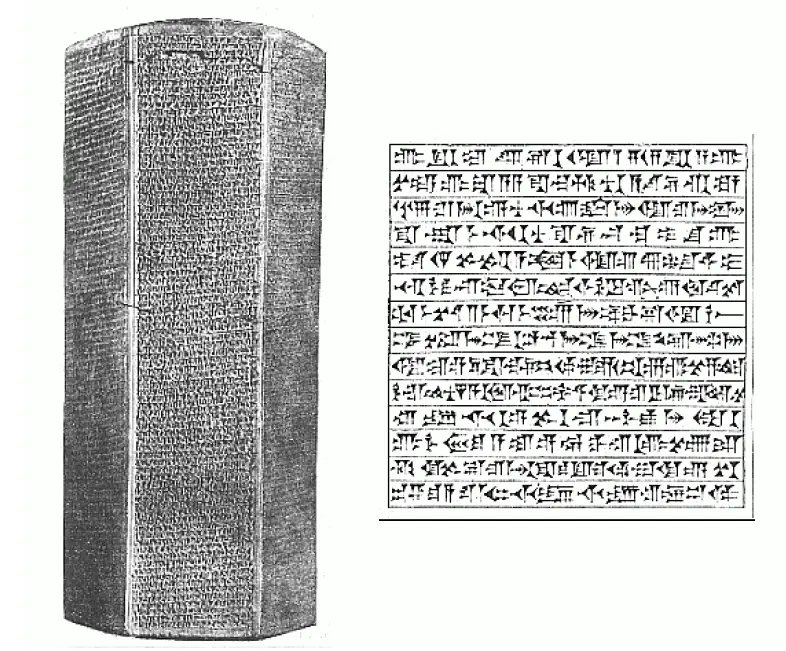
The words we wish to refer to are in the eleventh to the twenty-first lines. Sennacherib says:
1. “I fixed upon him. And of Hezekiah [king of the]
2. Jews, who had not submitted to my yoke,
3. forty-six of his fenced cities, and the strongholds, and the smaller cities
4. which were round about them and which were without number,
5. by the battering of rams, and the attack of engines
6. and by the assaults of foot soldiers, and ….. (*5)
7. I besieged, I captured, 200,150 people, small and great, male and female,
8. horses, and mules, and asses, and camels, and men,
9. and sheep innumerable from their midst I brought out, and
10. I reckoned [them] as spoil. [Hezekiah] himself like a caged bird within Jerusalem,
11. his royal city, I shut in, &c.
Now read the words of Hezekiah in Ps 124:7:
“Our soul is escaped as a bird out of the snare of the fowlers:
The snare is broken, and we are delivered”.
This takes the Psalm right back to the very days of Hezekiah and Sennacherib. Indeed, it takes us back beyond the
days of Hezekiah and Sennacherib: for it is a Psalm of David. Some 360 years before Hezekiah (964-603 B.C.), David
had found himself in similar trouble. He was hunted like a partridge in the mountains, pursued as a dog, and sought as a
flea, by Saul. He had been shut up in his hiding places (*6). At such a similar time of Hezekiah’s need, when he was shut
up in his house by sickness, and besieged in Jerusalem by Sennacherib, he was indeed “like a caged bird”. What Psalm
could more suitably express the sense of his need, and his praise for Divine deliverance?
He had no need himself to write another “Song”. Here was one ready to his hand. Indeed, David’s reference to his
escape “as a bird out of the snare of the fowlers” would be seized on by Hezekiah as exactly suited to express his
deliverance from the “snare”, as well as from the siege of Sennacherib. It makes the history live again before our eyes.
We can see the vain boasting of his enemies; and hear his own praise, as he exclaims:
“Blessed be Jehovah, Who hath not given us as prey to their teeth” (Ps 124:6).
(xii) THE CAPTIVITY OF ZION.
The foregoing statement of Sennacherib (see xi, p. 98), that he had taken away 200,150 captives from all the tribes
of Israel, enables us to understand Hezekiah’s prayer “for the remnant that are left”. There is no need to forcibly
introduce the captivity in Babylon. The “turning of captivity” was an idiomatic expression (by the Fig. Paronomasia
(*7), Ap. 6), used to emphasize the return of good fortune: not necessarily deliverance from a literal captivity of
bondage. Jehovah “turned the captivity of Job” (Job 42:10) by delivering him out of his troubles and giving him twice
as much as he had before. Ps 126:1-3 refers to the deliverance of Hezekiah and Zion, as well as to the captives
mentioned on the cylinder of Sennacherib (see p. 98).
(xiii) HEZEKIAH’S ZEAL FOR “THE HOUSE OF JEHOVAH”.
This was one of the most prominent features of Hezekiah’s character. It occupied his thoughts and filled his heart.
The first act of his reign was to “open the doors of the house of Jehovah” (2 Ch 29:3) which Ahaz his father had “shut
up” (2 Ch 28:24). This was “in the first year of his reign, in the first month”. See also Isa 37:1,14. 2 Ki 20:8. Isa 38:20,22.
Now read Ps 122:1,9 and 134:1, 2.
(xiv) HEZEKIAH CHILDLESS.
While the king of Assyria was besieging the gates of Zion, and the King of Terrors was besieging Hezekiah who was
on his bed of sickness, Hezekiah at that moment had no heir to his throne; and the promise of Jehovah to David (2 Sa
7:12) seemed about to fail. Like Abraham when he had “no seed” (Ge 15), Hezekiah must have been anxious at such a
crisis.
He trusted in Jehovah for victory over his enemies; and he trusted in Jehovah for His faithfulness as to His promise
to David. This is shown in Ps 132:11. In this crisis Jehovah sent Isaiah to Hezekiah with the promise of a son (2 Ki 20:18.
Isa 39:7). Not until three of the fifteen added years had passed was the promise fulfilled, in the birth of Manasseh. This
it is which accounts for Hezekiah’s anxiety.
There is nothing in the return from Babylon that can have any connection whatever with Ps 127 and 128. Rejoicing in
the multiplication of children in those sad days would be quite out of place. But in the case of Hezekiah, they stand out
in all their full significance, and furnish an undesigned coincidence of the greatest importance. Read 127:3-5, and the
whole of Ps 128, the last verse of which reflects Hezekiah’s words (Isa 39:8).
(xv) THE PASSOVER FOR “ALL ISRAEL”.
The proper time for keeping the Passover was already past, but rather than wait eleven months, Hezekiah resolved
to keep it in the second month, according to the provision made for such as occasion in Nu 9:1-11 (2 Ch 30:1-3).
Moreover, Hezekiah would have it for “all Israel” (2 Ch 30:5,6). So the tribes from the North came down and untied
with the tribes of the South (2 Ch 30:11,18). The hand of God was with them to give them “ONE HEART” (2 Ch 30:12).
Then we read in 2 Ch 30:25,26 of the happiness of it all.
Ps 133 celebrates this great event of Hezekiah’s reign; but it is a Psalm of David. Yes, but it celebrates another
occasion precisely similar, when David’s message “bowed the heart of all the men of Judah, even as the heart of ONE
MAN” (2 Sa 19:14; cp. v. 9). It was exactly suited, therefore, to Hezekiah’s circumstances. Hezekiah’s purpose was to
unite the tribes of the Northern Kingdom with the tribes of the South. Hermon’s dew was one with the dew on Zion.
The same cloud of the night mist united Israel and Judah; and we are invited to “Behold how good and pleasant it was
for brethren to dwell together AT ONE”.
These fifteen points put these “Songs of THE degrees” back into their historic setting, more than 600 years before
Christ; and rescues them from the hands of those who would bring them down to about 150 B.C. and force them to
have some connection with times and events for which no historical basis whatever can be found.
(*1) Old Testament Problems. London: Henry Frowde, 1907.
(*2) In the Psalms the word is shir (see Ap. 65. xxiii), while in Isa 38:20 it is neginah (see Ap. 65. xiv). But the
latter word, by the Fig. Metonomy (of the Subject), refers to the words, as shir does (Ps 69:12; 77:6. Lam 3:14,
and in v. 63) to the “musick”; and the two words are used synonymously in the superscriptions and sub-scriptions
of Ps 66 and 75.
(*3) Note the Fig. Epanadiplosis (Ap. 6), by which this statement is marked off, and its completeness emphasized
by beginning and ending with the same word, “Jehovah”.
(*4) According to “received” dating this is usually given as 705-681 B.C. Sennacherib’s siege of Jerusalem took
place in the 14 th year of Hezekiah (603 B.C. Ap. 50. V). According to Professor Sayce, “Bible and Monuments”
(Variorum Aids, p. 80), this invasion took place four years after his accession; and, as he is supposed to have
reigned twenty years afterward (twenty-four years in all), his true regnal period would be, according to The
Companion Bible dating (Ap. 50. V), 607-583 B.C. and not 705-681 B.C.
(*5) The three words at the end of this line are the proper names of military engines.
(*6) Read 1 Sa 23:1-13,19-24,12,14; 26:1-20.
(*7) veshabti, eth-shebuth. Cp. 2 Ch 28:11. Ne 8:17. Job 42:10. Ps 14:7; 53:6; 85:1; 126:1,4. Jer 30:3,18; 31:23;
32:44; 33:7,11,26; 48:47; 49:6,39. Lam 2:14. Eze 16:53; 29:14; 39:25. Am 9:14. Zep 2:7; 3:20.
Appendix 68
ZION
I. OPHEL, OR “THE CITY OF DAVID”.
II. THE JEBUSITE WATER-SUPPLY.
III. HEZEKIAH’S CONDUIT AND POOL.
IV. THE “SILOAM INSCRIPTION”.
V. THE TEMPLE OF SOLOMON ON MOUNT MORIAH.
VI. SOLOMON’S ROYAL BUILDERS ON MORIAH.
VII. SOLOMON’S ASCENT.
VIII. THE “DUNG GATE” OF NEHEMIAH.
I. OPHEL, OR “THE CITY OF DAVID”.
THAT Zion (Heb.) or Sion (Greek) was “the city of David” is clear from 2 Sa 5:7. That Ophel and Zion are equivalent
names applied to the highest point of mound of the hill ridge running due south from Mount Moriah is now generally
conceded. That Zion was the name of the original Jebusite fortress on this summit, almost directly above Gihon (now
known as “the Virgin’s Fount”) is also accepted by the majority of the authorities on the topography of Jerusalem.
It therefore becomes necessary to readjust some of the place-names which have been given to a Zion on the west
side of Jerusalem on traditionary accounts (which, from the time of Josephus onwards, have located Zion on the
south-western hill of the city), and to transfer them to a Zion south of Mount Moriah. This readjustment will transfer the
name to the true site and satisfy the requirements of fulfilled prophecy; which declares that “Zion shall be ploughed as a
field” (Jer 26:18. Mic 3:12). This is true of the site now claimed for it; but is not wholly true of the traditional site on
the south-west side of Jerusalem, which still has buildings upon it.
The general plan on p. 100 is from the Ordnance Map of Jerusalem, from the survey by Sir Charles Wilson, and shows
Moriah now occupied by the Haram ash Sharif, i.e. “The noble Sanctuary”, which stands on its rectangular “platform”
about the center of what is known as “the Haram area”. This and the other more or less ancient and modern buildings on
this area are shown in dotted lines on the plans.
Immediately to the south lies the ridged hill on the summit or “swelling” of which stood the Jebusite fortress or
citadel of Zion (or Ophel), from which the whole area immediately adjoining took its name, when captured by David,
as “the city of David”. Both name and title became in later times ascribed to the whole area of the city of Jerusalem.
The key to a right understanding of the whole question concerning the correct location of Zion is undoubtedly the
spring known in the O.T. as Gihon (the modern name being “the Virgin’s Fount”), with its underground rock-hewn
conduit constructed by Hezekiah to convey the waters of the Fount to the Pool of Siloam within the enclosing wall of
the city (see plan, p. 100).
Starting from the SE. angle of the “Haram area”, this enclosing wall ran southward on the steep slope of the Zion of
Ophel Hill, till it reached a point south of “the Old Pool” (Isa 22:11). Thence, turning sharply almost due N., the wall was
carried round the bottom of the western slope of the Zion Hill, and ran NE. till it reached the south-westerly end of
Moriah, at the corner of the present “Haram area”; and thence due E. till it completed the circuit at the SE. corner of
the Haram. The line of this wall is indicated on the plan (p. 100) by the thick dotted line (*1) thus – – – .
(*1) On the plan (p. 100) a point is marked at the south end of the conduit, as “Warren’s Shaft”. In his “Recovery
of Jerusalem”, Sir Charles Warren tells us that “at 450 feet from the Siloam end … we found a shaft leading
upwards apparently to the open air.” This is of great importance as it altars considerably the conjectured line of
wall that is shown on the P.E.F. plans as running due N. up the east slope of Ophel, from the great masonry dam
below the Old Pool. This shaft must have been within the city wall. Therefore, as 450 feet from the exit at Siloam
locates it as being beyond the first bend in the serpentine course, of the conduit, the city wall must necessarily
have been carried up at least 100 feet nearer to the east, and probably in the position it is shown in on the plan
on p. 100.
N.B. — All the plans on these pages have been specially made for The Companion Bible.
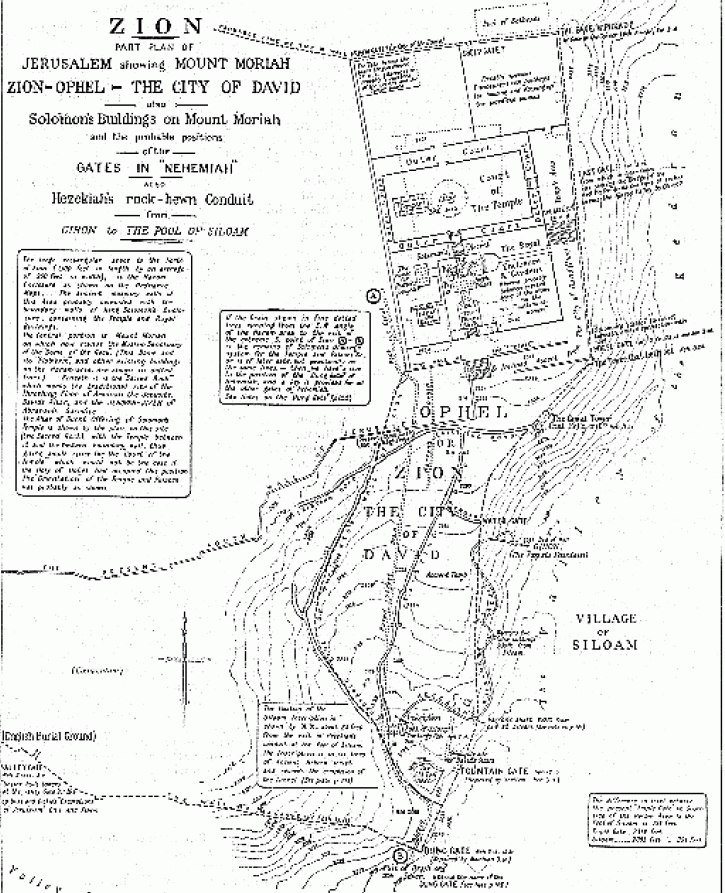
II. THE JEBUSITE WATER-SUPPLY.
The rock-hewn conduit from Gihon (or the Virgin’s Fount) is shown with remarkable accuracy on the Ordnance Survey
maps. If, as it is confidently asserted, Gihon (or the well-spring or Fount of the Virgin) is the only spring in the
immediate vicinity of Jerusalem, then Melchizedek, King of Salem, and, later, the Jebusites, would be in possession of
the only unfailing water-supply of the district. That the Jebusites had access to this well or spring from within their
wall and fortress is clear: but, in the end, it proved their undoing, for David’s men obtained possession of Jebus by
means of the tzinnor (A.V. “gutter”), i.e. the channel and shaft leading from the well into their citadel. (See notes on 2
Sam 5:6-8 and 1 Ch 11:6; also the Section on p. 102). (*1)
The spring is intermittent, overflowing periodically, thus pointing to the existence of either a natural chasm or
reservoir, or a made reservoir, whose site is at the present unknown. Possibly it is under Mount Moriah itself. Tradition
has much to say as to a deep well with an unfailing water-supply beneath the Temple area. (Cp. also Ps 46:4.) (*2)
The fortress or citadel of Zion was immediately above this well-spring, and its defenders could thus command their
water-supply from within, and also the security of the source without. Before the time of Hezekiah, “the city of David”
was dependent upon this source for its water-supply in times of danger threatened from without, in the same manner
that the Jebusites were, viz. they descended from Ophel by means of rock-hewn passages, with steps and slopes (still
in existence) till they reached the top of WARREN’S Shaft (see Section of David’s tzinnor or “gutter”, p. 102), and by
means of buckets drew their water from the unfailing well-spring some 40 to 50 feet below. At the top of this shaft is
still to be seen the iron ring employed for this purpose.
(*1) This Section, by Sir Charles Warren’s kind permission, is presented W. to E. (and facing north), like the other
plans on pp. 100 and 105, so as not to confuse the reader. In the Section, as shown on p. 102, it must be
understood that the opening to the canal running south is thus shown by way of accommodation.
(*2) The Heb. word nachar here is used of a constant flow of water in contrast with nahal, which means a wady or
summer stream dependent on rains.
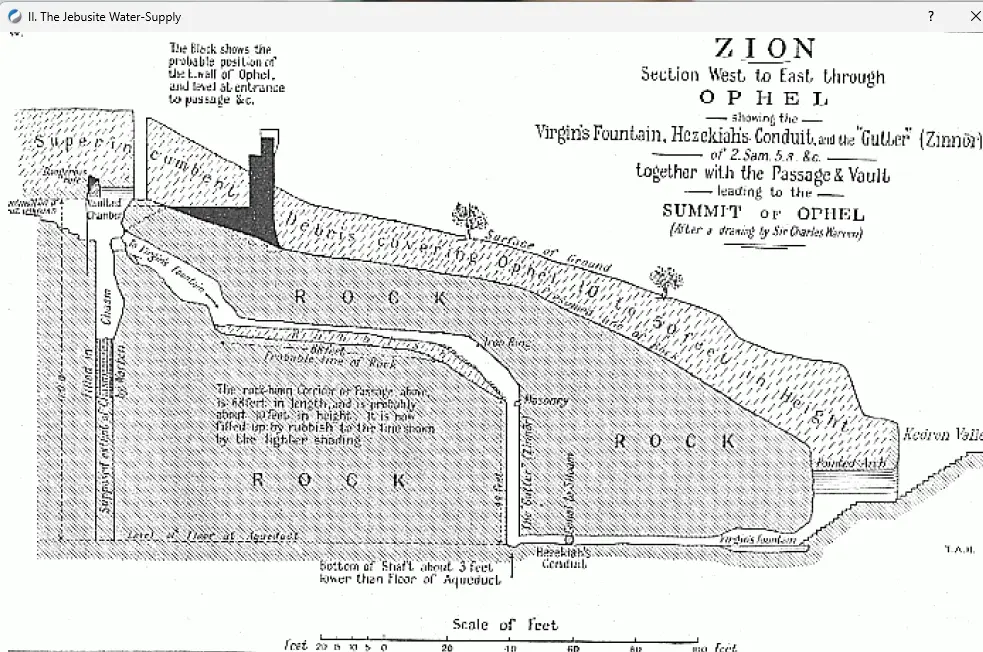
III. HEZEKIAH’S CONDUIT AND POOL.
The rock-hewn tunnel or conduit discovered by SIR CHARLES WARREN in 1867, and first mentioned by him, conveyed
the overflow water (*1) from this spring to the Pool of Siloam.
That this conduit and pool were made by Hezekiah is now considered certain from the inscription found in the tunnel
itself (see the plan on p. 100). Hezekiah, before the Assyrian invasion, in 603 B.C. (see Ap. 50. V, p. 60), constructed
this tunnel and brought the water from Gihon to a new pool (above “the Old Pool” of Isa 22:11) that he had made for the
purpose (2 Ki 20:20). This pool henceforth became known as “the King’s Pool” (Ne 2:14). When the Assyrian army
approached, Hezekiah “stopped the waters of the fountains which were without the city” (2 Ch 32:3-5), i.e. he
concealed their extra-mural approaches and outlets.
THE SILOAM INSCRIPTION, discovered in 1880, on a stone on the right wall of the tunnel about 20 feet from its exit
into the Pool of Siloam, is undoubtedly the work of Hezekiah (see plate, p. 103). An interesting fact with regard to this
inscription is that it gives the length of the conduit in cubits, which, being compared with modern measurements in
English feet, shows that the cubit used was 17.5 inches or thereabouts.
If we knew for certain that the exact points from which Hezekiah measured exactly corresponded with those of the
moderns, them we should be able to settle the vexed question as to the length of the cubit used, at all events in secular
matters, by King Hezekiah. We do not, of course, know this, but it is of great interest to note the fact that the
Inscription’s 1,200 cubits, and the latest measurement of (about) 1,750 English feet yield a cubit of 17.5 inches (*2).
(*1) Before Hezekiah’s time the overflow water must have escaped from the Virgin’s Fount at a lower level than is
now possible, and flowed out and down the lower end of the Kidron valley, past the king’s garden, probably being
the feeder for Joab’s well (En-rogel?).
(*2) In a recent letter, Sir Charles Warren writes on this subject: “Stress must not be laid on the exactness of
measurements made under conditions so difficult to obtain absolute accuracy.” He adds, “it is impossible that any
of the plans of the aqueduct can be rigidly correct, because the roof is so low that your head is horizontal in
looking at the compass, so that you can only squint at it”. It is necessary to remember this warning, coming from
such a source. Nevertheless the figures, as above shown, are highly interesting.
IV. THE SILOAM INSCRIPTION.
According to The Companion Bible Chronology (see Ap. 50 and 86) the date of this Inscription (see § III, pp. 101,
102) is given as 608-7 B.C. for the following reasons. The fall of Samaria was in 611 B.C. Hezekiah, fore-seeing that
Judah’s turn would follow, started the work of making the “Pool” and the “conduit” of 2 Ki 20:20. This difficult
undertaking would probably occupy two or three years.
When the siege of Jerusalem by Sennacherib was begun in Hezekiah’s fourteenth year, this water-supply was
complete and in working order, as Hezekiah had stopped the extra-mural outlets (2 Ch 32:2-4). Therefore, the
rock-hewn conduit from Gihon (now known as “the Virgin’s Fountain”) to Siloam must have been constructed between
Hezekiah’s sixth and fourteenth years (611-603 B.C.).
If we assume that it was begun soon after the fall of Samaria and occupied three years in construction, and that the
Inscription was made on completion, as the record itself indicates, this gives us the date (above) 608-7 B.C. It is
graven in ancient Hebrew characters, similar to those of the Moabite Stone (see Ap. 54); and occupies six lines; the
translation of which is given below.
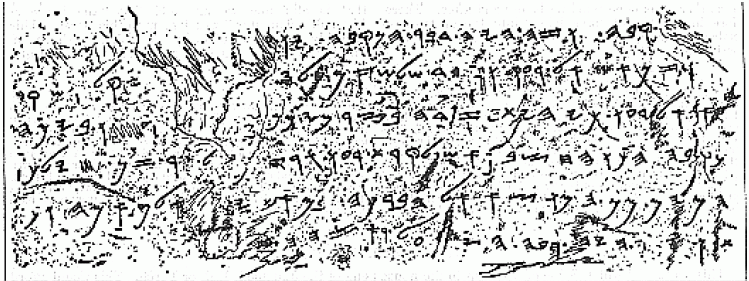
TRANSLATION OF THE SILOAM INSCRIPTION.
Line 1. [Behold] the excavation. Now this is the history of the breaking through. While the workman were still
lifting up Line 2. The pickax, each toward his neighbor, and while three cubits still remained to [cut through, each
heard] the voice of the other calling Line 3. to his neighbor, for there was an excess (or cleft) in the rock on the right
… And on the day of the Line 4. breaking through, the excavators struck, each to meet the other, pickax against
pickax; and there flowed Line 5. the waters from the spring to the pool over [a space of] one thousand and two
hundred cubits. And … Line 6. of a cubit was the height of the rock above the heads of the excavators.
V. THE TEMPLE OF SOLOMON ON MOUNT MORIAH.
The Plan on p. 105 shows the various buildings on the Temple area on the Moriah site to a larger scale. No attempt is
made either to “design afresh” or, with the ready and often disastrous zeal of the modern iconoclast, to “restore”
Solomon’s Temple in this plan. The efforts put forth in the majority of cases by those who, with the best intentions,
set forth their “ideas”, result in melancholy exhibitions, from the crudely unhappy delineations of the earnest student,
who works in entire ignorance of scales of measurement or the simplest requirements of the builder’s art, to the
redundantly fanciful productions of the professional designer, who, by his very acquaintance with the requirements of
architecture, is often led to try and set before us what he imagines the Temple of Solomon, &c., ought to be.
Accordingly, we have on the one hand bald representations of a Temple of practical impossibility, or, on the other, the
most elaborate architectural confections from all sorts of sources — Phoenician, Egyptian, Grecian, Roman, and even
Gothic.
Not content with these “styles” of architecture for Solomon’s Temple, it is not unusual for illustrators of this subject to
import into their designs all the details they can possibly assimilate from the specification of the Millennial Temple
given by Ezekiel, and to add these on to the meager details given of the Temple of Solomon!
One moment’s serious attention to David’s solemn statement in 1 Ch 28:12,19, that he had received direct instruction
from Jehovah for “the pattern of all that he had by the Spirit”, and “in writing” — in other words, both model and
specification from on High — ought to preserve us from such mistakes. The Temple was built from a heavenly plan and
specification, and there is an entire absence of every detail that would enable us to “restore” such a building. Just as,
in the case of the Tabernacle, the essential details are omitted, so that men may not copy the Mishkan (or habitation)
of Jehovah, so, in the case of Solomon’s Temple, we are placed in the same position.
The plan therefore given on p. 105 deals mainly with the figures given in the sacred records in bulk, merely
arranging the various buildings in accordance with the position of the altar of burnt offering and the Temple in relation
thereto.
The Altar of Burnt Offering is shown on the site of the “Sacred Stone”, which is exactly under the center of the
present Moslem Sanctuary over it, know as “the Dome of the Rock”. (*1) This is the traditional site of David’s altar on
“the threshing-floor of Araunah the Jebusite”. The Temple with its porch, the twin pillars Jachin and Boaz, and the
molten sea, are shown to the west of the altar, and the wide open space, the Court of the Temple, is left blank — for
the best of all reasons: we have no revelation as to how the space was occupied. Josephus and the Jewish rabbinical
writings are alike useless for the purpose of informing us about Solomon’s Temple. The simple fact is that we know
next to nothing, and beyond the statements of “block” measurements, so to speak, we have no guide as to details. That
there was an inner and outer court to the Temple is most probably, although there is no mention of courts until a later
date.
(*1) This and the other main buildings on Haram area are shown on the plans by dotted lines.
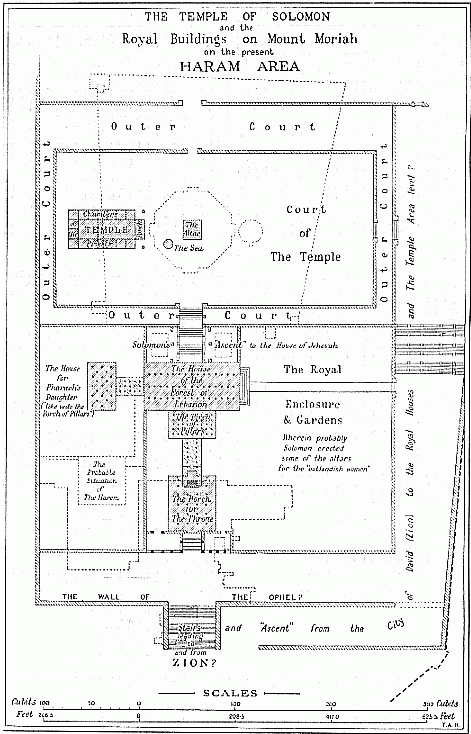
VI. SOLOMON’S ROYAL BUILDINGS ON MOUNT MORIAH. With regard to these the case is
different. We are not told that David or Solomon received a
Divine plan and specification for “the house of the forest of Lebanon”, &c. Therefore it is permissible to try and
arrange these buildings, according to the very slight details given, and according to the dictates of common sense.
It seems to be forgotten by some modern “Restorers” of Solomon’s house, and other buildings, that the great king had
received specially the gift of “wisdom”. He was a man with “a wise and understanding heart”, so that there was none
like him before and after. Therefore he would not have fallen into the mistakes of palace building with which he is
credited by some writers. (*1)
Solomon’s house was built of wood from the “forest of Lebanon”, or, as we should say “of Lebanon wood”. It was 100
cubits long, 50 cubits broad, and 30 cubits in height. Although the number of cedar pillars is given, it is impossible to do
more than indicate them on the plan by number. No details as to arrangement are given. The same remark applies to
the Porch of Pillars, which apparently was a magnificent portico, to the house itself, and also to the statements
concerning the Porch of Judgment. The gross dimensions are given of “the Porch of Pillars” (50 cubits by 30 cubits) and
that is all; and we are told that “the house of Pharaoh’s daughter” was like unto this porch. This probably means 50
cubits by 30 cubits, as shown on the plan. Apart from this, all is left unspecified and vague.
(*1) e.g. Prof. STADE in his Geschichte des Volkes Israel, gives an elaborate plan, which has been reproduced in
one of the latest and most important works on Jerusalem. It is, however, completely at variance with the
Scripture record. This plan makes havoc of the Bible statements as to the royal buildings, for it shows (1) The
King’s House, (2) The House of the Forest of Lebanon, (3) Hall of Pillars, (4) The Throne Hall, (5) House of
Pharaoh’s Daughter — whereas the Hebrew text of 1 Ki 7:1-8 plainly records the fact that Solomon’s House and the
House of the Forset of Lebanon were one. This house had a “Porch of Pillars”, probably to the south, and also,
probably, south again, lay the Porch of Judgment, where Solomon sat to administer justice. This, as shown on p.
105, was situated in a position easy of access from “the city of David” — for the people’s sake 00 and at a
sufficient distance from the royal residence for the monarch’s own sake. Solomon was a gentleman as well as a
king, and it is incredible that he would have allowed the populace admission to the Judgment Hall through his own
private grounds. The House for Pharaoh’s daughter completes the buildings specified, although an extensive
Harem must have been added later on.
VII. SOLOMON’S ASCENT.
This ascent, by which Solomon went up to the house of Jehovah, would be between the house and the outer court
of the Temple, and would probably comprise two or three flights of steps or “stairs”, protected by another covered
portico or “porch”, with pillars in accordance with the other buildings. The Temple area level would probably be some
15 or 20 feet above that of the king’s house, and this difference in level would admit of the construction of an “ascent”
that must have possessed features of unusual interest and magnificence from the account given of the visit of the Queen
of Sheba (2 Ki 10:1-10; 2 Ch 9:1-12).
To reach the level of the present Haram area at the south side from “the city of David”, some means of easy ascent
must have been employed. This is shown on the plan, p. 105, as being by a series of steps — forming an important
stairway, giving direct means of approach to a spacious plateau on to which opened out the south end of the Judgment
Hall or Porch. This would afford direct access to the people to the Hall for Judgment concerning their disputes, &c.
In addition to this great stairway for the people, there must also have been an easy way of “going up” from “the city
of David” to the Temple area. This would probably be by means of an inclined ascent, such as that indicated on the plan
(p. 105). It must be remembered that this would also be requisite for a roadway for the king’s chariots, &c. The
evidence is abundant that Solomon had a number of horses and chariots. These would hardly have been installed on the
Haram area level, in juxtaposition with the royal buildings. The fact that beneath the SE. corner of the Haram is still to
be seen the great underground series of pillars and arches known as “Solomon’s stables”, gives strength to the suggestion
that the originals of these and the “Horse Gate” were in very close proximity. (See plan, p. 100.)
VIII. THE “DUNG GATE” OF NEHEMIAH.
On the plan (p. 100 is shown in dotted lines a large drain, running round the SW. angle of the Haram, to its exit at
the extreme S. point of “the city of David” (Zion). This drain is of very great importance with regard to the question of
locating the “Dung Gate” of Nehemiah.
In all probability this drain indicates the position of the “main-drainage system” of the Temple area, and the adjacent
royal buildings, from the time of Solomon and onwards. Ample provision must have been made in buildings of the
character and extent of the Temple and palace for the disposal of the blood of the sacrificial animals and the water of
the ceremonial cleansings, in addition to the sewage from the Levitical quarters, and the huge court entourage of
Solomon (*1) and possibly some of the later kings. For this purpose a great drain must have been employed to convey all
this sewage matter to the lower levels and outside the city.
The fact that the remains of such a large drain or sewer are still in existence in much the position necessitated by the
buildings on the Temple area, &c., suggests that this was either the one constructed by Solomon, or else one laid down
on about the same lines at a later date (*2). As shown by the latest Palestine Exploration Fund plan of Jerusalem, this
drain runs S. down the slope of the Tyropoeon valley, past the Pool of Siloam (the King’s Pool, Ne 2:14), and passes out
under an ancient gateway, recently discovered, to the south of “the Old Pool” (Isa 22:11).
In all likelihood this gateway marks the position (there or thereabouts) or Nehemiah’s “DUNG GATE”. It would be so
named from its close association with — as we should say now — the sewage outfall, as the drain (still existing here)
passed out beneath it, to discharge itself a little lower down into the gully formed by the junction of the Kidron and
Hinnom Valleys, and not far distant from the ridge site identified by some as Aceldama.
That this is the case receives strong confirmation from the fact that this sewer or drain passes under the present
south wall of Jerusalem in close proximity to the existing gate there, which still bears the Arabic name of Bab al
Magharibe or the Dung Gate. The difference in present levels from the SW. corner of the Haram to the “Dung Gate” (at
the south of Zion), and shown on the plan, p. 100 A – B, is 300 feet. This is a fall admirably suited for the purposes such
a drain would have to fulfill. This being so, it supplies the key to unlock the difficulties relating to the location of the
rest of the gates of Nehemiah.
The VALLEY GATE, from whence Nehemiah issued on his night inspection tour (C.2), and from whence the two
processions started E. and N. at the Dedication of the Wall (C.12), is seen to be on the slope of the SW. hill. Recent
explorations have revealed an ancient gateway in the position shown on the plan (p. 100).
The DUNG GATE being thus located at the extreme south of “the city of David”, the next, or “Fountain Gate”, is shown
in close proximity to the site near which the “Stairs of David”, leading up into the higher portion of the city of David,
must undoubtedly have existed.
The WATER GATE is shown close to where and existing road now runs to Gihon; and the other gates follow on in
orderly sequence till the SHEEP GATE is reached on the north of the Temple area, and close to the pool now identified
as the Pool of Bethesda “by the Sheep Gate” (Jn 5:2, marg.). This opened out probably into the large enclosure shown
on the plan (p. 105) necessary for the reception and feeding of the vast numbers of sacrificial animals.
The PRISON GATE (or Gate of the Guard more probably) would be near the extreme NW. angle of the Temple area,
and would be connected with the barracks or quarters of the Temple guard (from whence its name). It was at this
gate, Nehemiah tells up, the procession which started N. from the Valley Gate, at the dedication of the wall, “stood
still”, either to give the other company time to reach the same point, or else to allow the other, the priestly company
under Ezra (Ne 12:36), to precede Nehemiah and the other lay “rulers” into the House of God for the general
thanksgiving (12:40).
(*1) The occupants of the Harem, and their attendants alone, would probably number at least 2,000.
(*2) Another large drain is shown on the latest maps in this neighborhood. This is known as “Warren’s Drain”. It
starts from the Haram area, a little to the left of, and nearly parallel with, the one just referred to. This drain
runs due south for some 700 feet, and then ends, apparently, abruptly. (See plan, p. 100.)
Appendix 69
TRUST
In the Old Testament there are seven Hebrew words translated “trust”, which itself occurs 155 times. “Trust” is the
New Testament word “believe”.
i. batah = to confide in, so as to be secure and without fear. This is the word rendered “trust” in 107 passages,
viz. every passage except those given below.
ii. hasah = to flee for refuge to, take shelter in. This is the word rendered “trust” in thirty-seven passages, viz.
Dt 32:37. Jdg 9:15. Ru 2:12. 2 Sa 22:3,31. Ps 2:12; 5:11; 7:1; 11:1; 16:1; 17:7; 18:2,30; 25:20; 31:1,19; 34:8,22;
36:7; 37:40; 57:1; 61:4; 64:10; 71:1; 73:28; 91:4; 118:8,9; 141:8; 144:2. Pr 30:5. Isa 14:32; 30:2,3; 57:13. Na
1:7. Zep 3:12.
iii. ‘aman = to put faith in; hence, to stay or rest on. Rendered “trust” in six passages, viz. Jdg 11:20. Job 4:18;
12:20; 15:15,31. Mic 7:5.
iv. hul = to tarry, or wait for, once: Job 35:14.
v. galal = to roll on, or devolve, once: Ps 22:8.
vi. yahal = to wait on, or for, with confidence, twice: Job 13:15. Isa 51:5.
vii. rehaz = to rely on, once. Da 3:28.
Appendix 70
Ps 15 AND “THE SERMON ON THE MOUNT”
The place of Ps 15 is seen in the Structure of the first book of the Psalms (p. 721), in which the perfect man of Ps 15
is set in contrast with “the man of the earth” and other men in Ps 9-14. It sets forth the character and conditions of a
true citizen of Zion.
Hence, the Lord Jesus, in proclaiming the kingdom, Mt 4:17-7:29 (see the Structure of the whole Gospel), lays down
the characters of the true subjects of the kingdom. The kingdom has nothing to do with the present Dispensation,
which is one of Grace. The kingdom proclaimed by the King was rejected, and the King was crucified. Hence, “now we
see NOT YET all things put under Him” (Heb 2:8). the kingdom is therefore now in abeyance. But when it shall be set up,
then Ps 15 and “The Sermon on the Mount” will find and receive their full and proper interpretation. See Ap. 63. ix; 71;
and 72.
We note below the correspondence of the subjects treated, in the same order as they are set forth in the Psalm,
which is so complete that it evidently formed the text on which the Sermon on the Mount was based. See the Structure
of Mt 5:1-7:27.
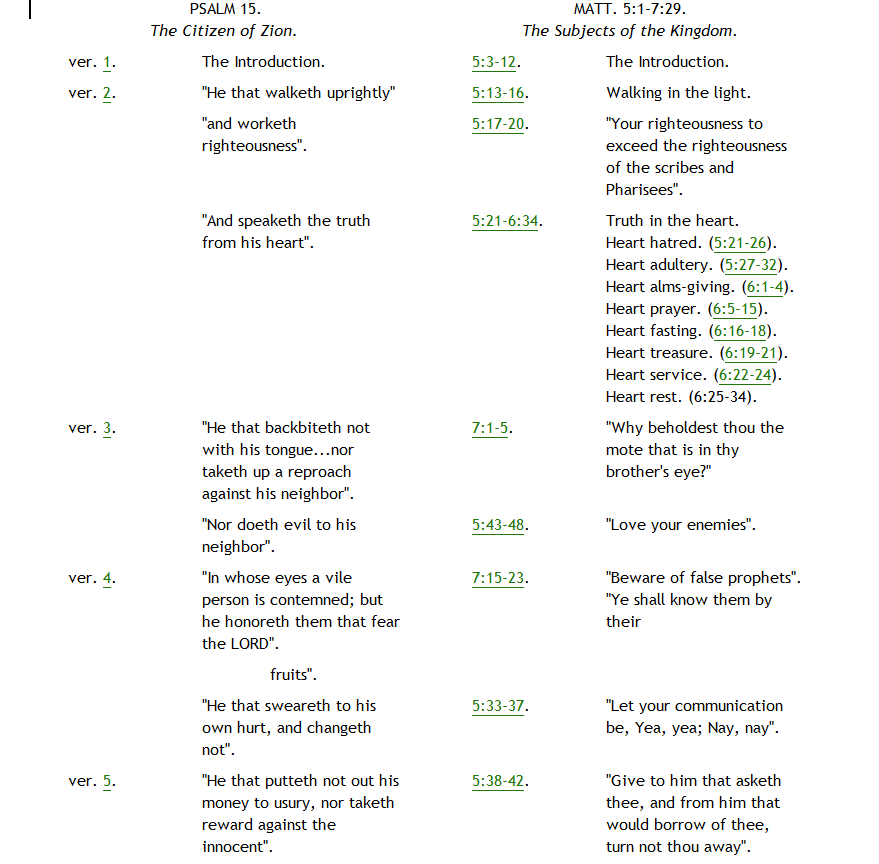

Appendix 71
“THE SUFFERINGS, AND THE GLORY”.
We are told, in 1 Pe 1:10-12, that the prophets of old searched “what, or what manner of time the Spirit of Christ
which was in them did signify, when it testified beforehand the sufferings of Christ, and the glory that should follow.
Unto whom it was revealed, that not unto themselves, but unto us they did minister the things, which are now
reported unto you … with the Holy Ghost sent down from heaven”.
They wrote of the sufferings, and they wrote of the glory that should follow; but there was nothing to tell them
about the times or seasons. Whether the glory was to follow immediately on the sufferings, or whether there was to
be an interval, and whether that interval was to be short or long, no hint was given. hence, they searched as to “what
manner of time was signified”.
This “time” refers to the “unsearchable riches of Christ”. They could not them be traced. Even angels desire to look
into these things (1 Pe 1:12). “Now,” all is revealed. It is ministered unto us, in the Scriptures of truth, on earth; and
God is making known, by means of the Church, something of His manifold wisdom to the principalities and powers in
the heavenly places (Eph 3:9,10).
Angels and prophets saw the “sufferings” like the tops of a distant mountain range — while beyond it a farther range
was seen in a distant haze of glory. But what lay between they could neither see nor know. But now it is revealed. The
sufferings are past, and we are in the valley between these two mountain ranges. the glory is beyond. The secret “hid
in God” has been made known; and we can understand, a little, the answer to the question of Christ to the two
disciples: “Ought not Christ to have suffered these things, and to enter into His glory?” (Lk 24:26). They are linked
together inseparably, especially in the first epistle of Peter. See 1 Pe 1:11; 3:18; 4:13; 5:1.
In the Old Testament they are each frequently dwelt upon together: but, we find that, while the glory is often
mentioned and enlarged upon by itself, without any reference to the sufferings, we never find the sufferings mentioned
without the glory being referred to immediately after. Sometimes the change is quite sudden. In Ps 22, note the change
from v. 21 to vv. 22-end. In Ps 102, note the change from v. 11 to vv. 12-end. In Isa 53 note the change in the middle
of v. 10. (See Ap. 72.)
It seems that when the sufferings are mentioned, we are not left to think that all is to end there. The glory may be
mentioned alone, because there is to be no end to it. But to the sufferings there was to be an end, and that end was to
be revealed in glory.
That is why, when the Lord makes the first mention of His sufferings, in Mt 16:21, He at once proceeded to speak of
the time when He “shall come in the glory of His Father” (v. 27), and to add that some of those who were standing
should see it. And then, after six days, three of them saw the power and coming of our Lord Jesus Christ, and were
eye-witnesses of His majesty, when they were with Him in the holy mount (2 Pe 1:16-18. Cp. Jn 1:14).
Having heard of the sufferings, the disciples were not left to conclude that all was to end there: hence they were at
once given the most wonderful exhibition of the glory which was to follow. This is why the Transfiguration scene
occurs in the third part of the Lord’s ministry, which had to do with His sufferings. See notes on the Scriptures
referred to above, and compare Ap. 72.
Appendix 72
THE PARENTHESIS OF THE PRESENT DISPENSATION
From what has been said in Ap. 63. ix and Ap. 71, it will be seen that there are different Dispensations, or different
characters of Divine administration, suited to the different times in which such administrations are exercised. The
object of this appendix is to show that, in the Old Testament, while this present Dispensation was kept secret (cp. Mt
13:34,35. Ro 11:25. Eph 3:5,9, &c.), there are remarkable breaks which can be explained only after we have the key
put into our hands.
There are certain scriptures which we cannot understand unless we use this key. Like the angels and prophets (1 Pe
1:11,12) we may search in vain, while others may refuse to search and “look into” these things, and profanely speak of
it as the “gap theory”. Whether it be a “theory”, let Scripture decide, and the Savior Himself teach. In the synagogue at
Nazareth “He found the place where it was written:
The Spirit of the Lord is upon Me,
Because He hath anointed Me to preach the gospel to the poor;
He hath sent Me to heal the brokenhearted,
And recovering of sight to the blind,
To set at liberty them that are bruised,
To preach the acceptable year of the Lord.
And HE CLOSED THE BOOK, and He gave it again to the minister, and sat down” (Lk 4:18-20). Why this mysterious
action? Why not continue the reading? Because He could not; for the words which immediately follow refer to the end
of the present Dispensation of Grace, and speak of the coming Dispensation of Judgment. Had he continued to read Isa
61:1,2, the next line would have been
“And the day of vengeance of our God”.
But this part of the prophecy was not then to be fulfilled. As far as He had read, He could truly say, “This day is this
Scripture fulfilled in your ears.” But He could not have said “This day is this Scripture fulfilled”, had He not “closed the
book”, but gone on to read the next line. And yet, in the A.V. and all other versions, there is only a comma between the
two lines, while there is a period of nearly 2,000 years between the two statements. (In the MSS. there is no mark of
punctuation at all.) This will show the importance of “searching” and “looking into” the “manner of time” of which the
prophets wrote.
Other examples may be found in
Ge 1, between verses 1 and 2.
Ps 22, between verses 21 and 22.
Ps 118, in the middle of verse 22.
Isa 9:6, after the first clause.
Isa 53, in the middle of verse 10.
Isa 61, in the middle of verse 2 (see above).
Lam 4, between verses 21 and 22.
Da 9, between verses 26 and 27.
Da 11, between verses 20 and 21.
Hos 2, between verses 13 and 14.
Hos 3, between verses 4 and 5.
Am 9, between verses 10 and 11.
Mic 5, between verses 2 and 3.
Hab 2, between verses 13 and 14.
Zep 3, between verses 7 and 8.
Mt 10, in the middle of verse 23.
Mt 12, in the middle of verse 20.
Lk 1, between verses 31 and 32.
Lk 21, in the middle of verse 24.
Jn 1, between verses 5 and 6.
1 Pe 1, in the middle of verse 11.
Rv 12, between verses 5 and 6.
Appendix 73
THE TEN WORDS OF Ps 119
The number of the words which are frequently repeated in Ps 119 has been variously given and enumerated by
expositors and commentators. It will be better to give them here on the authority of the Massorah (Ap. 30).
The rubric on verse 122 is as follows: “Throughout the whole of the Great Alphabet [i.e. the Alphabetic Psalm, 119]
there is in every verse one of the following ten expressions ” DEREK ( = Way), ‘EDUTH ( = Testimony), PIKKUDIM ( =
Precepts), MIZVAH ( = Commandment), ‘IMRAH ( = Saying), TORAH ( = Law), MISHPAT ( = Judgment), ZEDEK, ZEDAKAH,
and ZADDIK ( = Righteousness), HOK, and HUKKAH ( = Statutes), DABAR ( = Word), which correspond to the Ten
Commandments; except one verse, in which there is none of these: viz. verse 122.” (Massorah, Ginsburg’s Edition, Vol.
II.)
The following list includes all the “Ten Words” given above, with every occurrence in the Psalm, together with the
first occurrence of each word.
(i.) WAY (derek) is from darak, to tread with the feet, and denotes the act of walking. Hence it is used of a going,
or way, or journeying. The first occurrence is Ge 3:24. It occurs in this Psalm thirteen times: vv.
1,3,5,14,26,27,29,30,32,33,37,59,168.
(ii.) TESTIMONIES (‘eduth) is from ‘ud, to turn back again, to go over again, to reiterate, hence, to testify. The first
occurrence is Ge 21:30 (edah). It occurs in this Psalm twenty-three times; nine times (‘eduth), vv.
14,31,36,88,99,111,129,144,157; fourteen times (‘edah, fem. sing.), vv.
2,22,24,46,59,79,95,119,125,138,146,152,167,168.
(iii.) PRECEPTS (pikkudim) is from pakad, to take oversight or charge: hence, mandates enjoined on others. It
occurs only in the Book of Psalms (see 19:8; 103:18; 111:7). In Ps 119 twenty-one times: vv.
4,15,27,40,45,56,63,69,78,87,93,94,100,104,110,128,134,141,159,168,173.
(iv.) COMMANDMENTS (mizvah) is from zavah, to set up, constitute. Hence, constitutional commands. First
occurrence Gen. 26:5. In Ps. 119 it occurs twenty-two times : vv. 6,10,19,21,32,35,47,48,60,66,73,86,96 (sing.),
98,115,127,131,143,151,166,172,176.
(v.) WORD (‘imrah) is from ‘amar, to bring forth to light; hence, to say. The verb is very regularly followed by the
words used; hence ‘imrah means an utterance and the purport of it. Not the same as dabar (No. x below), which refers
to the articulate utterance of it. The first occurrence is in Gen. 4:23, and is rendered “speech”. In plural only once, Ps.
12:6 (the only place where the plural is found). In Ps. 119 it occurs nineteen times : viz.
11,38,41,50,58,67,76,82,103,116,123,133,140,148,158,162,170,172. With dabar the two occur forty-two times.
(vi.) LAW (torah) is from yarah, to project, issue: hence, to point out, to show (Pr 6:13). Then, to instruct, teach.
The Torah contains Jehovah’s Instructions to His People, pointing out to them His will. First occurrence is in Ge 26:5
(pl.). In Ps 119 it occurs twenty-five times: always in the singular: viz. vv.
1,18,29,34,44,51,55,61,70,72,77,85,92,97,109,113,126,136,142,150,153,163,165,174.
(vii.) JUDGMENT (mishpat) is from shaphat, to set upright, erect (cp. Eng. right, and German richten and recht);
hence, to judge. Mishpat means judgment. Its first occurrence is in Ge 18:19 (in Jehovah’s mouth). In Ps 119 it occurs
twenty-three times (always in plural, except four times), viz.: vv. 7,13,20,30,39,43,52,62,75,84,91 (ordinances),
102,106,108,120,121,132 (as thou usest to do, see note), 137,149,156,160,164,175.
(viii.) RIGHTEOUSNESS, RIGHT, &c. (zedek, masc.), is from zadak, to be right, upright, just, righteous. Hence the
noun means rightness. By comparing the first occurrence (Lev 19:15) with the second (Lev 19:36) we get the idea that
the word has special reference to equal balancing. Zedek (masc.) occurs twelve times, and is rendered “righteousness”:
vv. 123,142 (second), 144,172; “right”, v. 7,62,106,138,160,164; “justice”, v. 121. Zedakah (fem.), first occurrence, Ge
15:6. In Ps 119, “righteousness”, vv. 40,142 (first). Zaddik (adj.), spoken of a king (2 Sa 23:3), once, in v. 137. The three
words fifteen in all.
(ix.) STATUTE (hok and hukka) is from hakak, to hew, cut in, engrave, inscribe; hence, to decree, or ordain. The
noun = a decree or ordinance. First occurrence, Gen. 26:5 (hukkah fem.). In Ps. 119 it occurs twenty-two times : viz. :
vv. 5,8,12,16 (hukkah, fem.), 23,26,33,48,54,64,68,71,80,83,112,117,118,124,135,145,155,171.
(x.) WORD, WORDS (dabar), is from dabar, to arrange in a row; hence, to set forth in speech. It refers to the
articulate form of what is said, whether spoken or written (cp. v above); to the mode or manner by which the
ipsissima verba are imparted. The first occurrence is in Ge 11:1 (“speech”). In Ps 119 it occurs twenty-four times, three
of them in pl., viz.: vv. 9,16,17,25,28,42 (twice), 43,49,57 (pl.), 65,74,81,89,101,105,107,114,130 (pl.), 139 (pl.),
147,160,161,169.
Appendix 74
THE BOOK OF PROVERBS:
Introduction and Analysis.
Contributed by
Dr. J. W. Thirtle
The Book of Proverbs is generally described as belonging to a branch of Hebrew literature which has for its subject
Wisdom, or, as we should say, Philosophy. This view has some truth in it; but it does not express the whole truth, as
will appear from an analysis of the book, and a careful examination of its constituent parts.
The book makes no claim to unity of authorship; it is avowedly a collection, and includes the work of others besides
Solomon the king. Hence, though in some sections there may be wisdom of a general order, in others one may find
cautions and counsels which were intended for a particular individual, and not for “all sorts and conditions of men”; and
which therefore, are not abstract Wisdom in the sense implied by most expositors of the book.
The conviction that this is the case will grow upon those who discriminate the material of which the book is
composed, noting the varying motives of the writers, and the outstanding characteristics of their proverbs, or sayings.
On the surface one distinguishes four divisions — The Proverbs of Solomon, the Words of the Wise, the Words of Agur,
and the Words of Lemuel. As these several writings may be easily distinguished, there is no reason why we should
summarily conclude that all the sections are of the “Wisdom” order.
Taken as a whole, the material rightly answers to the description of “Proverbs” (ch. 1, v. 1), or sententious sayings,
generally completed in the distich, or verse of two lines; but, as the authorship is complex, so also there may be
diversity of motive and object in the writings.
The present contention is that, while the Proverbs of Solomon may consist of teaching for all and sundry — dealing
with prudence, discretion, and the conduct of life — the sections which contain “the Words of the Wise” were intended
as instruction for a prince, and therefore designed to teach elementary lessons in policy and statecraft, even to show a
young ruler how he might “cleanse his way”, as the representative of Jehovah upon the throne of Israel. These parts of
the book have hitherto been treated as if designed to emphasize certain commands of the Decalogue: whereas, in
reality, they demand closer attention, as dealing with the dangers and temptations such as would inevitably beset a
king on the throne of Israel.
Hence, in a word, we find in the first twenty-nine chapters of the book several series of Proverbs which were FOR
Solomon, and again several series which were BY Solomon. (*1) Between the two classes there is a wide difference. Of
those that were FOR the king, being, in fact, “Words of the Wise” (men, or teachers), given for the instruction of the
young man, it may be said that, having a relation to the principles with were fundamental in the Divinely ordained
constitution of Israel, they stand apart from the class of Proverbs which enunciated by Solomon himself, were more of
less generally concerned with the life and behavior of the individual Israelite of the time.
The following is an analysis of the book from the point of view thus propounded:—
A. GENERAL INTRODUCTION — TITLE (ch. 1. vv. 1-6).
Misapprehension on the part of the Massorites or their predecessors in the editing of the text, let to inclusion in the
title of the line which, as heading, opens Section I. “The Words of the Wise and their dark sayings”, or sententious
utterances.
1. “Words of the Wise” (men, or teachers) — addresses by a father to a son, or rather by a teacher to a pupil, the
distinctive terms being the same (v. 6-). The addresses are fifteen in number, and all of them introduced by the formula
“My son” (1:7-7:27). The general subject of this section is embodied in the words “The fear of the LORD is the beginning
of knowledge; but fools despise wisdom and instruction” (v. 7). The “son” is addressed directly, “thou” and “thee”, “thy”
being also used; and again and again he is warned, in the most solemn terms, against “the strange woman,” i.e. the
foreign or alien woman — such women having from time to time led astray any Israelites that consorted with them.
Recall the allurements of the daughters of Moab; and the cases of Samson and Ahab. In other sections “my son” is warned
against “sinners” and “the wicked”, –that is, the heathen who knew not the true God, but who were haters of
righteousness, lovers of war, and given to oppression. He is, in particular, counseled not to “strike hands” with such —
i.e. not to enter into alliance or covenant with any such.
2. Two addresses, in the former of which (ch. 8, E5) Wisdom makes her claim upon the devotion of one who is
urged to esteem her as better than gold or silver, and is reminded that by Wisdom alone can kings reign and princes
decree justice; while in the latter (ch. 9), Wisdom and Folly are contrasted, the fear of Jehovah (or piety, as we know
it to have been esteemed in Israel) is magnified, and a warning is uttered against the foolish woman, already introduced
as “the strange woman”, with whom no Israelite should have any association — assuredly no king in Israel should seek her
company. In this section the address is sometimes to “ye”, “them”, “they” (that is, in the plural); at other times to
“thee”, “thou” (i.e. in the singular number). So far, after the title of the book, we have met with no mention of
Solomon; and none of his work. Hitherto, we have had proverbs which Solomon was taught.
3. A collection of Proverbs by Solomon, being so described in the opening verse (10:1 C). if the contents of sections 1
and 2 (A 1:-6-9:18, p. 864), already described, had been by Solomon, there would have been no need in this place for
the introductory line “The Proverbs of Solomon.” The mode of address is quite unlike that of section 1, with its second
person of the pronoun; the proverbs are not spoken to “my son”, but they mention “he” and “him”, using generally the
third person of the pronoun. Apparently, they continue to ch. 19:26, or thereabouts. They were for men in general to
learn, and not for a prince or distinguished individual (as “my son”).
4. Another section of addresses to “my son” begins with 19:20 (D, p. 864) or thereabouts; and continues to the end of
ch. 24. Here we have further lessons upon the ways of a king — like those of the earlier sections of the book, but quite
unmatched by anything in “The Proverbs of Solomon” (see 19:27, “My son”; and “the king” 20:2,8,26,28; 21:1; 22:11).
These are “Words of the Wise” (men, or teachers): this is twice affirmed (22:17; 24:23 R.V.); and the occurrences of the
formula “my son” are six in number (19:27; 23:15,19,26; 24:13,21). The counsels, like those of the sections 1 and 2, are
such as would eminently befit a prince in Israel: “my son” is instructed to regard the fear of the LORD as more desirable
than riches (22:1,4). Apparently the words are addressed to one who is to sit among rulers (23:1); one whose duty it is,
for the present, to fear the king as well as God (24:21); but one who is learning the duties of judicial administration
(20:8,26,28; 21:3; 22:11). There is nothing commonplace in warnings against “having respect of persons” in judgment:
such counsel is for a ruler (24:23,24). In this section again the foreign woman is denounced (22:14; 23:27,33); and riches
are shown to be of no account in comparison with wisdom and righteousness (20:15; 21:6; 23:4). In the earlier portion
of this division the pronouns are mostly in the third person, “he” and “him”; afterwards in the second person, “thou”,
“thy”, and “thee”. The counsels are manifestly such as King Solomon should have taken to heart.
5. A second collection of Proverbs by Solomon — chapters 25 and 26 (see opening verse of chapter 25, C, p. 864).
The book having been brought into its present shape in the reign of King Hezekiah, this section was “copied out” by the
scribes of that time. They would find in the royal library at Jerusalem many writings for the good of the nation, and
among them some of the best utterances of Solomon, as well as of his father David, who was likewise a great patron of
literature. The things said about kings are what might as well be expected from one who was himself the occupant of
a throne (25:2-7).
6. Without special introduction, ch. 27 (D) begins another series of “Words of the Wise”. The indication is found in
the substance of the proverbs, which are so obviously designed as instruction for a prince, and also in the occurrence
of the formula “my son” (27:11). The general applicability of these words to the case of a ruler in Israel is obvious (see
28:2, 6-8, 16; 29:4, 12, 14, 26).
7. The words of Agur, the son of Jakeh (ch. 30, A, p. 864).
8. The words of King Lemuel, the prophecy that his mother taught him (31:19), leading to the poem on
9. The virtuous woman (31:10-31).
In order to a proper understanding of “the Words of the Wise”, it is needful to bear in mind the following facts:—
1. The word “father” is used for a teacher — 2 Ki 2:12; 6:21; 13:14 (cp. Jdg 17:10; 18:19); and thus came to be the
common designation of the Jewish Rabbins.
2. The word “son” is used for a pupil — 1 Sa 3:6,16; 1 Ki 20:35; 2 Ki 2:3,5,7,15, and elsewhere; for the Israelitish
prophets, in some cases, conducted schools for young men, and received from them the obedience which was due to
parents, in whose place they stood for the time being. In this connection, note the words of remorse, suggested as
used by “my son” in the event of disobedience: I “have not obeyed the voice of MY TEACHERS, nor inclined mine ear to
THEM THAT INSTRUCTED ME” (ch. 5:13).
Again (3): The expressions “sinners”, “wicked”, “fools”, and “hypocrites” were applied in Israel to the heathen, and
those who followed their ways (Isa 13:11; 14:5: cp. Ps 9:5; 26:5; Pr 3:33; 28:4,28; 29:2). Though, as suggested, dealing
with politics, the “Words of the Wise” are in the language of the school; and the prince to whom the wise men address
themselves is led to view the surrounding nations and their ways from the standpoint of those who find the beginning
and end of knowledge in “the fear of the LORD”.
(2) The “strange woman”, whether answering to the Hebrew word zarah or nokriah, was not an erring Israelite, but
an ALIEN woman, to traffic with whom would inevitably lead to declension from the Lord. Both Hebrew words are
found in ch. 5:20; and in ch. 6 (22 ff.) the subject is extended, and associated with adultery, in order that personal
purity may be properly emphasized. As the Divine intention was that Israel should be separate from the nations of the
earth (Dt 7:6, and refs.: cp. Eze 20:32 ff.), it follows that the consorting with “strange women” implied contempt of the
covenant purpose of God in regard to the elect family of Abraham. There were, moreover, other consequences. In the
event of the transgressor being of the seed royal, such acts would bring confusion, and would imperil the dynasty of
David, the king of Jehovah’s choice; while all such offenders in Israel were thereby liable to be led into idolatry (Ex
34:16).
Through misinterpretation of ch. 2:17, some have held that the “strange woman” was an adulteress of the house of
Israel, and this has excluded from view the aspect which has thus far been presented. Careful examination of the
passage, however, finds in the word “god”, as here employed, no reference to Jehovah, but rather to the national
“god”, or gods, of the “alien woman”. In this verse the teacher would emphasize the audacity of the flatterer: “she
forsaketh the guide of her youth, and forgetteth the covenant of her god”. That is, leaving her own people in Philistia,
Edom, Moab, or Egypt, she has assumed the part of an adventuress, and come among a community of whose God she
knows nothing.
It was quite in order, on the one hand, to speak of nations as the people of their god (Nu 21:29: cp. 2 Ki 11:17; Ps
47:9); and likewise, on the other hand, to speak of gods as the gods of distinctive peoples. (Jdg 11:23; Jer 43:12; 48:7:
cp. Jos 7:13; Jdg 5:3,5; Isa 8:19; 40:1). The usage thus indicated was sanctified in relation to the faithful in many
passages of Holy Scripture: see the divergent courses of Orpha and Ruth (Ru 1:15,16), and compare the gracious words
of Jehovah: “I will be YOUR God, and ye shall be MY People” (Lev 26:12: cp. Ex 6:7; Jer 7:23; 11:4; 24:7; 30:22; Eze
11:20; 14:11; 36:28; 37:27; Zec 13:9).
Another ground for the contention that the “strange woman” merely means an Israelite of evil reputation has been
found by some in ch. 7:19,20 — “the goodman is not at home, he is gone a long journey”, &c. This, however, proves
nothing against the position taken up in the analysis now presented. In fact, it may be assumed that, in the days of
Solomon (as ever since) female corrupters of men, alien or otherwise, included some who had the protection of
husbands, or men who sustained such a relation.
Thus we fine “the Words of the Wise” to have been addressed by teachers to Solomon the prince, teachers whose
desire it was to instruct him in the ways of his father’s God: in fact, both parents are mentioned (1:8; 6:20).
Accordingly, these sections of the book deal with the domestic politics of Israel. After the opening verse there is no
mention of the nation in specific terms; but the fear of the Lord, the pious service of Jehovah, is inculcated as
fundamental. The “Words” or “Sayings”, as the title of the book intimates, treat of “discretion” and “wise dealing”, as
these are shown to relate to “the fear of the LORD”. Moreover, the “Words” range themselves in classes that were
distinctly anticipated in the Pentateuch as proper subjects for the consideration of rulers in Israel. This fact has am
important bearing upon the age of the book, and also upon the age of other portions of the Old Testament.
For instance: in Dt 17:14-20 it is stipulated that, if, on settlement in the Land of Canaan, the People should desire a
king, then in such matter they should have regard to the Divine choice, which would be, not to put responsibility upon
a foreigner, but upon “one from among thy brethren”. The stipulations are continued thus: (1) He shall not multiply
horses, after the manner of the Egyptians; (2) he shall not multiply wives, who might “turn away his heart” from God;
(3) he shall not greatly multiply to himself silver and gold; (4) he shall make a copy of the Law, and read therein daily,
that he may learn to fear the Lord; (5) all this is to be to the end that he may prolong his days in his kingdom, and
never lack successors on the throne. Moreover, in Dt 7:2-5 (cp. Ex 34:12 ff., and Jos 23:12,13) it is laid down that the
Israelites should destroy the Canaanites and their symbols of worship; should make no covenant with them, and should
guard against intermarriage with them; the last-named prohibition being supported by the warning that it would lead
to apostasy from Jehovah: “They will turn away thy son from following Me, that they may serve other gods.”
To the thoughtful reader of the Book of Proverbs it is clear that the sanctions and prohibitions of these passages of
the Pentateuch form the warp and woof of the teaching of the wise men to whose care the son of David was
committed. The Proverbs of Solomon, strictly so called, as found in sections 3 and 5 of the book, are quite distinct
from “The Words of the Wise”, as given in sections 1, 2, 4 and 6, and addressed to “my son”. The prince was, in these
latter, diligently fortified against practices that would bring about religious apostasy, and eventuate in dynastic disaster.
Hence, in these divisions of the book, we find instruction which answers with precision to the stipulations given in the
Pentateuch, thus:-
1. Horses are treated as no account, for “victory is of the Lord” (21:31).
2. The taking of foreign wives is condemned with unceasing energy (2:16 ff.; 6:24 ff.; 7:5 ff.).
3. Gold and silver, riches, are declared to be inferior to the fear of the Lord; in fact, to be at the disposal
of wisdom, and therefore not to be desired apart therefrom (3:16; 8:18,19; 22:1-4; 23:4,5; 27:24; 28:6-8).
4. The majesty of the Law is affirmed, and to keep it is a mark of wisdom; while the Law cannot offer
acceptable worship to God (6:20-23; 28:4-9; 29:18).
5. Obedience is commended, and shown to bring prolongation of life (3:2,16; 4:10; 9:11; cp. 10:27).
These several points agree with the stipulations of Dt 17, as we have indicated them in the light of Dt 7. Further, as
the ruler was not to make covenant with the nations, so also we find denunciations of alliance with “sinners” and
“strangers”, as distinct from women (1:10-15), “come with us … one purse” (6:1; cp. 20:26); also counsels against
following the ways of the nations in regard to war (1:10-18; 3:30,31; 4:14-17). The lessons were of the utmost gravity;
but, as we know, they were not, in their entirety, taken to heart but the young prince.
When, at length, Solomon was called upon to make his life-choice, he rightly prayed for wisdom rather than wealth;
and, as we know, was given “a wise and understanding heart”, also, in addition, that which he did not request, “both
riches and honor” (1 Ki 3:9-13). Hence, in his own Proverbs, Solomon spoke in praise of wisdom (13:1; 14:1), and
accorded a secondary place to riches (11:28; 13:7,8; 14:24; 15:6,16; 16:16; 18:11). That teaching, however, which was
of the greatest moment, he did not receive and hold fast. Accordingly we peruse his Proverbs in vain for any warnings
against the “strange woman”. Clearly this lesson was not learnt. Hence, in the record of his life (1 Ki 11) we read:—
King Solomon loved many strange women (the plural of the word nokriah), together with
the daughters of Pharaoh, women of the Moabites, Ammonites, Edomites, Zidonians, and
Hittites; of the nations concerning which the LORD said unto the children of Israel, Ye shall
not go in to them, neither shall they come in unto you: for surely they will turn away your
heart after their gods: Solomon clave unto these in love (1,2).
The words “concerning which the LORD said unto the children of Israel” take us back to Ex 34:16, and Dt 7:3,4. The
thing that was apprehended took place. We further read:—
It came to pass, when Solomon was old, that his wives turned away his heart after other
gods: and his heart was not perfect with the LORD his God, as was the heart of David his
father. For Solomon went after Ashtoreth the goddess of the Zidonians, and after Milcom
the abomination of the Ammonites. And Solomon did evil in the sight of the LORD, and went
not fully after the LORD, as did David his father. Then did Solomon build an high place for
Chemosh, the abomination of Moab, in the hill that is before Jerusalem, and for Molech, the
abomination of the children of Ammon. And likewise did he for all his strange wives, which
burnt incense and sacrificed unto their gods (4-8).
In further contempt of the will of the Lord for his kingdom, Solomon introduced horses from Egypt (1 Ki 10:26-29; cp.
ch. 9:19). The result was terrible. The kingdom was divided, in execution of the purpose set forth in 1 Ki 11:11-13, and
the ten tribes taken from under Rehoboam, the son of Solomon, of whom we read the significant (and repeated)
words: “His mother’s name was Naamah THE AMMONITESS” (1 Ki 14:21,31). And primarily this evil came from the folly of
the king in consorting with foreign women, in defiance of the instructions of teachers whose words have come down
to us in “the Words of the Wise”. Such conduct was a breach of the Divine covenant. The serious view which was
taken of all such proceedings by the pious Israelite may be gathered from the words and deeds of Ezra the Scribe, at
the time of the Return (Ezr 9; 10 passim; cp. Ne 13:23 ff. See also Josephus Antiq. VIII. vii. 5).
Having thus discriminated the Proverbs, and seen that, while some were written BY Solomon, others were written
FOR him, we suggest that the instruction which was given to the young prince shows an intimate acquaintance with
Israelitish policy, as Divinely ordained, and set out in the Book of Deuteronomy. That is to say, in the tenth century
B.C., the cautions and warnings given in Duet. 7 and 17 were developed in detail by those who were charged with the
education of him who was to succeed King David on the throne of Israel.
Yet the theory has been advanced, and is by many maintained, that the Book of Deuteronomy had no existence in
the age of Solomon! Indeed, it has been boldly declared that Deuteronomy was written in the reign of Manasseh, some
time near 650 B.C. And, naturally, scholars, who have not been able to distinguish allusions to the book in the early
Prophets, have not been careful to look for any reflection of its teaching in the Book of Proverbs, which, so readily,
has been placed in its entirety in the class of Wisdom Literature. Now, however, with due place and significance given
to “the Words of the Wise”, we see that the Fifth Book of the Pentateuch is demanded in the history of Israel over
three hundred years before the time of its presumed “discovery” in the days of Manasseh, and still longer before its
suggested fabrication in the days of Josiah.
If that is so, then the facts before us furnish another reason for profound distrust in regard to a system of criticism
which exhibits tendency to hurry conclusions, while as yet the essential facts are not gathered, much less understood
with thoroughness.
Thus we find that a study of the Book of Proverbs, with due attention to the divisions (most of them expressly
indicated in the text), not only reflects light upon a great chapter of Israelitish history, but also has an important bearing
upon critical questions, with which, hitherto, it has not been thought to have any intimate connection.
(*1) See the Structure on p. 864, which corresponds with this analysis.
Appendix 75
SPECIAL PASSAGES IN THE BOOK OF PROVERBS ACQUIRING NEW LIGHT
In the Companion notes to the Book of Proverbs, it will be observed that certain words are carefully discriminated:
such as the words for “fool”, “poor”; the singular and plural of the wicked, the righteous, &c., are noted. But certain
proverbs also are presented in a new light altogether. Among these are the following:
1:7. “The fear of the LORD”.
1:17. “In vain the net is spread in the sight of any bird”.
2:7. “He layeth up sound wisdom for the righteous”.
3:2,16. “Length of days” supposed to be given by “wisdom”. See also 4:10; 9:11; 10:27.
5:2. “That thy lips may keep knowledge”.
5:14. “Almost all in evil”.
16:1. “The preparations of the heart in man…is from the LORD”.
21:1. “The king’s heart is in the hand of the LORD as the rivers of water”.
21:4. “An high look, and a proud heart…is sin”.
Appendix 76
SUPPOSED “LATER” HEBREW WORDS IN ECCLESIASTES
It is alleged by some modern critics that the Book of Ecclesiastes belongs to a much later date, and was written by a
later hand, because certain words are alleged to belong to a later period of Hebrew literature. Several of these words
are noted in the margin, but it may be useful to the student to find them together in one list.
i. kanas, “gathered”, ch. 2:8. But it occurs in Ps 33:7; 147:2. Eze 22:21; 39:28.
ii. medinah, “provinces”, ch. 2:8; 5:8. But it is found in 1 Ki 20:14,15,17,19. Lam 1:1. Eze 19:8.
iii. mikreh, “event”, or happening, ch. 2:14,15; 3:19 (that which befalleth), and 9:2, 3. But it is found in Ru 2:3;
and 1 Sa 6:9; 20:26.
iv. shalat, “have rule”, ch. 2:19. But the word is found in Ps 119:133, and a derivative of it even in Ge 42:6.
v. hephez, “purpose”, ch. 3:1,17; 5:4,8; 8:6; 12:1,10. But it is found in 1 Sa 15:22, where it is rendered “delight”;
also 18:25. 2 Sa 22:20 (the verb). 1 Ki 5:8,9,10; 9:11; 10:13; where it is rendered “desire”. Even in Job 21:21;
22:3; where it is rendered “pleasure”. In Isa 53:10 “pleasure” evidently means what Jehovah has been pleased
to purpose. Cp. Isa 44:28; 46:10.
vi. soph, “the end”, ch. 3:11; 7:2; 12:13 (conclusion). This is found in 2 Ch 20:16. Joel 2:20, where it is rendered
“hinder part”. The verb is found in Nu 22:30,30, and repeatedly in Job.
vii. takaph, “prevail”, ch. 4:12; but the only two other places where it occurs are Job 14:20 and 15:24.
viii. misken, “poor”, ch. 4:13; 9:15,15,16; but the derivative of it is found in Dt 8:9.
ix. nekasim, “wealth”, ch. 5:19; 6:2. This is found as early as Jos 22:8. 2 Ch 1:11,12.
x. ‘amad, “stand”, “appear”, ch. 8:3. This occurs in Ge 18:8,22; 19:27; 24:30; 41:1,17; 43:15. Ex 9:10; 14:19;
18:13; 20:18,21, &c.; Lev 19:16.
xi. kasher, “prosper”, ch. 10:10 (profitable); 11:6 (prosper). But it is found in Ps 68:6, where “with chains” should
perhaps be rendered “into prosperity”.
xii. zua’, “tremble”, ch. 12:3. But we find it in Hab 2:7 (“vex”), and its derivative zeva’ah, Isa 28:19. Jer 15:4;
24:9.
These examples will be sufficient to show how slender is the argument on which an objection so grave, and a
conclusion so premature, is based. Some of the references given above may be later, of course, than the true date of
Ecclesiastes; nevertheless, they are all much earlier than the alleged date, which is about 200 B.C. or less.
Appendix 77
THE CHRONOLOGICAL ORDER OF THE PROPHETS
1. That the Canonical order of the books of the prophets is not their Chronological order is well known. But the
dates usually to be found at the head or in the margin of our Bibles — as well as in many of the “Tables” supplied in
“Aids” to students — involve the subject in hopeless confusion. The four prophets commonly styled “Greater” (or
Longer), viz. ISAIAH, JEREMIAH, EZEKIEL, and DANIEL, are all dated. Of the other twelve, called “Minor” (or shorter), six
are dated and six are undated. (See the Structure on p. 1206).
The dated books are HOSEA, AMOS, MICAH, ZEPHANIAH, HAGGAI, and ZECHARIAH.
The undated books are JOEL, OBADIAH, JONAH, NAHUM, HABAKKUK, and MALACHI.
Of the whole sixteen, therefore, we have ten dated and six undated. (See Ap. 10.) From the particulars given in the
dated books themselves, we are enabled to lay down with precision the years and periods covered by the respective
prophecies. With regard to the undated books the case is different; and we have to rely upon the guidance of their
internal evidence. But this in almost every case is so clear, that there is no great difficulty in assigning each of the
prophetical books to its respective chronological position (Obadiah being perhaps the only exception). The Chart on p.
113 has been prepared accordingly.
It must be premised that the periods indicated by the thick black lines are the duration of the periods in which the
Divine Message continued to “come” to and through the particular prophet named: e.g. ISAIAH is shown on the Chart as
649-588 B.C., thus comprising a period of sixty-one years. This does not represent the years of the prophet’s life, which
in all probability extended to some 81 or 83 years. (See notes on p. 930.)
2. It is a Jewish belief that JEREMIAH and ZECHARIAH were contemporaries. This is quite possible. We are not told
when, or how, or where Jeremiah died. When Jerusalem was destroyed finally by Nebuchadnezzar (477 B. C.)
Jeremiah would be about 57 years old. He may easily have lived another thirty or forty, or even more, years after that
event. (*1) If we suppose he outlived the destruction of Jerusalem by forty years, then the year of his death would be
437 B.C., eleven years before the end of the Babylonian Captivity, in 426 B.C. ZECHARIAH began his seven years of
prophetic ministry twenty-seven years later, in 410 B.C.
But we are not told anything about him in Scripture, save that his grandfather was a prophet; neither have we any
clue to his age, as we have e.g. in the cases of JEREMIAH and DANIEL. ZECHARIAH may very well have been at least
thirty or forty years of age in 410 B.C., when he gives us his first date (1:1). Consequently, he would have been
contemporary with the great Benjamite priest for from three to thirteen years!
3. It is further necessary to state, and important to be observed, that the dates given in the Chart on p. 113 have
been charted down from the dating given (or suggested by internal evidence) in the prophetic books themselves, and
NOT vice versa. So the student may understand that the remarkable and significant groupings of the prophets as therein
depicted are in no wise “manipulated” or “fitted in” to suit any preconceived ideas or theories. They are charted down
simply from the dates and the data afforded by the sacred records themselves, and tell clearly their own story.
4. Turning now to the Chart itself (p. 113), it must be further premised that “section-paper” has been used, as in Ap.
50. This is highly important; as only thus can the exact relative proportions of the length of each prophetical ministry
be presented accurately to the eye. The thick black lines represent the period covered by each prophet, either as
expressly stated, or to be inferred from internal or historical evidence.
And here, the value of the section-paper is at once apparent: as these black lines are not merely an approximate in
their proportions of length one to another — as would be the case if they were set up in type; but, in each and every
case, they begin and end exactly at the very year stated or indicated. Thus the eye is enabled at once to grasp the
proportionate lengths of each and all of the prophetical periods; the overlapping and concurrences in each particular
group; and their historical position as shown on the background of the reigns of the kings of Judah and Israel.
The columns of figures to the left and right are the B.C. years, rising by tens from 350 to 700 B.C. Each of the larger
section-squares thus shows twenty years, and each of the small ones two years. On this plan, every date, year, and
period has been charted down, and can be checked by the student with absolute exactitude.
It must also be observed that the thick black lines themselves mark the exact positions of the beginning and ending
of the years shown on the figure-columns to the left and right, and indicated by the fainter horizontal lines — and NOT
the figures placed directly above and below in each case. These latter merely state the years which begin and end each
period, as shown accurately by the top and bottom of the black line throughout: e.g. JEREMIAH is given as 518-477
B.C. The top and bottom of the thick black stroke are on the lines of these respective years in the figure-columns.
Where there is only one figure given, as in the case of HABAKKUK and ZEPHANIAH, viz. 518 B.C., it will be understood
that only one date year is indicated in the Scriptures.
THE TABLE.
5. It will be seen on referring to the Chart on p. 113 that the sixteen prophetical books fall into four remarkable and
well defined divisions, separated by three “breaks”, or periods of years as shown below:—
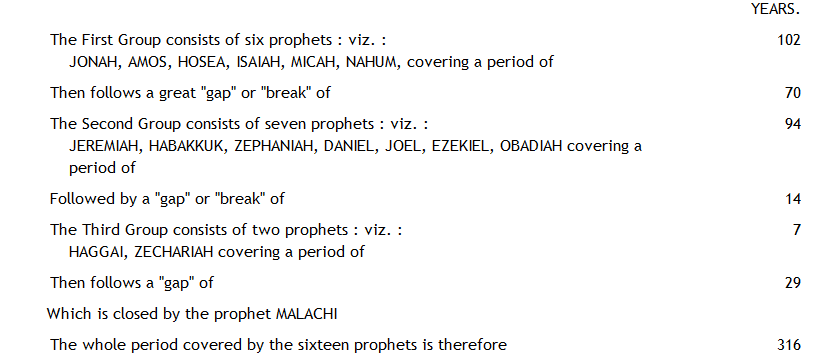
From the above it is seen that MALACHI is to be reckoned as being separate and apart from the rest; and not, as
usually presented, linked together with HAGGAI and ZECHARIAH. “By the Hebrews, Malachi is known as ‘the Seal of the
Prophets’, and as closing the Canon of the Jewish Scriptures.” (*2)
The other fifteen prophets (5 x 3) arrange themselves in three groups of 6, 7, and 2; and the period covered by
these collectively — including the breaks — is 287 years (forty-one sevens).
6. The First Group commences with JONAH and ends with NAHUM. Both are connected with Nineveh. This group
consists of six prophets, and the period they cover is 102 years (seventeen sixes).
Between the First and Second Groups there is the great “gap” or “break” of seventy years (ten sevens, see Ap. 10).
According to Jewish tradition, ISAIAH perished in the Manassean persecution (see the Note on p. 930). If this persecution
took place, or culminated, about five years after Manasseh’s accession — as is most probable — this would be 584 B.C.;
and that year is sixty-five years from the dated commencement of Isaiah’s “Vision”: viz., the year in which King UZZIAH
died (649 B.C.: see Ap. 50. VII, p. 68, and cp. the Chart on p. 113).
We have, however, no indication that “the Word of the Lord came” to ISAIAH later than the end of the reign of
ZEDEKIAH, and MANASSEH’S accession in 588 B.C.
Therefore, from that year on, and until “the thirteenth year of Josiah” (518 B.C.), there was no “coming” of “the
Word”; but, instead, a long solemn silence on the part of Jehovah for seventy years! (588 – 518 = 70.) This silence was
broken at length by the Divine utterances through JEREMIAH, HABAKKUK, and ZEPHANIAH simultaneously, in 518 B.C.;
and the Word then “came” in an unbroken sequence of ninety-four years (518 – 424 = 94) through the seven prophets
associated with the final scenes in the history of the Southern Kingdom, JUDAH — including the Babylonian Captivity —
as the six earlier prophets had been associated with the closing scenes of the Northern Kingdom, which ended in 601
B.C.
The Second Group closes with the latest date recorded by Daniel, “the third year of Cyrus” (Da 10:1), i.e. in 424
B.C. Then occurs a short break of fourteen years (two sevens) between DANIEL and HAGGAI (424 – 410 = 14), followed
by The Third Group, consisting of HAGGAI and ZECHARIAH, extending over seven years (410 – 403 = 7).
The seven years covered by Zechariah are succeeded by the last “break” of twenty-nine years, closed by the affixing
of “the Seal of the Prophets”, MALACHI, in 374 B.C. This was exactly thirty years from the restoration of the Temple
worship and ritual, commencing after the Dedication of the Temple in 405 B.C., with the First Passover in Nisan, 404
B.C. (Ap. 58, p. 84).
This year (374 B.C.) marked the commencement of the last great national testing time of the People in the land: viz.
four hundred years (40 x 10), and ended with the beginning of Christ’s ministry in A.D. 26.
7. On examining this chronological grouping, it will be seen that it presents the prophetical books to us as a whole;
and thus, in a manner is at variance with the usual classification into “Four Prophets the Greater (or Longer), and
Twelve Prophets the Minor or (Shorter).”
Although it is, of course, manifestly true that ISAIAH, JEREMIAH, EZEKIEL, and DANIEL are “greater”, in the sense that
they are messages of ampler dimensions, and far wider scope than the majority of the others, yet –according to their
chronological positions in the Scriptures, as shown in the Chart (p. 113) — it would appear that they are grouped
together by the Divine Spirit, with the so-called “Minor” (or Shorter) prophets, as being units only in a particular
“coming” of the Word of Jehovah, during certain clearly defined periods of time connected with the close of the
national history of Israel’s sons as possessors of the land.
It is interesting to note the close association of the figures “6 ” and “7 ” with these periods.
a. The three groups together cover a period of 203 years, during which “the Word of the Lord came”
through the prophets (102 + 94 + 7 = 203); and 203 is twenty-nine sevens.
b. The prophecies of the First Group, linked together by the number of Man “6 ” (Ap. 10), are seen to be
closely connected with the last hundred years or so of the Northern Kingdom. The prophecies of the
Second Group, linked together by the special number of Spiritual Perfection “7 ” (Ap. 10), are as closely
connected with the destruction and punishment of JUDAH and JERUSALEM.
c. In the First Group, HOSEA, ISAIAH, and MICAH were contemporary for twenty-one years (three sevens);
viz. from 632 to 611 B.C. In the Second Group, JEREMIAH, DANIEL, JOEL, and EZEKIEL are contemporaries
for seven years (one seven); viz. from 484 to 477 B.C.
If OBADIAH’S date is 482 B.C., then we have five prophets all contemporaries during this period. And five is the
number associated with Divine Grace (Ap. 10).
After the “break” of fourteen years (two sevens) between the Second and Third Groups, we have ZECHARIAH, the last
of the fifteen prophets of the three groups, continuing from 410 to 403 B.C. (one seven); HAGGAI being contemporary
with him in 410. The fifteen prophets represent the number of Grace thrice repeated (5 x 3).
8. MALACHI’S date is 374 B.C. As stated above, this is exactly thirty years after the Restoration, and the resumption
of the Temple worship and ritual, beginning with the Passover in 404 B.C. (Ezr 6:19). The “Seal of the Prophets” was
therefore affixed thirty years from that important start-point, and twenty-nine clear years from Ezra’s last date: viz.,
1 st of Nisan 403 B.C. (Ezr 10:17), the year that witnessed the Dedication of the Wall (Ne 12:27-47) and the Reformation
of the People under Nehemiah (Ne 13).
9. It may also be noted that the Book of JONAH — the prophet quoted by our Lord as the “Sign” of His own
Resurrection — commences the grouped fifteen, while ZECHARIAH ends them with the glorious and detailed statements
of the Return of the King to reign as “the Lord of all the earth”.
Again: as the “break” of twenty-nine years follows after Zechariah, before the “Seal”, MALACHI, is affixed in 374 B.C.,
this points to a fact of great importance: viz., that the O.T. is really closed by the Book of Zechariah and not Malachi,
as usually understood. Malachi marks the commencement of the great final probationary period of 400 years, which
ended with the coming of “My Messenger” (John the Baptist) followed by the Advent of “the Messenger of the
Covenant” (Messiah Himself).
MALACHI is thus seen to be linked on to John the Baptist (cp. Mal 4:5,6, and Mt 11:10-15), and “seals” together the last
page of the O.T., and the beginning of “The Book of the Generation of Jesus the Messiah.”
(*1) The belief of some that Heb 11:37 refers to Jeremiah is based on the Jewish tradition that the prophet was
“stoned” to death in Egypt. But of this we have no proof.
(*2) WORDSWORTH on Malachi, Prelim. note.
The Table From Page 113.
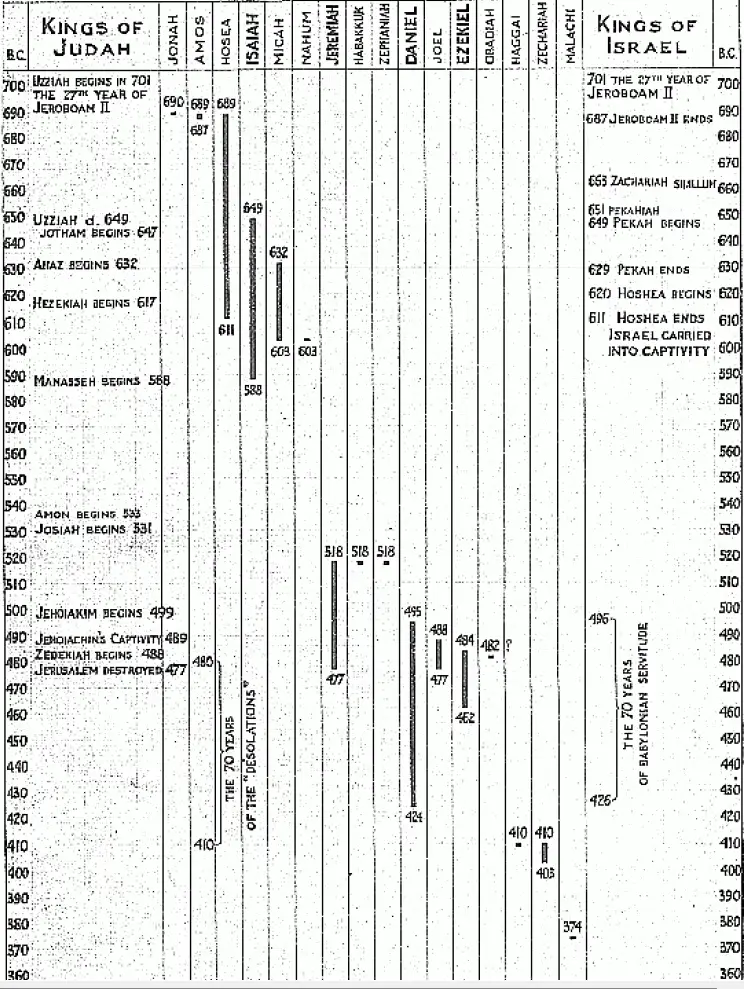

Appendix 78
THE INTER-RELATION OF THE PROPHETICAL BOOKS
In the Hebrew Canon (Ap. 1) we have:
1. The five books of the “Law”. This is the number of Grace.
2. The eight books of the “Prophets” — this is the Dominical number.
3. The eleven books of the Hagiographa –this is the remarkable number (the fifth prime) which plays so
important a part in the works of God. (See Ap. 10.)
In the Law, the grace of God was shown to Israel (Dt 4:31-37, &c.); but true grace came by Jesus Christ. (See note on
John 1:16 John 1:17.) In the Prophets, we have Jehovah’s special dealing with Israel. In the “former prophets” we see
the law-principle; and in the latter prophets we see faith-principle; and two together presenting us with a wonderful
picture of the failure of man on the one hand, and the faithfulness of Jehovah on the other.
THE BOOKS OF THE PROPHETS.
Through the changing of the order of the books of the prophets, by the Translators of the Septuagint, the Church has
lost sight of the one grand illustration of the great principle of Old Testament teaching, which is currently supposed to
be taught only in the New; viz, that law-principle brings in “the curse”, whereas faith-principle brings in “the blessing”.
The non-recognition of the fact that this is Old Testament teaching has obscured the specific doctrine of the New: viz.,
that over and above belief on the Lord Jesus Christ, a “mystery” or “secret”, which had been hid in God “from the
beginning of the world” (Eph 3:9), was made manifest after Pentecost, and after the Dispensation covered by the Acts
of the Apostles, to the apostle Paul. See notes on Eph 1:9 Eph 3; and 5:32.
There is another Structure, differing from that given in Ap. 1, but equally true, viz.:—
THE FORMER PROPHETS.
LAW-PRINCIPLE.
A | JOSHUA. Israel brought into the Land. God keeps His covenant. Israel under priests.
B | JUDGES. Israel in the Land. Man breaks the covenant. Failure of the priesthood.
B | SAMUEL. Israel in the Land. God shows mercy in appointing prophets, and a king whose throne shall be
established for ever.
A | KINGS. Israel ejected from the Land. Man breaks the covenant as before; the ten tribes and the kings break
the one made with David.
Here, in the “former” prophets (Zec 7:7), we see, arranged in an Introversion, the whole of Israel’s failure in the
Land, set forth by the Lord. Now we are shown in the “latter” prophets how God’s faithfulness was going to secure His
own purposes, and Israel’s blessing.
THE LATTER PROPHETS.
FAITH-PRINCIPLE.
Priests and kings were anointed: but God would now send an anointed One, i.e. Messiah; and if they would believe
on Him they would be established. For He would be also a Prophet. Corporate testimony had failed: therefore there
would be a division among individuals of the nation on account of Him; so that in times of crisis those whose sins had
not been expiated by His priestly work would be excluded from the Nation for not hearkening to Him as Prophet (Dt
18:18,19), and extirpated by His work as King (Isa 6:9-13; 7:9; Jn 7:40-43; Ac 3:19-26; 13:38-52; Mt 13:36-43). In Him,
then, the righteous Servant of Jehovah, the future of Israel is seen in the latter prophets (Isa 49).
He is both rejected and accepted. The Nation went back to the land to try that question under Divine auspices (Da
9:24-27). When they rejected Him, they were not established, but again scattered. But when they accept Him they
will be regathered, and never again rooted out.
They can come back only through David (from whom their second breach of covenant referred to was a departure),
before the first breach of covenant can be healed up; for the character and form of the Structure (here, as elsewhere)
corresponds with the subject-matter; and, in this, the Introversion of the Structure is the same as the principle on
which God works: viz., by introversion. The Law must go forth from Zion.
We find then that the following is the Structure, showing
THE INTER-RELATION OF THE PROPHETIC BOOKS.
C | ISAIAH. Restoration of the throne of David through the priestly work of Messiah, from the standpoint of the
two tribes.
D | JEREMIAH. Political disruption, and final restoration of Judah and Ephraim (the twelve tribes) by a new
Covenant.
D | EZEKIEL. Ecclesiastical disruption, God ceasing to rule the Land in demonstration; and final restoration
of the same, re-establishing all the twelve tribes.
C | THE TWELVE MINOR PROPHETS. Restoration of the throne of David through the priestly work of Messiah,
from standpoint of the ten tribes. (See the Structure of these, preceding HOSEA.)
The New Covenant of Jer 31:31-34 has indeed been made (Mt 26:28); and can never be made again: for His “blood of
the Covenant” has been shed, once for all. Had the nation repented on the proclamation of Peter (Ac 2:38; 3:19-26), all
would have been fulfilled; in the same way as John the Baptist would have been taken for Elijah the prophet (Mal 3:1;
4:5. Cp. Mt 11:10-15) had the nation, through its rulers, repented at his proclamation (Mt 3:1,2) and that of Messiah (Mt
4:17, &c.). But, seeing that these great calls to “repent” were not obeyed, both fulfillments stand in abeyance, until this
one great condition of national restoration and blessing shall have taken place.
The modern doctrine, in certain circles, that the New Covenant holds good with Gentiles now, or with the
present-day “house of Israel”, would bestow justification on unbelievers. This is not the teaching of Heb 8 and 10. This
does not affect the position of those who are “in Christ” in this Dispensation of the “Mystery”. They have all, and more
than all, in that “New Covenant” which will yet bring back blessing to Restored Israel.
When that national repentance does take place, the time will come for the travailing woman to bring forth (Isa
66:8; Jn 16:19-22). But that is still future. What is true, is that declaration of Jehovah by Micah: “Therefore will He
give them up, until the time that she which travaileth hath brought forth; then the remnant of his brethren shall
return unto the children of Israel” (Mic 5:3).
Appendix 79
ISAIAH: THE EVIDENCES FOR ONE AUTHORSHIP
The hypothesis of modern critics is that Isaiah is not the sole author of the prophecy bearing his name, but that he
only wrote chapters 1-39 (called by them “the former portion”), and that an unknown author or authors (for there are
now alleged to have been three, or more, Isaiahs) are responsible for chapters 40 to the end (called by them “the latter
portion”). Thus, they would treat this prophecy mush as Isaiah himself is said to have been treated, who, as tradition
tells us, was “sawn asunder”. This “latter portion” also modern critics would relegate to a later date: viz., toward the
close of the seventy years’ exile. This is a very modern theory; for, the one authorship of this prophecy has been held
without question by both Jews and Christians for over 2,000 years.
I. THE USE OF HIS NAME IN THE NEW TESTAMENT.
A sufficient and conclusive answer to this matter is afforded by Holy Scripture itself, in the fact that Isaiah is
twenty-one times mentioned by name in the New Testament as the author of this prophecy. Eleven of these passages
attribute to him words occurring in the latter portion of the book, and ten of them words occurring in the former
portion. A complete list is appended, divided as follows:—
(i) THE TEN PASSAGES NAMING ISAIAH AS THE AUTHOR OF THE “FORMER” PORTION.
Mt 4:13.
Mt 13:14.
Mt 15:7.
Mk 7:6.
Jn 12:39.
Jn 12:41.
Ac 28:25.
Ro 9:27.
Ro 9:29.
Ro 15:12.
Isa 9:1,2.
Isa 6:9.
Isa 29:13.
Isa 29:13.
Isa 6:9.
Isa 6:9.
Isa 6:9.
Isa 10:22,23.
Isa 1:9.
Isa 11:10.
(ii) THE ELEVEN PASSAGES NAMING ISAIAH AS THE AUTHOR OF THE “LATTER” PORTION.
Mt 3:3.
Mt 8:17.
Mt 12:17.
Lk 3:4.
Lk 4:17.
Jn 1:23.
Jn 12:38.
Ac 8:28.
Ac 8:30.
Ro 10:16.
Ro 10:20.
Isa 40:3.
Isa 53:4.
Isa 42:1-3.
Isa 40:3-5.
Isa 61:1,2.
Isa 40:3.
Isa 53:1.
Isa 53:7,8.
Isa 53:7,8.
Isa 53:1.
Isa 65:1,2.
(iii) The above twenty-one passages are distributed over six books of the New Test.: viz., Matt. (six times); Mark
(once); Luke (twice); John (four times); Acts (three times); Romans (five times).
(iv) And the prophet is named by seven different speakers or writers in the New Testament: Four times by Christ
Himself; three being from the former portion of Isaiah (Mt 13:14; 15:7. Mk 7:6), and one from the latter (Mt 12:17).
Twice by Matthew: once from the former portion (Mt 4:14), and once from the latter portion (Mt 8:17).
Four times by Luke: all from the latter portion of Isaiah (Lk 3:4; 4:17. Ac 8:28,30).
Three times by John the Evangelist: twice from the former portion (Jn 12:39,41), and once from the latter portion
(Jn 12:38).
Twice by John the Baptist: both from the latter portion (Mt 3:3. Jn 1:23).
Six times by Paul the Apostle: four from the former portion (Ac 28:25. Ro 9:27,29; 15:12), and twice from the latter
portion (Ro 10:16,20).
II. THE EMPLOYMENT OF CERTAIN WORDS.
A further evidence of the unity of Isaiah is furnished by the Structure of the book: which, as the student of The
Companion Bible will readily perceive, does not lend itself in any degree to the arbitrary ending suggested, at chapter
39. A “pillar” of this “theory” is found in the supposed occurrence of certain words in the “former” portion of the
prophecy which are not found in the “latter” portion, and vice versa. An examination of a few such words which are
cited by modern critics will show the palpable inaccuracy characterizing their assertions.
It is asserted that the following are found only in the “latter” portion of Isaiah (chapters 40 to the end):—
1. The titles Creator, Redeemer, Savior. But the facts of creating, redeeming, and saving are referred to in
1:27; 12:1,2; 14:1; 17:10; 25:9; 27:11; 29:22; 30:18; 33:22; 35:10.
2. The thought of Jehovah as “Father”. But the relation is stated in 1:2.
3. The word bachar (to choose). But see 1:29; 7:15,16; 14:1.
4. The word halal (to praise). But see 13:10; 38:18.
5. The word paer (to glorify). But see 10:15.
6. The word patsach (to break forth into joy). But see 14:7.
7. The word tsemach (to spring forth). But see 4:2.
8. The word zero’ (the arm [of Jehovah]). But see 9:20; 17:5; 30:30; 33:2.
There are more than 300 words and expressions which are common to both the alleged “former” and “latter” portions
of Isaiah’s prophecy; and which do not occur at all in the later prophecies of Daniel, Haggai, Zechariah, and Malachi. A
sufficient number of these, to illustrate this fact amply, will be found given in the notes under their occurrences.
Appendix 80
ISAIAH: QUOTATIONS AND ALLUSIONS IN THE NEW TESTAMENT
The prophet Isaiah is quoted or referred to some eighty-five times in the New Testament. But several passages are
cited or alluded to more than once; so that sixty-one separate passages are referred to in these eighty-five New
Testament citations.
Of these sixty-one passages in Isaiah, it will be noticed that twenty-three are from the alleged “former” part of Isaiah
(chs. 1-39), and are cited thirty-two times; while thirty-eight (the larger number) are cited from the alleged “latter”
part (chs. 40-66) which is most called in question by modern critics. These sixty-one passages are cited eighty-five
times.
The following table exhibits the whole; and the evidence hereby afforded, as to the unity of the authorship of
Isaiah, may be added to that already given in Ap. 79:—
(The alleged “former” part) 8:14.
ISAIAH.
1. 1:9.1.
2. 6:1-3.2.
3. 6:9,10.3.
4. 7:14.
5. 8:12,13.
6. 8:14.
7. 8:18.
8. 9:1,2.
9. 10:22,23.
10. 11:4.
11. 11:10.
12. 21:9.
13. 22:13.
14. 22:22.
15. 25:8.
16. 28:11,12.
17. 28:16.
18. 29:10.
19. 29:13.
20. 29:14.
21. 29:16.
22. 34:4,10.
23. 35:3.
(The alleged “latter” part)
1. 40:3-6.
2. 40:6-8.
3. 40:13.7.
4. 41:4.
5. 42:1-4.12.
6. 43:18,19.
7. 45:9.14.
8. 45:23.
9. 49:6.
10. 49:8.
11. 49:10.
12. 52:5.
13. 52:7.
14. 52:11.
15. 52:15.
16. 53:1.
17. 53:4.
18. 53:5.
19. 53:7,8.
20. 53:9.30.
21. 53:12.
22. 54:1.
23. 54:13.
24. 55:3.34.
25. 55:10.
26. 56:7.
27. 57:19.
28. 59:7,8.
29. 59:17.
30. 59:20,21.
31. 60:3,10,11.44.
32. 61:1,2.
33. 63:2,3.
34. 64:4.
35. 65:1,2.
36. 65:17.
37. 66:1,2.
38. 66:24.
NEW TESTAMENT.
1. Ro 9:29.
2. Jn 12:41.
3. Mt 13:14.
4. Mk 4:12.
5. Lk 8:10.
6. Jn 12:40.
7. Ac 28:26,27.
8. Mt 1:23.
9. 1 Pe 3:14,15.
10. Ro 9:32-33.
11. Heb 2:13.
12. Mt 4:14-16.
13. Ro 9:27,28.
14. 2 Th 2:8.
15. Ro 15:12.
16. Rv 14:8.
17. Rv 18:2.
18. 1 Co 15:54.
19. Rv 3:7.
20. 1 Co 15:54.
21. Rv 7:17.
22. 1 Co 14:21.
23. Ro 9:33.
24. Ro 10:11.
25. 1 Pe 2:6.
26. Ro 11:8.
27. Mt 15:8,9.
28. Mk 7:6,7.
29. 1 Co 1:19.
30. Ro 9:20.
31. Rv 6:13,14.
32. Heb 12:12.
1. Mt 3:3.
2. Mk 1:2,3.
3. Lk 3:4-6.
4. Jn 1:23.
5. 1 Pe 1:24,25.
6. Jas 1:10,11.
7. Ro 11:34.
8. 1 Co 2:16.
9. Rv 1:8,11,17.
10. Rv 21:6.
11. Rv 22:13.
12. Mt 12:17-21.
13. 2 Co 5:17.
14. Ro 9:20.
15. Ro 14:11.
16. Php 2:10,11.
17. Lk 2:32.
18. Ac 13:47.
19. 2 Co 6:2.
20. Rv 7:16.
21. Ro 2:24.
22. Ro 10:15.
23. 2 Co 6:17.
24. Ro 15:21.
25. Jn 12:38.
26. Ro 10:16.
27. Mt 8:17.
28. 1 Pe 2:24,25.
29. Ac 8:32,33.
30. 1 Pe 2:22.
31. Mk 15:28.
32. Gal 4:27.
33. Jn 6:45.
34. Ac 13:34.
35. 2 Co 9:10.
36. Mt 21:13.
37. Mk 11:17.
38. Lk 19:46.
39. Eph 2:17.
40. Ro 3:15.
41. Eph 6:14-17.
42. 1 Th 5:3.
43. Ro 11:26,27.
44. Rv 21:24-26.
32. 61:1,2.45. Lk 4:17-19.
46. Rv 19:13-15.
47. 1 Co 2:9.
48. Ro 10:20,21.
49. 2 Pe 3:13.
50. Rv 21:1.
51. Ac 7:49,50.
52. Mt 5:34,35.
53. Mk 9:44.
The eighty-five citations or allusions are distributed as follows: In Matt. there are nine; Mark, six; Luke, five; John,
five; Acts, five; Rom., eighteen (eight from the “former” part, and ten from the “latter”); 1 Cor., six; 2 Cor., four; Gal.,
one; Eph., two; Phil., one; 1 Thess., one; 2 Thess., one; Heb., two; James, one; 1 Pet., five; 2 Pet., one; Rev.,
twelve (five from the “former” part, and seven from the “latter”).
Twelve books give six direct quotations.
Eighteen books contain eighty-five allusions to Isaiah.
Only seven books out of twenty-seven have none.
The greater part of the New Testament is concerned with establishing the genuineness and authority of the book of
the prophet Isaiah, and its one authorship. (See Ap. 79.)
Appendix 81
THE “ALTAR TO JEHOVAH IN THE LAND OF EGYPT” (Isa 19:19)
The fulfillment of this prophecy took place in 1 B.C., and is recorded by Josephus (Ant. xiii. 3. 1-3; 6; Wars 7. 10, 3;
and Against Apion, 2. 5):—
In consequence of wars between the Jews and Syrians, ONIAS IV, the High Priest, fled to Alexandria; where, on
account of his active sympathy with the cause of Egypt against Syria, he was welcomed by PTOLEMY PHILOMETOR, and
rewarded by being made prince over the Jews in Egypt, (*1) with the title of Ethnarch and Alabarch. Josephus says:—
“Onias asked permission from Ptolemy and Cleopatra to build a temple in Egypt like that at Jerusalem, and to appoint
for it priests and Levites of his own Nation. This he devised, relying chiefly on the prophet Isaiah, who, 600 years
before predicted that a temple must be builded in Egypt by a Jew to the supreme God. He therefore wrote to
Ptolemy and Cleopatra the following epistle:—
‘Having come with the Jews to Leontopolis of the Heliopolite district, and other abodes of my Nation, and
finding that many had sacred rites, not as was due, and were thus hostile to each other, which has befallen
the Egyptians also through the vanity of their religions, and disagreeing in their services, I found a most
convenient place in the fore-mentioned stronghold, abounding with wood and sacred animals. I ask leave,
then, clearing away an idol temple, that has fallen down, to build a temple to the supreme God, that the
Jews dwelling in Egypt, harmoniously coming together, may minister to thy benefit. For Isaiah the prophet
has predicted thus: “There shall be an altar in Egypt to the LORD God”; and he prophesied many other such
things concerning the place.’
“The King and Queen replied: ‘We have read thy request asking leave to clear away the fallen temple in
Leontopolis of the Heliopolite nome. We are surprised that a temple should be pleasing to God, settled in an
impure place, and one full of sacred animals. But since thou sayest that Isaiah the prophet so long ago
foretold it, we grant thee leave, if, according to the Law we may not seen to have offended against God.'”
(Ant. xiii. 6.)
The place of this temple was the identical spot where many centuries before, Israel had light in their dwellings while
the rest of Egypt was suffering from a plague of darkness. Here again was light in the darkness, which continued for
more that 200 years (about 160 B.C. to A.D. 71), when it was closed by Vespasian.
The Jerusalem Jews were opposed to, and jealous of, this rival temple; and, by changing two letters almost identical
in form (<START HEBREW>j<END HEBREW> = „ [or CH] to <START HEBREW>h<END HEBREW> = H) turned “the city of the sun” (cheres) into “the city of destruction (heres). But the
former reading is found in many codices, two early printed editions, and some ancient versions, as well as in the
margins of the A.V. and R.V. The Septuagine reading shows that the Hebrew MSS. from which that version was made,
read ‘irha-zedek = “the city of righteousness.”
The “five cities” of Isa 19:18 were probably Heliopolis (the city of the sun, where this temple was built),
Leontopolis, Daphne, Migdol, and Memphis.
(*1) See longer note in the Text on p. 1096.
Appendix 82
THE FORMULAE OF PROPHETIC UTTERANCE
It is clear that there was an appropriate and recognized style of prophetic address, and of the introduction to
special prophetic utterances. By attending to this we shall read the prophetic books to an advantage that cannot be
realized by submitting, without thought, to the superficial guidance of chapter-beginning and chapter-ending. These
will be found of little use in helping us to distinguish separate and distinct prophecies.
In JEREMIAH, the formulae are generally “The word of the LORD came”, “Thus saith the LORD”, or “The word that
came”.
In EZEKIEL, the call is to the prophet as “son of man”, (*1) and the formula is “the word of the LORD came”, many
times repeated.
In the Minor (or Shorter) Prophets, it is “The word of the LORD by”, “Hear the word that the LORD hath spoken”, or
“The burden of the word of the LORD”.
In ISAIAH, the prophetic utterances have two distinct forms. As to Israel, the chosen People, they open with “Listen”,
“Awake”, “Ho”, “Arise, shine”, “Behold”; while in the case of the surrounding nations it was a series of “Burdens” or
“Woes”; as well as to Ephraim (28), and to the rebellious sons who go down to Egypt, to the “Assyrian”, &c. See the
Structures on pp. 930, 1015, and 1104.
An illustrative example of the usefulness of noting these formulae is furnished by Isa 34 and 35. Most Commentators
make chapter 35 commence a new prophecy, and thus entirely obscure the great issue of the prophecy, which begins
in ch. 34:1 with the Call:—”COME NEAR, YE NATIONS, to hear; and HEARKEN, ye peoples: let the earth HEAR”, &c. The
Call is to witness Jehovah’s JUDGMENT ON EDOM (in ch. 34), which issues in the salvation of ISRAEL (in ch. 35). Thus
the prophecy is seen to have no break, but forms one complete and comprehensive whole, embracing these two great
parts of one subject.
In ch. 34 we have the desolation of Edom: wild beasts celebrate the discomfiture of its inhabitants: then, in ch. 35,
the wilderness and solitary place are seen to be glad; and, as it were, in sympathy with Divine judgment, the desert
rejoices and blossoms as the rose (35:1, 2). In the result, ch. 35 shows that the People of Jehovah enjoy the inheritance
of the Edomites. Not only are their enemies gone, but so are the wild beasts which were at once the evidences and
tokens of their judgment. It will have become the way of holiness; the unclean shall not pass over it; no lion shall be
there, but the redeemed shall walk there (35:8, 9).
But all the beauty of this wonderful transition is lost, when chapter 35 is made the beginning of a new and distinct
prophecy; and, more that this, the difficulty is created by the Hebrew suffix “for them”, in 35:1. Not knowing what to
do with it, the Revisers solve the difficulty by simply omitting these two words “for them”; and this in the absence of
any manuscript authority, and without giving in the margin even the slightest hint that they have entirely ignored the
Hebrew suffix in the verb susum (i.e. the final “m”).
The two chapters (34 and 35) form a comprehensive message, a matter of world concern: for it combined an
implied vindication of the righteousness of God, and a confirmation of His promise to save His People Israel with an
everlasting salvation.
A failure to recognize the formula of Isaiah’s prophetic utterance led, first, to a misapplication of the chapter, and
then to an unjustifiable disregard of the pronominal suffix. This typical case of confusion, resulting primarily from an
unfortunate arrangement in chapter-division, suggests the great importance of care being exercised in a correct
individualizing of the prophecies of Holy Scripture.
(*1) Without the article. For the expression “THE Son of Man” belongs only to Him Who was “t f6 he second
man”, “the last Adam”, the successor or superseder of “the first man Adam” to Whom dominion in the earth is now
committed. Cp. Ge 1:26, Ps 8:1,9; and vv. 4-6, Heb 2:8 “not yet”. See Ap. 98.
Appendix 83
JEREMIAH: THE CHRONOLOGICAL ORDER OF HIS PROPHECIES
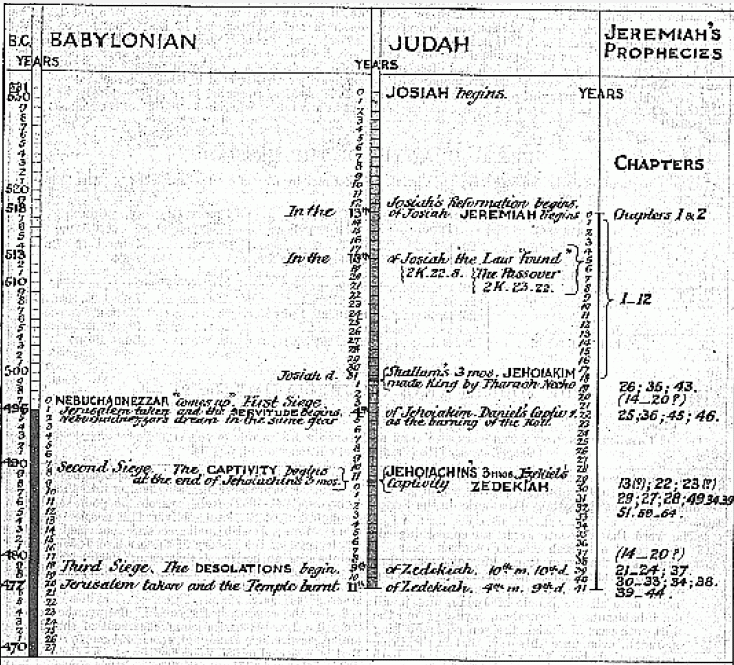
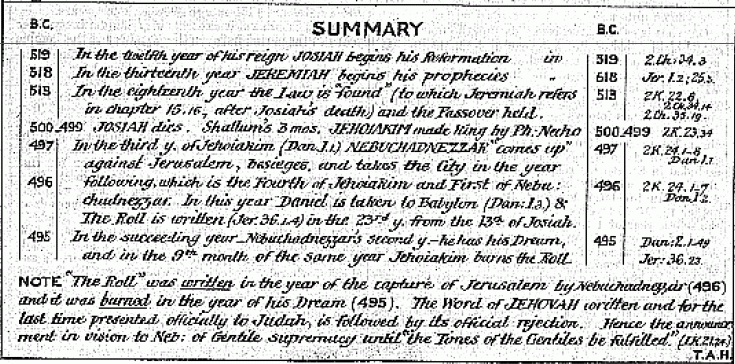
Appendix 84
THE SEPTUAGINT VERSION OF JEREMIAH
The Septuagint translation of Jeremiah differs both in matter and form from the Massoretic Hebrew Text. It is a
Paraphrase rather than a Version, and an Exposition rather than a Translation. It is not therefore to be regarded as
representing an independent Hebrew Text, but as a paraphrase, often abbreviated, and often inaccurate. No Hebrew
MS. ever seen corresponds with a text from which the Septuagint professes to have been derived.
It omits about one-eighth of the Hebrew text, or about 2,700 words; while the changes manifest the carelessness and
arbitrariness of the translator or translators. Indeed, the Hebrew language does not seem to have been understood, or
its meaning apprehended; for, when the sense of a word could not be understood, it was summarily transliterated in
Greek characters.
It is needless therefore to treat it seriously, or to set out in any tables wherein such differences consist.
Appendix 85
JEREMIAH, A TYPE OF THE MESSIAH
In many particulars Jeremiah was a type of Christ. Sometimes by way of contrast (marked *). The following passages
may be compared:—
JEREMIAH
(Type).
11:18
11:19
11:19*
11:20
13:17
18:23
18:23*
20:7
20:10
26:11
26:15
26:15,16
29:26
29:27
Lam 1:12
3:8
3:14
3:48
CHRIST
(Antitype).
Isa 11:2. Jn 2:25.
Isa 53:7,8.
Isa 53:10.
Isa 53:11.
Mt 26:38. Lk 19:41; 22:41,44,45.
Jn 11:53.
Lk 23:34,61.
Mk 5:40.
Lk 11:54. (Cp. Ps 55:12,13.)
Mt 26:65,66.
Mt 27:4-25.
Jn 10:21. Lk 23:13-15.
Jn 7:20; 10:20,39.
Jn 8:53. Lk 7:39.
Jn 1:29. Isa 53:10.
Mt 27:46.
Ps 69:12.
Lk 19:41.
Appendix 86
“THE FOURTH YEAR OF JEHOIAKIM”
(Jer 25:1-3)
(Being supplemental to Appendix 50, p. 42).
“The only ancient authority of value on Babylonian History is the Old Testament” (Encycl. Brit., 11 th (Cambridge)
edition, vol. iii, p. 101).
1. The great prophecy of the seventy years of Babylonian servitude in Jer 25 is prefaced, in vv. 1-3, by one of the
most important date-marks in the Scriptures:—
“The word that came to Jeremiah concerning all the people of Judah IN THE FOURTH YEAR
OF JEHOIAKIM the son of Josiah king of Judah, that WAS THE FIRST YEAR OF
NEBUCHADNEZZAR king of Babylon; the which Jeremiah the prophet spake unto all the
people of Judah, and to all the inhabitants of Jerusalem, saying, From the thirteenth year of
Josiah the son of Amon king of Judah, even unto this day, that is the three and twentieth
year, the word of the LORD hath come unto me.”
On what is called “received” dating, the fourth year of Jehoiakim (being the first year of Nebuchadnezzar) is usually
given as 606 B.C.; whereas in The Companion Bible, both in the margin, and in Ap. 50. V, p. 60, and VII, p. 67, it is
shown as 496 B.C. — a difference of 110 years. This is a serious matter, but the reason is simple, and is as follows:—
In the majority of the systems of dating extant, chronologers have ignored, and omitted from their sequence of Anno
Mundi years, the ninety-three years included in St. PAUL’S reckoning in Ac 13:19-22; and also, in the majority of cases,
the interregnum and “gaps” in the later kings of Judah, amounting together to 110-113 years (*1); and, further, by
accepting the 480 th year of 1 Ki 6:1 as being a cardinal, instead of an ordinal number; and as being an Anno Mundi date,
instead of one to be understood according to Anno Dei reckoning (see Ap. 50, Introduction, § 6).
The Holy Spirit, we may believe, expressly made use of St. Paul, in the statement in the passage referred to, in
order to preserve us from falling into this error. CLINTON (1781-1852) well says on the point (*2): “The computation of
St. Paul, delivered in a solemn argument before a Jewish audience, and confirmed by the whole tenor of the history in
the Book of Judges, out-weighs the authority of that date” (480). In spite, however, of this Divine warning, many
accept the 480 th year as being a cardinal number, and reckon it as an Anno Mundi date.
2. On the commonly “received” dating, the period from the Exodus to the commencement of the Babylonian
servitude is usually given as 1491 B.C. to 606 B.C.; that is, a period of 885 years; whereas The Companion Bible dates
are 1491 B.C. to 496 B.C. = 995 years.
But, if ST. PAUL is correct in adding ninety-three years to the period between the Exodus and the Temple (making
thus 573 instead of 479); and if the inter-regnum between Amaziah and Uzziah, and the “gaps” clearly indicated in the
sacred record and shown on the Charts in Ap. 50 are recognized, then it is perfectly clear that the majority of the
chronologers are 110 to 113 years out of the true Anno Mundi reckoning, and, instead of the Babylonian servitude
commencing in the year 606 B.C. (the fourth year of Jehoiakim and first year of Nebuchadnezzar), the real Anno Mundi
year for that most important event is 496 B.C., as shown in Ap. 50.
3. This, no doubt, will be startling to some who may be inclined to suppose that certain dates and periods of time in
the Scriptures have been irrevocably “fixed”.
On the authority of certain well-known names, we are asked to believe that “profane history”, and the annals of
ancient nations, supply us with infallible proofs and checks, whereby we can test and correct the chronological
statements of Holy Scripture. But we need to be reminded that this is very far from being true.
Chronologists of all ages are, as a rule, very much like sheep — they follow a leader: and, once the idea became
current that the “correct” (supposed) dates of certain epochs and periods in Greek (and other) history could be brought
to bear upon and override certain Biblical chronological statements, which presented “difficulties” to these modern
chronologers, then it soon became almost a matter of course to make the figures of Divine revelation submit and
conform to “profane” figures, derived from parchment or clay, instead of vice versa. (*3)
4. FYNES CLINTON, in his learned work Fasti Hellenici (Vol. I, pp. 283-285) has such an appropriate and weighty
statement that bears on this subject, in the Introduction to his Scripture Chronology, that it is well to quote the
testimony of one who is regarded as among the ablest of chronologers. He remarks:—
“The history contained in the Hebrew Scriptures presents a remarkable and pleasing contrast to the early
accounts of the Greeks. In the latter, we trace with difficulty a few obscure facts preserved to us by the
poets, who transmitted, with all the embellishments of poetry and fable, what they had received from oral
tradition. In the annals of the Hebrew nation we have authentic narratives, written by contemporaries, and
these writing under the guidance of inspiration. What they have delivered to us comes, accordingly, under a
double sanction. They were aided by Divine inspiration in recording facts upon which, as mere human
witnesses, their evidence would be valid. But, as the narrative comes with an authority which no other
writing can possess, so, in the matters related, it has a character of its own. The history of the Israelites is the
history of miraculous inter-positions. Their passage out of Egypt was miraculous. Their entrance into the
promised land was miraculous. Their prosperous and their adverse fortunes in that land, their servitudes and
their deliverances, their conquests and their captivities, were all miraculous. Their entire history, from the
call of Abraham to the building of the sacred Temple, was a series of miracles. It is so much the object of the
sacred historians to describe these, that little else is recorded. The ordinary events and transactions, what
constitutes the civil history of other States, are either very briefly told, or omitted altogether; the incidental
mention of these facts being always subordinate to the main design of registering the extraordinary
manifestations of Divine power. For these reasons, the history of the Hebrews cannot be treated like the
history of any other nation; and he who would attempt to write their history, divesting it of its miraculous
character, would find himself without materials. Conformably with this spirit, there are no historians in the
sacred volume of the period in which miraculous intervention was withdrawn. After the declaration by the
mouth of Malachi that a messenger should be sent to prepare the way, the next event recorded by any inspired
writer is the birth of that messenger. But of the interval of 400 (*4) years between the promise and the
completion no account is given.”
And then CLINTON significantly remarks:—
“And this period of more than 400 (*4) years between Malachi and the Baptist is properly the only portion in
the whole long series of ages, from the birth of Abraham to the Christian era, which is capable of being
treated like the history of any other nation.
“From this spirit of the Scripture history, the writers not designing to give a full account of all transactions,
but only to dwell on that portion in which the Divine character was marked, many things which we might
desire to know are omitted; and on many occasions a mere outline of the history is preserved. It is mortifying
to our curiosity that a precise date of many remarkable facts cannot be obtained.
“The destruction of the Temple is determined by concurrent sacred and profane testimony to July, 587 B.C.
From this point we ascent to the birth of Abraham. But between these two epochs, the birth of Abraham and
the destruction of the temple, two breaks occur in the series of Scripture dates; which make it impossible to
fix the actual year of the birth of Abraham; and this date being unknown, and assigned only upon conjecture,
all the preceding epochs are necessarily unknown also.”
This important statement deserves the most serious consideration; for CLINTON himself frequently transgresses its
spirit in his Scripture Chronology: e.g. he “determines” the “captivity of Zedekiah to June, 587 B.C.” And this he
accomplishes by “bringing”, as he says, Scripture and profane accounts to “a still nearer coincidence by comparing the
history of ZEDEKIAH and JEHOIACHIN with the dates assigned to the Babylonian kings by the Astronomical Canon” (Fasti
Hellenici, I, p. 319). In other words, this means that he “squares” the scriptural records of events some 200 years before
the commencement of the period which he has before stated is alone “capable of being treated like the history of any
other nation”, by means of the Astronomical Canon of Ptolemy.
PTOLEMY’S Canon (cent. 2 A.D.) is to CLINTON and his disciples what the monuments are to PROFESSOR SAYCE and
his followers. Both “necessitate” the accommodation of Biblical chronology to suit their respective “Foundations of
Belief” in dating.
5. But it is on the principle so excellently enunciated by CLINTON, and quoted above, that the dating of The
Companion Bible is set forth: viz., that “the history of the Hebrews cannot be treated like the history of any other
nation”. If this is granted, the same argument must necessarily apply to the chronology of such a people. And it may be
carried a step farther. The chronology of the history of the Chosen People is unlike that of any other nation, in that it
has a system of reckoning by durations, and not, like other nations, by dates; and a system of registering events and
periods of time by what it may be permitted to call “double entry”. This is to say, not only do we find in the Bible a
regular sequence of years, commencing with Adam and ending with Christ, and consequently a true and perfect record
of Anno Mundi years in the lifetime of mankind during that period; but also, concurrently with this, we find another
system of dealing with dates and periods concerning the Hebrew race alone. This system is used and referred to in The
Companion Bible as being according to Anno Dei reckoning. (See Introduction to Ap. 50, pp. 40-42.) And it may be
strongly urged that failure on the part of the majority of chronologers, and partial failure on the part of others to
recognize this, so to speak, double entry system of the Bible dating has “necessitated”, as we are told, the adjustment
of the Biblical figures to suit the requirements of Astronomical Canons and ancient monuments.
6. But, to the candid mind it is incredible that the inspired Scriptures should be found so faulty in their chronological
records and statements as many would have us suppose; or that it is “necessitated” that they should be “determined” from
profane sources and un-inspired canons, whether on parchment or stone! (*5)
CLINTON’S Calendar of Greek dates, it must be borne in mind, only commences with the traditional date of the first
Olympiad (*6) (776 B.C.). From that year on and backwards, everything in his Scripture Chronology is assumed to be
capable of being arranged, and made to harmonize with that date.
But, it must also be remembered that grave suspicions have been entertained as to the correctness of this view.
SIR ISAAC NEWTON (1642-1727), for instance, in his Chronology of Ancient Kingdoms Amended, charges the Greek
chroniclers with having made the antiquities of Greece 300 or 400 years older than the truth. The whole passage reads
thus (Works, vol. v, p. 4 of the Introduction):—
“A little while after the death of ALEXANDER THE GREAT, they began to set down the generations, reigns, and
successions, in numbers of years; and, by putting reigns and successions equipollent (equivalent) to
generations; and three generations to an hundred or an hundred and twenty years, as appears by their
chronology, they have made the antiquities of Greece 300 or 400 years older than the truth. And this was the
original of the technical chronology of the Greeks. ERATOSTHENES wrote about an hundred years after the
death of ALEXANDER THE GREAT; he was followed by APOLLODORUS; and these two have been followed ever
since by chronologers.”
NEWTON then goes on to quote the attack on HERODOTUS by PLUTARCH (born about 46 A.D.), for chronological
nebulosity (*7), in support of his contention as to the uncertainty and doubtfulness of the chronology of the Greeks. He
further adds:—
“As for the chronology of the Latins, that is still more uncertain … The old records of the Latins were burnt by
the Gauls, sixty-four years before the death of ALEXANDER THE GREAT: and QUINTIUS FABIUS PICTOR (cent. 3
B.C.), the oldest historian of the Latins, lived an hundred years later than that king.”
7. If NEWTON was right, then it follows that the Canon of PTOLEMY, upon which the faith of modern chronologers is
so implicitly — almost pathetically — pinned, must have been built upon unreliable foundations. Grecian chronology is
the basis of “PTOLEMY’S Canon”; and, if his foundations are “suspect”, and this is certainly the case, then the elaborate
super-structure reared upon them must necessarily be regarded with suspicion likewise.
EUSEBIUS, the Church historian and bishop of Caesarea (A.D. 264-349), is mainly responsible for the modern system
of dating which results in squaring scriptural chronology with the Greek Olympiad years, and it is upon EUSEBIUS’S
reckonings and quotations that CLINTON also mainly relies.
In his Chronicle of Universal History, the first book, entitled Chronography, contains sketches of the various nations
and states of the old world from the Creation to his own day.
The second book of this work consists of synchronical tables with the names of the contemporary rulers of the
various nations, and the principal events in the history of each from ABRAHAM to his own time. EUSEBIUS gets his
information from various sources. He makes use of JOSEPHUS (A.D. 37-95), AFRICANUS (cent. 3 A.D.), BEROSUS (cent. 3
B.C.), POLYHISTOR (cent. 1 B.C.), ABYDENUS (about 200 B.C.), CEPHALION (cent. 1 A.D.), MANETHO (cent. 3 B.C.), and
other lost writers — equally “profane”.
In his turn, he is largely used by moderns to “determine” scriptural dates; and it is mainly through his instrumentality
that many of the so-called “received” datings of the O.T., from Abraham to the Christian era, have been “fixed”.
In addition to these and other ancient records, and “systems” of chronology, we have notably the Canon of Ptolemy
referred to above. PTOLEMY, an astronomer of the second century A.D., give a list of Babylonian, Persian, Greek,
Egyptian, and Roman rulers, “from about 750 B.C. to his own time.”
The Seder Olam is a Jewish chronological work of about the same date (cent. 2 A.D.).
Now to-day, we have what is called “the Witness of the Monuments”, of which it may be remarked that frequently
their testimony is accepted in preference to the scriptural record, and is often used to impugn the statements and
chronology of the Bible. The result of recent modern explorations in Assyria, Babylonia, and Egypt, has been that we
have almost every date in the O.T. redated, because we are told by some (as PROFESSOR SAYCE, quoted above) that
this is “necessitated” by the Assyrian Canon.
The Assyrian Eponym Canon is a list, compiled from several imperfect copies (*8) on clay tablets of lists of public
officials (called “Eponyms”) who held office, one for each year. This list contains some 270 names, and is supposed to
cover the period from soon after the close of Solomon’s reign to the reign of Josiah. It is spoken of as showing “some
slight discrepancies, (*9) but on the whole is held to be highly valuable”. This is the Assyrian Canon which, according to
PROFESSOR SAYCE, “necessitates” the redating of the Biblical events and periods!
The Babylonian and Egyptian Monumental Records also contribute their quota towards the “fixing” of scriptural
chronology; but these are, it is acknowledged, more of less incomplete, and therefore, more or less untrustworthy.
So far as supplying interesting sidelight details of the periods with which they deal, and that impinge upon sacred
history, these sources are all more or less useful. But, so far as affording absolutely trustworthy material from which a
complete chronological compendium can be formed from the Creation to Christ, is concerned, they are all more or less
useless, for the simplest of all reasons, viz. that they have no datum line or start-point in common. They possess, so to
speak, no “common denominator”.
8. It must be remembered that the ancients, excepting of course the “Church” historians, had not the Hebrew
Scriptures of Truth to guide them. They knew not at what period in the duration of the world they were living! The
only knowledge they had of the origin of the world, and man’s beginning, was derived from myth and fable. Had they
possessed such knowledge as we possess in the Word of God, they would have undoubtedly have used it; and, instead
of finding, as we do, their chronological systems, commencing (and ending) with floating periods, concerning which
they had more or less reliable information, they would have extended their chronological hawsers backward, and
anchored their systems firmly at “the beginning”.
CENSORINUS (quoted in the note on p. 122) may be taken to voice the whole body of ancient chronologers when, in
writing on chronological subjects, he says:—
“If the origin of the world had been known unto man, I would thence have taken my beginning … Whether
time had a beginning, or whether it always was, the certain number of years cannot be comprehended.”
And PTOLEMY, the author of the famous “Canon”, says:—
“To find observation upon the passages of the whole world, or such an immense crowd of times I think much
out of their way that desire to learn and know the truth.”
He means, it was a hopeless matter to fix upon the original start-point for chronology!
9. An illustration may be permitted from the fundamental principles governing the engineering world. Suppose a line
of railway to be projected, say, for the sake of argument, 4,000 miles more or less in length (*10). The line is run
through countries of varied physical character, from flat plains to lofty hill districts. Preparatory to constructing the
line, it is essential that an accurated survey of the whole length of territory though which it has to pass be made.
For this purpose two things are absolutely necessary to the engineer: viz. a “bench-mark” (or marks) and a “datum
line”.
The “bench-mark” is a mark cut in stone of some durable material in a fixed position, and forms the terminus a quo,
from which every measurement of distance on the whole length of line is measured off.
The datum line is supposed perfectly horizontal line extending beneath the whole distance between the proposed
termini; and from which all the levels are to be calculated. The first bench-mark is the starting-point a line of levels for
the determination of altitudes over the whole distance; or one of a number of similar marks, made at suitable carefully
measured distances, as the survey proceeds, in order that the exact distances between each, and ultimately between
the terminus a quo and the terminus ad quem may be ascertained before the work is carried out.
10. To apply this to our subject:—
All are agreed that the FOURTH YEAR OF JEHOIAKIM, and the FIRST YEAR OF NEBUCHADNEZZAR form a point of
contact between sacred and profane history of the utmost importance. From this point of contact it is claimed that a
“complete scheme of dates may be derived”, as some put it; or, according to others, “from this date we reckon on to
Christ and back to Adam.”
The year of the point of contact is generally said to be 606 B.C. or 604 B.C. It is perfectly justifiable to occupy this
position; but, only if the dating of the point of contact can be demonstrated and maintained. It is quite easy to say that
this year of contact between the sacred and profane history is 606 B.C. or 604 B.C., and from this we can reckon “back
to Adam and on to Christ”. But a question of paramount importance at once suggests itself, viz. What is the datum, or
foundation, or bench-mark date from which the year, say 606 B.C., is obtained?
The answer usually received is “we determine it from (the date of) the captivity of Zedekiah” (CLINTON). Or, “the
agreement of leading chronologers is a sufficient guarantee that David began to reign in 10561055 B.C., and, therefore,
that all dates subsequent to that event can be definitely fixed.” Or else we are told that the Assyrian Cannon (and the
“Monuments” generally) “necessitate” the date of this year of contact as being 604 B.C. (PROFESSOR SAYCE).
11. But all this is only begging the question. The argument — if mere ipse dixit assertions based on floating dates and
periods, as acknowledged by CENSORINUS and PTOLEMY, can be truly called an argument — when examined, is found to
be quite unreliable; and, in the engineering world would be described as “fudging the levels!” This exactly describes
the present case, because this date-level (i.e. 606 or 604 B.C.), so to speak, makes its appearance in the middle of the
supposed line (or, to be more accurate, towards the end of it) without being referred back to datum, that one definite
“fixed” departure point or bench-mark at the teminus a quo from which the years can alone be accurately reckoned.
12. It is as though the engineer took a map showing the district through which it was intended to construct the last
600 or 700 miles of his line, and the proposed terminus, but without any absolute certainty as to where the actual
position of that terminus should be; and should then say to himself, “from information received”, and from the general
appearance and apparent scale of this map, I “determine” the highest point of my line to be 606 miles from where I
“conjecture” my terminus ad quem ought to be! From this point therefore, 606 miles from our supposed terminus, we
will measure back 450 miles, and “fix” an important station (David); and then, another 569 miles back from David, we
“determine” another important station (Exodus), and so on.
13. This system of “measuring on the flat”, to use a technical engineering term, for fixing stations and important
positions for his railway, would be charmingly simple for the engineer — on paper. But “The Standing Orders” of the
joint Committee of both Houses of Parliament would shut out those said plans from receiving one moment’s
consideration.
It would be impossible to find an engineer who would be guilty of such folly. He would accurately measure his
distances from a fixed point at the terminus a quo, referring everything back to that, and using his datum line to check
his levels, otherwise he might as easily find himself 100 miles or more out.
14. To apply this:—
In the chronology of the Bible we have given to us one primal fixed point (or bench-mark) and one only, from which
every distance-point on the line of time, so to speak, must be measured, and to which everything must be referred
back as datum!
That datum-point, or bench-mark, is the creation of Adam, and is represented by the datum-mark 0 (nought) or
zero. And as the unit of measurement, in the illustration suggested above, is one mile (*11), so the unit of
measurement in the chronology of the Bible is one year (whether sidereal or lunar matters not for the sake of the
argument).
15. Working therefore from our datum-point of first bench-mark 0 (zero), which represents the creation of Adam,
we measure off 130 years on our line and reach the first station, so to speak, SETH. This gives us a second bench-mark
from which to measure on to ENOS. Thus, by measuring onward, but always checking by referring back to datum,
which is the primal station, we are able to mark off and locate exactly the various stations and junctions (junctures) all
down the line, from the terminus a quo until we reach a point which some of the later stations themselves will indicate
as being the exact position for the terminus ad quem. This may be either the Incarnation or the Crucifixion and
Resurrection of our Lord.
If Holy Scripture had definitely stated the exact period in years between the creation of “the First Man Adam”, and
“the Last Adam”, or had given us the exact date of the Incarnation or Resurrection of Christ, we should then have been
justified in reckoning back from this fixed date as from the known and authoritative terminus ad quem.
But this is not the case, although we believe the period is clearly inferred and indicated, as the Charts in Ap. 50
show, which thus agree with USSHER’S conclusions, although not reaching them by USSHER’S methods, or figures. (*12)
We have therefore no alternative. We must make our measurements, i.e. reckon our years, from the only terminus we
possess, viz. the start-point or bench-mark laid down for us in “the Scriptures of truth”, that is, the creation of Adam.
16. This is the principle adopted in the chronology of The Companion Bible: and, on this principle alone all the
important “stations” on the chronological line have been laid down, or “determined” (to borrow CLINTON’S word), not by
Astronomical or Assyrian Canons, but on the authority of the Biblical Cannon alone.
Acting on this principle we recognize the fact that ST. PAUL’S period, from the Exodus to the Temple, is the real
period of 573 Anno Mundi years; while the 479 (480 th) years of 1 Ki 6:1 are to be taken as according to Anno DEI
reckoning. Thus, by accepting this, and admitting, instead of omitting, the “gaps” so clearly indicated in the line of the
later kings of Judah, it will appear that the important chronological contact-point between sacred and secular history,
which Scripture calls “THE FOURTH YEAR OF JEHOIAKIM and THE FIRST YEAR OF NEBUCHADNEZZAR”, is to be dated 496
B.C., instead of the usually “received” date of 606 B.C., or thereabout.
(*1) The uncertainty of the three years here is “necessitated”, as Professor SAYCE says in another connection, by
the absolute impossibility of avoiding overlapping owing to the use of both cardinal and ordinal numbers
throughout in the successions of the kings.
(*2) Fasti Hellenici, Scripture Chronology, I, p. 313.
(*3) e.g. in The Variorum Aids to Bible Students we are told by Professor SAYCE, in a special head-note to his
article The Bible and the Monuments, that the dates he gives throughout are necessitated by the Assyrian Canon
(p. 78).
(*4) CLINTON, apparently in these two passages, speaks of the 400 years as being a round number; meaning that
is was about 400 years from MALACHI to the birth of JOHN THE BAPTIST, and therefore the Incarnation.
A reference to Ap. 50. VII, p. 67, VII (6), p. 69, and Ap. 58, p. 84, will show that the 400 years he speaks of are
not a round number, but the actual number of years that elapsed between the prediction of MALACHI — “the seal
of the prophets” — and the coming of “My messenger” (John the Baptist) followed by “the Messenger of the
Covenant”, 3:1 (Jesus Christ). From its internal evidence it is perfectly clear that the prophecy of Malachi — “the
burden of Jehovah” –must be dated several years after the Restoration, and the Dedication of the Temple of
Zerubbabel.
From the first Passover in Nisan 404 B.C. — following immediately after the Dedication — to the birth of John the
Baptist in the spring of the year 4 B.C. was four hundred years (10 x 40), the Incarnation being six months later
in the same year. But the ministries of both the Baptist and Christ began thirty years later; i.
e. in 26 A.D. Four hundred years back from this date gives us 374 B.C., and 374 B.C. is of course thirty
years after the recommencement of the Mosaic ritual dating from the Passover in Nisan 404 B.C. It is
therefore a fair inference that the “seal of the prophets” should have been affixed thirty years after
the Restoration of the Temple services, and exactly four hundred years before the fulfillment (Mt
3:1-3. Mk 1:2,3. Lk 3:2-6. Jn 1:6-23) of Malachi’s prediction in 3:1.
The language used by Malachi describes a condition of things that could not well have been reached under twenty
or thirty years. On the other hand the period could not have been longer. See Ap. 77, p. 113, and the notes on
Malachi. Another illustration of the principle of Anno DEI reckoning should be noted here. The fourth year of
JEHOIAKIM and first of NEBUCHADNEZZAR is dated 496 B.
C. : that is, 492 years from the Nativity.
The Babylonian servitude, seventy years, and the succeeding twenty-two years, from the decree of Cyrus (426
B.C.) to the First Passover after the Dedication of the Temple (404 B.C.), are together ninety-two years. If this,
the Great Lo-Ammi period (corresponding to the ninety-three Lo-Ammi years in Judges), is deducted we get again
400 years (496 – 92 – 4 = 400). Thus we have the scriptural Great number of probation (10 x 40 = 400)
significantly connected with this fourth year of JEHOIAKIM. Cp. also Ge 21:10. Ac 7:6; and see Ap. 50, pp.
51-53. There are other examples in the Scriptures.
(*5) See note on 2 Kings 15:27.
(*6) His authority for this date is given in the following sentences :–“The first Olympiad is placed by CENSORINUS
(c. 21) in the 1014 th year before the consulship of ULPIUS and PONTIANUS in A.D. 238 = 776 B.C. … If the 207 th
games were celebrated in July, A.D. 49, 206 Olympiads, or 824 years had elapsed, and the first games were
celebrated in July, 776 B.C.” That is to say, a date is taken, supposed to be A.D. 49 (Fasti Hellenici, Vol. I,
Tables, p. 150), on testimony quoted from another ancient writer (SOLINUS, cent. 3 A.D.), that in that year the
207 th Olympic games were held; and, as 206 Olympiads = 824 years, therefore the first games were celebrated in
776 B.C. This year 776 B.C. therefore has become the pivot upon which all chronology has been made to depend,
and Scripture events to “fit” in!
(*7) HERODOTUS was in the same boat with CENSORINUS and PTOLEMY. See. p. 123. (*8) No complete list is yet
known. (*9) See note on 2 Kings 15:27. (*10) And for comparison with the 4,000 years in question. (*11) Of
course, the real unit is one inch; but, for convenience, the mile is considered as the unit in such a case. (*12) See
his Annales Veteris et Novi Testamenti (1650-1654).
Appendix 87
“PHARAOH’S HOUSE IN TAHPANHES” (Jer 43:9)
In the year 1886 W.M. Flinders Petrie was exploring at Tell Defenneh, in Egypt; he was told that the name of one of
the mounds was Kasr Bint el Jehudi, which means “the palace of the Jew’s daughter”. This name recalled to his mind
the passage in Jer 43:6,7, and at once connected Defenneh with “Tahpanhes”, where in vv. 8-11 Jeremiah received this
order:
“Take great stones in thine hand, and hide them in the clay in the brickkiln, which is at the
entry of Pharaoh’s house in Tahpanhes, in the sight of the men of Judah; and say unto them,
Thus saith the LORD of hosts, the God of Israel; Behold, I will send and take Nebuchadrezzar
the king of Babylon, My servant, and will set his throne upon these stones that I have hid; and
he shall spread his royal pavilion over them”, &c. Jer 43:8-10.
In the notes on 2 Sam 12:31, Jer 43:9, and Na 3:14, we have shown that the Heb. malben cannot mean a “brickkiln”
as rendered in the A.V. and in R.V. (2 Sa 12:31, and Na 3:14 (marg. brickmould)), but brickwork of any kind. In 2 Sam,
12:31, and Jer 43:9, a pavement of brickwork; and in Na 3:14, fortresses built of brick.
That this is so is fully proved by Jer 43:9, as the prophecy could not be fulfilled by Nebuchadrezzar’s spreading his
pavilion over the stones hidden in a “brickkiln”, to say nothing of a brickkiln being situated “at the entry of Pharaoh’s
house”. Neither would a brickkiln require to be fortified.
But it was left to Professor Flinders Petrie to discover the solution of the difficulty on clearing around the fort:
“The entrance was in the side of a block of buildings projecting from the fort; and in front of it, on the opposite
side of the roadway, similarly projecting from the fort, was a large platform of brickwork suitable for out-door
business, … just what is now called a mastaba … Jer 43:9 is the exact description of the mastaba which I found.” See
the illustration below, which we give by permission.
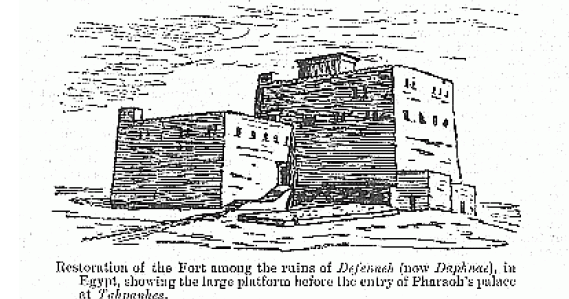
(Photo Caption: Restoration of the Fort among the ruins of Defenneh (now Daphnae), in Egypt, showing the large
platform before the entry of Pharaoh’s palace at Thapanhes.
Appendix 88
THE MILLENNIAL “SANCTUARY” AND “OBLATION” OF Eze 40-48.

NOTES OF THE “SANCTUARY” OF EZEKIEL.
1. It is a mistake to speak of the wonderful series of courts and buildings, described in the closing chapters of
Ezekiel, collectively as the Temple. The proper term is “The Sanctuary”, as it is set forth in 45:1-4 (see plan above).
2. The governing figure of the dimensions given throughout the last eight chapters — not only in connection with the
Sanctuary, but also in the measurements of the holy “Oblation unto Jehovah”, of the Land — is the number “5 ” (Ap. 10).
3. The Sanctuary is in the midst of the central portion of the middle (the Priests’) portion of the “Oblation” (see
block plan, p. 127). The Altar which occupies the exact center of the Sanctuary (not the Temple proper, see below), is
thus twelve miles from the north gate of the city, twelve miles from the southern boundary of the Levites’ portion, and
thirty miles from the eastern and western boundaries of the “Oblation” respectively.
4. The Sanctuary is comprised in a great square (42:15-20) enclosed with a wall measuring 500 reeds each way. If the
“measuring reed” = 12 ft. 6 in., then 500 reeds will be equivalent to about nine English furlongs, or a little more than one
mile square. (*1)
5. In the center of this great square we have next the boundary wall enclosing the OUTER COURT. This wall is 12 ft.
6 in. high by 12 ft. 6 in. broad, and forms a square of 500 cubits (*2) (external measurements). Five hundred cubits is
25.025 x 500 = 1042.7 English feet, or about 1/5 of a mile.
6. Within this is the Inner Court, a square of 300 cubits (*2) (25.025 x 300 = 625 English feet).
7. Inside the Inner Court we have the Temple (or Palace, Heb. heykal) Court, or the Separate Place (*3)
(41:12,13,14,15; 42:1,10,13), and the Temple-Palace itself, each occupying a space of 100 cubits = 216 feet square, and
forming together a rectangle of 200 x 100 cubits ( = 432 ft. x 216 ft.).
8. Finally in the midst of the “Separate Place” stands the Altar, twelve cubits square ( = 25 ft.) on its base or “settle”
of fourteen cubits square ( = about 29 ft.). Thus it will be seen that “the ALTAR before the HOUSE” (40:47), in the midst
of “the Separate Place”, is the actual center of the Millennial Sanctuary and worship, and not the “Building”, the
“House”, or “Temple” immediately to the west of it (*4). This indicates that the millennial “Temple” is really the
Palace, or Habitation of Messiah in connection with “the City of the great King” (Ps 48:2. Mt 5:35), when He, as the
“GLORY of Jehovah”, will from time to time visit His earthly metropolis.
At the glorious “Dedication” of the Sanctuary, of which brief mention is made in 43:2-6, Jehovah’s Glory (Messiah)
enters the “House” by way of “the gate of the Outward Sanctuary which looketh toward the East” (43:4; 44:1). This will
then be closed for all purposes of general ingress and egress; and is reserved strictly for the use of “the Prince” (the
risen David?) who, as Messiah’s vicegerent (cp. 37:24,25), will alone be permitted to make use of it.
9. A word is necessary regarding the mistake into which some commentators have fallen with regard to the
measurements of the “Oblation”. It has been assumed that these are stated, and are to be understood, as being given in
cubits, not reeds.
According to this reckoning, all the oblation (25,000 x 25,000 somethings); and if cubits, it would represent a square
of rather less than ten miles each way. The absurdity of this view will be at once apparent when the cubit-scale is
applied to the city. This is stated (48:15,16) as being 5,000 x 5,000 something; if these are cubits, the the “City of the
Great King” (Ps 48), which in every allusion to it in the Scriptures is suggestive of magnificence and spaciousness, is
reduced to a petty area of less than four square miles (5,000 cubits x 5,000 cubits = a square of less than two miles each
way).
The point need not be labored. 5,000 reeds x 5,000 reeds give us a city twelve miles square, with an area of 144
square miles — dimensions of dignity and importance befitting the metropolis of the world. In measuring or “setting out”
buildings and distances, rods and tapes or chains are used now of recognized standardized lengths. This is precisely
what we have in 40:3; where the angelic measurer or surveyor is presented to us “with a line of flax” ( = tape) in his
hand, and “a measuring reed” ( = a rod). Cf. 47:3.
In the block plan (p. 127) it will be seen that “the possession of the City” is shown to the south of the Oblation.
Whereas in Ps 48:2, which is distinctly Messianic in its fuller scope, it is stated:
“Beautiful for situation ( = elevation), the joy of the whole earth,
Is Mount Zion on the sides of the North.” (See the notes on Ps 48:2.)
(cp. the only other places where the expression “the sides of the North” occurs, Isa 14:12-14; 38:6,15; 39:2, and the note
on Ps 75:6).
That “the Possession of the City” will lie parallel with “the great valley” cloven through the Mount of Olives and
running east and west (Zec 14:4,5) seems clear. The “City of the Great King” will therefore be situated in a magnificent
position on the north side of this great valley. No wonder it is spoken of as “beautiful for situation” (elevation, or
extension). As the original Zion towered above the Kidron Valley in days gone by, so in the Messianic days to come,
“Zion, the City of our God” will be seen towering in majestic elevation above the north side of the “very great valley”
that will then “cleft” east and west, and through which the cleansing waters will flow eastward to make the land, now
desert, “blossom as the rose” (47:8: and cp. Isa 35).
10. Difficulties are sometimes raised with regard to taking the measurements of the “Oblation” as being in reeds not
cubits, on the score of disproportion to the “Land”. It is argued that a square block of 60 miles by 60 = 3,600 square
miles, taken out of the whole territory as divided among the Tribes, is out of all proportion to the area of the “Holy
Land”. But it is nowhere stated that Palestine as we know it now is the whole extent of the “Land”.
The majority of the maps intended to show the division of the millennial land, are presented usually with the
geographical boundaries of the Holy Land as they are now known to us, practically the same as in the days of our Lord,
with the huge square block of the “Oblation” occupying about one-fifth of the map of Palestine.
This is an entire misconception. The promise in Ge 15:18 yet awaits fulfillment. And if, with the statement therein
that the northern and southern boundaries of the Promised Land are the two great rivers, the Euphrates and the Nile,
then, the comparison of this with Eze 47:20 gives us the western boundary, viz. the “Great Sea” (Mediterranean). This
leaves the eastern boundary to be accounted for; and the possibility is that “the East Sea” of verse 18 is the Persian
Gulf, at the head of which is the northern boundary (the Euphrates) will end. As “the tongue of the Egyptian sea” will
be utterly destroyed “in that day” (Isa 11:15), this amplitude, or enlargement of the area of territory promised to
Abraham on the south gives strength for the suggestion of a corresponding extension to the east.
If this is so, then the whole of the Promised Land will be a magnificent territory, bounded on the north by the
Euphrates, on the eat by the Indian Ocean (the east sea), on the south by the Nile, and on the west by the
Mediterranean. This will include not only the Arabian peninsula, but the great Arabian and Syrian deserts, and the plains
of Babylonia. A glorious patrimony truly, and worthy of occupation by the “strong nation” of Mic 4:7, the People
through whom all the nations of the earth are yet to be blessed! See Ge 12:3; and especially 28:14. It may be that the
Twelve Tribes may be allotted special strips or “lots” of the land on either side of the Oblation as usually shown; but
that an enormously increased territory N., E., and S., will become “in that Day” the realization of the Promised Land is
certain.
BLOCK PLAN, SHOWING “ALL THE OBLATION” (48:20).
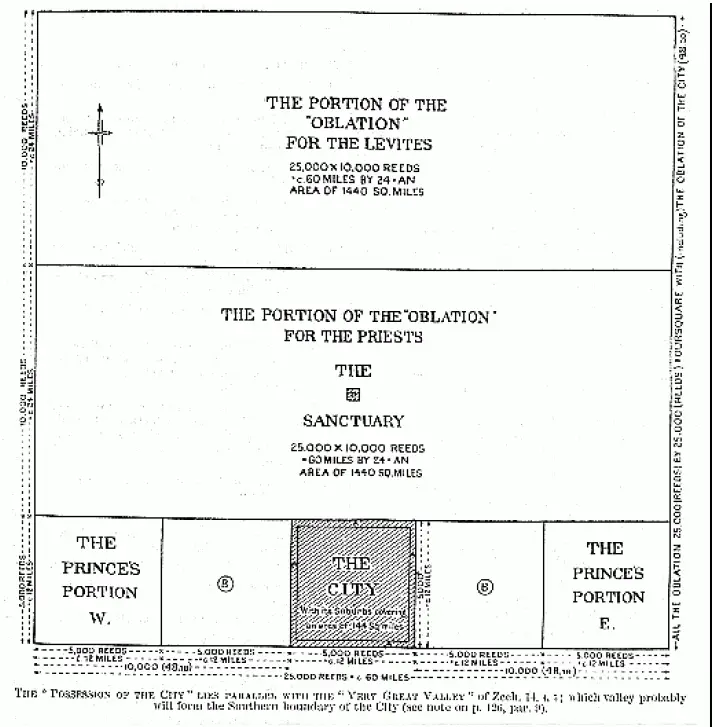
The whole size of the “OBLATION” is 25,000 x 25,000 REEDS (48:20), and equals about 60 ENGLISH MILES square.
Divided into three main Portions:
1. The Portion for the Priests, containing in the center the Sanctuary, The Holy Portion of the Land, 25,000 x
10,000 Reeds (45:1-4) = 60 miles by 24.
2. The Portion for the Levites, 25,000 x 10,000 (45:5) = 60 miles by 24.
3. The “Possession of the City”, 25,000 x 5,000 (45:6) = 60 miles by 12, including the Two “Portions” for the
Prince, one on the W., the other on the E. of the City (see block plan above).
The CITY is set in the midst of the “Possession of the City”, and its dimensions are given (48:15) as 5,000 x 5,000
reeds = about 12 miles square; thus covering an area of 144 square miles (English). Of this, 250 reeds all round are
marked off as “suburbs”, thus reducing the actual size of the “City” itself to about 11 miles square, covering an area of
121 square miles (48:15-17). Verse 18 gives the length of the “possession”, to E. and W., as being 10,000 reeds each
way. This manifestly includes the “Prince’s Portions” at either end. Between these portions and the suburbs of the City
lies on either side (B B) the remainder of “the residue in length over against (i.e. alongside) the oblation of the holy
(portion)”, which is evidently the “garden” portion of the City, as “the increase (Heb. tebu’ah, 48:18) thereof shall be
for food for them that serve the City”.
· The “City Portion” is therefore seen to be divided into 5 (Ap. 10) portions, each 5,000 reeds square, or
into 5 blocks of 144 English square miles each. The total area covered being 144 x 5 = 720 square miles.
· The “Priests’ Portion” is one large block containing a superficial area exactly double, viz. 1,440 square
miles.
· The “Levites’ Portion” is of equal size. The total area of “All the Oblation” is therefore, in English miles,
1,440 + 1,440 + 720 = 3,600 square miles.
The above figures will enable the student to grasp fully a fact that is often lost sight of: viz. that everything in
connection with the whole of the Oblation to Jehovah, including the City, will be planned, as shown by these
dimensions, on a “magnifical” scale. To give one instance of the scale on which the Oblation will be “laid out” — the
nearest point from which the outside wall of the Sanctuary, in the midst of the Priests’ portion, can be reached from
the Northern Gate of the City is 11 1/2 miles. There will be no overcrowding or jerry-building in “that day”. It is not
possible for us now to do more than faintly imagine to ourselves what the City will be like; 12 miles square, perfectly
planned, with “garden” spaces on either hand occupying like areas, and these again bounded by the Prince’s “private
gardens”, so to speak, and abode, of similar size.
SPECIFICATION OF “THE SANCTUARY”.
And its planning out in relation to the “Oblation unto Jehovah” of the Land and the location of the tribes.
Eze 40-48.
Order.Refs.
1. The “Wall on the outside of the house round about” (12 ft. 6 ins. high, and 12 ft. 6 ins. broad).40:5
2. THE EAST OUTER GATE. Details.6-16
3. THE OUTER COURT. Details.17-19
4. THE NORTH OUTER GATE. Details.20-22
5. THE NORTH AND EAST INNER GATES.23
6. THE SOUTH OUTER GATE. Details.24-26
7. THE SOUTH INNER GATE.27
8. THE INNER COURT. SOUTH GATE. Details.28-31
9. THE INNER COURT. EAST GATE. Details.32-34
10. THE INNER COURT. NORTH GATE. Details.35-43
11. CHAMBERS for the “SINGERS”.44
12. CHAMBERS for the Priests in charge of the HOUSE.45
13. CHAMBERS for the Priests in charge of the ALTAR.46
14. THE ALTAR COURT (100 cubits square. See plan on p. 125) and THE ALTAR that was before the House.47
15. The PORCH of the HOUSE. Details.48,49
16. THE TEMPLE (Heb. heykal. Often translated Palace: e.g. Ps 45:8,15). Details.41:1-11
17. THE BUILDING that was before the SEPARATE PALACE (*5) (i.e. the TEMPLE or HOUSE itself facing the SEPARATE PLACE — the ALTAR COURT — 100 cubits square = about 208 feet). Details.12-14
18. Length of the “BUILDING”, including the INNER TEMPLE (100 cubits). Details.15
19. The DOOR (entrance). Details.16-21
20. The ALTAR of wood — within the Sanctuary — “the Table before Jehovah”.22
21. The TWO DOORS (entrances) or the SANCTUARY. Details.23-26
22. THE OUTER COURT. NORTH entrance. Width 100 cubits, of which 50 cubits is occupied by the porch of the outer gate. Details.42:1-8
23. THE OUTER COURT. EAST entrance. Details. Concerning the Priests.9-12
24. Measurements of the space separating between the Sanctuary and the profane place: i.e. the great outer “surround” of 500 reeds square ( = a little more than a mile square) enclosed within a wall of unspecified dimensions.15-20
25. The OUTER EAST GATE — and the Vision of the Triumphal First Entry of the Messiah KING into the HOUSE (when Ps. 24:7-10 will be fulfilled).43:1-5
26. JEHOVAH’S Command from “the HOUSE” giving “the LAW OF THE HOUSE”.6-12
27. THE ALTAR. 12 cubits square ( = 25 ft. x 25 ft.) on its base (settle) of 14 cubits square ( = about 29 ft. x 29 ft.).13-17
28. THE ORDINANCES OF THE ALTAR.18-27
29. The CLOSED outer EAST Gate and the reason.44:1-3
30. Ezekiel brought into the COURT OF THE HOUSE by the NORTH (the Sacrificial) gate — to receive.4
31. “THE ORDINANCES of the HOUSE OF JEHOVAH”.5-31
32. THE LAND. The OBLATION (*6) unto Jehovah, 25,000 reeds by 10,000 reeds (about 60 miles by 24 miles).45:1
33. Of this — THE SANCTUARY (500 reeds by 500 reeds square = about 1 mile square) and THE MOST HOLY PLACE — and for the dwelling of the priests.2-4
34. THE LEVITES’ portion, 25,000 reeds by 10,000.5
35. THE POSSESSION of the CITY, 25,000 reeds by 5,000 reeds ( = about 60 miles by 12 miles, therefore covering an area of 720 square miles).6
36. THE PRINCE’S PORTIONS east and west of the City, each 5,000 x 5,000 reeds square ( = about 12 miles square and covering each an area of 144 square miles).7
37. The rest of the Land for Israel according to their Tribes.8
38. ORDINANCES.9-25
39. ORDINANCES for WORSHIP for the Prince (David?) and the People.46:1-18
40. The Place of Preparation of the Offerings.19,20
41. The FOUR Corner Courts of the OUTER COURT.21-24
42. THE HEALING WATERS from the HOUSE.47:1-2
43. Boundaries of the Land.13-23
44. LOCATION of the Seven Tribes on the North side (Dan, Asher, Naphtali, Manasseh, Ephraim, Reuben, JUDAH).48:1-7
45. JEHOVAH’S OBLATION for THE SANCTUARY and the Priests, 25,000 x 10,000 reeds.8-12
46. THE PORTION for the LEVITES.13,14
47. THE PORTION for THE CITY (*6).15-19
48. “ALL THE OBLATION”, 25,000 reeds by 25,000 reeds = 60 x 60 square miles – an area of about 3,600 square miles.20
49. The PRINCE’S portions east and west of the City (see block plan on p. 127).21,22
50. LOCATION of the remaining Five Tribes — BENJAMIN, Simeon, Issachar, Zebulun, Gad.23-28
51. SUMMARY.29
52. “Goings out of the City” (exits) and its Gates.30-35
53. THE NAME OF THE CITY, “JEHOVAHSHAMMAH” (JEHOVAH [is] T35
(*1) The “measuring reed” is given as being “of six cubits (long) by the cubit and an handbreadth” (40:5; 43:13);
and in 41:8 we have the specified standard length of the reed as “a full reed of six great cubits”. This “great
cubit” is therefore one cubit + one handbreadth. Six handbreadths are reckoned to the ordinary cubit. In this
case there is one extra. So that the “great cubit” employed in the measurements of the Sanctuary and the Land is
equal to seven handbreadths (Ap. 10). It follows therefore that “six great cubits” = 42 (6 x 7) handbreadths. If the
handbreadth is taken as being 3.575 in., or a little more than 3 1/2 in., which is most probably about the exact
figure, then the “great cubit” is 3.575 x 7 = 25.025 in.; and “the full reed” will therefore be 25.025 x 6 = 150.150
in. This = 12.5125 English feet, or in round numbers 12 feet 6 inches.
(*2) The main dimensions given supply us with these figures, although they are not specifically stated as in the
case of the 500 reeds of 42:16-20.
(*3) The Separate Place has in its center the ALTAR and seems to be the court for worship of “separated ones”.
(*4) In the “Specification”, it is a remarkable fact that the Altar is the item numbered 27. The whole number of
“items” specified from 40:1-48:35 is 53. This gives 26 items on either side of 27 — thus placing the Altar exactly
in the midst of the angelic specification — as it is placed in the center of the Sanctuary.
(*5) The Separate Place. Only used here seven times (41:12, 13, 14, 15; 42:1, 10, 13), and in Lam 4:7 where the
word is rendered polishing.
(*6) See the Plan (to scale), and Notes on p. 127.
Appendix 89
THE VISIONS OF DANIEL (chs. 7-12), SYNCHRONOUS.
The visions recorded in these chapters are synchronous, and all relate to “the time of the end” (i.e. the last seven
years of the seventy sevens of chapter 9:24-27, see Ap. 91). This will be seen from the similar expressions exhibited in
the following table:—
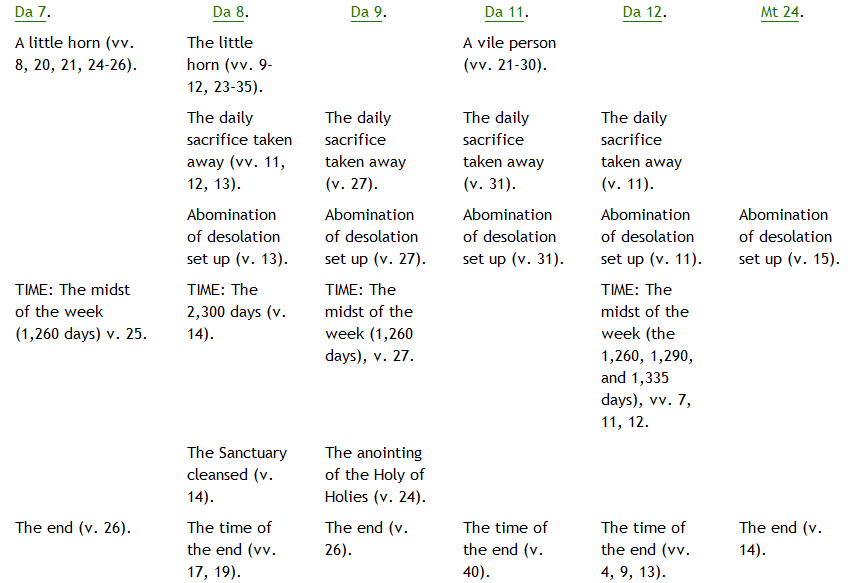
Appendix 90
THE “TIMES”, AND NUMBERED “DAYS” OF Da 7:25; 8:14; 12:7,11,12
There are five (*1) specific periods of “time” and “days” mentioned in the Book of Daniel (7:25; 8:14; 12:7,11,12). In
addition to these five, we have the great period of the “seventy sevens” (or weeks) of years in chapter 9. Sixty-nine
of these were completed at the “cutting off” of the Messiah; the last of “seventieth seven” is yet to come (see Ap. 91).
All the other five periods of time in the book are to be referred to, and are standardized, so to speak, by this last
“seven”. The “seventy weeks” (sevens) are confessedly to be reckoned as years. Therefore, on the basis of a Jewish
year of 360 days, one “seven” is 360 x 7 = 2,520 days.
The terminus a quo of 1, 4, 5, 6 (see diagram) is manifestly determined by the term “in the midst of the week” (the
last “seven” of years), of the standard (col. 3): that is, 1,260 days, or 3 1/2 years from either end of the column. “The
prince that shall come” (Antichrist) “will make a (*2) covenant with many for one week” (i.e. seven years) (9:27). After
3 1/2 years, on grounds not stated, he breaks this covenant (or “league”, 11:23), the daily sacrifice is “taken away”, the
“abomination” set up, and “Jacob’s trouble” (Jer 30:7) commences and continues for the remainder of the “seven”: viz.:
for the 1,260 days or 3 1/2 years. It is this “midst of the week” that determines both the a quo and the ad quem of
these Numbered Days.
In 8:14 it is stated, “then shall the Sanctuary be cleansed” (*3). With regard to this “cleansing”, all the periods, 1, 2,
3, 4, 5, 6 (see diagram) synchronize at the end (see Ap. 89); while the last tow columns (5 and 6) are extended and
prolonged beyond the close of the 1,260 days by two significant periods of days, viz. 30 days and 75 days, respectively.
The first of these, 1,290 days is 1,260 + 30. And the 30 days here may be taken as a “Ve-Adar” or intercalary month of
30 days of “cleansing” following directly after the destruction of the false Messiah, and the break up of his confederacy.
These thirty days may possibly be the period allotted for the construction of the new and glorious “Sanctuary” of Eze
40-43, which is to be erected after the destruction and removal of the Jewish temple which will have been built by the
sons of Israel some time previously to its profanation by the Antichrist — as the antitype of Antiochus Epiphanes.
With regard to the 1,335 days of 12:12: This is 1,260 days with an excess of 75 days. This again being an excess of 45
days beyond the 1,290 of 12:11. 1,335 is, therefore, 1,260 + 30 + 45. If the 30 days are occupied with the “cleansing”,
i.e. with the “justifying” or “making righteous” a new and glorious “Sanctuary”, then it may be that the further 45 days,
over and above the 1,290, will cover the preparation time for the fulfillment of the forty-fifth psalm (such preparation
including, the resurrection to life of those concerned in 12:2), in order that the nuptials of the king may be celebrated
as described in such wonderful and minute detail in that psalm. (*4)
In connection with this period (1,335 days) we have the only Beatitude in the book! “Blessed (ashrey) is he that
waiteth ( = is steadfast) and cometh to the thousand three hundred and five and thirty days” (12:12). A blessed “lot”
indeed for those who will have passed through “the Trouble” and are counted worthy to be participators in the scenes
of glory and triumph of the King when He is united to restored Israel in that Day, as portrayed in the forty-fifth psalm!
In examining the diagram and the references in the book, it will be seen (1) that the only one of these five periods
of “time” and “days” that presents any serious difficulty is that of the 2,300 days. (2) That its terminus ad quem is the
same as the others, viz. the end of the seventieth seven is clear from 8:14, which gives it as being marked by the
“cleansing of the Sanctuary”. Reckoning backwards, therefore, the terminus a quo of this period is seen to be 220 days
short of the commencement of the seventieth “seven”.
It is not clearly revealed what event or events will mark the commencement of these 2,300 days, but it will be
probably some political crisis connected with the confederated kingdoms under the sway of the Antichrist. The key is
possibly to be found in chapter 8, typified by the contention between the ram and he-goat representing Medo-Persia
and Greece. But, though the terminus a quo of this period is not given to us in plain language (like e.g. the “midst of
the week” of 9:27), yet it will be known to, and understood by, the people of God, who pass through “the Trouble”
time of the seventieth “seven”, for “the wise (in that day) shall understand” (12:10).
If the “time of trouble” of Da 12:1 is a “time” like the “time” of 7:25; 12:7 (Nos. 1 and 4, above), i.e. one year, then
there are six specific periods of time in the book of Daniel, in addition to the seventieth, or last “seven”. If so, the
“time” of Da 12:1 suggests that “Jacob’s trouble” will be closed by a “time” (or year) of acutest “tribulation”. Does this
correspond with “the acceptable year” of Isa 61:2, immediately preceding the “Vengeance”?
The Diagram will illustrate the above remarks.
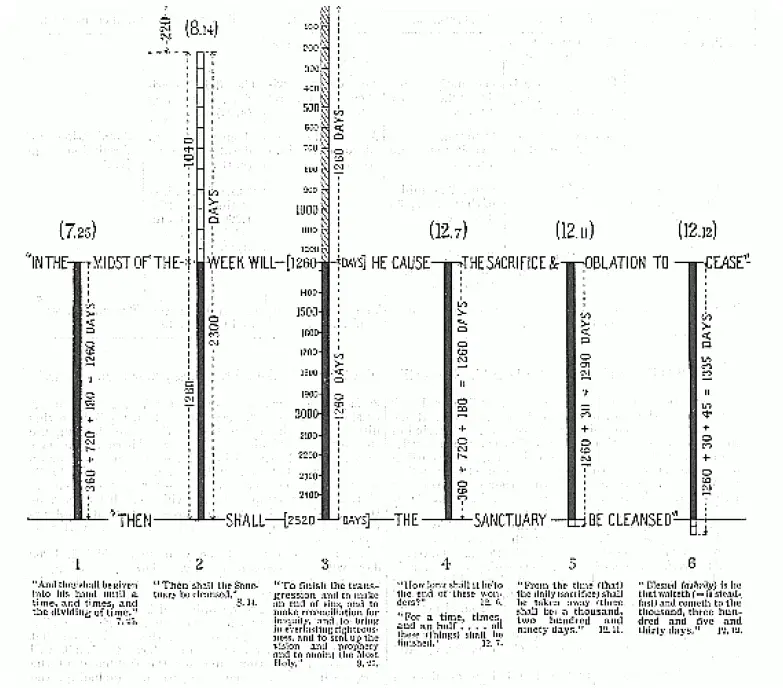
1. “And they shall be given into his had until a time, and times, and the dividing of time.” 7:25.
2. “The shall the Sanctuary be cleansed.” 8:14.
3. “To finish the transgression and to make an end of sins, and to make reconciliation for iniquity, and to bring
in everlasting righteousness, and to seal up the vision and prophecy and to anoint the Most Holy.” 9:27.
4. “How long shall it be to the end of these wonders?” 12:6 “For a time, times, and an half … all these
(things) shall be finished.” 12:7.
5. “From the time (that) the daily (sacrifice) shall be taken away (there shall be) a thousand two hundred
and ninety days.” 12:11.
6. “Blessed (ashrey) is he that waiteth ( = is steadfast) and cometh to the thousand, three hundred and five
and thirty days.” 12:12.
(*1) See the last paragraph on p. 130.
(*2) No definite art. in the Heb.
(*3) Heb. zadak = justified or made righteous. Not the word used of ceremonial or moral cleansing (Heb.
tah-heer); and it may be noted that the word is here employed in the Niphal-Praeterite form — and is therefore
equal to — the Sanctuary was justified or made, or appointed righteous.
(*4) Further, it is interesting to note in connection with the numbers 30 and 45, that Ps 30 was sung “at the
dedication of the house of David” — its subject being praise for deliverance in “The Day of (the) Trouble” (Ps 20:1)
— which is prophetically this very 1,260 days of “Jacob’s trouble” in Daniel and Revelation. And 45 is the number
of the Psalm which, as the Great King’s Nuptial Ode — sets before us the glory and triumph of the Messiah at His
marriage with the elect remnant of Israel — the “wife” of such passages as Isa 54:5-8; 62:4,5. Jer 3:14, &c.
Moreover, the No. 75 is that of the Psalm which sets before us “God’s anointed” in the Sanctuary, and
emphatically declared (v. 7) “God is Judge” (or Ruler).
Appendix 91
THE “SEVENTY WEEKS” OF Da 9:24-27
For the meaning of this passage, reference must be made to the notes, and especially to the Structures, which are
always the best commentary and the surest guide to interpretation.
We may set out the three divisions of the whole period on the diagram (not exact to scale):—
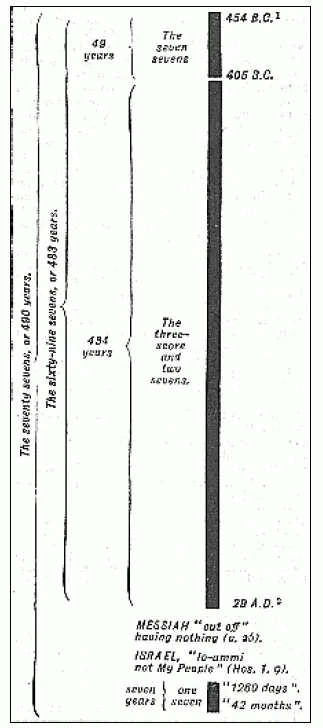
I. THE FIRST PERIOD is simple, being the “seven sevens”, or 49 years.
II. THE SECOND PERIOD. The “threescore and two sevens”, or 434 years, from 405 B.C. to A.D. 29 = the year of
the “cutting off” of Messiah (see Ap. 50 pp, 60, 61). This was 483 years from the issuing of the decree in 454
B.C. (i.e. 49 + 434 = 483 years). The “cutting off” of Messiah is stated as being “after” the “threescore and two
weeks”. The word “after”, here, evidently means, and is intended to be understood as indicating, the
completion of the period named; i.e. on the expiration of the sixty-two sevens will “Messiah be cut off”.
Beyond this exactness it is hardly necessary for us to go.
III. THE THIRD PERIOD. This is the one seven, i.e. the seventieth (or “last”), seven which has still to be accounted
for. That it must be yet future seems certain, from the agreement of its events with those of the visions of
chapters 7-12 (Ap. 89), and the numbered “days” of chs. 8:14 and 12:7, 11, 12 (Ap. 90); also from the fact that
none of the six definite events (of 9:24), which mark its end has as yet taken place (*1). These belong to the
whole seventy sevens, and are thus connected with the seventieth or last seven, being the object and end of
the whole prophecy. The following three, among other reasons, may be added:—
1. If the seventieth, or “one seven”, is to be reckoned from the cutting off of Messiah in direct, continuous,
and historic sequence, then it leads us nowhere –certainly not to any of the six events of v. 24, which
are all categorically stated to relate to Daniel’s People, “all Israel” (v. 7), and to the holy City “Jerusalem”.
No interpretation which transfers these six events to Gentiles or to Gentile times, is admissible. If they are
continuous, then there is no point or crisis in the Acts of the Apostles which marks their end. If they
coincided with any events of importance, such as the end of Peter’s ministry or the beginning of that of
Paul, or Ac 12 and 13, that would be something. But there is nothing.
2. Messiah was to “have nothing” that was His, “after” His cutting off. This clearly points to the crucifixion of
Messiah, and the rejection of His Messianic kingdom. For nearly 2,000 years Messiah has “had nothing” of
all the many “glorious things” which have been spoken of Him, in connection with Himself or with His
People Israel.
3. This last, or “one seven” of years, is divided into two distinct equal parts (see Ap. 90), and the division
takes place in connection with an event which has no connection whatever with any event which has yet
taken place. Messiah did not “make a (not the) covenant” of any kind, either with Israel or with any one
else, at the end of, or “after” the sixty-ninth week; nor did He “break” any covenant three and a half years
later. Man may “make” and “break” covenants, but Divine Covenants are never broken.
On the other hand: of “the prince that shall come” it is distinctly stated that he shall do both these very things (vv.
26, 27); and, in Ap. 89 and 90 both are connected with “the time of the end”. Hence, we are forced to the conclusion
that this last seven of years still awaits its fulfilment; and this fulfilment must be as literal and complete as that of all the
other parts of this vision and prophecy; for the end must be the glorious consummation for Israel of v. 24, the complete
destruction of “the coming prince” (the false Messiah or Antichrist), and the setting up of the Messiah’s kingdom.
Nothing less will satisfy all the requirements of Daniel’s vision of “the seventy weeks”. The Hebrew word rendered
“week” is shabua’, and means, simply, a “septad”, a “hebdomad”, or a seven, hence a week, because it is a seven (of
days). But in this passage it is confessedly used of a seven of years; and this of necessity, for no other seven of any
other portion of time will satisfy the prophecy and fall within its terminus a quo, and the terminus ad quem.
Seventy of these sevens of years (or 490 years) are the one subject of this prophecy. We are told exactly when they
would commence, and how they were to end. They sum up, within their bounds, all the then counsels of God as to His
future dealings with His People Israel; for they are “determined” (the angel said to Daniel) “upon thy People, and upon
they Holy City” (v. 24). These words cannot have any other interpretation than “all Israel” (v. 7), and Jerusalem, and
the Holy Sanctuary; for that had been the subject of Daniel’s prayer, to which this prophecy was sent as the specific
answer. (See vv. 2, 7, 16, 17, 18, 19, and especially v. 24.)
These “seventy sevens [of years]” are divided into three distinct and separate periods:—
I. The seven sevens, or 49 years.
II. The sixty-two sevens, or 434 years.
III. The one seven, or 7 years.
(I. and II. = 483 years.)
(I., II., and III. = 490 years)
The terminus a quo of the whole period is the issuing of a decree “to restore and to build (or rather, rebuild)
Jerusalem.”
The terminus ad quem of the whole period is the cleansing of the Sanctuary. This is also the end of all the visions of
Daniel in chaps. 7-12 (Ap. 89); and all the numbered “days” of 7:25; 8:14; and 12:7, 11, 12, have this cleansing as their
object and end.
As to the whole period, Daniel is bidden by the angelic Hierophant to “understand … and consider” (v. 23); while, as
to its three separate divisions, Daniel is to “know therefore and understand” (v. 25). See the Structures of these
passages, pp. 1196, 1198, 1199.
THE FIRST PERIOD. The seven sevens (or 49 years). These commence with “the going forth of the commandment to
restore and to build Jerusalem”. This was in the first month, Nisan, 454 B.C. (see Ap. 50, pp. 60, 67, and 70). Hanani’s
report to Nehemiah was made in the ninth month Chisleu, in 455 B.C., three months before; both months being in the
“twentieth year of Artaxerxes”.
See notes on Neh 1:1 and 2:1; also on pp. 615-18; and Ap. 57. The ARTAXERXES (or Great King) of Ne 1:1; 2:1, who
issues this decree, is identified with the great king ASTYAGES. (See Ap. 57.) ASTYGES was brotherin-law to
Nebuchadnezzar. The madness of the latter had at this time lasted for seven years. ASTYGES had evidently in imperial
matters been acting for his brother-in-law. This seems to be clear from the fact that the decree was issued in Shushan,
and not Babylon; and no one, however great a potentate he might be, would have dared to issue such a decree,
connected with the affairs of the suzerainty of Babylon, unless he possessed the authority to do so.
Therefore it may be put thus: In Nisan, 454 B.C., ASTYAGES (i.e. Artaxerxes = the Great King) issued the decree
spoken of in Da 9:25. Later, in the same year, Nebuchadnezzar’s “madness” was lifted off him. “At the end of the days”
his understanding and reason returned to him, it seems, as suddenly as they had left him; and he thereupon issued his
imperial proclamation throughout his dominions, as recorded in Da 4:34-37. See the note there on v. 34.
The seven sevens therefore, meaning seven sevens of literal years, occupied 49 years (454 B.C. to 405 B.C. = 49
years). They began in 454 B.C. with the decree, and end with the completion of the walls and the dedication of the
Temple in 405 B.C. See Ezr 6:10,15-19. It must be remembered that the issuing of this decree took place long before
Ezra appeared on the scene; and before any of the subsequent decrees of other monarchs, which all had to do with
the Temple; whereas the first, issued to Nehemiah (2:1), had to do only with the “City” and its “walls”. See the notes
on Ezra-Nehemiah, and Appendix 58. (*3)
THE SECOND PERIOD. The sixty-two sevens (or 434 years). These follow on directly from the end of the seven
sevens of the First Period, and close with the cutting off of the Messiah.
THE THIRD PERIOD. The last, or the seventieth seven. This period is yet future, and awaits the same literal fulfilment
as the other two periods.
(*1) Archbishop Ussher’s Chronology was first added to the A.V. by Bishop Lloyd in the edition of 1701. But, in Ne
2:1, Bishop Lloyd put his own date “445 B.C.”, to suit his own theory. Archbishop Ussher’s date for the
commencement of the reign of Artaxerxes was A.M. 3531, which, in his Collatio Annorum, corresponds to 474
B.C. “The twentieth year of Artaxerxes” would, therefore, be 454 B.C., as given above.
(*2) The era called “Anno Domini” was first fixed by a monk (Denys le Petit, commonly know by his Latin name,
Dionysius Exiguus), about A.D. 532. It did not come into general use for some centuries. Charles III of Germany
was the first who used the expression, “in the year of our Lord”, in 879. It was found afterward that a mistake
had been made by fixing the era four years too late! this explains the marginal notes in Mt 2:1 and Lk 2:20, “The
fourth year before the Common Account called Anno Domini.” (In some editions of the A.V. we have seen “the
fifth year”, Lk 2:1, also “the sixth year”, Lk 1:6.) Hence, the year called A.D. 33 was really the year A.D. 29.
This, with 454, makes exactly 483 years, or 69 weeks of years.
(*3) N.B. There was a further division of this first period of seven sevens which may be mentioned. From the
decree of Ne 2:1 to the end of the Babylonian servitude (see notes on p. 615), which was the “first year of
DARIUS” ( = CYRUS, see Ap. 57) the son of ASTYAGES, was 28 years (454 – 426 = 28); and those events closed the
fourth of the seven sevens. See Ap. 50, p. 60.
Appendix 92
REFERENCES TO THE PENTATEUCH IN THE PROPHETS
It is alleged by modern critics that, while Deuteronomy was the work of some anonymous writer in the reigns of
Josiah and Manasseh, the ritual portions of Exodus, Leviticus, and Numbers were the work of Ezra and the priests in
Babylon. This, practically, the greater part of the Pentateuch is assumed to be post-exilic, and therefore not written by
Moses; and this in spite of the fact that the claims of the whole Bible necessitate the Mosaic authorship. On the other
hand, it is admitted by the same modern critics that the prophets lived and wrote in the reigns of those kings with
whose reigns they are respectively associated.
But the Pentateuch is full of technical terms and legal phraseology; and has its own peculiar vocabulary. The constant
reference to these by all the prophets proves conclusively that the Pentateuch as a whole must have had a prior
existence; and must have been well known by the prophets, and understood by those who heard the prophetic
utterances and read the prophetic writings.
Throughout all the books of the prophets such references to the Pentateuch have been noted in the margin of The
Companion Bible with the brief indication “Ref. to Pent.”, followed by the passages referred to. It is not claimed that
none have been overlooked: so that the number will be greater rather than less. It would occupy too much space here
to give the table which had been prepared. Any reader can collect the whole from the notes, and arrange them in the
order of chapters and verses of the Pentateucal books.
An examination of these references will show that altogether 1,531 have been noted, and are distributed as follows:
GENESIS is referred to 149 times; EXODUS, 312; LEVITICUS, 285; NUMBERS, 168; while DEUTERONOMY is referred to 617
times. Thus DEUTERONOMY, of which the modern critics have made the greatest havoc, is referred to more often than
any of the other four books: 468 times more often than Genesis; 305 times more often than Exodus; 332 times more
often that Leviticus; and 449 times more often than Numbers. That is to say, more often than any two of the other
books put together.
It is also remarkable that the references to technical, legal, and ritual terms are more numerous than to those relating
to historical events. The latter would necessarily be better known and remembered; but the former could not have
been thus referred to unless the ritual itself (less easily remembered) had existed in writing, and thus been generally
known and understood. It is evident that it would have been perfectly useless for the prophets to write and quote aught
but what was well known, or could be easily referred to and verified.
Regard must also be had to the fact that the canonical order of the prophetic books is not the same as their
chronological order; for Malachi (the latest prophet) refers (Mal 1:2) to an earlier passage of Deuteronomy (Dt 7:8) than
Isaiah (one of the earliest prophets), who refers, in Isa 1:2, to a later passage (Dt 32:1).
Appendix 93
THE ALLEGED “CORRUPTION” OF THE HEBREW TEXT
In the modern commentaries we very frequently meet with the objectionable word “corruption” used of the Hebrew text of the Old Testament. As specimens of this feature of modernism, the following are taken at random from one of the latest commentaries:
1. This “probably signifies not only a new paragraph but a later hand”.
2. This “leads to the conclusion that there is some original corruption of the Hebrew text.”
3. “The text in this verse is extremely difficult to interpret; and no satisfactory translation can be given of it.”
4. “The Hebrew of this verse seems to be so corrupt that there is no satisfactory meaning to be obtained from it.”
5. “It is certain that the original text must be corrupt.”
6. “It is better to regard it as being in some way a corrupted text … but is now unintelligible.”
7. “These three verses are extremely corrupt, and it is probably impossible to restore the text with any certainty.”
Such remarks abound; and very few pages are free from them. There is a continual running confession of inability to understand the Hebrew text. Like the schoolboy who always thinks “the book is wrong”, modern critics never seem to suspect that the difficulty lies with themselves and not with “the Book”. We must accept their confession, whatever the explanation may be. The object of this Appendix is to show that those who are so ready to speak about “corruption” can have little or no knowledge of the Massorah, or of its object.
We have explained its character somewhat in Ap. 30. We now propose to point out that its one great special aim and end was to make such “corruption” impossible. Well knowing the frailties and infirmities of human nature, those who had charge of the Sacred Text hedged it round on all sides with regulations and information called the Massorah, because it was meant to be ” a fence to the Scripture”, and because it should be, thus, next to impossible for a scribe to make a mistake in copying it.
Some general facts are given in Ap. 30 (which should here be consulted); but further particular features are now added from Dr. C. D. Ginsburg’s four large folio volumes, which contain the Massorah so far as he has been able to collect, arrange, and transcribe the writing in smaller characters at the top and bottom of every page of most of the accessible manuscripts containing it.
III. Again: certain letters have come down with the text, from the most ancient times, having a small ornament or flourish on the top: for example, we find
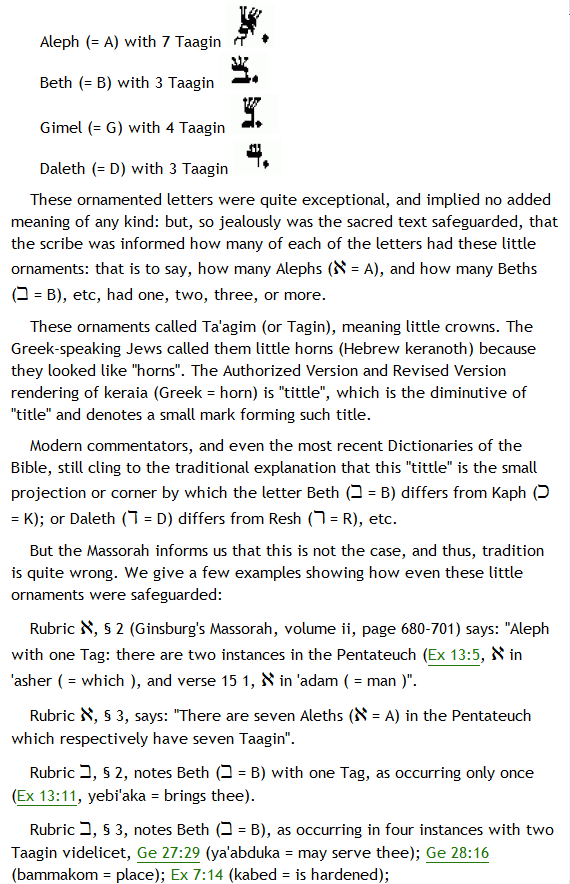
Appendix 94 THE GREEK TEXT OF THE NEW TESTAMENT
I. INTRODUCTION. While modern critics are occupied with the problem as to the origin of the Four Gospels, and with their so-called “discrepancies”, we believe that MATTHEW, MARK, and JOHN got their respective Gospels where LUKE got his, viz., anothen = “from above” (Lk 1:3, see note there); and that the “discrepancies”, so called, are the creation of the Commentators and Harmonists themselves. The latter particularly; for when they see two similar events, they immediately assume they are identical; and when they read similar discourses of our Lord, they at once assume that they are discordant accounts of the same instead of seeing that they are repetitions, made at different times, under different circumstances, with different antecedents and consequents, which necessitate the employment of words and expressions so as to accord with the several occasions. These differences thus become proofs of accuracy and perfection.
The Bible claims to be the Word of God, coming from Himself as His revelation to man. If these claims be not true, then the Bible cannot be even “a good book”. In this respect “the living Word” is like the written Word; for, if the claims of the Lord Jesus to be God were not true, He could not be even “a good man”. As to those claims, man can believe them, or leave them. In the former case, he goes to the Word of God, and is overwhelmed with evidences of its truth; in the latter case, he abandons Divine revelation for man’s imagination.
II. INSPIRATION. In Divine revelation “holy men spake from God as they were moved (or borne along) by the Holy Spirit” (2 Pe 1:21). The wind, as it is borne along among the trees, causes each tree to give forth its own peculiar sound, so that the experienced ear of a woodman could tell, even in the dark, the name of the tree under which he might be standing, and distinguish the creaking elm from the rustling aspen. Even so, while each “holy man of God” is “moved” by One Spirit, the individuality of the inspired writers is preserved. Thus we may explain the medical words of “Luke the beloved physician” used in his Gospel and in the Acts of the Apostles (Col 4:14).
As to Inspiration itself, we have no need to resort to human theories, or definitions, as we have a Divine definition in Ac 1:16 which is allsufficient. “This scripture must needs have been fulfilled, which the Holy Ghost, by the mouth of David, spake before concerning Judas.” The reference is to Ps 41:9. It is “by the mouth” and “by the hand” of holy men that God has spoken to us. Hence it was David’s voice and David’s pen, but the words were not David’s words. Nothing more is required to settle the faith of all believers; but it requires Divine operation to convince unbelievers; hence, it is vain to depend on human arguments.
III. THE LANGUAGE. With regard to this, it is generally assumed that, because it comes to us in Greek, the N.T. ought to be in classical Greek, and is then condemned because it is not! Classical Greek was at its prime some centuries before; and in the time of our Lord there were several reasons why the N.T. was not written in classical Greek.
1. The writers were Hebrews; and thus, while the language is Greek, the thoughts and idioms are Hebrew. These idioms or Hebraisms are generally pointed out in the notes of The Companion Bible. If the Greek of the N.T. be regarded as an inspired translation from Hebrew or Aramaic originals, most of the various readings would be accounted for and understood.
2. Then we have to remember that in the time of our Lord there were no less than four languages in use in Palestine, and their mixture formed the “Yiddish” of those days.
a. There was HEBREW, spoken by Hebrews;
b. There was GREEK, which was spoken in Palestine by the educated classes generally;
c. There was LATIN, the language of the Romans, who then held possession of the land;
d. And there was ARAMAIC, the language of the common people.
Doubtless our Lord spoke all these (for we never read of His using an interpreter). In the synagogues He would necessarily use Hebrew; to Pilate He would naturally answer in Latin; while to the common people He would doubtless speak in Aramaic.
3. ARAMAIC was Hebrew, as it was developed during and after the Captivity in Babylon (*1). There were two branches, known roughly as Eastern (which is Chaldee), and Western (Mesopotamian, or Palestinian).
This latter was known also as Syriac; and the Greeks used “Syrian” as an abbreviation for Assyrian. This was perpetuated by the early Christians. Syriac flourished till the seventh century A.D. In the eighth and ninth it was overtaken by the Arabic; and by the thirteenth century it had disappeared. We have already noted that certain parts of the O.T. are written in Chaldee (or Eastern Aramaic): viz. Ezr 4:8-6:18; 7:12-26; Da 2:4-7:28. Cp. also 2 Ki 18:26.
Aramaic is of three kinds:—
1. Jerusalem.2. Samaritan.3. Galilean.
Of these, Jerusalem might be compared with High German, and the other two with Low German. There are many Aramaic words preserved in the Greek of the N.T., and most of the commentators call attention to a few of them; but, from the books cited below, we are able to present a more or less complete list of the examples to which attention is called in the notes of The Companion Bible (*2).
1. Abba (*3). Mk 14:36. Ro 8:15. Gal 4:6.
2. Ainias. Ac 9:33,34.
3. Akeldama. Ac 1:19. Akeldamach (LA). Acheldamach (T Tr.). Hacheldamach (WH). See Ap. 161. I. Aram. Hakal dema’, or Hakal demah.
4. Alphaios. Mt 10:3. Mk 2:14; 3:18. Lk 6:15. Ac 1:13.
5. Annas. Lk 3:2. Jn 18:13,24. Ac 4:6.
6. Bar-abbas. Mt 27:16,17,20,21,26. Mk 15:7,11,15. Lk 23:18. Jn 18:40,40.
7. Bartholomaios. Mt 10:3. Mk 3:18. Lk 6:14. Ac 1:13.
8. Bar-iesous. Ac 13:6.
9. Bar-iona. Mt 16:17. See No. 27, below.
10. Bar-nabas. Ac 4:36, &c. 1 Co 9:6. Gal 2:1,9,13. Col 4:10.
11. Bar-sabas. Ac 1:23; 15:22 (Barsabbas all the texts).
12. Bar-timaios. Mk 10:46.
13. Beel-zeboul. Mt 10:25; 12:24,27. Mk 3:22. Lk 11:15,18,19.
14. Bethesda. Jn 5:2. (Bethzatha, T WH; Bethsaida, or Bethzather, L EH Rm.)
15. Bethsaida. Mt 11:21. Mk 6:45; 8:22. Lk 9:10; 10:13. Jn 1:44; 12:21.
16. Bethphage. Mt 21:1. Mk 11:1. Lk 19:29.
17. Boanerges. Mk 3:17. (Boanerges, L T Tr. A WH.)
18. Gethsemanei. Mt 26:36. Mk 14:32.
19. Golgotha. Mt 27:33. Mk 15:22. Jn 19:17.
20. Eloi. Mk 15:34.
21. Ephphatha. Mk 7:34.
22. Zakchaios. Lk 19:2,5,8.
23. Zebedaios. Mt 4:21,21; 10:2; 20:20; 26:37; 27:56. Mk 1:19,10; 3:17; 10:35. Lk 5:10. Jn 21:2.
24. Eli. Mt 27:46. (Elei (voc.), T WH m.; Eloi WH.)
25. Thaddaios. Mt 10:3. Mk 3:18.
26. Thomas. Mt 10:3. Mk 3:18. Lk 6:15. Jn 11:16; 14:5; 20:24,26,27,28,29; 21:2. Ac 1:13.
27. Ioannes. Jn 1:42; 21:15,16,17. (Ioanes, Tr. WH.) See Bar-iona. (Iona being a contraction of Ioana.)
28. Kephas. Jn 1:42. 1 Co 1:12; 3:22; 9:5; 15:5. Gal 2:9.
29. Kleopas. Lk 24:18.
30. Klopas. Jn 19:25.
31. Lama. Mt 27:46. Mk 15:34. (Lema, L. Lema, T Tr. A WH).
32. Mammonas. Mt 6:24. Lk 16:9,11,13. (Mamonas, L T Tr. A WH.)
33. Maran-atha. 1 Co 16:22 ( = Our Lord, come!). Aram. Marana’ tha’.
34. Martha. Lk 10:38,40,41. Jn 11:1, &c.
35. Mattaios. Mt 9:9; 10:3. Mk 3:18. Lk 6:15. Ac 1:13,26. (All the critics spell it Maththaios.)
36. Nazareth (-et). Mt 2:23; 4:13 (Nazara, T Tr. A WH); 21:11. Mk 1:9. Lk 1:26; 2:4,39,51; 4:16 (Nazara. Omit the Art. L T Tr. A WH and R.) Jn 1:45,46. Acs 10:38.
37. Pascha. Mt 26:2,17,18,19. Mk 14:1,12,12,14,16. Lk 2:41; 22:1,7,8,11,13,15. Jn 2:13,23; 6:4; 11:55,55; 12:1; 13:1; 18:28,39; 19:14. Ac 12:4. 1 Co 5:7. Heb 11:28. The Hebrew is pesak.
38. Rabboni, Rabbouni (Rabbonei, WH). Mk 10:51. Jn 20:16.
39. Raka. Mt 5:22. (Reyka’ is an abbreviation of Reykan.)
40. Sabachthani. Mt 27:46. Mk 15:34. (Sabachthanei, T Tr. WH.)
41. Sabbata (Aram. sabbata’). Heb. shabbath. Mt 12:1,5,10,11,12, &c.
42. Tabitha. Ac 9:36,40.
43. Talitha kumi. Mk 5:41. (In galilaean Aramaic it was talitha’ kumi.)
44. Hosanna (in Aram. = Save us; in Heb. = Help us). Mt 21:9,9,15. Mk 11:9,10. Jn 12:13.
IV. THE PAPYRI and OSTRACA. Besides the Greek text mention ought to be made of these, although it concerns the interpretation of the text rather than the text itself. We have only to think of the changes which have taken place in our own English language during the last 300 years, to understand the inexpressible usefulness of documents written on the material called papyrus, and on pieces of broken pottery called ostraca, recently discovered in Egypt and elsewhere. They are found in the ruins of ancient temples and houses, and in the rubbish heaps of towns and villages, and are of great importance.
They consist of business-letters, love-letters, contracts, estimates, certificates, agreements, accounts, bills-of-sale, mortgages, school-exercises, receipts, bribes, pawn-tickets, charms, litanies, tales, magical literature, and every sort of literary production.
These are of inestimable value in enabling us to arrive at the true meaning of many words (used in the time of Christ) which were heretofore inexplicable. Examples may be seen in the notes on “scrip” (Mt 10:10. Mk 6:8. Lk 9:3); “have” (Mt 6:2,5,16. Lk 6:24. Phm 15); “officer” (Lk 12:58); “presseth” (Lk 16:16); “suffereth violence” (Mt 11:12), &c. (*4)
V. THE MANUSCRIPTS of the Greek New Testament dating from the fourth century A.D. are more in number that those of any Greek or Roman author, for these latter are rare, and none are really ancient; while those of the N.T. have been set down by Dr. Scrivener at not less than 3,600, a few containing the whole, and the rest various parts, of the N.T. The study of these from a literary point of view has been called “Textual Criticism”, and it necessarily proceeds altogether on documentary evidence; while “Modern Criticism” introduces the element of human opinion and hypothesis.
Man has never made a proper use of God’s gifts. God gave men the sun, moon, and stars for signs and for seasons, to govern the day, and the night, and the years. But no one to-day can tell us what year (Anno Mundi) we are actually living in! In like manner God gave us His Word, but man, compassed with infirmity, has failed to preserve and transmit it faithfully. The worst part of this is that man charges God with the result, and throws the blame on Him for all the confusion due to his own want of care!
The Old Testament had from very early times official custodians of the Hebrew text. Its Guilds of Scribes, Nakdanim, Sopherim, and Massorites elaborated plans by which the original text had been preserved with the greatest possible care (see Ap. 93). (*5) But though, in this respect, it had advantages which the Greek text of the N.T. never had, it nevertheless shows many signs of human failure and infirmity. Man has only to touch anything to leave his mark upon it. Hence the MSS. of the Greek Testament are to be studied to-day with the utmost care. The materials are:—
i. The MSS. themselves in whole or in part.
ii. Ancient versions made from them in other languages. (*6)
iii. Citations made from them by early Christian writers long before the oldest MSS. we possess (see Ap. 168).
As to the MSS. themselves we must leave all palaeographical matters aside (such as have to do with paper, ink, and caligraphy), and confine ourselves to what is material.
1. These MSS. consist of two great classes: (a) Those written in Uncial (or capital) letters; and (b) those written in “running hand”, called Cursives. The former are considered to be the more ancient, although it is obvious and undeniable that some cursives may be transcripts of uncial MSS. more ancient than any existing uncial MS. This will show that we cannot depend altogether upon textual criticism.
2. It is more to our point to note that what are called “breathings” (soft or hard) and the accents are not found in any MSS. before the seventh century (unless they have been added by a later hand).
3. Punctuation also, as we have it to-day, is entirely absent. The earliest two MSS. (known as B, the MS. in the Vatican and a the Sinaitic MS., now at St. Petersburg) have only an occasional dot, and this on a level with the top of the letters. The text reads on without any divisions between letters or words until MSS. of the ninth century, when (in Cod. Augiensis, now in Cambridge) there is seen for the first time a single point which separates each word. This dot is placed in the middle of the line, but is often omitted.
None of our modern marks of punctuation are found until the ninth century, and then only in Latin versions and some cursives. From this it will be seen that the punctuation of all modern editions of the Greek text, and of all versions made from it, rests entirely on human authority, and has no weight whatever in determining or even influencing the interpretation of a single passage. This refers also to the employment of capital letters, and to all the modern literary refinements of the present day (*7).
4. Chapters also were alike unknown. The Vatican MS. makes a new section where there is an evident break in the sense. These are called titloe, or kephalaia (*8). There are none in a (Sinaitic), see above. They are not found till the fifth century in Codex A (British Museum), Codex C (Ephraemi, Paris), and in Codex R (Nitriensis, British Museum) of the sixth century. They are quite foreign to the original texts. For a long time they were attributed to HUGUES DE ST. CHER (Huego de Sancto Caro), Provincial to the Dominicans in France, and afterwards a Cardinal in Spain, who died in 1263. But it is now generally believed that they were made by STEPHEN LANGTON, Archbishop of Canterbury, who died in 1227. It follows therefore that our modern chapter divisions also are destitute of MS. authority.
5. As to verses. In the Hebrew O.T. these were fixed and counted for each book by the Massorites; but they are unknown in any MSS. of the Greek N.T. There are none in the first printed text in The Complutensian Polyglot (1437-1517), or in the first printed Greek text (Erasmus, in 1516), or in R. Stephens’s first edition of 1550. Verses were first introduced in Stephens’s smaller (16 mo) edition, published in 1551 at Geneva. These also are therefore destitute of any authority.
VI. THE PRINTED EDITIONS OF THE GREEK TEXT. Many printed editions followed the first efforts of ERASMUS. Omitting the Complutensian Polyglot mentioned above, the following is a list of all those of any importance:—
1. Erasmus (1 st Edition) 1516
2. Stephens 1546-9
3. Beza 1624
4. Elzevir 1624
5. Griesbach 1774-5
6. Scholz 1830-6
7. Lachmann 1831-50
8. Tischendorf 1841-72
9. Tregelles 1856-72
10. Alford 1862-71
11. Wordsworth 1870
12. Revisers’ Text 1881
13. Westcott and Hort 1881-1903
14. Scrivener 1886
15. Weymouth 1886
16. Nestle 1904
All the above are “Critical Texts”, and each editor has striven to produce a text more accurate than that of his predecessors. Beza (No. 3 above) and the Elzevir (No. 4) may be considered as being the so-called “Received Text” which the translators of the Authorized Version used in 1611.
VII. THE MODERN CRITICAL TEXTS. In the notes of The Companion Bible we have not troubled the general English reader with the names of distinctive characters or value of the several MANUSCRIPTS. We have thought it more practical and useful to give the combined judgment of six of the above editors; viz. Lachmann, Tischendorf, Tregelles, Alford, Westcott and Hort, and the Greek Text as adopted by the Revisers of the English N.T., 1881, noting the agreement or disagreement of the Syriac Version therewith. (See note 3, p. 136.)
A vast number of various readings are merely different spellings of words, or a varying order of two or more words. These are not noticed in The Companion Bible, as they do not affect the sense. There are many more, consisting of cases of nouns and inflections of verbs, &c., but these are noticed only when they are material to the interpretation. All are noted in cases where it really matters, but these are not numerous. A few are the subject of separate Appendixes. The number of these Appendixes may be found under the respective passages, such as Mt 16:18. Mk 16:9-20. Ac 7:17. Ro 16:25. 1 Pe 3:19. Rv 1:10.
The six critical Greek texts are indicated in the notes by their initial letters (see below). Where the reading is placed within brackets by the respective editors, the initial letter itself is also placed within brackets, and it is followed by “m” were the reading is placed in the margin. It will thus be seen which of the above editors retain, insert, or omit a particular reading; and which of these expresses his doubts by placing it within brackets or in the margin. To enable the reader to form his own judgment as to the value of any particular reading, it remains only to give a brief statement of the principles on which the respective editors (*9) framed their texts.
GRIESBACH (*9) based his text on the theory of Three Recensions of the Greek manuscripts, regarding the collective witness of each Recension as one; so that a Reading having the authority of all three was regarded by him as genuine. It is only a theory, but it has a foundation of truth, and will always retain a value peculiarly its own.
LACHMANN (L.), disregarding these Recensions, professed to give the text based only on the evidence of witnesses up to the end of the fourth century. All were taken into account up to that date; and all were discarded after it, whether uncial MSS., or cursives, or other documentary evidence. He even adopted Readings which were palpably errors, on the simple ground that they were the best attested Readings up to the fourth century.
TISCHENDORF (T.) followed more of less the principles laid down by Lachmann, but not to the neglect of other evidence as furnished by Ancient Versions and Fathers. In his eighth edition, however, he approaches nearer to Lachmann’s principles.
TREGELLES (Tr.) produced his text on principles which were substantially the same as Lachmann, but he admits the evidence of uncial manuscripts down to the seventh century, and includes a careful testing of a wide circle of other authorities. The chief value of his text lies not only in this, but in its scrupulous fidelity and accuracy; and it is probably the best and most exact presentation of the original text ever published.
ALFORD (A.) constructed his text, he says, “by following, in all ordinary cases, the united or preponderating evidence of the most ancient authorities.” When these disagree he takes later evidence into account, and to a very large extent. Where this evidence is divided he endeavours to discover the cause of the variation, and gives great weight to internal probability; and, in some cases, relies on his own independent judgment. At any rate he is fearlessly honest. He says, “that Reading has been adopted which, on the whole, seemed most likely to have stood in the original text. Such judgments are, of course, open to be questioned.” This necessarily deprives his text of much of its weight; though where he is in agreement with the other editors, it adds to the weight of the evidence as a whole.
WESTCOTT AND HORT (WH). In this text, the classification of MSS. into “families” is revived, with greater elaboration than that of Griesbach. It is prepared with the greatest care, and at present holds a place equal in estimation to that of Tregelles. Where all these authorities agree, and are supported by the Syriac Version, the text may be regarded as fairly settled, until further MS. evidence is forthcoming. But it must always be remembered that some cursive MSS. may be copies of uncial MSS. more ancient than any at present known. This fact will always lessen the value of the printed critical editions.
The Revisers of the N.T. of 1881 “did not deem it within their province to construct a continuous and complete Greek text.” They adopted, however, a large number of readings which deviated from the text presumed to underlie the Authorized Version. In 1896 and edition known as the Parallel N.T. Greek and English, was published by the Clarendon Press for both Universities. In the Cambridge edition the Textus Receptus is given, with the Revisers’ alternative readings, in the margin. In the Oxford edition, the Revisers give their Greek with the readings of the Textus Receptus in the margin.
(*1) It is so called because it was the language of Aram, or Mesopotamia, which is Greek for Aram Naharaim = Aram between the two rivers (Ge 24:10. Dt 23:4. Jdg 3:8. Ps 60, title). It is still called “The Island”. There were other Arams beside this: (2) Aram Dammasek (north-east of Palestine), or simply Aram, because best know to Israel (2 Sa 8:5. Isa 7:8; 17:3. Am 1:5); (3) Aram Zobah (not far from Damascus and Hamath), under Saul and David (1 Sa 14:47. 2 Sa 8:3); (4) Aram Beth-rehob (N. Galilee, Ap. 169), 2 Sa 10:6; (5) Aram Maachah (1 Ch 19:6,7); (6) Aram Geshur (2 Sa 15:8).
(*2) Further information may be found in the following works:—
· AD. NEUBAUER: On the dialects spoken in Palestine in the time of Christ, in Studia Biblica … by members of the University of Oxford. Vol. I, pp. 3974. Oxford, 1885.
· F.W.J. DILLOO: De moedertaal venounzen heere Jesus Christus en van zyne Apostelen, p. 70. Amsterdam, 1886.
· ARNOLD MEYER: Jesu Mutter-Sprache. Leipzig, 1896.
· G. DALMAN: Die Worte Jesu, mit Berucksichtigung des nathkanonischen judischen Schrifttums und der aram. Sprache erortert. Vol. I. Leipzig, 1898. Also Grammatik des judisch-palastinischen Aramaisch. 2. Auflage. Leipzig, 1905. In the Index of Greek words.
(*3) The order of the words is that of the Greek alphabet.
(*4) The examples given in the notes are from Deissmann’s Light from the Ancient East, 1910; New Light on the New Testament, 1901; Bible Studies, 1901. Milligan’s Selections from the Greek Papyri, &c. Cambridge Press, 1910.
(*5) Ancient copies of the Septuagint reveal two other orders: that of Diorthotes (or Corrector) and the Antiballon (or Comparer). But these attended chiefly to “clerical” and not textual errors.
(*6) Of these, the Aramaic (or Syriac), i.e. the Peshitto, is the most important, ranking as superior in authority to the oldest Greek manuscripts, and dating from as early as A.D. 170. Though the Syrian Church was divided by the Third and Fourth General Councils in the fifth century, into three, and eventually into yet more, hostile communions, which have lasted for 1,400 years with all their bitter controversies, yet the same version is read to-day in the rival churches. Their manuscripts have flowed into the libraries of the West, “yet they all exhibit a text in every important respect the same.” Pehsitto means a version simple and plain, without the addition of allegorical or mystical glosses. Hence we have give this authority, where needed throughout our notes, as being of more value than the modern critical Greek texts; and have noted (for the most part) only those “various readings” with which the Syriac agrees. See § VII, below.
(*7) Such as are set forth in the Rules for Compositors and Readers at the University Press, Oxford.
(*8) There are sixty-eight in Matthew; forty-eight in Mark; eighty-three in Luke; and eighteen in John.
(*9) We include Griesbach’s principles, though his edition is not included in the notes of The Companion Bible.
Appendix 95 THE NEW TESTAMENT AND THE ORDER OF ITS BOOKS
I. THE NEW TESTAMENT IN RELATION TO THE BIBLE AS A WHOLE.
The word “Testament”, as a translation of the Greek word diatheke (which means covenant), has been nothing less than a great calamity; for, by its use, truth has been effectually veiled all through the centuries; causing a wrong turning to be taken as to the purpose and character of this present Dispensation, by which the errors of tradition have usurped the place of important truth.
The word “Testament” as s name for a collection of books is unknown to Scripture. It comes to us through the Latin Vulgate. This was the rendering in the older Latin Versions before JEROME’S time; but, JEROME, while using foedus or pactum for the Heb. berith in the O.T., unfortunately reverted to testamentum in his revision of his N.T. translation (A.D. 382-405). Some of the Latin Fathers preferred instrumentum, much in the sense of our legal use of the word (*1). RUFINUS uses the expression novum et vetus instrumentum (*2), and AUGUSTINE uses both words instrumentum and testamentum (*3).
From the Vulgate, the word testament passed both into the English Bibles and the German. The Greek word is diatheke, which means “covenant”, and the R.V. substitutes this meaning in every place except two (Heb 9:16,17, on which see the notes). But even this word was never used as the title for the collection of books which make up the New Testament so called.
When these books were placed beside the books of the Hebrew Canon it became desirable, if not necessary, to distinguish them; and, as the then two Dispensations were already spoken of in Scripture as “old” and “new” (2 Co 3:6. Heb 8:6-13), so the books, which were connected with them, came to be called by the same names also. In Ex 24:7 and 2 Ki 23:2,21, we read of “the book of the covenant” (*4), and this distinction of the two covenants was already confirmed by 2 Co 3:16,14, where the Apostle speaks of “the reading of the old covenant”.
The term “New Covenant” is indeed a Scriptural expression, but it is not used of a collection of books. It is used of the great prophecy and promise of Jer 31:31; 32:40 and Eze 37:26 (which is referred to in Heb 8:8-12; 9:15-21; 10:15-18). The time for the making of this “New Covenant with the House of Israel and the House of Judah was drawing near. The last prophet, MALACHI, had spoken of the coming of the “Angel of the Covenant”, and of the “Messenger” who was to prepare His way before Him (Mal 3:1). He announces also the sending of ELIJAH the prophet to prepare the way of MESSIAH, and connects his name with that of MOSES (Mal 4:4,5).
In due time JOHN THE BAPTIST was sent “in the spirit and power of ELIJAH” (Lk 1:17); and, had the people “received” him and obeyed his call to national repentance, he would have been counted for Elijah the prophet (Mt 11:14; 17:11-13). In like manner we may well conclude that the act and word of MESSIAH at the last supper was the making of the New Covenant itself; for the Lord said of the cup “this is [i.e. represents] My blood of the New Covenant” (Mt 26:28. Mk 14:24. Lk 22:20), thus fulfilling the prophecy of Jer 31:31-34, as testified by Heb 8:8-12; 9:15-21; 10:15-18.
The use of blood was confined to two purposes:—
1. Atonement for sin (Lev 17:11. Heb 9:22), (*5) and
2. the making of a covenant (Ex 24:6-8. Heb 9:16-22).
The use of the Greek word diatheke (covenant) in relation to a collection of books is appropriate only so far as these books are regarded as belonging to the “new covenant” foretold by Jeremiah, and as being “new covenant” foretold by Jeremiah, and as being distinct from “the book of the (old) covenant”, made in Ex 24:6-8. The one great fact, which stands out in connection with the whole of the books which we call the Bible, is that they form the “Word of God”, and are made up of the “words” of God (Jer 15:16. Jn 17:8,14,17).
This is the claim that is made by the book itself, and it is ours to receive it as such. We, therefore, neither set out to discuss it, nor to prove it. “God hath spoken”; and this, for our learning, and not for our reasoning; for our faith, and not for our questioning; still less for our criticism: for the Word which He hath spoken is to be our judge in that day (Jn 12:48, Dt 18:19,20, and Heb 4:12, where it is declared to be “able to judge” (A.V. “a discerner”, Gr. kritikos; hence our “critic”)). See further, Ap. 94.
Thousands of infidels to-day believe and teach that the Council of Nice, held in A.D. 325, separated the “spurious” scriptures from the genuine ones, by some vote, or trick, when the sacred books were placed under a communion table, and, after prayer, the inspired books jumped upon the table, while the false books remained beneath.
This story originated with one “John Pappus”, and infidels make a great mistake in identifying him with “Papias”, or “Pappius”, one of the earliest Fathers, called by Eusebius (iii. 36) a “Bishop” of Hierapolis, who wrote about A.D. 115. The Encycl. Brit., 11 th (Camb.) ed., vol. xx, p. 737, suggests about A.D. 60-135 as the period of his life.
But John Pappus, who gave currency to the above story, was a German theologian born in 1549. In 1601 he published the text of an Anonymous Greek MS. This MS. cannot be older than A.D. 870, because it mentions events occurring in 869. Now the Council of Nice was held 544 years before, and all its members had been dead and buried for some five centuries. The Council of Nice was not called to decide the Canon. Nothing relating to the Canon of Scripture can be found in any of its canons or acts. And, even if it were otherwise, the votes of Councils could no more settle the Canon of the New Testament than a Town Council could settle the laws of a nation.
The great outstanding fact is that
“JEHOVAH HATH SPOKEN”,
and that the Bible as a whole claims to give us His words; for speaking or writing cannot be without words. Moreover, He tells us (Heb 1:1) that He has spoken
“AT SUNDRY TIMES AND IN DIVERS MANNERS”,
or, according to the Greek, in many parts (or portions) and by many ways (or methods). If we rightly divide these (according to 2 Ti 2:15) we have
THE CONTENTS OF THE BIBLE AS A WHOLE,
which may be exhibited as follows (*6):—
A1 | DIVINE. By the FATHER Himself. The “times” being from Ge 2:16 to Ex 3:10. The “manner” being to individuals from Adam onward.
B1 | HUMAN AGENCY. “By the Prophets.”. The “time” being from the call and mission of Moses (Ex 3:10) to that of John the Baptist, “greater than them all” (Mt 11:11). The “manner” was by human agency.
A2 | DIVINE. “By HIS SON” (Heb 1:1,2. Cp. Dt 18:18,19). The “time” being from the beginning of His ministry (Mt 4:12) to the end of it (Mt 26:46). See Ap. 119.
B2 | HUMAN AGENCY. “By them that heard HIM”, (“the Son”, Heb 2:3,4). The “time” from Acts 1-28. The “manner” was by apostolic testimony and writings, contained in the General Epistles; and in the earlier Pauline Epistles written during that “time”.
A3 | DIVINE. By “THE SPIRIT OF TRUTH” (as promised in Jn 16:12-15). The “time” from the end of the Dispensation covered by the Acts of the Apostles, when He revealed “the things concerning Christ”; which could not be spoken by Him until the events had taken place, which were the foundation of the doctrines revealed in the later Pauline Epistles (Eph., Phil., Col.). See esp. Eph 2:4-7 (*7). In these Epistles the Holy Spirit “guided” into all the truth, and thus fulfilled the promise of the Lord, in Jn 16:12-15.
B3 | HUMAN AND ANGELIC AGENCY. By “HIS SERVANT JOHN”, who bare record of the Word of God, and of all things that he saw (Rv 1:1,2). The “time” was that covered by the giving the Book of the Revelation in Patmos. The “manner” was that it was “sent and signified (showed by signs) by His angel (*8).”
Since this written Word — “the Scripture of Truth” — was thus complete, God has not spoken directly or indirectly to mankind, either by Himself or by human agency. “The Silence of God” during this Dispensation is a solemn reality. But He is going to speak again when this Dispensation comes to a close, and in Ps 50 we are told what He is going to say when the silence is broken.
According to the division of the “times” exhibited above (p. 138), it will be seen that they are six in number (the number of “man”, Ap. 10). And it will be noted that the order of the Divine three is FATHER (A1), SON (A2), and HOLY SPIRIT (A3). When the “time” comes for Him to speak “once again”, it will be apart from human agency. This will make these “times and manners” seven in all (the number of spiritual perfection, Ap. 10).
Until, therefore, God shall speak once more, we have God’s word –written. To this we are now shut up; to this we do well “to take heed in our hearts” (2 Pe 1:19). We may not add to or take away from it (Rv 22:18,19). We may not receive any other writing purporting to have come from God. There are many such in the present day; some of the authors being bold impostors and deceivers (*9), others being deceived by “automatic” writings through demons and evil spirits (1 Ti 4:1-3). To all such we are to say “Anathema”, and to treat them as accursed things (Gal 1:6-9).
II. THE ORDER OF THE BOOKS OF THE NEW “TESTAMENT”.
Our English Bibles follow the order as given in the Latin Vulgate. This order, therefore, depends on the arbitrary judgment of one man, Jerome (A.D. 382405). All theories based on this order rest on human authority, and are thus without any true foundation. The original Greek manuscripts do not agree among themselves as to any particular order of the separate books, and a few of them have most remarkable differences. We are, however, on safe ground in stating that the books are generally divided into
FIVE WELL-DEFINED GROUPS.
For the most part these groups are in the following order:—
1. The Four Gospels.
2. The Acts of the Apostles.
3. The General Epistles (*10).
4. The Pauline Epistles (*11).
5. The Apocalypse.
Even the order of these five groups varies in very few cases (*12). But these are so exceptional as not to affect the general order as given above; indeed, they help to confirm it. While the order of these five groups may be regarded as fairly established, yet, within each, the order of the separate books is by no means uniform, except in the fourth, which never varies (*12). (See notes on the chronological and canonical orders of the Pauline Epistles, preliminary to the Structure of ROMANS, as a whole.)
Even in the first group, while the Four Gospels are almost always the same as we have them in the A.V. and R.V., yet in the Codex Bezae (Cent. 6) John follows Matthew; and in another, precedes it. When we divide the Pauline Epistles (Group 4 above), and re-combine them in their chronological and historical order, we find that they re-arrange themselves so as to be distributed between the fourth and sixth of the six groups shown above on p. 138. (*13)
The five groups of the New Testament order of books (shown above) thus fall into four chronological groups, being the same as the last four of the whole Bible, corresponding with A2, B2, A3, and B3 (p. 138):—
C | THE FOUR GOSPELS: where the SON is the Divine Speaker, according to Heb 1:2-.
D | THE ACTS OF THE APOSTLES, THE GENERAL EPISTLES, THE EARLIER PAULINE EPISTLES:
Where human agency is employed in “them that heard” the Son (Heb 2:3,4), and Paul also, who both heard and saw Him.
C | THE LATER PAULINE EPISTLES :–EPHESIANS, PHILIPPIANS, COLOSSIANS:
Where “the Spirit of Truth” is the Divine Speaker, Teacher, and Guide, according to Jn 16:12-15.
D | THE APOCALYPSE: where human agency is again employed in the person of John the Apostle and Evangelist, instructed by angelic agency.
From these four groups we may gather the one great scope of the New Testament books as a whole.
Corresponding with the above we may set them out as follows:—
C | THE KING and the KINGDOM. Proclaimed to the Nation in the LAND. The Kingdom rejected and the King crucified in JERUSALEM, the capital.
D | The re-offer of both (Ac 2:38; 3:19-26) to the Dispersion among the Gentiles; and their final rejection in ROME, the capital of the Dispersion (Ac 28:16-28).
C | The KING exalted, and made the Head over all things for the Church, which is His Body (Eph 1:20-23. Php 2:9-11. Col 1:13-19), in the Kingdom of His beloved Son (Col 1:13). The mystery revealed (Eph 3:1-12. Col 1:24-29). The Kingdom on earth in abeyance. “Not yet” (Heb 2:8).
D | The KINGDOM set up in judgment, power, and glory. The King enthroned. Set forth as the great subject of the Apocalypse.
(*1) Tertullian (A.D. 150-200), Adv. Marc. iv. 1. In iv. 2, he uses it of a single gospel (Luke). (*2) Expos. Symb. Apostol. (*3) De Civ. Dei, xx. 4.
(*4) See also 1 Mac 1:57 and Sir 24:23. (*5) “Washing in blood” would defile, not cleanse. Sprinkling with blood, and washing in water, alone known to the O.T. (save in Ps 58:10). As to Rv 1:5 and 7:14, see notes there.
(*6) While the divisions shown in the Structure are true as a whole, it is not denied that there may be exceptions to the general rule; but these only go to establish the truth of the rule itself.
(*7) The other later Epistles of Paul were written to individuals, and to a special class of Hebrew believers.
(*8) Not by “the Spirit of Truth”. His mission, in A3, was to guide into the truth, while, in Acts of the Apostles (B2), it was to bear witness by miracles to the confirmation of them that heard the Son. In the Apocalypse it was not Divine speaking by “the Spirit of Truth”, but the showing by an Hierophant.
(*9) Such as Swedenborg, Joanna Southcote, Joe Smith (of Mormonite fame), the author of “The Flying Roll”, Mrs. Eddy, Dowic, and others.
(*10) James usually coming first, following next after the Acts of the Apostles.
(*11) Invariably in their present, canonical order, as given in the A.V.
(*12) For example: the fourth follows the second; the second and fourth are followed by the first; and in one case the fifth comes between the second and third.
(*13) Except that, in the best and oldest Codices, Hebrews follows 2 Thess. (instead of Philemon); while in one (that from which Cod. B was taken) Hebrews follows Galatians.
Appendix 96
THE DIVERSITY OF THE FOUR GOSPELS
We have already seen from the Structure on p. 1304, and notes there, that each of the Four Gospels has its own special character and design. These are not to be determined by human ingenuity or on modern lines, but to be gathered from the Structure. This shows that they may be regarded as being the completion of the Old Testament, rather than the beginning of the New. In any case they have nothing whatever to do with the founding of “the Church”, or with the beginning of “Christianity” (see Ap. 113, notes on the Structure of the Acts as a whole, and Ro 15:8). They are the four distinct presentations of the Messiah, and together form one perfect whole.
The twofold subject of the Lord’s fourfold ministry (Ap. 119) shows this very clearly; and excludes all modern hypotheses. This being so, only those events, miracles, and discourses of our Lord are selected which are needed for the presentation of our Lord and His ministry, and which bear upon, illustrate, and thus emphasize the special object of each Gospel. This is why certain words and works are peculiar to one Gospel, and are omitted from another; and why certain utterances of the Lord are repeated on other occasions, and with varying words. Also why we have “the kingdom of God” in the other Gospels (see Ap. 114).
It has been too generally assumed that events and discourses which are similar are identical also. But this is not the case as may be seen from Ap. 116, 152, 153, 155, 156, 157, 158, 163, 164.
By failing to distinguish or to “try the things that differ” (Php 1:10), and to rightly divide “the word of truth” (2 Ti 2:15) as to its times, events separated by great landmarks of time are brought together and treated as though they were one and the same, whereby difficulties are created which baffle all the attempts of those who would fain remove them.
Appendix 97
THE UNITY OF THE FOUR GOSPELS
In the notes on pp. 1304 and 1305, and in Ap. 96, we have shown that there is a Diversity in the Four Gospels. But there is a Unity also, as is shown by the fact that all Four Gospels follow the same general Structure. This runs through them all alike, showing that, after all, the presentation of the Lord is one (*1). While it was not in God’s purpose to give us one Gospel, yet amid all the diversity of the parts there is a continuity of the whole. The parts are distributed according as they are appropriate to the special design and character of each Gospel, and this in perfect order and accuracy.
After what has been said in Ap. 96, and in the notes to the Structure on p. 1304, it would be out of place to attempt to present anything like a complete “Harmony”; but, in order to show how needless it is to dislocate certain passages in order to bring together similar events and discourses (supposed to be identical, as though nothing the Lord said or did was ever repeated), a condensed outline is presented. It will be noted that there are great events which were never repeated: such as the Mission of the Twelve, the Transfiguration, the Dividing of the Garments, &c. These help us in determining the order and place of other events which, though similar, are not identical.
From the outline given below it will be easy to see how the several accounts of similar events and discourses are distributed in the several Gospels, without violently altering the sequence of verses and chapters, as is done in most so-called “Harmonies”.
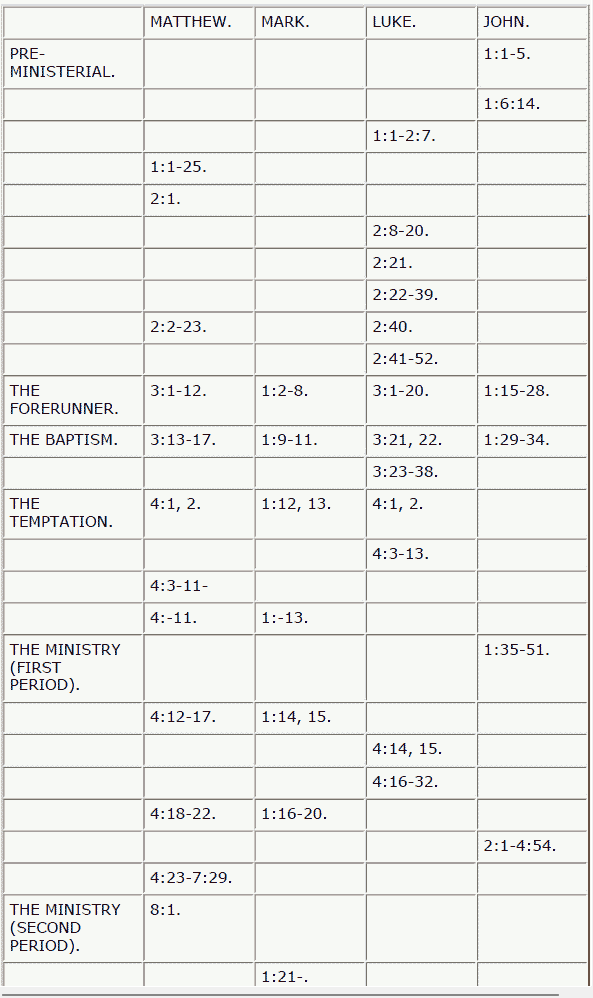
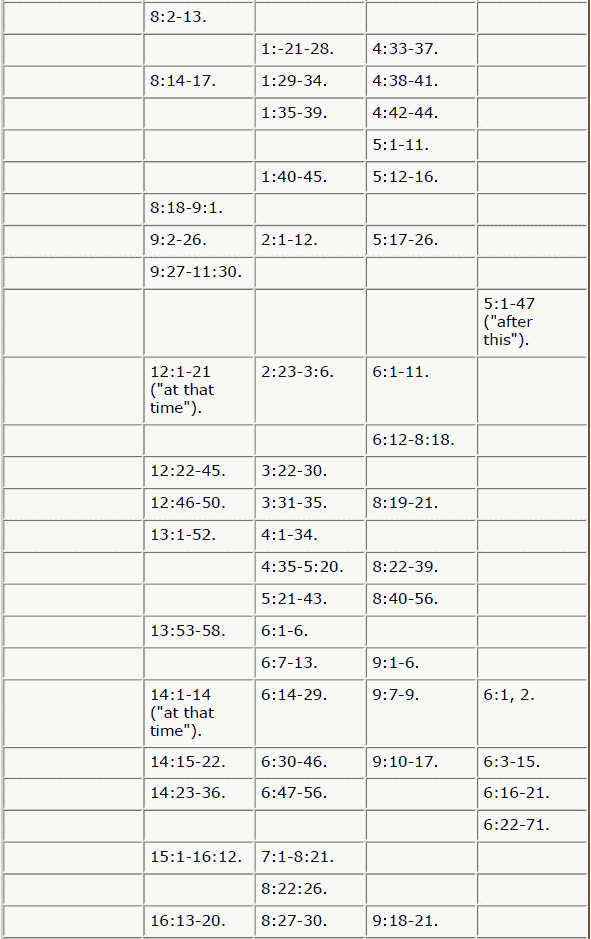
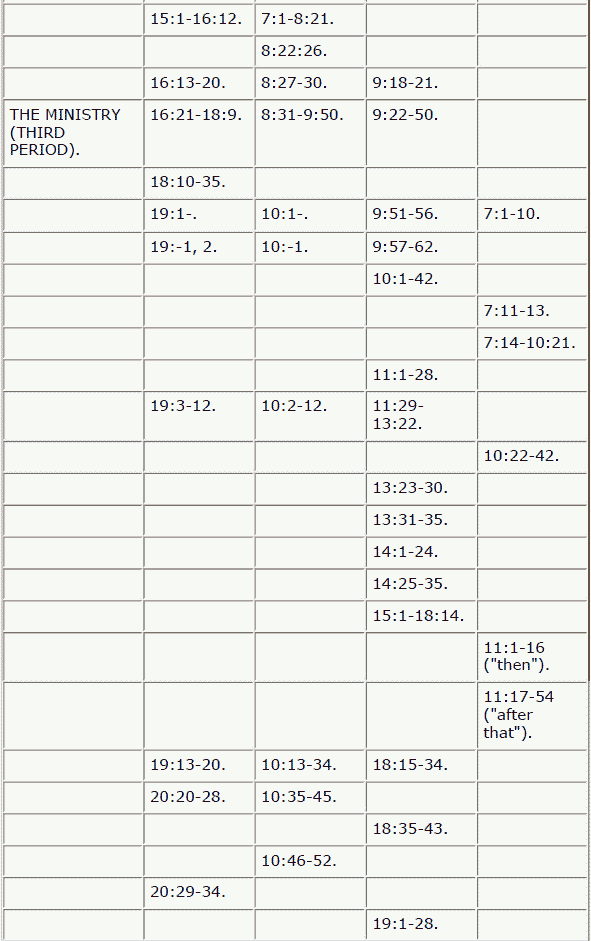
[For the Fourth Period of the Lord’s Ministry and subsequent events, see Appendix 156. For the sequence of events after the resurrection of the Lord, see Appendix 166.]
(*1) But note that in the Structure of John there is no “Temptation” and no “Agony”.
Appendix 98 THE DIVINE NAMES AND TITLES IN THE NEW TESTAMENT
All names and titles used of one Person represent the different relationships which are sustained by Him. In the New Testament these are more varied, and not less important than those in the Old Testament; and Ap. 4 should be compared with this Appendix.
The following exhibition of them practically embraces all that is necessary to enable the English reader to understand them, and to grasp something of the perfection with which each is used. The list of the Names, &c., is given according to the common English rendering of the A.V., as being more easy for reference. It does not include “Spirit” or “Holy Spirit”: for which see the separate Appendix 101.
Reference is made, in the notes, to the following divisions and subdivisions:—
I. GOD.
GOD. Gr. Theos. The Greek language, being of human origin, utterly fails (and naturally so) to exhibit the wonderful precision of the Hebrew, inasmuch as the language necessarily reflects, and cannot go beyond the knowledge, or rather the lack of knowledge, of the Divine Being apart from revelation.
i. Theos corresponds, generally, with ‘Elohim of the O.T., denoting the Creator (see Ap. 4. I); but it corresponds also with El (Ap. 4. IV), and Eloah (Ap. 4. V). Sometimes it corresponds with Jehovah (who is ‘Elohim in Covenant relation), in which case it is printed GOD, as in the Old Testament (both A.V. and R.V.).
1. Theos is used in the N.T. of the Father, as the revealed God (see Jn 1:1. Ac 17:24, &c.)
2. It is used of the Son (Mt 1:23. Jn 1:1; 20:28, &c. Ro 9:5. 2 Pe 1:1. 1 Jn 5:20). Cp. Col 2:9 and 2 Pe 1:3,4.
3. It is used of the Holy Spirit (Ac 5 v. 3, compared with v. 4).
4. It is used generically, as in Jn 10:34. Ac 12:22. 2 Co 4:4. Php 3:19, &c.
5. It is used of false gods, as in Ac 7:43, &c.; and is printed “god” as in the O.T.
ii. Cognate with Theos, there are three other words to be noted:
1. Theotes, rendered “Deity”, and used of Christ. Occurs only in Col 2:9, and has relation to the Godhead personally; while
2. Theiotes, rendered “Deity” also, is Deity in the abstract. Occurs only in Ro 1:20.
3. Theios, rendered “Divine”, and is used of Christ. Occurs only in 2 Pe 1:3,4; and, with the Article, in Ac 17:29, where it is rendered “Godhead”. Gr. = that which [is] Divine.
II. I AM.
Used by Christ of Himself, in Jn 8:58. See note on Ex 3:14.
III. FATHER.
FATHER. Gr. Pater. Expresses relationship, the correlative of which is “son”. When used of man it not only denotes parentage, but it sometimes has the wider meaning of “ancestor”, “founder”, or a “senior” (as in 1 Jn 2:13,14); also the author or source of anything (Jn 8:44. Heb 12:9); and expresses a spiritual relationship, as in 1 Co 4:15. When used of God it denotes His relationship to His “beloved Son”; and to those (“sons”) who have been begotten (not “born”, see note on Matt 1:1) into a new creation. It implies “sons”, not “offspring”, as in Ac 17:28,29. These were “offspring”, and were existing (Gr. huparcho), as such, according to nature, on the ground of creation; not “sons” as being “begotten” into a new creation.
IV. ALMIGHTY.
ALMIGHTY. Gr. Pantokrator. This title belongs to the same God, as Creator, but expresses His relationship to all He has created, by the exercise of His power over “all the works of His hands”. It occurs only in 2 Co 6:18. Rv 1:8; 4:8; 11:17; 15:3; 16:7,14; 19:6,15; 21:22.
V. POTENTATE.
POTENTATE. Gr. Dunastes = a mighty Prince, or Ruler (cp. Engl. “dynasty”). Used of God, only in 1 Ti 6:15. Elsewhere used, only twice, of earthly rulers, in Lk 1:52 (generally), and of the Ethiopian eunuch in Ac 8:27.
VI. LORD.
This is the rendering of two Greek words: i. Kurios, and ii. Despotes; and one Aramaic, iii. Rabboni.
i. Kurios. Kurios means “owner” (and is so translated in Lk 19:33). It expresses the authority and lordship arising from and pertaining to ownership. Hence, while it is used of each Person of the Trinity, it is similarly used of the lower and human relationship of “master”. Cp. Lk 19:33 and see below a. 4.
So much depends on the presence or absence of the Greek Article, when used of the Divine relationship that these are carefully distinguished in the subdivisions below.
For obvious reasons the four Gospels have been treated, below, apart from the other books of the N.T.
<START GREEK>a<END GREEK>. In the Four Gospels.
1. Used of Jehovah (Ap. 4. II), and printed “LORD” throughout.
A. With the Article (ho Kurios).
a. In quotations from the O.T. it occurs four (*1) times: in Mt 1:22; 2:15; 5:33; 22:44-.
b. In other connexions it occurs fourteen times: once in Matt. (9:38); once in Mark (5:19); twelve times in Luke (1:6,9,15,25,28,46; 2:15,22,23,38; 10:2; 20:42).
B. Without the Article (Kurios).
a. In quotations from the O.T. it occurs twenty-nine times: eight times in Matt. (3:3; 4:7,10; 21:9,42; 22:37; 23:39; 27:10); eight times in Mark (1:3; 11:9,10; 12:11,29,29,30,36-); nine times in Luke (3:4; 4:8,12,18,19; 10:27; 13:35; 19:38; 20:37); four times in John (1:23; 12:13,38,38).
b. In other connexions twenty-four times: six times in
Matt. (1:20,24; 2:13,19; 11:25; 28:2); once in Mark (13:20); seventeen times in Luke (1:11,16,17,32,38,45,48,66,68,76; 2:9,23,24,26,39; 5:17; 10:21).
2. Used by Christ of Himself.
A. With the Article (ho Kurios).
a. In direct reference: six times (Mt 21:3; 24:42; Mk 11:3; Lk 19:31; Jn 13:13,14).
b. In indirect reference: twice (Mt 22:44; Lk 20:42).
B. Without the Article (Kurios).
a. In direct reference: eleven times (Mt 7:21,21,22,22; 12:8; 25:37,44; Mk 2:28; Lk 6:5,46,46).
b. In indirect reference: four times (Mt 22:43,45; Mk 12:37; Lk 20:44).
3. Used of Christ by others.
A. By His disciples: fifty-nine times (Mt 8:21,25; 13:51; 14:28,30; 16:22; 17:4; 18:21; 26:22; [not one in Mark (*2)] Lk 1:43; 5:8; 9:54,57,59,61; 10:17,40; 11:1; 12:41; 13:23; 17:37; 19:8,34; 22:31,33,38,49; 23:42; 24:34; Jn 6:68; 9:36,38; 11:3,12,21,27,32,34,39; 13:6,9,25,36,37; 14:5,8,22; 20:2,13,18,20,25,28; 21:7,15,16,17,20,21).
B. By others than His disciples.
a. Rendered “Lord” eighteen times: twelve in Matt. (8:2,6,8; 9:28; 15:22,25,27; 17:15; 20:30,31,38; 28:6); only twice in Mark (*3) (7:28; 9:24); four times in Luke (2:11; 5:12; 7:6; 18:41); twice in John (6:34; 8:11).
b. Rendered “Sir” six times: Jn 4:11,15,19,49; 5:7; 20:15 (Mary, addressing the supposed gardener).
c. By the Holy Spirit frequently in the narratives of the Evangelists.
4. Used of others than Christ.
A. With the Article (ho Kurios), emphasizing ownership. Occurs forty-two times: twenty-one times in Matt. (10:24,25; 15:27; 18:25,27,31,32,34; 20:8; 21:40; 24:45,46,48,50; 25:18,19,21,23,23,26); twice in Mark (12:9; 13:35); sixteen times in Luke (12:36,37,42,43,45,46,47; 14:21,23; 16:3,5,5,8; 19:33; 20:13,15); three times in John (13:16; 15:15,20).
B. Without the Article (Kurios). Generally in courtesy, emphasizing superior relationship. Occ. nineteen times. Rendered “Lord” fourteen times (Mt 18:26; 25:11,11,29,22,24. Lk 13:8,25,25; 14:22; 19:16,18,20,25); “Master” twice (Mt 6:24. Lk 16:13); “Sir” four times (Mt 13:27; 21:30; 27:63. Jn 12:21).
<START GREEK>b<END GREEK>. In the other books of the New Testament.
1. Used of Jehovah (Ap. 4. II), and printed “LORD” throughout; as in the O.T.
A. With the Article (ho Kurios).
a. In quotations from the O.T. Occurs ten times (Ac 2:25,34; 4:26; 7:33; 13:47; 15:17. Ro 15:11. 1 Co 10:26,28. Heb 8:11).
b. In other connexions: Ac 2:47. 2 Co 10:18. Heb 8:2; 12:14. Jas 5:11. 2 Pe 3:9,15. Jude 5. Rv 11:15,21,22.
B. Without the Article (Kurios).
a. In quotations from, or references to, the O.T.: Ac 2:20,21; 3:22; 7:30,31,37,49. Ro 4:8; 9:28,29; 10:13,16; 11:3,34; 12:19; 14:11. 1 Co 1:31; 2:16; 3:20; 14:21. 2 Co 6:17,18; 10:17. Heb 1:10; 7:21; 8:8,9,10; 10:16,30,30; 12:5,6; 13:6. 1 Pe 1:25; 3:12,12.
b. In other connexions : Ac 1:24; 2:39; 5:9,19; 17:24. 2 Co 3:16. Jas 5:4,10,11-. 2 Pe 2:9,11; 3:8,10. Jude 9,14. Rv 4:8; 11:17; 15:3,4; 16:5,7; 18:8; 19:1,6; 22:5,6.
2. Used of Christ.
A. With the Article, as in -Ac 2:34. 2 Co 3:17-, &c.
B. Without the Article, as in 1 Co 8:6, &c.
ii. Despotes. Like Kurios (i, above) it denotes owner; but it includes (when used of God) the exercise of more absolute, unlimited and despotic authority and power in heaven and on earth. It is derived from deo = to bind, and pous = the foot. It occurs ten times in the New Testament, and is rendered five times “Lord”; and five times “Master” (see No. XIV. 2, below).
1. Used of Jehovah (Ap. 4. II) three times (Lk 2:29. Ac 4:24. Rv 6:10).
2. Used of Christ, twice (2 Pe 2:1. Jude 4).
iii. Rabboni. Aramaic for the Heb. Rabbi = my Master, or Teacher. See Ap. 94. II. 3. Occurs twice, once translated “Lord” (Mk 10:51); and once transliterated “Rabboni” (Jn 20:16).
VII. EMMANUEL.
EMMANUEL. Heb. ‘Immanuel = God (El) with us (Isa 7:14; 8:8). Used of Christ, Mt 1:23, being another proof of His Deity (see No. Vi. i. a. 2. A. a. b.).
VIII. MESSIAH.
This is the Greek transliteration of the Heb. Mashiah, with the same meaning, Anointed. Used twice of Christ (Jn 1:41; 4:25).
IX. CHRIST.
This is the Greek translation of the Heb. Mashiah, See No. VIII. Christos has the same meaning, from chrio, to anoint. Hence, the Noun is used of and for the Messiah, and in the Gospels should always be translated “Messiah”, as well as in the Acts, and sometimes in the later books of the New Testament.
X. JESUS.
Iesous is the same as the Heb. Jehoshua, or the abbreviated form Joshua (cp. Heb 4:8), and means [the] Salvation of jehovah, or Jehovah [the] Saviour. The name “Jesus” expresses the relation of Jehovah to Him in Incarnation, by which “He humbled Himself, and became obedient unto death, even the death of the cross” (Php 2:8); Who, being God, did not deem His glory a thing not to be thus relinquished (see note on “robbery”, Php 2:6). The name “Jesus” is the name associated with “the shame” which He endured in order to “save His People from their sins” (Mt 1:21). His People therefore never addressed Him as “Jesus”, but always as “Master” (No. XIV. v) or “Lord” (VI, i, a, 3). (Jn 13:13,14. Lk 6:46), and so should all His people to-day; not following the example of demons (Mt 8:29), or of His enemies, who irreverently called Him “Jesus”.
XI. JESUS CHRIST.
In the combination of these two names, the former is emphatic by its position, the second being subsidiary and explanatory. In the Gospels it means “Jesus the Messiah”. In the Epistles it means Jesus Who humbled Himself but is now exalted and glorified as Christ. Care should be taken to note the various readings.
XII. CHRIST JESUS.
This is the converse of “Jesus Christ” (XI) and denotes the now exalted One, Who once humbled Himself.
XIII. CHRIST THE LORD.
This is the Heb. Mashiah Jehovah = Jehovah’s Anointed, as in 1 Sa 24:6. Occ. only in Lk 2:11; and with the Article = the Anointed of Jehovah, Lk 2:26.
XIV. MASTER.
This title is the translation of eight distinct Greek words, which are all carefully distinguished in the notes.
i. Kurios (the same as No. VI. i. a. 2, 3, above). Is used of the Lord in Mk 13:35. Eph 6:9, and Col 4:1. Used of others (Mt 6:24. Lk 16:13). See Vi. i. a. 4. B., above.
ii. Despotes, see No. VI, ii, above. It occurs ten times, and is rendered five times “Lord” (see VI. ii); and five times “Master”, once of the Divine Master (2 Ti 2:21); and four times of human masters.
iii. Oikodespotes = master of a house; house-master. It occurs twelve times, and is used in Parables by the Lord of Himself seven times, and of others thrice: it is rendered four times “house-holder”; five times “goodman of the house”; and three times “master” (Mt 10:25. Lk 13:25; 14:21). Twice it is used of others than Christ (Mk 14:14. Lk 21:11).
iv. Epistates = Commander. Occurs five times as addressed to the Lord (Lk 5:5; 8:24,24,45; 9:33,49; 17:13).
v. Didaskalos = Teacher, or as we should say “Doctor”. Occurs fifty-eight times, and is twice explained as meaning “Rabbi”. See No. vii, p. 144.
1. The Lord was addressed as Didaskalos ( = Teacher), rendered “Master” thrity-one times; six times in Matthew (8:18; 12:38; 19:16; 22:16, 25, 36); ten times in Mark (4:38; 9:17,38; 10:17,20,35; 12:14,19,32; 13:1); twelve times in Luke (3:12; 7:40; 9:38; 10:25; 11:45; 12:13; 18:18; 19:39; 20:21,28,39; 21:7); three times in John (1:39; 8:4; 20:16).
2. The Lord spoke of as “Master” by Himself eight times: three times in Matthew (10:24, 25; 26:18); once in Mark (14:14); thrice in Luke (6:40,40; 22:11); once in John (13:14).
3. The Lord spoken of as “Master” by others than Himself six times: twice in Matthew (9:11; 17:24); once in Mark (5:35); once in Luke (8:49); twice in John (11:28; 13:13).
4. Spoken of others than the Lord twice, and rendered “master” in Jn 3:10. Jas 3:1. In other renderings once “doctor” (Lk 2:46), and ten times “teacher”, once of the Lord (Jn 3:2), and nine times of human teachers (Ac 13:1. Ro 2:20. 1 Co 12:28,29. Eph 4:11. 1 Ti 2:7. 2 Ti 1:11; 4:3. Heb 5:12).
vi. Kathegetes = A Guide or Leader. Used of the Lord by Himself three times (Mt 23:8,10,10).
vii. Rabbi. The Hebrew term for “my Teacher”, transliterated into Greek. Twice explained as meaning the same as the Gr. Didaskalos (see XIV. v, p. 143). Occurs seventeen times, and used as follows:
1. The Lord addressed as “Rabbi” five times (Jn 1:39,49; 3:2,26; 6:25). Rendered “Master” nine times (Mt 26:25,49. Mk 9:5; 11:21; 14:45,46. Jn 4:31; 9:2; 11:8).
2. Used of others than the Lord four times (Mt 23:7,7,8. Jn 3:26).
viii. Rabboni. Aramaic for Rabbi (see Ap. 94. III. 38). Occurs twice, once transliterated (Jn 20:16); and once translated “Lord” (Mk 10:51).
XV. THE SON OF GOD.
This title expresses the relation of the Son to the Father (Mt 1:20. Lk 1:31,35); and of all those who are begotten of God (see note on Matt 1:1. 1 Jn 3:1). It differs therefore from the relationship expressed by “the Son of man”, which relates to “dominion” in the earth (see XVI, below). As the Son of God, Christ is “the heir of all things” (Heb 1:2), and is invested with “all power”, and is “the Resurrection and the Life” (Jn 11:25), having power to raise the dead (Jn 5:25). As “the Son of man”, all judgment is committed to Him (Jn 5:27) in the earth. See on No. XVI, below.
XVI. THE SON OF MAN.
This title, when used of Christ, always has the Article; and the word for man is anthropos (see Ap. 123, I). When used of a human being, as in Ezekiel, it never has the Article (see notes on Ps 8:4, and Eze 2:1).
To the “first man, Adam” was given dominion over the works of the Creator (Ge 1:26). Through the Fall (Ge 3), this dominion was forfeited, and lost, and is now in abeyance; no one son of Adam having any right to universal dominion. Hence, all the chaos, “unrest”, and conflicts between men and nations, which must continue until He shall come Whose right it is to rule in the earth (Eze 21:27). The great enemy, who wrought all the mischief at the Fall, has tried, from time to time, to exercise this authority by setting up some human head. He tried Nebuchadnezzar, Alexander the Great, and others, and in later days Napoleon; but he will finally succeed for a brief period with the Antichrist, until “the second man”, “the last Adam” (1 Co 15:45), “the Son of Man”, to Whom all dominion in the earth has, in the counsels of God, been given, shall take unto Him His great power and reign.
All this and more is contained in His title as “the Son of man”. Its first occurrences is in Ps 8, where in verses 1 and 8 His connection with the “earth” is proclaimed; and “dominion” over it is given to Him. It denotes Him Who is “the heir of all things”, in virtue of which all things shall one day be put under His feet. “But now we see not yet all things put under Him. But we see Jesus, Who was made a little lower than the angels”, humbling Himself unto death, even the death of the Cross (cp. Heb 2:8,9).
In support of this, the occurrences and distribution of this title in the N.T. are full of significance and instruction.
1. As to the occurrences. We find the expression eighty-eight times: Mt 8:20; 9:6; 10:23; 11:19; 12:8,32,40; 13:37,41; 16:13,27,28; 17:9,12,22; 18:11; 19:28; 20:18,28; 24:27,30,37,39,44; 25:13,31; 26:2,24,24,45,64. Mk 2:10,28; 8:31,38; 9:9,12,31; 10:33,45; 13:26; 14:21,21,41,62. Lk 5:24; 6:5,22; 7:34; 9:22,26,44,56,58; 11:30; 12:8,10,40; 17:22,24,26,30; 18:8,31; 19:10; 21:27,36; 22:22,48,69; 24:7. Jn 1:51; 3:13,14; 5:27; 6:27,53,62; 8:27; 12:23,34,34; 13:31. Ac 7:56. Heb 2:6 (*4). Rv 1:13; 14:14. On Jn 9:35 see note there.
The first is in Mt 8:20, where the first thing stated of, and by, the One Who humbled Himself is that in this same earth “the Son of man had not where to lay His head.”
The second, in like manner, is connected with the earth, and shows that He was God, as well as Man, having “authority on earth to forgive sins” (Mt 9:6); and so the order of the occurrences may be carried out.
Note, in this connection, the contrast between the relationship to mankind of the Lord, as “the Son of God”, and as “the Son of man” in Jn 5:25-27. Cp. Ac 10:40-42; 17:31.
2. As to the distribution of this title: our of the whole number (88), no less than 84 are in the Four Gospels, which contain the record of His coming for this special purpose; and of His rejection. They are all used by the Lord of Himself.
After these 84 occurrences, we have one in the Acts (7:56) where Stephen sees Him “standing” as though not yet “set down”, and waiting to be “sent” according to the promise of Jehovah by Peter in Ac 3:20 (cp. Heb 10:13); and two in the Apocalypse (Rv 1:13 and 14:14), where He comes to eject the usurper, and reign in righteousness over a restored earth. Heb 2:6 (*4) is a quotation from Ps 8, which can only be realized by Him.
This distribution of the title shows us that it has nothing whatever to do with “the Church of God”; and that those who belong to it have no relation to the Lord Jesus as “the Son of man”. They stand related to Him as “the Son of God”.
The distribution between the four separate Gospels is equally significant. In Matthew it occurs 32 times. Mt 8:20 is the first occurrence in the New Testament, and it is interesting to contrast it with the last occurrence (Rv 14:14). In the first He had “not where to lay His head”, but in the last that head has on it “a golden crown”, and in His hands is seen “a sharp sickle”. With this He reaps in judgment the harvest of the earth, for the time to reap it will then have come. This is emphasized by the word “earth” being 6 times repeated in the verses 15, 16, 18, 19.
· In Mark it occurs 14 times, which is twice seven; the two of testimony, and the seven of spiritual perfection of Jehovah’s Servant.
· In Luke it occurs 26 times.
· In John it occurs 12 times, the number which stands associated with Divine governmental perfection. (See Ap. 10.)
Similarly significant are the first and last occurrences in the Four Gospels respectively: the first being in connection with the humiliation of “the Son of man”, and the last with His glorification. Cp. Mt 8:20 with 26:64; Mk 2:10 with 14:62; Lk 5:24 with 24:7; and Jn 3:13,14 with 13:31.
Thus, while as “the Son of God” He is “the Heir of all things” (Heb 1:2) as “the Son of man” He is the Heir to that dominion in the earth which was entrusted to the first man, and forfeited by him.
XVII. THE SON OF ABRAHAM (Mt 1:1).
Expresses the relation of the Son of man, as being heir to the land given to Abraham (Ge 15:18-21).
XVIII. THE SON OF DAVID (Mt 1:1. Lk 1:32, &c.).
Expresses His relationship, as being the Heir to David’s throne (2 Sa 7:12-16. Isa 11:1. Ac 2:29-32; 13:33-37. Rv 5:5; 22:16).
(*1) These numbers refer to the Received Greek Text. In some cases there are various readings, but in most of them the difference consists in the omission of the article. Any important variations are referred to in the notes.
(*2) Because, in Mark, the presentation of the Lord is as “Jehovah’s Servant”; and a servant is not usually addressed as Lord. See notes on p. 1381. This is not a peculiarity of Mark, but shows the accuracy and perfection of this presentation by the Holy Spirit.
(*3) Once by a Gentile, the other being omitted by the Critical texts (though not by the Syr.).
(*4) The reference in Heb 2:6 is a quotation from Ps 8:4, and refers to “the first man”, Adam; and only by application to the Lord.
Appendix 99
THE TWO GENEALOGIES OF Mt 1 AND Lk 3
“THE BOOK OF THE GENERATION OF JESUS CHRIST” (THE MESSIAH)
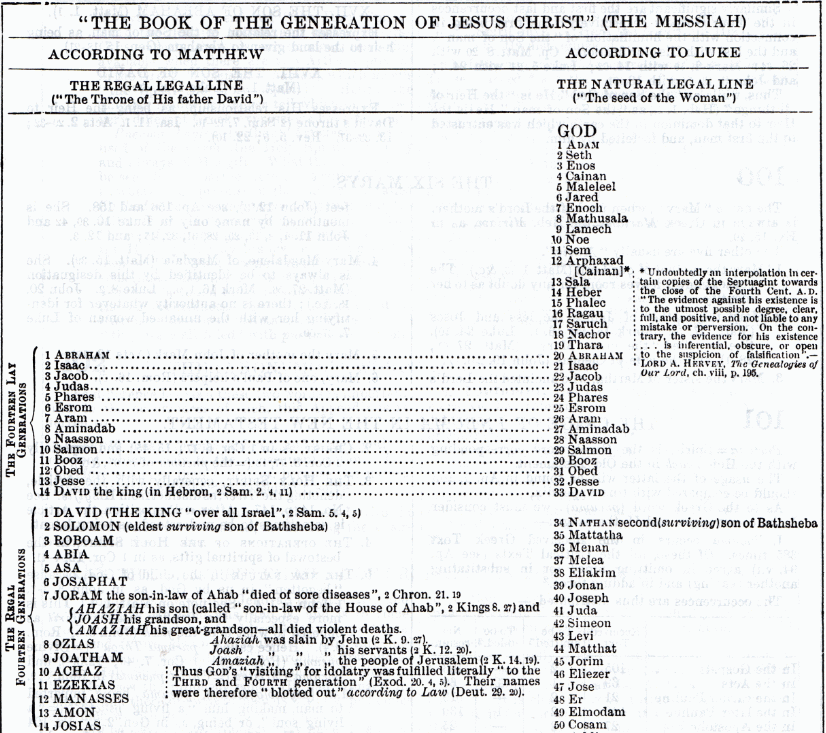
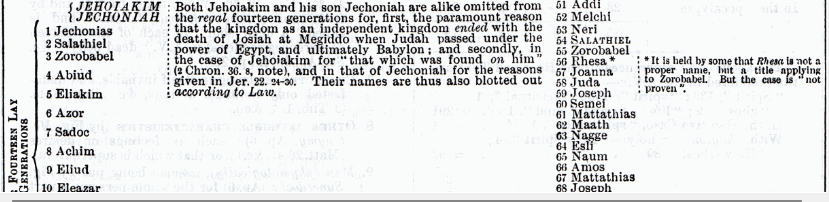
Appendix 100
THE SIX MARYS
The name “Mary”, when used of the Lord’s mother, is always in Greek Mariam = the Hebrew Miriam, as is Ex 15:20. The other five are usually “Maria”.
1. Mary the mother of our Lord (Mt 1:16, &c). The context never leaves room for any doubt as to her identity.
2. Mary the mother of James the less and Joses (Mt 27:56. Mk 15:40; 16:1. Lk 24:10). She is called “the other Mary” (Mt 27:61; 28:1), and the wife of Cleopas (Jn 19:25).
3. Mary the sister of Martha, who anointed the Lord’s feet (Jn 12:3), see Ap. 156 and 158. She is mentioned by name only in Lk 10:39,42 and Jn 11:1,2,19,20,28,31,32,45; and 12:3.
4. Mary Magdalene, of Magdala (Mt 15:39). She is always to be identified by this designation (Mt 27:56. Mk 16:1,9. Lk 8:2. Jn 20:18, &c); there is no authority whatever for identifying her with the unnamed woman of Lk 7:37-50.
5. Mary the mother of John Mark (Ac 12:12).
6. Mary, one of Paul’s helpers. (Ro 16:6).
Appendix 101
THE USAGE OF PNEUMA IN THE NEW TESTAMENT
Pneuma = Spirit, is the Greek word corresponding with the Heb. ruach in the Old Testament. The usage of the latter will be found in Ap. 9, and should be compared with this appendix. As to the Greek word
(pneuma): we must consider:
I. The occurrences, and
II. The usage:—
I. The occurrences of pneuma Pneuma occurs in the Received Greek Text 385 times. Of these, all the Critical Texts (see Ap. 94. vii) agree in omitting nine (*1) (or in substituting another reading) and in adding three
(*2). The occurrences are thus distributed:—
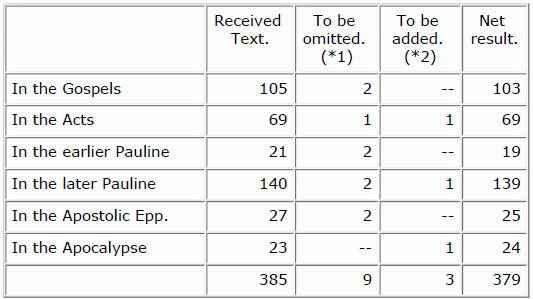
The above 385 occurrences in the Received Text are thus rendered in the A.V.:—
“Spirit”, 133; “spirit”, 153; “spiritual”, 1; “ghost”, 2; “life”, 1; and “wind”, 1291
In the Genitive case, “spirituality”, 11
With “hagion” (holy) = Holy Spirit”, 4; “Holy Ghost”, 8993
385
In the margin:—
“Breath” is given twice as an alternative for “spirit”, and once for “life”.
“Of the spirit” is given as an alternative for “spiritually”; and
“spirit” is given as an alternative for “spiritual”.
II. The usages of pneuma. The following have been noted in The Companion Bible. It is used for
1. GOD. “God is pneuma” (Jn 4:24). Not “a” spirit, for there is no indefinite Article in the Greek.
2. CHRIST, as in 1 Co 6:17; 15:45; and especially 2 Co 3:17,18 ( = the pneuma of v. 6-, &c.).
3. THE HOLY SPIRIT, generally with the Article, denoting the Giver, as distinct from His gifts. See No. 14, p. 147. After a preposition the Article is sometimes to be understood, as being latent.
4. THE OPERATIONS OF THE HOLY SPIRIT, in the bestowal of spiritual gifts, as in 1 Co 12:4-11.
5. THE NEW NATURE in the child of God, because “begotten” in us by God, as in Jn 3:3-7. 1 Jn 5:1,4. See note on Matt 1:1. This is more especially the Pauline usage: spirit as opposed to what is of the flesh (Jn
3:6. Ro 8:4). Hence called “pneuma Theou” ( = Divine pneuma (Ro 8:9. 1 Co 7:40; 12:3), and pneuma Christou ( = Christ pneuma) in Ro 8:9.
6. MAN (psychologically), pneuma being imparted to man, making him “a living psuche” ( = “a living soul”, or being, as in Ge 2:7. Ps 104:29,30. Ecc 12:7). When taken back to and by God, man, without pneuma,
becomes and is called “a dead soul” in each of the thirteen occurrences rendered in A.V. “dead body”, &c. See Ap. 13. ix, p. 21).
7. CHARACTER, as being in itself invisible, and manifested only in one’s actions, &c. Ro 8:15. (2 Ti 1:7, &c.).
8. OTHER INVISIBLE CHARACTERISTICS (by Fig. Metonymy, Ap. 6): such as feelings or desires (Mt 26:41, &c.); or that which is supernatural.
9. MAN (physiologically), pneuma being put by Fig. Synecdoche (Ap. 6) for the whole person; a part for the whole (as in Lk 1:47, “my spirit” = I myself). See Ap. 9. VII.
10. ADVERBIALLY. But this is only once in the A.V., where it is translated “spirituality” in Ro 8:6. Cp. the R.V. rendering.
11. ANGELS, OR SPIRIT BEINGS. As in Ac 8:29. Heb 1:7,14. 1 Pe 3:19. Rv 1:4.
12. DEMONS or evil spirit beings, as in Mk 7:25,26. Lk 10:17,20, &c.
13. THE RESURRECTION BODY, as in 1 Co 15:45. 1 Pe 3:18; 4:6.
14. Pneuma hagion = holy spirit, and is so printed in The Companion Bible. This usage (without Articles) occurs 52 times in the N.T., and is always wrongly rendered “the Holy Spirit” (with the definite Article,
and capital letters). Consequently there is no stronger rendering available when there are two Articles present in the Greek (to pneuma to hagion), which means “the Spirit the Holy [Spirit]”. Hence, the
English reader can never tell which of the two very different Greek expressions he is reading.
Pneuma hagion (without Articles) is never used of the Giver (the Holy Spirit), but only and always of His gift. What this gift is may be seen by comparing Ac 1:4,5 with Lk 24:49, where “the promise of the Father” is
called (in the former passage) pneuma hagion, and in the latter is called “power from on high”. This “power from on high” includes whatever gifts the Holy Spirit may bestow “according to His own will”. What particular
gift is meant is sometimes stated, e.g. “faith”, “power”, &c. This will be found to be the case in every one of the 52 occurrences. See Ac 2:4 (the first occurrence subsequent to Ac 1:4,5), where we read “they were all
filled
(*3) with pneuma hagion, and began to speak with other tongues, as THE Spirit gave”. Here the Giver and His gift are strictly distinguished.
The following are the 52 occurrences of pneuma hagion. Those marked * are the subject of a various reading, and h.p. denotes hagion pneuma: Mt 1:18,20; 3:11. Mk 1:8. Lk 1:15,35,41,67; 2:25; 3:16; 4:1; 11:13. Jn
1:33; 7:39; 20:22. Ac 1:2,5; 2:4; 4:8,31*; 6:3, 5; 7:55; 8:15, 17, 19; 9:17; 10:38; 11:16, 24; 13:9, 52; 19:2. Ro 5:5; 9:1; 14:17; 15:13,16. 1 Co 2:13*; 6:19 h.p.; 12:3. 2 Co 6:6. 1 Th 1:5,6. 2 Ti 1:14. Tit 3:5. Heb 2:4; 6:4. 1 Pe
1:12. 2 Pe 1:21. Jude 20.
The above 14 usages of pneuma, and the 52 occurrences of pneuma hagion, are all indicated in the notes of The Companion Bible.
(*1) Lk 2:40; 9:55. Ac 18:5. Ro 8:1. 1 Co 6:20. Eph 5:9. 1 Ti 4:12. 1 Pe 1:22. 1 Jn 5:7.
(*2) Ac 4:25-. Php 4:23. Rv 22:6.
(*3) The Verb to fill takes three Cases after it. In the Active, the Accusative of the vessel or whatever is filled; and the Genitive, of what it is filled with. In the Passive, the Dative of the filler; and the
Genitive, of what the vessel is filled with. In Eph 5:18 it is the Dative, strengthened by the Preposition (en pneumati), denoting the Holy Spirit Himself as being the one Who fills with other gifts than
“wine”.
Appendix 102
THE SYNONYMOUS WORDS FOR “WILL” AND “WISH”
The difference between these two words is important; and, in the occurrences of each, this Appendix is referred to.
1. thelo means to wish or desire, and is the emotional element which leads to the consequent action. It is therefore stronger than boulomai, because the natural impulse is stronger than the reasoned resolve.
2. The Noun thelema must also be noted, with the same distinction from boulema, as denoting the desire rather than the resolve.
3. boulomai, though it sometimes means more, yet has reference to the result of thelo; viz. the deliberate determination, whether in accordance with, or contrary to, the original wish or impulse.
4. In like manner the Noun boulema is to be distinguished from thelema (No. 2) as denoting resolve, counsel, or determination, rather than the wish or desire. Boulema occurs only twice, Ac 27:43. Ro 9:19.
The Noun, boule with a similar meaning, occurs twelve times.
For illustrations of the differences see Mt 1:19. Mk 15:9,12,15. Ro 7:15, &c.
Appendix 103
THE FIRST FULFILMENT OF PROPHECY IN THE N.T
(Mt 1:22,23. Isa 7:14).
I. Prophecy is the word of Jehovah (2 Pe 1:21) and, as Jehovah is He Who was, and is, and is to come, prophecy must partake of, and relate to, the past, present, and future also; and must have this threefold
interpretation or application. The prophecy first quoted by the Holy Spirit in the New Testament will show us how He uses the prophecy which He had Himself inspired; and therefore will furnish us with the principles
on which we are to interpret other prophecies.
It will be seen that a prophecy may have (1) a reference to the time and occasion on which it was first spoken; (2) a reference to a later event or circumstances (when it is quoted as having been “spoken” or
“written”); and (3) a reference to yet a later or future or final event, which exhausts it (when it is quoted as being “fulfilled”; i.e. filled full).
Hence, instead of speaking “praeterists” and “futurists”, we must sometimes take a larger view and be prepared to see both a past, present and future interpretation.
II. The subject of this first quoted prophecy (Isa 7:14) is Messiah, Christ the Lord; for “the testimony concerning Jesus is the spirit of prophecy” (Rv 19:10).
III. Prophecy is always associated with man’s failure, from Ge 3 onward. There was no place for prophecy until man had failed; or for prophets, until the priests became absorbed in their ritual, and ceased to be God’s
spokesman, and the teachers of His word. Hence, God’s true prophets and teachers of His word have always been opposed to the pretensions of priests.
IV. This prophecy was originally uttered when AHAZ king of Judah, in a great crisis, had failed to ask the sign which Jehovah had proffered; and which He Himself afterward gave to Ahaz. It therefore of necessity had
reference to the then present circumstances. There was evidently a certain damsel, spoken of as “the” well known damsel (see the note on “virgin”, Isa 7:14), in connection with whom this prophecy should find a then
speedy accomplishment. And it evidently did so, or it would have been no “sign” to Ahaz, as nothing would have been signified by it.
But it is equally true that that did not exhaust it, for only a part of the whole prophecy was then fulfilled.
The prophecy begins at Isa 7:10 and runs on to Isa 9:7. It is clearly wrong, therefore, to take a part and put it for the whole; for it reaches on to future Millennial times, and is connected with the glorious coming of
Messiah.
The whole prophecy, therefore, is Messianic; and although the first part had a partial and preliminary fulfillment at the time it was spoken, it cannot be separated from the last part, which takes in the fact that the
“children” are used as symbolical “signs”. For it ends by declaring that they “are for signs and for wonders in Israel from the Lord of hosts, which dwelleth in Mount Zion” (Isa 8:18). The two parts are connected and linked
together by the use of the word “Immanuel” (7:14 and 8:8, 10 R.V. marg.)
1.—THE PAST.
As to the past; it is clear from the prophecy that Ahaz, greatly moved at the confederacy of Ephraim (put by Metonymy, Ap. 6, for Israel) with Syria, was tempted to make a counter-confederacy with the king of
Assyria. A sign was given to him that he need not yield to the temptation, for the danger would pass away. That “sign” must have had a signification for Ahaz that would convince him of the truth of the prophets’ words.
The sign was that a man child would be born to some certain and well known maiden (for it is Ha-‘Almah – “the maiden”), which man-child would be called Immanuel; 1000 and, before that child would know how to
distinguish between good and evil, the kings of Ephraim and Syria would both be removed. No record of this birth is given; but it must have taken place; as Jehovah gave the sign for that very purpose.
In chap. 8 another “sign” was given to Ahaz. Another child would be born, this time to the prophetess. He too, would have a fore-determined name — Mahershalal-hash-baz; and, before he should be able to say
“father” or “mother”, both Syria and Ephraim should be spoiled by the king of Assyria.
II.—THE FUTURE.
In chap. 9:6 there is a third sign, and again it is a child. It is a sign connected with the future; or rather one that connects the first sign with this and with the future.
“Unto us a child is born,
Unto us a son is given.”
This child is also forenamed, and the name is “Wonderful, Counsellor, The Mighty God, The Everlasting Father, The Prince of Peace”. And the prophecy closes by declaring that His kingdom shall have no end; and shall
be associated with the throne of David.
There were, altogether, four “children” who were set “for signs and for wonders in Israel by the LORD of hosts” (8:18). Two were only “signs”, but two were “wonders”, and they are given, and placed, in alternate
correspondence.
A | SHEAR-JASHUB, 7:3 (The son of the Prophet), a “sign”.
B. | IMMANUEL, 7:14, a “wonder”.
A. | MAHER-SHALAL-HASH-BAZ, 8:1-3 (The son of the Prophet), a “sign”.
B. | “WONDERFUL”, &c. 9:6, 7, a “wonder”.
Does not this point to the fact that the child of chap. 7:14 is to be associated with the child of chap. 9:6? and, though it was a “sign” of events then transpiring, those events did not and could not exhaust it or the
“wonders” to which it pointed.
The names also of these “children” are signs. The meaning of the name Isaiah was itself a sign of that salvation of Jehovah of which he prophesied.
i. SHEAR-JASHUR (7:3) meant the remnant shall return, i.e. repent, and stay upon Jehovah, and wait for Him.
ii. IMMANUEL (7:14) told of the fact that salvation would come to Israel only when God with us should be true as a blessed and glorious reality.
iii. MAHER-SHALAL-HASH-BAZ (8:1-3) tells of the Assyrian hasting to make a prey and spoil of the nation, and reveals the need of the salvation of Jehovah. That too, was only partially fulfilled. For there is
another who is called “the Assyrian”, and in Da 9:26 is called “the prince that shall come” (cp. Isa 14:25). He will hasten to make a prey of the nation; but there is yet another — Emmanuel, the Prince of the
Covenant– Who will destroy him and bring in, for Israel, final and eternal salvation. His name is called,
iv. “WONDERFUL” – “THE PRINCE OF PEACE”.
III.—THE PRESENT.
But what is happening now — as a present application of this great prophecy? What else is signified by these “signs”? Jehovah has been hiding His face from the house of Jacob (8:17). What is this “stone of stumbling”?
What is this “rock of offence to both the houses of Israel” which causeth the Lord to hide His face? Is it not the rejection of Messiah as the Immanuel of Isa 7:14? And is He not the “Child born” of chap. 9:6, 7?
Thus,
1. In this first use of His own prophecy (Isa 7:14) in Mt 1:22,23 the Holy Spirit takes the words out of their original combinations to which their first utterance refers.
2. The prophecy is then resolved into its elements, and by the same Spirit Who gave it, the elements are re-combined in accordance with the Divine purpose.
3. He takes up the threads of the whole prophecy (Isa 7:10; 9:7), and shows that the original circumstances did not allow of the complete fulfillment at the time the words were spoken and written; and
finally,
4. He connects the names and meanings with prophetic truth, and shows that even these looked forward to times and scenes far beyond their original use; so that even the IMMANUEL of 7:14 which was
fulfilled in Mt 1:22,23 did not exhaust the IMMANUEL of Isa 8:10, which is yet future according to Lk 1:31,33.
Appendix 104
PREPOSITIONS
For the true understanding of the New Testament a knowledge of the Greek Prepositions is indispensable.
They might be exhibited in groups, or according to the Cases (*1) of the Noun which they govern, or according to their geometrical relations to a line, a superficies, and a solid, or according to the relative frequency
of their occurrences (*2). But we have given them below in their alphabetical order, so that they may be more readily found by the reader.
They are eighteen in number, and may thus be defined:—
i. ana governs only one case (the Accusative), and denotes up, upon, formed from ano (as kata is from kato, which ana stands in direct antithesis). In relation to vertical lines it denotes the top. With numerals it is
used as a distributive (Mt 20:9,10. Lk 9:3. Jn 2:6); also adverbially (Rv 21:21).
ii. anti governs only one case (the Genitive), and denotes over against, or opposite. Hence it is used as instead of or in the place of (e.g. Mt 2:22. Lk 11:11); and denotes equivalence (Mt 20:28. Heb 12:16. 1 Pe 3:9),
while huper (No. xvii, below) denotes in the interest of, or on behalf of (Lk 6:28. Jn 17:19).
iii. amphi is used only in composition in the N.T. and is rare in Classical Greek. It denotes about, or around. Used of a solid, it denotes both sides.
iv. apo governs only one case (the Genitive), and denotes motion from the surface of an object, as a line drawn from the circumference; it thus stands in contrast with ek (No. vii, below), which denotes a line
drawn from the centre; while para denotes a line drawn as a tangent, thus -Hence, it is used of motion away from a place (e.g. Mt 3:16; 8:1. Ac 15:38); marking the distance which separates the two places, or the
interval of time between two events (e.g. Mt 19:4. Ac 20:18). It also marks the origin or source whence anything comes such as birth, descent, residence (e.g. Mt 2:1; 15:1; 21:11. Ac 10:23; 17:13), or of information
(e.g. Mt 7:16). Apo may consequently be used of deliverance or passing away from any state or condition (e.g. Mt 1:21;
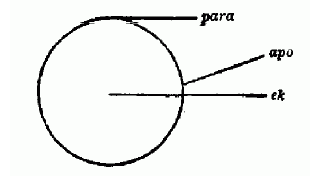
1. With the Genitive it has the general sense of through, as though dividing a surface into two by an intersecting line. It includes the idea of proceeding from and passing out (e.g. Mk 11:16. 1 Co 3:15. 1 Ti
2:15. 1 Pe 3:20). Cp. diameter. In a temporal sense; after an interval (Mt 26:61. Mk 2:1. Gal 2:1). From the ideas of space and time dia (with the Gen.) denotes any cause by means of which an action passes
to its accomplishment (e.g. Mt 1.22. Jn 1:3. Ac 3:18. 1 Co 16:3. 2 Co 9:13); hence, it denotes the passing through whatever is interposed between the beginning and the end of such action.
2. With the Accusative it has the sense of on account of, or because of (e.g. Mt 27:18. Mk 2:27. Rv 4:11), indicating both the exciting cause (Ac 12:20. Ro 4:25. 1 Co 11:10), the impulsive cause (e.g. Jn 12:9.
Ro 4:23; 15:15. Heb 2:9), or the prospective cause (Ro 6:19; 8:11; 14:15. Heb 5:3).
vi. eis governs only one case (the Accusative). Euclid uses eis when a line is drawn to meet another line, at a certain point. Hence, it denotes motion to or unto an object, with the purpose of reaching or touching it
(e.g. Mt 2:11; 3:10. Lk 8:14. Ac 16:10). From this comes the idea of the object toward which such motion is directed (e.g. Mt 18:20,30. 1 Co 12:13. Gal 3:27); and for, or with respect to which such action or movement
is made. In contrast with eis, pros (No. xv, below) may mark one object as the means of reaching an ulterior object which is denoted by eis (e.g. Jn 6:35. Ro 5:1. Eph 4:12). It is the opposite of ek (No. vii, below).
vii. ek governs only one case (the Genitive), and denotes motion from the interior. See under apo (No. iv, above, and diagram there). It is used of time, place, and origin. It means out from as distinguished from apo
(No. iv, above), which means off, or away from. Ek marks the more immediate origin, while apo marks the more remote origin; of expressing the intermediate meanings.
viii. en governs only one case (the Dative), and denotes being or remaining within, with the primary idea of rest and continuance. It has regard to place and space (e.g. Mt 10:16. Lk 5:16), or sphere of action (e.g.
Mt 14:2. Ro 1:5,8; 6:4). It is also used for the efficient cause as emanating from within, and hence has sometimes the force of by, denoting the instrument, with, passing on to union and fellowship; en denoting
inclusion, and sun (No. xvi, below) denoting conjunction. En denotes also continuance in time (Mt 2:1; 27:40. Jn 11:10). 2. with plural = among.
ix. epi governs three cases (the Genitive, Dative, and Accusative), and denotes superposition.
1. With the Genitive it denotes upon, as proceeding or springing from, and answers to the question “Where?” (e.g. Mt 9:2; 10:27. Mk 8:4. Lk 22:30. Jn 6:21). With the idea of locality it conveys the sense, in
the presence of (e.g. Mt 28:14. Mk 13:9. Ac 24:19. 1 Co 6:1). With the idea of time, it looks backward and upward, e.g. “in the days of” (Mt 1:11. Heb 1:2). With the idea of place, it denotes dignity and
power (e.g. Mt 23:2. Ac 12:21. Ro 9:5. Rv 2:26).
2. With the Dative it implies actual superposition, as one thing resting upon another, as upon a foundation or basis which may be actual (e. g. Mk 6:25,28,39), or moral (e.g. Mt 18:13. Mk 3:5). Both senses occur
in 1 Th 3:7. Hence it is used of the moving principle or motive suggesting the purpose or object (e.g. Eph 2:16), and sometimes including the result (e.g. 2 Ti 2:14).
3. With the Accusative it implies the downward pressure on that upon which a thing rests; active motion being suggested (e.g. 2 Co 3:15. 1 Ti 5:5). Hence, it denotes any extended motion downward (Mt 13:2;
18:12; 19:28; 27:45) from heaven to earth (Mk 4:20. Ac 11:15. 2 Co 12:9). Compared with pros (No. xv, below), pros marks the motion, the direction to be taken, while epi (with Acc.) marks the point to be
reached. This downward pressure may be that of the mind, or feeling (e.g. Mt 25:21; 27:43. Heb 6:1. 1 Pe 1:13). For the difference between eis (No. vi, above) and epi (with the Acc.) see Ro 9:21, “one
vessel unto (eis) honour”, and v. 23, “riches of glory on (epi) the vessels of mercy”.
x. kata governs two cases (the Genitive and the Accusative), and denotes two motions, vertical and horizontal.
1. With the Genitive it denotes vertical motion, the opposite of ana (No. i, above), descent, or detraction from a higher place or plane (e.g. Mt 8:32. Mk 5:13); and direction to, or against (e.g. Mk 9:40. Jn
18:29. Ac 25:27. 2 Co 13:8).
2. With the Accusative it denotes horizontal motion, along which the action proceeds (e.g. Lk 8:30; 10:33. Ac 5:15; 8:26. Php 3:14). Sometimes it includes the purpose or intention (e.g. 2 Ti 1:1; 4:3. Tit 1:1).
In this connection eis (No. vi, above. 2 Ti 4:14) marks the more immediate purpose, pros (No. xv. 3. Eph 4:12. Phm 5) the ultimate purpose, and kata (No. xv. 2) the destination of the motion (e.g. Mt
27:15. Heb 3:8) and the accordance, conformity or proportion of the two things which such motion thus connects (e.g. Mt 16:27; 23:3; 25:15. Lk 2:22).
xi. meta governs two cases (the Genitive and the Accusative), and denotes association and companionship with. It thus differs from sun (No. xvi, below), which denotes proximity to and hence conjunction or
coherence. Compare Eph 6:23 (meta) with Eph 4:31 (sun); and 1 Th 3:13 (meta) with Col 3:3 (sun).
1. Hence meta, with the Genitive, denotes among, amid (e.g. Mt 26:58. Mk 1:13. Rv 21:3), or in company with (e.g. Mt 9:15. Jn 11:31. 2 Th 1:7. Rv 14:13). It refers specially to the mental disposition with
which an action is performed (e.g. Mt 12:30. Mk 3:5. Lk 1:39; 9:49. Jn 8:28. 2 Co 7:15).
2. With the Accusative it means after, always in connection with time (e. g. Mt 17:1; 26:32. Jn 13:7. Heb 4:7; 7:28).
xii. para governs three cases (Gen., Dat., and Acc.), and the uniform meaning is beside, or along side of. See apo, No. iv, above, and cp. diagram there.
1. With the Genitive it denotes from beside, implying the source from which anything proceeds (e.g. Mt 2:4; 21:42. Lk 2:1; 6:19. Ac 26:10. Php 4:18). As distinguished from hupo (No. xviii, below) it denotes
the general sense of motion, while hupo marks the special sense or efficient cause of such motion. As distinguished from apo (No. iv, above) it marks the motion from a person (e.g. Mt 2:16), while apo may
imply motion from a place (e. g. Mt 2:1).
2. With the Dative it denotes rest beside, and at a person, place, or thing, expressing rest and position there (e.g. Jn 19:25. Ac 9:43); laid up with or in store with (e.g. Mt 6:1. Lk 1:30), or proximity to (e.g.
Mt 22:25. Col 4:16). Hence it implies in the power of (Mt 19:26. Lk 1:37); in the judgment of (e.g. Ro 2:12. 2 Pe 2:11).
3. With the Accusative it denotes motion to a place so as to be alongside it (e.g. Mt 15:29. Mk 4:1). Hence, beside and beyond, and so against (e.g. Ac 18:13. Ro 1:25,26; 4:18. 1 Co 3:11; Gal 1:8); and beside,
i.e. more or less than (e.g. Lk 3:13; 13:2. Ro 14:5. 2 Co 11:24). Compare pros, No. xv, below.
xiii. peri governs two cases (Genitive and Accusative), and denotes around, or about, like a completed circle. Hence concerning. It marks the object about which the action of the verb takes place.
1. With the Genitive it means as concerning, or, as regards, but always with the primary idea, and marking the central point of the activity (e. g. Mt 4:6. Lk 24:19,27,44).
2. With the Accusative it denotes the extension of such activity, hence, around (e.g. Mk 9:42. Lk 13:8. Ac 28:7. Php 2:23).
xiv. pro governs only one case (the Genitive), and denotes the position as being in sight or, before one, in place (e.g. Lk 7:27; 9:52. Jas 5:9); time (e.g. Mt 5:12. Jn 17:24. Ac 21:38); or superiority (e.g. Jas 5:12. 1 Pe
4:8).
xv. pros governs three cases (the Genitive, Dative and Accusative), and denotes to, or, toward, implying motion onward. Its general meaning with the three cases is the motive — as in consideration of (with the
Genitive); in addition to anything — as an act (with the Dative); with a view to anything — as an end (with the Accusative). Compared with para (No. xii, above), pros denotes only direction and tendency, whereas
para denotes both motion and change of place of some object.
1. With the Genitive only occurrence is Ac 27:34.
2. With the Dative it occurs five times: Lk 19:37. Jn 18:16; 20:12,13. Rv 1:13.
3. With the Accusative, see e.g. Mt 2:12; 3:10; 21:34; 26:57. Mk 5:11; 11:1; 14:54. Lk 7:7. Ac 6:1. 1 Th 3:6.
xvi. sun governs only one case (the Dative). See under meta (No. xi, above) (e.g. Lk 23:11. Ro 6:8).
xvii. huper governs two cases (the Genitive and Accusative), and denotes above, or over with respect to the upper plane of a solid. Latin, super.
1. With the Genitive it is used in its relative rather than its absolute sense. In the place of (e.g. Jn 11:50; 18:14. Ro 5:6. 1 Ti 2:6. Phm 13. 1 Pe 3:18.).
In the interests of (e.g. 2 Th 2:1).
In behalf of (e.g. Mt 5:44. Ac 9:16).
For the purpose of (e.g. Jn 11:4. Ro 15:8. 2 Co 12:19. Php 2:13).
With the Genitive huper is connected with peri being the apex of the triangle, or the fixed point of the compass, whereas peri (see No. xiii, above) is the circle described around it. Hence huper has
regard to feeling and implies the pleading a case on behalf of another, whereas peri implies the mere description of the circumstances of the case (e. g. 1 Pe 3:18. Jude 9).
2. With the Accusative it denotes beyond, in excess of measure, honour, number, or time (e.g. Mt 10:24. 2 Co 1:8. Eph 1:22. Php 2:9.
Phm 16).
xviii. hupo governs two cases (the Genitive and Accusative), denotes the under side of a solid, and is thus the opposite of huper (see No. xvii, above). With the Genitive it describes the motion from beneath; with
Dative (not used in the N.T.), position beneath; and with the Accusative, motion or extension underneath.
1. With the Genitive, hupo is used to mark the efficient or instrumental agent, from under whose hand or power the action of the verb proceeds (e.g. Mt 1:22; 2:16. Lk 14:8).
2. With the Accusative, it denotes the place whither such action extends (e.g. Mt 8:8. Mk 4:32. Jas 2:3).
Hence it implies moral or legal subjection (e.g. Matt. 8:0 . Ro 6:14; 7:14; 16:20. 1 Ti 6:1).
(*1) The Cases governed by the Prepositions stand in the following proportion: Genitive, 17; Accusative, 19; and Dative, 15, according to Helbing (Schanz’s Beitrage, No. 16 (1904), p. 11.
(*2) On p. 98 of his Grammar of the N.T. Greek, Professor J. H. Moulton gives a list as follows :– If en represents unity, the order of the frequency of the other Prepositions work out thus: eis, -64; ek, -34;
epi, -32; pros, -25; dia, -24; apo, -24; kata, -17; meta, -17; peri, -12; hupo, -08; para, -07; huper, -054; sun, 048; pro, -018; anti, -008; and ana, -0045.
Appendix 105
THE USAGE OF NEGATIVES IN THE NEW TESTAMENT
There are two principal negatives used in the New Testament, all others being combinations of one or other of these with other particles.
I. ou (before a vowel ouk; before an aspirated vowel ouch) = no, not; expressing full and direct negation, independently and absolutely; not depending on any condition expressed or implied.
(a) ouchi, a strengthened form, often used in questions.
II. me = no, not; expressing conditional negation, depending on feeling, or on some idea, conception, or hypothesis.
Hence,
ou is objective.
me is subjective.
ou denies a matter of fact.
me denies a matter of feeling.
ou denies absolutely.
me denies conditionally.
ou negatives and affirmation.
me negatives a supposition, and prohibits or forbids.
ou is generally used with the Indicative Mood.
me with the other moods of the verb.
For the difference, see Jn 3:18: “He that believeth on Him is not (ou) condemned: but he that believeth not (me, supposing such a case) is condemned already, because he hath not (me) believed (according to the
supposition made). See also Mt 22:29: “Ye do err, not knowing the Scriptures”. Had the negative here been “ou” it would imply the fact that they did not know, because of not possessing them. But it is “me”, implying the
feeling; they did not wish to know. The same distinctions apply to all the compounds of ou and me respectively.
III. ou me
1. The two negatives when combined lose their distinctive meanings, and form the strongest and most emphatic asseveration; but, solemn and strong as it is, whenever it was used by a human being the result
always belied it, and the speaker never made it good:—
· Mt 16:22. Peter said, “This shall not be unto Thee”. (But it was)
· Mt 26:35. Peter said, “I will not deny Thee”. (But he did)
· Jn 11:56. Some said, “What think ye, that He will not come to the feast?” (But He did)
· Jn 13:8. Peter said, “Thou shalt never wash my feet”. (But He did)
· Jn 20:25. Thomas said, “Except I shall see … I will not believe”. (But he did)
2. On the other hand, when the Lord used this solemn asservation it was always absolutely true, and was, or will yet be made good. It is variously rendered, as a simple negative (as above); no, not, by no means,
in no wise, or in no case, &c.
This expression was used by our Lord on forty-six separate occasions (omitting the parallel passages, which are placed within brackets), adding three (Mt 25:9. Lk 8:17, and Jn 16:7), and omitting two (Mt 24:2 and Lk
22:34), with the critical texts. They are as follows, and are all worthy of the closest attention (see Mt 5:18; 16:28; 24:34. Jn 6:37; &c.).
Mt 5:18,20,26; 10:23,42; 13:14; 15:6; 16:28 (Mk 9:1; Lk 9:27); 18:3 (Lk 18:17); 23:39; 24:2 (omitted by all, but retained in Mk 13:2), 21, 34 (Mk 13:30. Lk 21:32), 35 (Mk 13:31. Lk 21:3 422 3); 25:9 (added by all); 26:29
(Mk 14:25. Lk 22:18). Mk 9:41; 13:2 (omitted in Mt 24:2, retained here); 16:18. Lk 6:37; 8:17 (added by most); 10:19; 12:59; 13:35; 18:7,30; 21:18; 22:16,34 (omitted by all, retained in Jn 13:38), 67,68. Jn 4:14,48;
6:35,37; 8:12,51,52; 10:5,28; 11:28; 13:38 (omitted in Lk 22:34, but retained here); 16:7 (added by some).
3. The expression ou me is used once by an angel (Lk 1:15).
4. Fourteen times by Paul: three in Acts (13:41; 28:26), and eleven times in his Epistles (Ro 4:8. 1 Co 8:13. Gal 4:30; 5:16. 1 Th 4:15; 5:3. Heb 8:11,12; 10:17; 13:5).
5. Twice by Peter (1 Pe 2:6. 2 Pe 1:10).
6. Sixteen times in the Apocalypse (one being added in all the critical texts, 9:6): Rv 2:11; 3:3,5,12; 9:6; 15:4; 18:7,14,21,22,23; 21:25,27.
The occurrences are thus eighty-four in all (twelve sevens). See Ap. 10.
Appendix 106
THE SYNONYMOUS WORDS FOR “APPEAR”, “APPEARING”, ETC
I. APPEAR (The Verb).
There are eight words (or expressions) rendered appear, &c., in the A.V., which are to be distinguished as follows: —
i. phaino = to shine forth so as to be seen: having reference to the manner in which a matter presents or shows itself, independently of any observer. Hence the word phenomenon.
ii. anaphainomai. Passive of No. i, with ana prefixed = to be shown forth, come to light, come into sight.
iii. epiphaino = to shine, shew light upon. No. i with ep1 (Ap. 104. ix).
iv. emphanizo = to cause to be manifested or shown plainly and clearly; used of causing that to be seen (or known) which would not otherwise have been cognizable by the unaided eye (or mind). It occurs ten
times: Mt 27:53. Jn 14:21,22. Ac 23:15,22; 24:1; 25:2,15. Heb 9:24;
v. phaneroo = to bring to light, make manifest. Cp. phaneros = manifest in No. viii below.
vi. optomai = to see with the eye, referring to the thing seen (objectively); thus differing from blepo (see Ap. 133. I. 5), which denotes the act of seeing or of using the eye.
vii. erchomai = to come. Rendered “appear” only in Ac 22:30, where all the critical texts (See Ap. 94) read sunerchomai = “come together”.
viii. eimi phaneros = to be visible, manifest, or open to sight (phaneros, adj. of No. v, above, with eimi = to be). So rendered only in 1 Ti 4:15.
ix. apokalupto = to unveil so as to be visible to the eye.
II. APPEARING (The Noun).
i. apokalupsis = unveiling, revelation, manifestation. Hence Eng. “Apocalypse”. From apo = from (Ap. 104. iv), and kalupto, to cover = uncovering, or unveiling. When used of a person it always denotes that he is
visible. Occurs Lk 2:32. Ro 2:5; 8:19; 16:25. 1 Co 1:7; 14:6,26. 2 Co 12:1,7. Gal 1:12; 2:2. Eph 1:17; 3:3. 2 Th 1:7. 1 Pe 1:7,13; 4:31. Rv 1:1.
ii. epiphaneia a shining forth upon. Hence, Eng. epiphany. From No. iii, above.
Appendix 107
THE PRINCIPLE UNDERLYING THE QUOTATIONS FROM THE OLD TESTAMENT IN THE NEW
It is a fact that in quotations from the Old Testament the Greek text sometimes differs from the Hebrew. The difficulties found in connection with this subject arise from our thinking and speaking only of the human
agent as the writer, instead of having regard to the fact the the Word of God is the record of the words which He Himself employed when He spoke “at sundry times and in divers manners” (Heb 1:1, see Ap. 95); and
from not remembering (or believing) that “holy men of God spake as they were moved by the Holy Ghost” (2 Pe 1:27, and cp. Mt 15:4. Mk 12:36. Ac 1:16; 3:18; 28:25. Heb 3:7; 9:8; 10:15).
If we believe that throughout the Scriptures we have the words of God, and not of man, all difficulties vanish. The difficulties are created by first assuming that we are dealing with merely human documents, and
then denying the Divine Speaker and Author the right that is claimed by every human writer for himself. It thus seems that man may take any liberty he chooses in quoting, adapting, or repeating in a varied form his own
previously written words; but that he denies the Divine Author of the Holy Scripture the right to deal in the same manner with His own words. This is the cause of all the so called “discrepancies” and “difficulties” arising
from man’s ignorance.
The Holy Spirit, in referring to words which He has before caused to be written in connection with the special circumstances of each particular case, frequently refers to them again in relation to different
circumstances and other cases. He could have employed other words had He chosen to do so; but it has pleased Him to repeat His own words, introducing them in different connections, with other applications, and in
new senses. All these things are done, and words are even sometimes changed, in order to bring out some new truth for our learning. This is lost upon us when we charge upon God our own ignorance, and the supposed
infirmities of human agencies.
One great source of such difficulties is our failure to note the difference between what is said to be “spoken”, and what is said to be “written”. If we introduce the latter assumption when the former is definitely
stated, we at once create our own “discrepancy”. True, by a figure of speech we can say that an author has said a certain thing when he has written it; but we may not say that he spoke it when he distinctly says that
he wrote it, or vice versa. Some prophecies were spoken and not written; some were written by not spoken; while others were both spoken and written.
There is surely, all the difference in the world between to rhethen = that which was spoken, and ho gegraptai = that which standeth written. If we deliberately substitute the one for the other, of course there is a
discrepancy; but it is of our own creating. This at once disposes of two of the greatest and most serious of so called discrepancies, Mt 2:23 and 27:9 (see Ap. 161).
One other consideration will help us when the quotations are prophecies. Prophecies are the utterances of Jehovah; and Jehovah is He Who was, and is, and is to come — the Eternal. His words therefore partake of
His attributes, and may often have a past and present as well as future reference and fulfillment (See Ap. 103); and (1) a prophecy may refer to the then present circumstance under which it is spoken; (2) it may have a
further and subsequent reference to some great crises, which does not exhaust it; and (3) it may require a final reference, which shall be the consummation, and which shall fill it full, and thus be said to fulfill it.
Certain prophecies may therefore have a preterite reference, as well as a future fulfillment; but these are too often separated, and the part is put for the whole, one truth being used to upset another truth, to the
contempt of Divine utterances, and to the destruction of brotherly love. The principles underlying the New Testament quotations were fully set out by SOLOMON GLASSIUS (A.D. 1623) in his great work (written in Latin)
entitled, Philologia Sacra, chapter on “Gnomes”; and, as this has never been improved upon, we follow it here. The notes on the N.T. passages must be consulted for further information, e.g. Lk 4:18 (II. 1, below).
I. As to their INTERNAL form: i.e., the sense as distinct from the words:—
1. Where the sense originally intended by the Holy Spirit is preserved, though the words may vary.
Mt 1:23 (Isa 7:13,14), “spoken”, see above. Mt 2:6 (Mic 5:2); 3:3 (Isa 40:3); 11:10 (*1) (Mal 3:1); 12:17 (Isa 42:1-4); 13:14,15 (*s) (Isa 6:9,10); 21:16 (*s) (Ps 8:2); 21:42 (*s) (Ps 118:22,23); 22:44 (*s) (Ps 110:1); 26:31 (Zec
13:7); 27:35 (*s) (Ps 22:18); Mk 15:28 (Isa 53:12). Lk 4:18-21 (Isa 61:1,2). Jn 19:37 (Zec 12:10); Ac 3:22,23 (*s) (Dt 18:15-19); 13:33 (*s) (Ps 2:7); 15:16,17 (Am 9:11,12). Ro 14:11 (Isa 45:23); 15:3 (*s) (Ps 69:9); 15:12 (*s) (Isa
11:1,10). Eph 4:8 (Ps 68:18). Heb 1:8,9 (*s) (Ps 45:6,7); 1:10-13 (*s) (Ps 102:25); 5:6 and 7:17,21 (Ps 110:4); 10:5,6 (*s) (Ps 40:6-9. See below, II. 3. a). 1 Pe 2:6 (*s) (Isa 28:16).
2. Where the original sense is modified, and used with a new and different application. Mt 12:40 (Jnh 1:17). Jn 3:14,15 (Nu 21:8,9); 19:36 (Ex 12:46). Eph 5:31,32 (Ge 2:23,24)
3. Where the sense is ACCOMMODATED, being different from its first use, and is adapted to quite a different event or circumstance. Mt 2:15 (*h) (Hos 11:1); 2:17,18 (Jer 31:15); 8:17 (*h) (Isa 53:4); 13:35,
“spoken” (Ps 78:2); 15:8,9 (Isa 29:13); 27:9,10 (*2) Ac 13:40,41 (*s) (Hab 1:5). Ro 9:27,28 (*s*) (Isa 10:22,23); 9:29 (*s) (Isa 1:9); 10:6 (*s), 7,8 (*s) (Dt 30:12-14). 1 Co 1:19,20 (Isa 29:14; 33:18); 10:6 (Ex
32:6-25). Rv 1:7 (Zec 12:10); 1:17 (Isa 41:4); 11:4 (Zec 4:3,11,14).
II. As to their EXTERNAL form: i.e. the words, as distinct from the sense.
1. Where the words are from the Hebrew text or Septuagint version. Mt 12:7 (Hos 6:6); 22:32 (*h) (Ex 3:6); Mk 12:26 (*h) (Ex 3:6); 11:17 (*h) (Isa 56:17) Jer 7:11). Lk 4:18 (Isa 61:1,2).
2. Where the words are varied by omission, addition, or transposition. Mt 4:10 (Dt 6:13; 10:20); 4:15, 16 (Isa 9:1,2); 5:31 (Dt 24:1); 5:38 (Ex 21:24. Lev 24:20); 12:18-21 (Isa 42:1-4); 19:5 (*s) (Ge 2:24); 22:24
(Dt 25:5,6). Ro 11:3,4 (1 Ki 19:10,14,18). 1 Co 2:9 (Isa 64:4); 14:21 (Isa 28:11,12) 1 Pe 1:24,25 (Isa 40:6-8).
3. Where the words are changed, by a various reading, or by an inference, or in Number, Person, Mood, or Tense.
The necessity for this is constantly experienced today in adapting a quotation for any special purpose beyond its original intention. It is no less authoritative as Scripture, nor does it alter the Word of God.
a. By a different reading. Heb 10:5 (*s) (Ps 40:6; see the notes in both passages).
b. By an inference. Mt 2:6 (Mic 5:2). See notes. Ac 7:43 (Am 5:25-27) Ro 9:27 (*s) (Isa 10:22); 9:29 (Isa 1:9); 9:23 (Isa 28:16); Eph 4:8 (Ps 68:18).
c. In Number. Mt 4:7 (Dt 6:16), Ro 4:7 (Ps 32:1); Ro 10:15 (Isa 52:7).
4. Where two or more citations are combined. Composite quotations.
This is a common practice in all literature.
PLATO (429 – 347 B.C.) Ion, p. 538, connects two lines from HOMER (about 850 B.C.), one from Iliad, xi. 1. 638, and the other from I.
630.
XENOPHON ( 430 – 357 B.C.) Memorabilia, Bk. I. ch. 2, § 58, gives as one quotation two passages from Homer (Iliad, ii. 188, &c., and 198, &c.)
LUCIAN (A.D. 160) in his Charon, § 22, combines five lines together from HOMER from different passages (Iliad, ix. 319, 320; and Odyssey, x. 521, and xi. 539).
PLUTARCH (about A.D. 46) in his Progress in Virtue, combines in one sentence Homer (Odyssey, vi. 187, and xxiv. 402).
CICERO (106 – 43 B.C.), De Oratore, Bk. II. § 80, combines in two lines parts of Terence’s lines (Andria, 115, 116, Parry’s Edn.).
PHILO (20 B.C. – A.D. 40) in Who is the Heir of Divine Things (§ 5), quotes, as one address of Moses, parts of two others (Nu 11:13 and 22). In the same treatise (§ 46) he combines parts of Ge 17:19 and 18:14.
Illustrations could be given from English authors.
Man may make a mistake in doing this, but not so the Holy Spirit.
In Mt 21:5, Isa 62:11 is combined with Zec 9:9.
In Mt 21:13, Isa 56:7 is combined with Jer 7:11.
In Mk 1:2,3, Mal 3:1 is combined with Isa 40:3.
In Lk 1:16,17, Mal 4:5,6 is combined with 3:1.
In Lk 3:4,.5, Mal 3:1 is combined with Isa 40:3.
In Ac 1:20, Ps 69:25 is combined with 109:8.
In Ro 3:10-12, Ecc 7:20 is combined with Ps 14:2,3 and 53:2,3.
In Ro 3:13-18, Ps 5:9 is combined with Isa 59:7,8 and Ps 36:1. In Ro 9:33, Isa 28:16 is combined with 8:14. In Ro 11:26,27 (*s) Isa 59:20,21 is combined with 27:9. In 1 Co 15:54-56, Isa 25:8 is combined with Hos 13:14. In
2 Co 6:16, Lev 26:11 is combined with Eze 37:27. In Gal 3:8, Ge 12:3 is combined with 18:18. In 1 Pe 2:7,8, Ps 118:22 is combined with Isa 8:14.
5. Where quotations are made from secular writers.
See notes on Acts 17:22 Acts 17:23, and 28. 1 Co 15:33. Col 2:21. Tit 1:12.
(*1) And the parallel passages in the other Gospels, which can be easily found. (*s) This denotes that it agrees with the Septuagint Version in these cases, and not with the Hebrew. (*s*) It denotes that it is
nearly, but not exactly, the same. (*h) This denotes that it agrees with the Hebrew, but not with the Septuagint Version. (*2) This was “spoken”, not written, and is therefore not a quotation. See Ap. 161.
Appendix 108
THE SYNONYMOUS WORDS FOR “CHILD”, “CHILDREN”, ETC
There are seven Greek words translated “child” in the N.T., which are to be distinguished as follows:—
i. teknon = that which is borne or born (from tikto, to bring forth). Anglo-Saxon = bearn, from beran, to bear. Hence, Scottish bairn. Used of a child by natural descent, whether boy or girl.
ii. teknion. Diminutive of teknon (No. i, above); a term of endearment.
iii. huios = a son, or male, having reference to origin and nature, including that of relationship to the father.
iv. pais = a child, whether son or daughter (in relation to law); a boy or girl (in relation to age); a servant, or maid (in relation to condition), like the French garcon.
v. paidion. Diminutive of pais (No. iv, above); hence, a young or little child, an infant; also a term of endearment.
vi. paidarion. Another diminutive of pais (No. iv, above), a lad; a little boy or girl.
vii. nepios. Not old enough to speak (from ne, negative, and epo, to speak).
viii. brephos. an embryo, or newly-born babe.
ix. korasion = a young girl, or maiden. Diminutive of kore, a girl; like paidion, used as a term of endearment.
x. neaniskos = a young man (always so translated), from the age of twenty to forty.
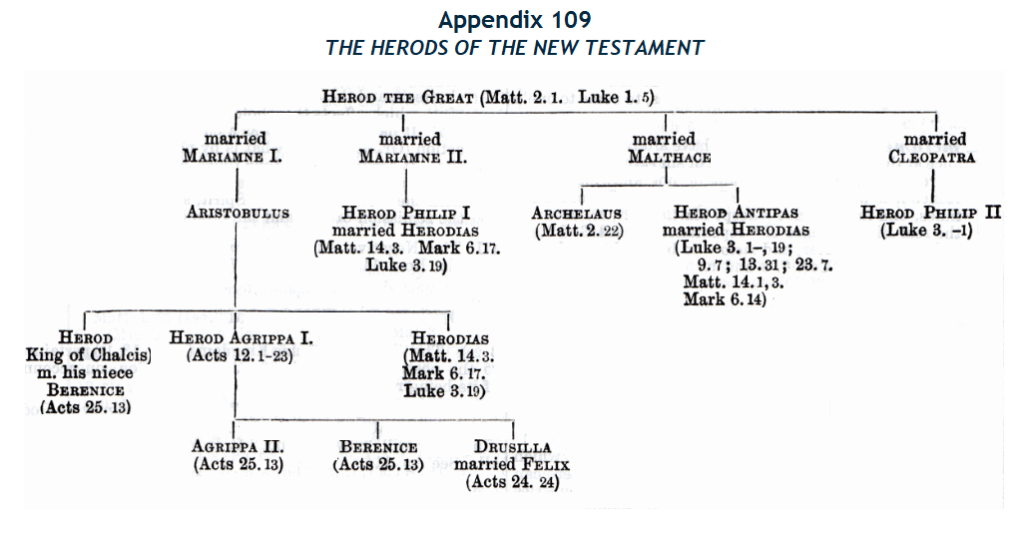
Appendix 110
THE USE OF PSUCHE IN THE NEW TESTAMENT
psuche
is the only word translated “soul” in the N.T. It occurs 105 times, and is rendered “soul” 58 times, “life” 40 times, “mind” 3 times, and “heart”, “heartily”, “us”, and “you” once each.
To ascertain its meaning, it is useless to go to heathen authors. The Greek philosophers were at variance among themselves. ARNOBIUS, a Christian writer of the latter part of the third century, in his work Adversus
Gentes, speaking of the speculations of the heathen of his day, says: “In exactly the same way (as the creation and the gods) is the condition of souls discussed. For this one thinks they are both immortal, and survive
the end of our earthly life; that one believes that they do not survive, but perish with the bodies themselves; the opinion of another, however, is that they suffer nothing immediately, but that, after the [form of] man
has been laid aside, they are allowed to live a little longer, and then come under the power of death.” (*1)
We must therefore, let Scripture be its own interpreter. Psuche exactly corresponds to the Hebrew Nepesh (Ap. 13), as will be seen from the following passages: Mk 12:29,30, compared with Dt 6:4,5; Ac 2:27 with
Ps 16:10; Ro 11:3 with 1 Ki 19:10; 1 Co 15:45 with Ge 2:7. In all these places, psuche in the New Testament represents nepesh in the Old.
The following are the occurrences of the word:—
I. psuche, used of the lower animals twice, is rendered
1. “life”: Rv 8:9
2. “soul”: Rv 16:3
II. psuche, used of man as an individual (just as we speak of a ship going down with every soul on board, or of so many lives being lost in a railway accident), occurs 14 times, and is rendered “soul”: Ac 2:41,43;
3:23; 7:14; 27:37. Ro 2:9; 13:1. 1 Co 15:45. Jas 5:20. 1 Pe 3:20. 2 Pe 2:14. Rv 6:9; 18:13; 20:4.
III. psuche, used of the life of man, which can be lost, destroyed, saved, laid down, &c., occurs 58 times, and is rendered
Appendix 111
THE SYNONYMOUS WORDS FOR “REPENT”, “REPENTANCE”
I. The Verb.
1.
metanoeo
= to change one’s mind, always for the better, and morally. Because of this it is often used in the Imperative (Mt 3:2; 4:17. Ac 2:38; 3:19). Not merely to forsake sin, but to change one’s apprehension
regarding it. It occurs thirty-four times. It answers to the Latin resipisco = to recover one’s senses, to come to one’s self.
2.
metamelomai
= to regret; to have after care or annoyances at the consequences of an act of sin rather than a deep regret at the cause from want of not knowing better. Hence it is never used in the Imperative. It
occurs six time, and in each case (except Mt 21:29,32) never in the real Biblical sense of “repentance toward God”. It is from meta = after, and melo = to be an object of care. See notes on 2 Cor 7:8 and 10. It is used of
Judas Iscariot (Mt 27:3); negatively of Paul’s regret (2 Co 7:8); and of God (Heb 7:21).
The Noun,
metameleia
, is not used in the N.T.
II. The Noun.
metanoia
= a real change of mind and attitude toward sin itself, and the cause of it (not merely the consequence of it), which affects the whole life and not merely a single act. It has been defined as a change in our
principle of action (Gr. nous) from what is by nature the exact opposite. It occurs twenty-four times, and except Heb 12:17 is a real “repentance toward God”. It is associated with the word of the Holy Spirit, and is
connected with the remission of sins and the promises of salvation.
III. The Negative Adjective, ametameletos, is used twice, viz. Ro 11:29, and 2 Co 7:10.
Appendix 112
THE SYNONYMOUS EXPRESSIONS FOR “KINGDOM”
For a true understanding of the new Testament, it is essential that the “Word of Truth” should be “rightly divided” (2 Ti 2:15) as to the various usages of the word “kingdom” in all the different combinations and contexts
in which we find it. Each has its own peculiar and particular sense, which must not be confused with another.
As to the word basileia, it denotes sovereignty, which requires the actual presence of a sovereign, or king. There can be no kingdom apart from a king. We all know of countries which were once “kingdoms” but are
now “republics”, for the simple but sufficient reason that they have no “king”, but are governed by the “public”, which is sovereign.
The countries remain the same, have the same peoples, the same cities, the same mountains and rivers, but they are no longer kingdoms. The common practice of taking the Kingdom as meaning the Church (See Ap.
113), has been the source of incalculable misunderstanding; and not “trying the things that differ” (Php 1:10, see note there) has led to great confusion in the interpretation of the whole of the New Testament.
The following definitions may help towards a clearer view of many important passages:—
1. “The Kingdom of Heaven”. The word “heaven” is generally in this connection in the plural, “of (or from) the heavens”. For the difference between the use of the singular and plural of this word, see the notes on
Matt 6:9 Matt 6:10. This expression is used only in the Gospel of Matthew, as being specially in harmony with the purpose of that Gospel. See notes on pp. 1304-5, and Ap. 114.
It is the dispensational term; and is used sometimes of the Messiah’s Kingdom on earth, and sometimes of the heavenly sovereignty over the earth. It is not from or out of (Gr. ek, Ap. 104. vii) “this world” (Gr. kosmos
Ap. 129. 1). This sovereignty comes from heaven, because the King is to come from thence (Jn 18:36). It was to this end He was born, and this was the first subject of His ministry (see Ap. 119). That Kingdom (Mt
4:17, &c.) was rejected, as was also the further proclamation of it in Ac 3:19-26 (according to the prophetic parable of Mt 22:2-7). Thenceforth the earthly realization of this Kingdom was postponed, and is now in
abeyance until the King shall be sent from heaven (Ac 3:20). The “secrets” of this Kingdom (Mt 13:11) pertained to the postponement of its earthly realization, on account of its being rejected.
2. “The Kingdom of God” is the sovereignty of God, which is moral and universal. It existed from the beginning, and will know no end. It is over all, and embraces all. See Ap. 114.
3. “The Kingdom of the Father”. (Mt 13:43) is not universal, but has regard to relationship, and “a heavenly calling” (Heb 3:1), and to the heavenly sphere of the Kingdom, in its relation to the earthly. It is sovereignty
exercised toward obedient sons, when the Son of man shall have gathered out of His Kingdom “all things that offend” (Mt 13:41). Cp. Da 7:25-27. Mt 25:31-46. Lk 20:34-36. The way of entrance into this may be seen in Jn
3:3. It is going on now concurrently with No.
4. “The Kingdom of the Son of man”. (Mt 16:28). This aspect of “the Kingdom of heaven” has regard to Israel on earth (cp. Da 7:13,14,18,21,22), as distinct from the “sons” who, as partakers of “a heavenly calling”
(Heb 3:1), will possess the heavenly sphere as sons of the resurrection (Lk 20:34-36. Cp. 1 Co 15:23. Rv 20:4-6). These two spheres are distinct, though they ar a8 c e one. No. 3 concerns “the saints of the most high
[places]” (Da 7:18,24). No. 4 concerns “the people of the saints of the most high”. These have their portion in “the Kingdom under the whole heaven”, which has regard to earthly sovereignty, in which “all dominions
shall serve and obey Him” (Da 7:27).
These two would have had their realization even then, had Israel repented at the summons of the Lord, and of “them that heard Him” in Ac 3:19-26. In that case the later revelation of the “Mystery” (or the great
secret) which with its exanastasis and its “heavenward Call” (Php 3:11,14), was hidden in God, would have remained in the keeping of the Father’s Divine sovereignty.
5. “The Kingdom of His dear Son”. Gr. the Kingdom of the Son of His love, or of His beloved Son (Col 1:13), has regard to quite another sphere, above all heavens, and refers to the sovereignty of God’s beloved
Son as made the “Head over all things to His ekklesia, which is His body, the fulness of Him that filleth all in all” (Eph 1:10,20-23). See also Eph 5:5.
This sovereignty had been “kept secret” (Ro 16:25), “hid in God (Eph 3:9), “hid from ages and from generations” (Col 1:25); but after the Kingdom (No. 4) proclaimed by the Lord and by “them that heard Him” (Heb
2:4) had been postponed, it was revealed and “made known” (Eph 3) for the “obedience of faith” (Ro 16:26). The subjects of this Divine sovereignty, on their believing this subsequent revelation, are “sealed” (or
designated) for their inheritance, which is to be enjoyed with Christ (Eph 1:13).
This relates to the position of those who come under that sovereignty.
6. “The Everlasting Kingdom of our Lord and Saviour Jesus Christ”. (2 Pe 1:11). This has regard to No. 5, but was then future (not having been revealed when Peter wrote); but it relates to the outward display of
His sovereignty in millennial glory; while No. 5 relates to the inward position and experimental enjoyment of it in present grace.
7. “The Kingdom of our Lord and of His Christ” (or Messiah). (Rv 11:15). This has regard to the end of the present time of abeyance of Nos. 3 and 4, and the millennial manifestation of both by Divine power, and in
glory. See also Rv 12:10.
At the end of the thousand years, No. 1, and perhaps others of them will cease, and be absorbed in the Kingdom of God (No. 2).
Appendix 113
THE “KINGDOM” AND THE “CHURCH”
From Appendixes 112 and 114 it will be seen that, if each use of the term “kingdom” has its own special and particular meaning and must not be confused with others that differ, there must be still greater confusion if
any one of them is identified with “the Church”, as is very commonly done: though which of the Kingdoms and which of the Churches is never definitely pointed out.
The following reasons may be given which will show that “the Kingdom” and “the Church” cannot thus be identified:—
1. The subjects of the former are spoken of as “inheriting”, or as being “heirs of the Kingdom”; but we cannot speak of inheriting or being heirs of “the Church”.
2. We read of the possibility of “receiving the Kingdom”, but in no sense can any Church be spoken of as being received.
3. We read of “the elders of the Churches”, messengers or servants of the Churches, but never of the elders, &c. of the Kingdom.
4. The word basileia, translated “kingdom”, occurs 162 times, and in the plural only in Mt 4:8. Lk 4:5. Heb 11:33. Rv 11:15. On the other hand, the word ekklesia occurs 115 times, and of these 36 are in the
plural and 79 in the singular, all rendered “church” except in Ac 19:32,39,41, “assembly”.
5. We read of “the children (or sons) of the Kingdom”, but the Bible knows nothing of the sons of “the Church”.
6. The characteristics of each are distinct.
7. The names and appellatives of “the Church” are never used of the Kingdom (Eph 1:23; 2:21; 4:4,16; 5:30. Col 1:24. 1 Ti 3:15).
8. The privilege of “that Church” which consists of the partakers of “a heavenly calling”, Heb 3:1 (see Ap. 112. 4, 5); Rv 20:4-6, will be to reign with Christ over the earthly Kingdom, whereas that Kingdom
will be “under the whole heaven” (Da 7:27).
9. The Church” of the Prison Epistles (Eph., Phil., Col.) is here and now, in the world, and is waiting for its exanastasis, and its “heavenward call” (Php 3:11,14); whereas the Kingdom is not here, because the
King is not here (Heb 2:8).
10. The Kingdom is the one great subject of prophecy; whereas the Church (of the Prison Epistles) is not the subject of prophecy, but, on the contrary, was kept secret, and hidden in God, until the time came
for the secret to be revealed. (see Ap. 112. 5).
It must be understood that this “secret” (Gr. musterion, see Ap. 182) did not and could not refer to Jews and Gentiles in future blessing, because this was never a secret, but was part of the original promise made to
Abraham in Ge 12:3, and was repeatedly spoken of throughout the Psalms and the Prophets. See Dt 32:43. Ps 18:49; 117:1. Isa 11:1,10, &c. Cp. Ro 15:8-12, and the quotations there given.
Appendix 114
THE “KINGDOM OF HEAVEN” AND THE “KINGDOM OF GOD”
We have seen in Ap. 112 that the word “kingdom”, like the Greek basileia, has regard to sovereignty rather than territory, and to the sphere of its exercise rather than to its extent. Using the word “kingdom” in this
sense, and in that which is conveyed in its English termination “dom”, which is short for dominion, we note that the former expression, “the Kingdom of heaven”, occurs only in Matthew, where we find it thirty-two
times (*1).
But in the parallel passages in the other Gospels we find, instead, the expression “the Kingdom of God” (e.g. cp. Mt 11:11 with Lk 7:28). The explanation of this seeming difference is that the Lord spoke in Aramaic;
certainly not in the Greek of the Gospel documents. See Ap. 94. III.
Now “heaven” is frequently used by the Figure Metonymy (of the Subject), Ap. 6 for God Himself, Whose dwelling is there. See Ps 73:9. Da 4:26,29. 2 Ch 32:20. Mt 21:25. Lk 15:21 (“I have sinned against heaven” is thus
contrasted with the words “and in thy sight”). Jn 3:27.
Our suggestion is that in all the passages where the respective expressions occur, identical words were spoken by the Lord, “the Kingdom of heaven”; but when it came to putting them into Greek, Matthew was
Divinely guided to retain the figure of speech literally (“heaven”), so as to be in keeping with the special character, design, and scope of his Gospel (see Ap. 96); while, in the other Gospels, the figure was translated as
being what it also meant, “the Kingdom of God”. Thus, while the same in a general sense, the two expressions are to be distinguished in their meaning and in their interpretation, as follows:—
I. The Kingdom (or Sovereignty) of HEAVEN
1. Has Messiah for its King;
2. It is from heaven; and under the heavens upon the earth;
3. It is limited in its scope;
4. It is political in its sphere;
5. It is Jewish and exclusive in its character;
6. It is national in its aspect;
7. It is the special subject of Old Testament prophecy;
8. And it is dispensational in its duration.
II. The Kingdom (or Sovereignty) of GOD
1. Has God for its Ruler;
2. It is in heaven, over the earth;
3. It is unlimited in its scope;
4. It is moral and spiritual in its sphere;
5. It is inclusive in its character (embracing the natural and spiritual seeds of Abraham, “the heavenly calling”, and the “Church” of the Mystery). Hence,
6. It is universal in its aspect;
7. It is (in its wider aspect) the subject of New Testament revelation;
8. And will be eternal in its duration.
(*1) The Kingdom of God occurs only five times in Matt. (6:33; 12:28; 19:24; 21:31,43).
Appendix 115
“BAPTIZE”, “BAPTISM”, ETC.
It will be useful for the student to have a complete and classified list of the various usages of these words in the N.T.; the following conspectus has been prepared, so that the reader may be in a position to draw his
own conclusions.
I. The VERB
baptizo
occurs eighty (*1) times, as follows:
i. In its absolute form, or followed by a noun in the accusative case. See Mt 3:16; 20:22,23. Mk 6:14; 10:38,39; 16:16. Lk 3:12,21; 7:29; 12:50. Jn 1:25,28; 3:22,23,26; 4:1,2; 10:40. Ac 2:41; 8:12,13,36,38; 9:18;
10:47; 16:15,33; 18:8; 19:4; 22:16. 1 Co 1:14,16,17.
ii. With the Dative case (implying element): Lk 3:16. Ac 1:5; 11:16.
iii. With
en
(Ap. 104. viii), denoting
1. The element, described as being
a. Water. Mt 3:11. Mk 1:8. Jn 1:26,31,33.
b.
Pneuma hagion
. (see Ap. 101. II. 14) Mt 3:11. Mk 1:8. Lk 3:16. Jn 1:33. Ac 1:5; 11:16. 1 Co 12:13 (*).
c. The name of the Lord. Ac 10:48.
d. The cloud and sea. 1 Co 10:2 (*).
2. The locality. Mt 3:6 (*). Mk 1:4,5 (*). Jn 3:23.
iv. With
eis
(Ap. 104. vi). Mt 28:19. Mk 1:9 (*). Ac 8:16; 19:3,5. Ro 6:3. 1 Co 1:13,15; 10:2 (*); 12:13 (*). Gal 3:27.
v. With
epi
(Ap. 104. ix). Ac 2:38 (with Dative)
vi. With
huper
(Ap. 104. xvii). 1 Co 15:29.
vii. With
hupo
(Ap. 104. xviii). Mt 3:6 (*), 13, 14. Mk 1:5,9 (*). Lk 3:7; 7:30.
viii. Translated “wash”. Mk 7:4. Lk 11:38.
II. The NOUNS.
i.
Baptisma
. Occurs twenty-two times, as follows:
1. General. Mt 20:22,23. Mk 10:38,39. Lk 12:50. Ro 6:4; Eph 4:5. Col 2:12. 1 Pe 3:21.
2. John’s baptism. Mt 3:7; 21:25. Mk 1:4; 11:30. Lk 3:3; 7:29; 20:4; Ac 1:22; 10:37; 13:24; 18:25; 19:3,4.
ii.
Baptismos
. Occurs four times:
1. Translated “washing”. Mt 7:4,8. Heb 9:10
2. Translated “baptisms”. Heb 6:2.
(*) In the five passages thus marked, the verb is followed by two phrases, and therefore appears under two heads. They are: Mt 3:6. Mk 1:5,9. 1 Co 10:2; 12:13.
Appendix 116
THE TEMPTATIONS OF OUR LORD
It is well known that the order of the temptations in Matthew is not the same as in Luke. Commentators and Harmonizers assume that the one is right and the other is wrong; and proceed to change the order of one
in order to make it agree with the other. See Ap. 96.
But an examination of the combined accounts, giving due weight to the words and expressions used, will explain all the differences, and show that both Gospels are absolutely correct; while the differences are caused
by the three temptations being repeated by the devil in a different order, thus making six instead of three.
Mark and Luke agree in stating that the temptations continued all the forty days (Mk 1:13. Lk 4:2); they are described as follows:—
I. (Lk 4:3,4) “The devil (ho diabolos) said to Him, ‘Speak to this stone (to litho touto) that it become a loaf (artos).'” This appears to be the first temptation: and there is no reason whatever why it should not have
been repeated in another form; for it is nowhere stated that there were three, and only three temptations (*1).
II. (Lk 4:5-8) “And the devil, conducting (anagagon) Him, shewed to Him all the kingdoms of the habitable world, or land (Gr. oikoumene, Ap. 129. 3), in a moment of time.” Nothing is said about “an exceeding high
mountain”. Lachmann brackets the words “into an high mountain”, and Tischendorff, Tregelles, Alford, WH and R.V. omit them.
The devil claims to possess the right to the kingdoms of the world, and the Lord does not dispute it. Satan says: “To Thee will I give this authority (exousia) and all their glory, for to me it has been delivered, and to
whomsoever I wish I give it. Therefore, if Thou wilt worship before me, all shall be Thine.”
Nothing is said here about “falling down”, as in Matthew. Here only “authority” is offered; for all the critical Greek texts read “pasa” (not “panta”) fem. to agree with exousia. The Lord did not say, “Get thee hence” (as
in Mt 4:10), but “Get thee behind Me”, which was a very different thing. Satan did not depart then, any more than Peter did when the same was said to him (Mt 16:23).
III. (Lk 4:9-12) “And he conducted (egagen) Him to Jerusalem, and set Him upon the wing (or battlement, Da 9:27 m.) of the temple, and said to Him, ‘If Thou art the Son of God, cast Thyself down hence, for it is
written, that to His angels He will give charge concerning Thee, to keep thee (tou diaphulaxai se)'”, &c.
There is nothing said about this “keeping thee” in Matthew; moreover, it is stated that having finished every form of temptation, “he departed from Him for a season”. Note that the devil departed (apeste) of his
own accord in Lk 4:13, while in Matthew the Lord summarily dismissed him, and commanded him to be gone. (Mt 4:10).
IV. (Mt 4:3,4) After the “season” (referred to in Lk 4:13), and on another occasion therefore, “he who was tempting Him (ho peirazon), having come (proselthon), said, “If Thou are the Son of God, say that these stones
become loaves (artoi)”. Not “this stone”, or “a loaf” (artos), as in Lk 4:3. Moreover he is not plainly called “the devil”, as in Lk 4:3, but is spoken of as the one who had already been named as tempting Him (ho peirazon);
and as “having come” (proselthon); not as simply speaking as being then present.
V. (Mt 4:5-7) “Then (tote)” — in strict succession to the preceding temptation of the “stones” and the “loaves” — “Then the devil taketh (paralambanei) Him unto the holy city, and setteth Him upon the wing (or
battlement) of the temple”, &c. Nothing is said here about the angels being charged to “keep” Him (as in Lk 4:10); nor is there any reason why any of these three forms of temptation should not have been repeated,
under other circumstances and conditions.
VI. (Mt 4:8-10) Here it is plainly stated that the second temptation (Lk 4:5-8) was repeated: for “Again the devil taketh Him unto an exceedingly high mountain, and sheweth to Him all the kingdoms of the world,
kosmos (Ap. 129. 1), not oikoumene (Ap. 129. 3), as in Lk 4:5, and their glory, and said to Him: “All these things, not “all this authority”, as in Lk 4:6, will I give to Thee if, falling down, Thou wilt worship me”. Here, in
this last temptation, the climax is reached. It was direct worship. Nothing is said in Luke about falling down. Here it is boldly and plainly said, “Worship me”. This was the crisis. There was no departing of satan’s own
accord here. The moment had come to end all these temptations by the Lord Himself. “Go! said the Lord (hupage), Get thee hence, Satan … Then the devil leaveth (aphiesin) Him, and behold, angels came and
ministered to Him”.
This angelic ministry marked the end. There is no such ministry mentioned at the end of the third temptation in Lk 4:3-12; for then Satan “departed” of his own accord, returning (in Mt 4:3) after “a season” (Lk 4:13).
True, the Lord had said “Get thee behind Me, Satan” (Lk 4:8); but He did not, then, summarily dismiss him, nor did satan depart: he continued with his third temptation, not departing till after the third had been
completed.
We thus conclude that, while there were temptations continuous during the whole of the forty days (Mk 1:13. Lk 4:2), they culminated in six direct assaults on the Son of man, in three different forms; each form
being repeated on two separate occasions, and under different circumstances, but not in the same order. This accords with all the variations of the words used, explains the different order of events in the two Gospels
and satisfies all the conditions demanded by the sacred text.
The two different orders in Matthew and Luke do not arise from a “mistake” in one or the other, so that one may be considered correct and the other incorrect; they arise form the punctilious accuracy of the Divine
record in describing the true and correct order in which Satan varied the six temptations; for which variation, he alone, and neither of the Evangelists, is responsible.
(*1) This is like other traditional expressions: for where do we read of “three” wise me? We see them only in medieval paintings. Where do we read of angels being women? Yet as such they are always
painted. Where do we find in Scripture other common sayings, such as “the talent hid in a napkin”? It was hidden “in the earth”. Where do we ever see a picture of the crucifixion with the mark of the spear
on the left side?
Appendix 117
THE LORD’S KNOWLEDGE
I. OF THE PAST: IN THE WRITTEN WORD OF GOD IN THE OLD TESTAMENT.
(Allusions are indicated by an asterisk.)
New Test. Old Test.
Mt 4:4. Dt 8:3.
Mt 4:7. Dt 6:16.
Mt 4:10. Dt 6:13.
Mt 5:17,18*.
Mt 5:21. Ex 20:13.
Mt 5:27. Ex 20:14.
Mt 5:31. Dt 24:1.
Mt 5:33-. Lev 19:12. Nu 30:2.
-Mt 5:33. Dt 23:21.
Mt 5:38. Ex 21:24.
Mt 5:43. Lev 19:18.
Mt 8:4*.
Mt 9:13. Hos 6:6.
Mt 10:35,36. Mic 7:6.
Mt 11:10. Mal 3:1.
Mt 12:3,4. 1 Sa 21:1-6.
Mt 12:7. Hos 6:6.
Mt 12:40. Jnh 1:17.
Mt 13:14,15. Isa 6:9,10.
Mt 15:4. Ex 20:12; 21:17.
Mt 15:8,9. Isa 29:13.
Mt 19:5. Ge 2:24.
Mt 19:8. Dt 24:1.
Mt 19:18. Ex 20:12-16. Dt 5:16-20.
Mt 19:19. Lev 19:18.
Mt 21:16. Ps 8:2.
Mt 21:42. Ps 118:22,23.
Mt 22:29*.
Mt 22:32. Ex 3:6.
Mt 22:37. Dt 6:5.
Mt 22:39. Lev 19:18.
Mt 22:44. Ps 110:1.
Mt 23:39. Ps 118:26.
Mt 24:7. Isa 19:2.
Mt 24:10. Isa 8:15.
Mt 24:15. Da 9:27.
Mt 24:21. Da 12:1.
Mt 24:29. Isa 13:10; 34:4.
Mt 24:30. Zec 12:12.
Mt 24:31. Isa 27:13. Dt 30:4.
Mt 24:37*. Ge 7.
Mt 26:24*.
Mt 26:31. Zec 13:7.
Mt 26:54*.
Mt 26:64. Ps 110. Da 7:13.
Mt 27:46. Ps 22:1.
Mk 8:18. Jer 5:21.
Mk 9:48. Isa 66:24.
Mk 10:3*.
Mk 13:12. Mic 7:6.
Mk 14:49*.
Lk 4:18,19. Isa 61:1,2.
Lk 10:27. Dt 6:5; 10:12.
Lk 11:51. Ge 4:8-10.
Lk 16:31*.
Lk 17:26,27. Ge 6.
Lk 17:28,29. Ge 19.
Lk 18:31*.
Lk 20:18. Da 2:45.
Lk 21:22. Hos 9:7.
Lk 21:26. Isa 34:4.
Lk 21:35. Isa 24:17.
Lk 22:37. Isa 53:12.
Lk 23:30. Isa 2:19. Hos 10:8.
Lk 23:46. Ps 31:5.
Lk 24:27.
Lk 24:44-47*.
Jn 3:14. Nu 21:9.
Jn 5:39*.
Jn 5:46,47*.
Jn 6:32. Ex 16:15.
Jn 6:45. Isa 54:13.
Jn 7:38*.
Jn 8:17. Dt 19:15.
Jn 10:34. Ps 82:6.
Jn 13:18. Ps 41:9.
Jn 15:25. Ps 35:19; 69:4; 119:78.
Jn 19:28. Ps 69:21.
II. OF THE FUTURE: IN HIS OWN PROPHETIC WORDS.
MATTHEW
4:17,19
5:3-12,17,18,20-22
6:2,4,16,18
7:7,22
8:11,12
9:6,15
10:15,32
11:11,22-24,29
12:6,31,36,41,42,45
13:40-50
15:13
16:25,27
17:12,22,23
18:14,35
19:28-30
20:18,23
21:2,43,44
22:30
23:36-39
24
25
26:23,29,32,34,64
MARK
4:12
7:29
8:35,38
9:1,9,31,41,48
10:45
11:2,3,14,26
12:34,40
13:2
14:8,13
LUKE
2:49
4:21
7:47,48
8:48,50
12:32
13:25
14:14
15:10
17:34-36
19:9,43
22:19-21,29,31,37
23:28,30,43
24:26,47,49
JOHN
1:51
2:19,24,25
3:13,14
4:10,14,21-23,50
5:8,17,19
6:27,33,35,37,39,40,44,47,51,64,70
7:34,37-39
8:12,28,51
9:5
10:15-28
11:25,26,40,43
12:23,32,48
13:19,20
14:2,6,9,16,19,23
15:1-7
16:4,7-13
17:1
18:36,37
20:17,21,23
21:6,18,19,22
Appendix 118
“IF”: THE VARIOUS CONDITIONS CONVEYED BY ITS USE.
1.
ean
= if haply, if so be that, from ei (No. 2) and an, haply, perchance. The exact condition is shown by the Mood of the verb with which it is used:
a. Followed by the Indicative Mood (with the Present Tense), it expresses the condition simply; without any reference to its being decisive by experience, or by the event, as in 1 Jn 5:15, elsewhere, and
in the Papyri.
b. Followed by the Subjunctive Mood, it expresses a hypothetical but possible condition, contingent on circumstances which the future will show (Jn 7:17).
2.
ei
= if. Putting the condition simply.
a. Followed by the Indicative Mood, the hypothesis is assumed as an actual fact, the condition being unfulfilled, but no doubt being thrown upon the supposition (1 Co 15:16).
b. Followed by the Optative Mood, it expresses an entire uncertainty; a mere assumption or conjecture of a supposed case (Ac 17:27. 1 Pe 3:14).
c. Followed by the Subjunctive Mood, like No. 1. b; except that this puts the condition with more certainty, and as being more dependent on the event (1 Co 14:5).
For two illustrations, see Ac 5:38,39. “If this counsel or this work be of men (1. b, a result which remains to be seen) … but if it is of God (1. a, which I assume to be the case)”, &c.
Jn 13:17. “If ye know these things (2. a, which I assume to be the fact) happy are ye if ye do them (1. b, a result which remains to be seen)”.
Note four “ifs” in Colossians, “if ye died with Christ” (2:20); and “if ye were raised with Christ” (3:1), both of which are No. 2 (assuming the fact to be true); “if any man have a quarrel” (3:13); “if he come to you” (4:10),
both of which are No. 1. b, being uncertainties.
One other “if” in Colossians is 1:23: “If ye continue in the faith” (eige = if indeed, a form of 2. a), which ye will assuredly do.
Appendix 119
THE FOURFOLD MINISTRY OF OUR LORD
In the Four Gospels the Ministry of our Lord is divided, not into “years”, but by subjects, which are of far greater importance than time. The “years” are mainly conjectural, but the subjects are Divinely recorded facts.
The subjects are two in number: the Kingdom and the King; and, since these are repeated in the form of Introversion, it brings the Person of the Lord into the Structure of the Gospel as the one great central subject
of each, for all four Gospels are similarly constructed. See pages 1305, 1381, 1427, and 1510. As, however, the index-letters are not the same in each Gospel, we set them out in their order:—
The Four Subjects.
Their Proclamation.
· The First is The Kingdom.
· The Second is The King.
Their Rejection.
· The Third is The King.
· The Fourth is The Kingdom.
These Subjects begin and end respectively in the Four Gospels as follows:—
MATTHEWMARKLUKEJOHN
1 st. 4:21-7:29 (125 verses)2 nd. 8:1-16:20 (347 verses)3 rd. 16:21-20:34 (134 verses)4 th. 21:1-26:35 (263 verses)
1 st. 1:14-20 (7 verses)2 nd. 1:21-8:30 (295 verses)3 rd 8:31-10:52 (110 verses)4 th 11:1-14:25 (139 verses)
1 st 4:14-5:11 (42 verses)2 nd. 5:12-9:21 (204 verses)3 rd. 9:22-18:43 (409 verses)4 th. 19:1-22:38 (171 verses)
1 st. 1:35-4:54 (132 verses)2 nd. 5-6 (118 verses)3 rd. 7:1-11:53 (248 verses)4 th. 11:54-17:26 (209 verses)
From the above it will be seen that, including all the Four Gospels,
· The First Subject (the Proclamation of the Kingdom) occupies in all 306 verses.
· The Second Subject (the Proclamation of the King) occupies in all 964 verses.
· The Third Subject (the Rejection of the King) occupies in all 901 verses.
· The Fourth Subject (the Rejection of the Kingdom) occupies in all 782 verses.
Thus, the Subject that occupies the greatest of verses is the KING: viz. 1865 verses in all (964 concerning the proclamation, and 901 concerning His rejection).
The Subject of the KINGDOM occupies 1088 verses in all (306 verses concerning its proclamation, and 782 concerning its rejection).
· The Gospel which has most to say about the First Subject (the Proclamation of the Kingdom) is JOHN, having 132 verses; while MARK has the least, having only 7 verses on this subject.
· The Gospel which has most to say about the Second Subject (the Proclamation of the King) is MATTHEW, having 347 verses; while JOHN (strange to say) has the least, 118 verses; the reason being that in
Matthew, the Lord is presented in His human relationship as King; whereas in John, He is presented as God manifest in the flesh.
· The Gospel which has most to say on the Third Subject (the Rejection of the King) is LUKE, having 409 verses; while MARK again has the least, 110 verses.
· The Gospel which has most to say about the Fourth Subject (the Rejection of the Kingdom) is MATTHEW, having 263; while Mark again has the least, 139 verses.
These particulars, when compared with the interrelation of the four Gospels as set forth in their respective Structures, are full of interest, and help to determine more specifically the great design of each Gospel.
Taking the Gospel of Matthew as an example, we find:—
· The first subject is marked by the beginning and ending being both noted (4:17 and 7:28). All between these verses referred to the Kingdom which had drawn near in the Person of the King, but which,
owing to His rejection, and the rejection of the “other servants” (22:4) in the Acts of the Apostles, was postponed, and is now in abeyance (Heb 2:8, “not yet”).
· The commencement of the Second Subject is noted by the ending of the First Subject (7:28). In ch. 8:2, 6, 8 the Lord is immediately addressed as “Lord”; and in v. 20 He gives His other title, “the Son of
man” (*1). The great miracles manifesting His Divine and Human perfections are recorded in this section, which ends with His question focussing the whole Subject: “Who do men say that I, the Son of man,
am?” and Peter’s answer: “Thou art the Messiah, the Son of the living God” (16:13-16).
· The Third Subject is marked in 16:21: “From that time forth began Jesus to shew unto His disciples how He must go unto Jerusalem, and suffer many things”, &c. Thus there was a moment at which He
introduced the Subject of His rejection, of which He had never before given even a hint. When once He had begun, He repeated it four times (in each Gospel), each time adding fresh details. See 16:21;
17:22; 20:18; 20:28.
· The Fourth Subject (the Rejection of the Kingdom) begins at 21:1 and continues down to 26:35, when He goes forth from the Upper Room to Gethsemane. In this section comes the second series (*2) of
Parables which deals with the Rejection and Postponement of the Kingdom, which was to be henceforth in abeyance. The approaching end of this period is marked off in 26:1, closing with the last Supper
at 26:26-29.
The same four subjects may be traced in like manner in the other Gospels.
(*1) Its first occurrence in the N.T., the last being in Rv 14:14. It is the title connected with dominion in the earth. See Ap. 98. XVI.
(*2) The first series being recorded in Mt 13 (see Ap. 145); the second series beginning with Mt 21:28, being specially marked by the word “again” in Mt 22:1.
Appendix 120
THE SYNAGOGUE; AND JEWISH SECTS
I. THE SYNAGOGUE.
Synagogues are mentioned as existing in Old Testament times, Ps 74:4,8. The Heb. here is mo’ed, and in v. 8 it is rendered “synagogues” in the A.V. and R.V. (margin, “places of assembly”). AQUILA also, a reviser of the
Septuagint (about A.D. 130), renders it sunagoge.
Synagogues were in use from the earliest times, and Dr. John Lightfoot (Works, vol. v., p. 112) identifies them with “the high places” so often mentioned in Scripture in a commendable sense, as 1 Sa 9:19; 10:5. 1 Ki
3:4, &c.” These are to be distinguished from the ‘high places’ connected with idolatry and false worship (as 1 Ki 11:7 and 12:31. Jer 7:31 and 19:5, &c.). How else could the “holy convocations” be held in accordance with
Lev 23:3,4, &c.?
On the return from the captivity, laws were made to regulate their erection, constitution, and use. The days of assembly were three: the Sabbath, the second day of the week (our Sunday sunset to Monday sunset),
and the fifth day (our Wednesday sunset, &c.). The expression in Ac 13:42, which in the Greek = the Sabbath between, may therefore refer to one of these intervening days.
The officers of the Synagogue were:—
1. The Archisunagogos = the ruler of the Synagogue, having charge of its affairs, regulating the service, &c.
2. The Sheliach (or mal’ak) hazzibbor = the angel of the ekklesia, who was the constant minister of the Synagogue, to pray, preach, have charge of the law and appoint its readers. Hence he was called
episkopos, or overseer. See notes on 1 Cor 11:10. Rv 1:20.
II. THE PHARISEES AND SADDUCEES.
1. The word PHARISEE is the Hebrew for one who was separated by special beliefs and practices, which were very strict as to tithing and eating, &c. (see Mt 23:23. Lk 18:12). It was for this reason that the
Lord was upbraided by the Pharisees (Mt 9:9-11; 11:19. Mk 2:16. Lk 5:30; 7:34). Doctrinally, they held that the oral law was necessary to complete and explain the written law; hence, the strong
denunciations of the Lord. Moreover, they held the natural immortality of man; and, JOSEPHUS says the transmigration of souls.
[The ESSENES cultivated an intensified form of Pharisaism.]
2. The word SADDUCEE is the Greek form of the Heb. zaddukim, which is derived form one Zadok, said to be the founder of the sect, who was a disciple of ANTIGONUS of SOCOH (200-170 B.C.). They were
the aristocratic and conservative party politically; and, doctrinally (generally speaking) they negatived the teaching of the Pharisees, even denying the doctrine of the resurrection.
Neither of these sects had any existence, as such, till the return from Babylon.
Appendix 121
THE SYNONYMOUS WORDS FOR “PREACH”, ETC.
1. kerusso = to proclaim (as a herald), from kerux, a herald; without reference to the matter proclaimed (which is contained in No. 4); and without including the idea of teaching.
2. kerux = a herald.
3. kerugma = that which is proclaimed.
4. evangelizo = to announce a joyful message; having to regard to the matter announced (not the manner, which is contained in No. 1).
5. katangello = to bring word down to anyone, bring it home by setting it forth.
6. diangello = to make known (through an intervening space); report further (by spreading it far and wide).
7. laleo = to talk or to use the voice, without references to the words spoken (See Mk 2:2).
8. dialegomai = to speak to and fro (alternately), converse, discuss (see Ac 20:7,9). Hence Eng. dialogue.
9. akoe = hearing. Put by Fig. Metonymy (of subject) for what is heard.
10. logos = the word (spoken, as a means or instrument, not as a product); the expression (both of sayings and of longer speeches); hence, an account, as in Mt 12:36; 18:23. Lk 16:2. Ac 19:40. Ro 9:28; 14:12. Php
4:17. Heb 13:17. 1 Pe 4:5. For the difference between logos and rhema, see note on Mark 9:32.
Appendix 122
THE SYNONYMOUS WORDS FOR “JUDGE”, “CONDEMN”, ETC.
1. krino = to judge, used of a legal or other decision; generally translated “judge”, sometimes “determine”, “conclude”, &c.
2. anakrino, No. 1 with ana (Ap. 104. i) prefixed = to examine; translated, with a negative, “ask no question” in 1 Co 10:25,27.
3. apokrinomai. Middle of No. 1 with apo (Ap. 104. iv) prefixed = to give forth a decision for oneself; hence to answer. According to Hebrew idiom, which prevails in both Testaments, it is often combined with
the word “said” in the expression “answered and said”, and receives it meaning from the context. See note on Deut 1:41. It thus frequently occurs when no question had been asked: e.g. in Mt 11:25, “answered
and said” means “prayed and said”; 22:1, “taught”; in Mk 9:5, “exclaimed”; 12:35, “asked”; Lk 13:14, “burst forth”; Jn 1:49, “confessed”; 5:19, “declared”. The word occurs so frequently (more than 240 times),
always translated “answer”, that it has not been deemed necessary to call attention to it in the notes.
4. diakrino. No. 1 with dia (Ap. 104. v) prefixed = to discriminate, make a difference; hence to doubt. It is translated “stagger at” in Ro 4:20.
5. enkrino = No. 1 with en (Ap. 104. ix) prefixed = to adjudge to a particular position. Occurs only in 2 Co 10:12, translated “make of the number”.
6. epikrino. No. 1 with epi (Ap. 104. ix) prefixed = to pronounce sentence upon. Occurs only in Lk 23:24.
7. katakrino. No. 1 with kata (Ap. 104. x) prefixed = to give sentence against, to condemn. Occurs 19 times, translated “condemn”, except in Mk 16:16 and Ro 14:23.
8. sunkrino. No. 1 with sun (Ap. 104. xvi) prefixed = to put together, in order to judge, hence to compare. Occurs only in 1 Co 2:13. 2 Co 10:12.
9. hupokrinomai. Middle of No. 1 with (Ap. 104. xviii) prefixed = to answer (like No. 3), and so to act on the stage; hence to feign. Occurs only in Lk 20:20. The nouns hupokrisis and hupokrites, which we have
anglicized into “hypocrisy” and “hypocrite”, are always so translated, save in Gal 2:13, and Jas 5:12.
Appendix 123
THE SYNONYMOUS WORDS FOR “MAN”, “MEN”.
Sometimes the word “man” is added in translating the Masc. Gender of Adjectives or Nouns, in which case it is not one of the words given below.
1. anthropos = an individual of the Genus Homo; a human being as distinct from animals. See Ap. 98. XVI, for “the Son of man”.
2. aner = an adult male person. Lat. vir, an honourable title (as distinct from mere “man”, No. 1); hence, used of a husband.
3. tis = some one, a certain one.
4. arren = a male; of the male sex.
5. arsen = The same as No. 4; being the old Ionic form, as No. 4 is the later Attic form.
6. teleios = one who has reached maturity as to age or qualification, or by initiation. Rendered “man” in 1 Co 14:20. See note there; also Ap. 125. 1, and cp. 1 Co 2:6.
Appendix 124
THE SYNONYMOUS WORDS FOR “OTHER”, “ANOTHER”.
1. allos = another of the same kind (denoting numerical distinction). The second of two where there may be more: e.g. Mt 10:23; 25:16,17,20; 27:42,61; 28:1. Jn 18:15,16; 20:2-4. Rv 17:10. See note on John 19:18.
2. heteros = another of a different kind (usually denoting generic distinction). The “other” of two, where there are only two: e.g. Mt 6:24; 11:3. Lk 5:7; 7:41; 14:31; 16:13,18; 17:34,35; 18:10; 23:40.
3. loipos = the remaining one. Pl. = those who are left.
4. tines = certain ones. 2 Co 3:1
5. kakeinos = and that one there. Contraction of kai ekeinos, only translated “other” in Mt 23:25 and Lk 11:42.
6. allotrios = not one’s own, belonging to another, or others (Heb 9:25). Hence a foreigner. See Lk 16:12
Appendix 125
THE SYNONYMOUS WORDS FOR “PERFECT” (Adj. and Verb).
1. teleios = that which has reached its end. From telos, end. Lat. finis, nothing beyond; hence perfect, in the sense of initiated. See 1 Co 2:6. Php 3:15.
2. teleioo = to make a full end, consummate.
3. epiteleo = to finish, or bring through to an end.
4. akribos = accurately, precisely, exactly, assiduously.
5. akribeia = accuracy, preciseness, exactness.
6. artios = fitting like a joint = perfect adaptation for given uses. Occ. only in 2 Ti 3:17.
7. pleroo = to fulfill, accomplish.
8. katartizo = to arrange or set in order, adjust, &c. It occurs thirteen times, and is rendered “mend” (Mt 4:21. Mk 1:19); “prepare” (Heb 10:5); “frame” (Heb 11:3); “restore” (Gal 6:1); “make perfect” (Heb 13:21. 1 Pe
5:10. All the texts read “will perfect”); “perfected” (Mt 21:16. 1 Th 3:10); “fit” (Ro 9:22). Passive “be perfect” (Lk 6:40. 2 Co 13:11); “be perfectly joined together” (1 Co 1:10).
9. exartizo = to equip, fit out (as a vessel for sea); i.e. ready for every emergency (occ. only in Ac 21:5 and 2 Ti 3:17).
10. hexis = habitude (as the result of long practice or habit). Occ. only in Heb 5:14.
Appendix 126
THE EIGHT BEATITUDES OF Mt 5, AND THE EIGHT WOES OF Mt 23
The eight Beatitudes of Mt 5:3-12 are best understood and interpreted by the eight contrasts, or “Woes” of 23:13-33. The comparison shows that 5:10-12 form one (the eighth) Beatitude, having one subject
(persecution) corresponding with the eighth “Woe” of 23:29-33.
They may be thus set out:—
“THE BEATITUDES”
(5:3-12)
1. The kingdom opened to the poor (v. 3)
2. Comfort for mourners (v. 4)
3. The meek inheriting the earth (v. 5)
4. True righteousness sought by true desire (v. 6)
5. The merciful obtaining mercy (v. 7)
6. Purity within, and the vision of God hereafter (v. 8)
7. Peacemakers, the sons of God (v. 9)
8. The persecuted (vv. 10-12)
“THE WOES”
(23:13-33)
1. The kingdom shut (v. 13)
2. Mourners distressed (v. 14)
3. Fanatics compassing the earth (v. 15)
4. False righteousness sought by casuistry (vv. 16-22)
5. Mercy “omitted” and “left undone” (vv. 23,24)
6. Purity without, uncleanness within. “Blindness” (vv. 25,26)
7. Hypocrites, and lawless (vv. 27,28)
8. The persecutors (vv. 29-33)
Beside these eight contrasts there is an internal correspondence of the principal thoughts, suggested by the combined series, and forming the Structure given in the note on Matt 5:3 Matt 5:4.
It may be further noted that these Beatitudes rest on special passages in the Psalms: Mt 5:3 (Ps 40:17); 5:4 (Ps 119:136); 5:5 (Ps 37:11); 5:6 (Ps 42:1,2); 5:7 (Ps 41:1); 5:8 (Ps 24:4; 73:1); 5:9 (Ps 133:1); 5:10 (Ps 37; 39;
40).
THE SYNONYMOUS WORDS FOR “POOR”, ETC
1. ptochos = destitute, and in want: always rendered “poor”: except in Lk 16:20,22 (beggar); Gal 4:9 (beggarly); Jas 2:2 (poor man).
2. penes = poor, as opposed to rich. Occurs only in 2 Co 9:9.
3. praiis = meek, as distinguished from passionate. Occ. only in Mt 5:5; 21:5; 1 Pe 3:4.
These words are used in the Septuagint interchangeably for the same Hebrew word; but the contexts show that they are all used for the same class, viz., the fellahin, or poor of an oppressed country, living quite lives
under tyrannical and oppressive rulers; and suffering deprivation from tax-gatherers and lawless neighbors.
Appendix 127
THE SYNONYMOUS WORDS FOR “POOR”, ETC
1. ptochos = destitute, and in want: always rendered “poor”: except in Lk 16:20,22 (beggar); Gal 4:9 (beggarly); Jas 2:2 (poor man).
2. penes = poor, as opposed to rich. Occurs only in 2 Co 9:9.
3. praiis = meek, as distinguished from passionate. Occ. only in Mt 5:5; 21:5; 1 Pe 3:4.
These words are used in the Septuagint interchangeably for the same Hebrew word; but the contexts show that they are all used for the same class, viz., the fellahin, or poor of an oppressed country, living quite lives
under tyrannical and oppressive rulers; and suffering deprivation from tax-gatherers and lawless neighbors.
Appendix 128
THE SYNONYMOUS WORDS USED FOR “SIN”, “WICKEDNESS”, “EVIL”, “UNGODLINESS”, “DISOBEDIENCE”, “TRANSGRESSION”, ETC
I. SIN
i. The Verb.
hamartano = to miss the mark or aim; then, to miss or wander from the right path; to go, or do, wrong.
ii. The Noun.
1. hamartia = a failing to hit the mark; aberration from prescribed law (connected with and resulting from the above). In N.T. always in a moral sense = a sin, whether by omission or commission, in thought,
word, or deed. Also used in connection with the sin-offering (Heb 10:6,8,18; 13:11, as in Ps 40:6, cp. Lev 5:8).
2. hamartema = the actual sin. The evil principle in action; the sinful act or deed.
3. paraptoma = a falling aside, when one should have stood upright. Hence (morally) a fall, a falling aside from truth and equity; a fault, or trespass.
In Ro 5:12, No. 1 entered the world. The disobedience of Adam (vv. 15, 17, 18) was No. 3, and the law entered that No. 3 which before was error, might become criminal in the knowledge of the sinner. After this,
where No. 1 abounded, grace did much more abound.
II. WICKEDNESS
1. poneria = depravity; iniquity, the wicked acting of the evil nature. See No. III. 1 below.
2. kakia = depravity, the vicious disposition and desires, rather than the active exercise of them, which is No. 1 (poneria).
III. EVIL (Adj. and Noun).
1. poneros = full of labors and pains in working mischief; evil intent (Mt 12:39. Lk 11:29); grudging, in connection with the idea expressed in the “evil eye” (Mt 6:23; 20:15. See the context, and cp. Lk 11:13).
2. kakos = depraved, bad in nature. Cp. No. II. 2.
3. anomos = lawless, contempt of law.
4. anomia = lawlessness.
5. athesmos = breaking through all restraints of ordinances or institutes, divine or human, to gratify one’s lusts. Occurs only in 2 Pe 2:7; 3:17.
IV. UNGODLINESS
asebeia = impiety, absence of “the fear of God”, having no reverence for sacred things; irreligious. Sept. for pasha’. Ap. 44. ix.
V. DISOBEDIENCE, ETC.
1. apeitheia = unwillingness to be persuaded, leading to obstinacy.
2. parakoe = unwillingness to hear, disobedient.
VI. TRANSGRESS, TRANSGRESSOR.
1. parabaino = to step on one side, overstep, go aside from, violate, transgress.
2. parerchomai = to go past, pass by, neglect.
3. parabates, one who steps aside, or oversteps.
VII. INIQUITY
1. adikia = unrighteousness, wrongdoing.
2. adikema = a wrong done.
3. paranomia = acting contrary to law or custom. Occ. only in 2 Pe 2:16.
VIII. ERR, ERROR
1. planao = to cause to wander or go astray; used of doctrinal error and religious deceit. Cp. planos 1 Ti 4:1, “seducing”).
2. apoplanao. No. 1 with apo = away from, prefixed (Ap. 104. iv). In Pass., to go astray from, swerve. Occ. only in Mk 13:22 and 1 Ti 6:10.
3. astocheo = to deviate from. Occ. only in 1 Ti 1:6; 6:21. 2 Ti 2:18.
IX. FAULT
hettema = a diminishing of that which should have been rendered in full measure; diminution, decrease. Occ. in Ro 11:12 and 1 Co 6:7.
Appendix 129
THE SYNONYMOUS WORDS FOR “WORLD”, “EARTH”, ETC
There are four Greek words which are thus translated; and it is most important that they should be, in each occurrence, carefully distinguished. They are as follows:—
1. kosmos = the world as created, ordered, and arranged. Hence it is used in the LXX for the Heb. word rendered “ornament”. See Ex 33:5,6. Isa 49:18. Jer 4:30. Eze 7:20, &c. It denotes the opposite of what man has
called “chaos”, which God never created. See notes on Isa 45:18 and Ge 1:2: for the Heb. bara’ means not only to create, but that what was created was beautiful. The root, meaning to carve, plane, polish, implies both
order and beauty. Cp. Ap. 146.
2. aion = an age, or age-time, the duration of which is indefinite, and may be limited or extended as the contest of each occurrence may demand. The root meaning of aion is expressed by the Heb ‘olam (see Ap.
151. I. A and II. A) which denotes indefinite unknown or concealed duration; just as we speak of the “patriarchal age”, or “the golden age”, &c. Hence, it has come to denote any given period of time, characterized by a
special form of Divine administration or dispensation.
In the plural we have the Heb. ‘olamim and Gr. ‘aiones used of ages, or of a succession of age-times, and of an abiding age to age. From this comes the adjective aionios (Ap. 151. II. B), used of an unrestricted
duration, as distinct from a particular or limited age-time. These age-times must be distinct or they could not be added to, or multiplied, as in the expression aions of aions. These ages or age-times were all prepared and
arranged by God (see Heb 1:2; 11:3); and there is a constant distinction in the New Testament between “this age”, and the “coming age” (see Mt 12:32. Heb 1:2. Eph 1:21).
“This age” is characterized by such passages as Mt 13:24-30,36-43. Mk 4:19; 10:30. Ro 12:2. 1 Co 2:8. 2 Co 4:4. Gal 1:4. Eph 2:2 (transl. “course”). 2 Ti 4:10. Tit 2:12. The “coming age” is characterized in such passages as
Mt 13:39,40,49; 24:3; 28:20. Mk 10:30. Lk 18:30; 20:35. 1 Co 15:23. Tit 2:13. The conjunction of these ages is spoken of as the sunteleia, marking the end of one age and the beginning of another.
Other indefinite durations are mentioned, but they always refer to some unknown and prolonged continuance of the end of which cannot be seen; such as the end of life (Ex 21:6). Hence the Hebrew Priesthood was so
characterized because its end could not be foreseen (see Ex 40:15. 1 Sa 1:22. Heb 7:12). It is used in the same way in other connections (see Mt 21:19. Jn 8:35). For further information see Ap. 151. II. A.
3. oikoumene = the world as inhabited. It is from the verb oikeo = to dwell. It is used of the habitable world, as distinct from the kosmos (No. 1 above, which = the world as created). Hence it is used in a more
limited and special sense of the Roman Empire, which was then predominant. See Lk 2:1; 4:5; 21:26. It is sometimes put by the Fig. Metonymy (of the Adjunct), Ap. 6, for the inhabitants (Ac 17:6,31. Heb 2:5,6, &c).
4. ge = land, as distinct from water; or earth as distinct from heaven; or region or territory, used of one special land, or country, as distinct from other countries, in which peoples dwell, each on its own soil.
Appendix 130
THE SYNONYMOUS WORDS FOR “LIGHT”, ETC.
1. phos = light (underived and absolute); the opp. of darkness. Used therefore specially of God (Jn 1:4,5; 8:12. 1 Jn 1:5, &c.).
2. phoster = a light, or light-giver, used of star light, and light holders or bearers. (Cp. Ge 1:14,16).
3. photismos = a lighting, illumination, shining.
4. luchnos = a portable hand lamp fed by oil, burning for a time and then going out. See Jn 5:35, where luchnos is used of John the Baptist in contrast with No. 1 (phos), which is used of Christ (Jn 8:12, &c.).
5. luchnia = a lampstand.
6. lampas = a torch (Jdg 7:16,20) fed with oil from a small vessel (the angeion of Mt 25:4) constructed for the purpose.
7. phengos = light (No. 1) in its effulgence, used of moonlight, except in Lk 11:33 where it is used of lamplight. Occurs elsewhere only in Mt 24:29 and Mk 13:24.
Appendix 130
THE SYNONYMOUS WORDS FOR “LIGHT”, ETC.
1. phos = light (underived and absolute); the opp. of darkness. Used therefore specially of God (Jn 1:4,5; 8:12. 1 Jn 1:5, &c.).
2. phoster = a light, or light-giver, used of star light, and light holders or bearers. (Cp. Ge 1:14,16).
3. photismos = a lighting, illumination, shining.
4. luchnos = a portable hand lamp fed by oil, burning for a time and then going out. See Jn 5:35, where luchnos is used of John the Baptist in contrast with No. 1 (phos), which is used of Christ (Jn
8:12, &c.).
5. luchnia = a lampstand.
6. lampas = a torch (Jdg 7:16,20) fed with oil from a small vessel (the angeion of Mt 25:4) constructed for the purpose.
7. phengos = light (No. 1) in its effulgence, used of moonlight, except in Lk 11:33 where it is used of lamplight. Occurs elsewhere only in Mt 24:29 and Mk 13:24.
Appendix 131
THE SYNONYMOUS WORDS FOR “HELL”, ETC.
“Hell” is the English rendering of two different Greek words in the N.T. The English word is from the Anglo-Saxon hel, Genitive case helle = a hidden place, from the Anglo-Saxon helan = to hide. It is in
the N.T. used as the translation of two Greek words:—
I. Gehenna. Gr. geenna. This is the transliteration of the Heb. Gai’ Hinnom, i.e. the Valley of Hinnom or “the Valley” of [the sons of] Hinnom, where were the fires through which children were passed
in the worship of Moloch.
In the O.T. Tophet was the Heb. word used, because it was a place in this valley.
In our Lord’s day the idolatry had ceased, but the fires were still continually burning there for the destruction of the refuse of Jerusalem. Hence, geenna was used for the fires of destruction associated
with the judgment of God. Sometimes, “geenna of fire”. See 2 Ki 23:10. Isa 30:33. Jer 7:31,32; 19:11-14.
Geenna occurs 12 times, and is always rendered “hell”, viz. Mt 5:22,29,30; 10:28; 18:9; 23:15,33. Mk 9:45,47. Lk 12:5. Jas 3:6.
II. Hades. Gr. hades, from a (privative) and idein, to see (Ap. 133. I. i); used by the Greeks for the unseen world. The meaning which the Greeks put upon it does not concern us; nor have we anything
to do with the imaginations of the heathen, or the traditions of Jews or Romanists, or the teachings of demons or evil spirits, or of any who still cling to them. The Holy Spirit has used it as one of the
“words pertaining to the earth”, and in so doing has “purified” it, “as silver tried in a furnace” (see notes on Ps 12:6). From this we learn that His own words “are pure”, but words belonging to this earth
have to be “purified”.
The Old Testament is the fountain head of the Hebrew language. It has no literature behind it. But the case is entirely different with the Greek language. The Hebrew Sheol is a word Divine in its
origin and usage. The Greek Hades is human in its origin and comes down to us laden with centuries of development, in which it has acquired new senses, meanings, and usages.
Seeing that the Holy Spirit has used it in Ac 2:27,31 as His own equivalent of Sheol in Ps 16:10, He has settled, once for all, the sense in which we are to understand it. The meaning He has given to
Sheol in Ps 16:10 is the one meaning we are to give it wherever it occurs in the N. T., whether we transliterate it or translate it. We have no liberty to do otherwise, and must discard everything outside
the Word of God.
The word occurs eleven times (Mt 11:23; 16:18. Lk 10:15; 16:23. Ac 2:27,31. 1 Co 15:55. Rv 1:18; 6:8; 20:13,14); and is rendered “hell” in every passage except one, where it is rendered “grave” (1 Co
15:55, marg. “hell”). In the R.V. the word is always transliterated “Hades”, except in 1 Co 15:55 (where “death” is substituted because of the reading, in all the texts, of thanate for hade), and in the
American R.V. also.
As Hades is the Divine Scriptural equivalent of Sheol, further light may be gained from Ap. 35, and a reference to the 65 passages there given. It may be well to note that while “Hades” is rendered
“hell” in the N.T. (except once, where the rendering “the grave” could not be avoided), Sheol, its Hebrew equivalent, occurs 65 times, and is rendered “the grave” 31 times (or 54%); “hell” 31 times (4
times with margin “the grave”, reducing it to 41.5%); and “pit” only 3 times (or 4.5 %).
“The grave”, therefore, is obviously the best rendering, meaning the state of death (Germ. sterbend, for w 6 a2 hich we have no English equivalent); not the act of dying, as an examination of all the
occurrences of both words will show.
1. The rendering “pit” so evidently means “the grave” that it may at once be substituted for it (Nu 16:30,33. Job 17:16).
2. The rendering “the grave” (not “a grave”, which is Hebrew keber or bor) exactly expresses the meaning of both Sheol and Hades. For, as to direction, it is always down: as to place, it is in
the earth: as to relation, it is always in contrast with the state of the living (Dt 32:22-25 and 1 Sa 2:6-8); as to association, it is connected with mourning (Ge 37:34,35), sorrow (Ge 42:38. 2 Sa
22:6. Ps 18:5; 116:3), fright and terror (Nu 16:27,34) mourning (Isa 38:3,10,17,18), silence (Ps 6:5; 31:17. Ecc 9:10), no knowledge (Ecc 9:5,6,10), punishment (Nu 16:29,34. 1 Ki 2:6,9. Job
24:19. Ps 9:17 (R.V. = re-turned), corruption (Ps 16:10. Ac 2:27,31); as to duration resurrection is the only exit from it (Ps 16:11. Ac 2:27,31; 13:33-37. 1 Co 15:55. Rv 1:18; 20:5,13,14).
III. Tartaroo (occurs only in 2 Pe 2:4) = to thrust down to Tartarus, Tartarus being a Greek word, not used elsewhere, or at all in the Sept. Homer describes it as subterranean (cp. Dt 32:22, which may
refer to this). The Homeric Tartarus is the prison of the Titans, or giants (cp. Heb. Rephaim, Ap. 25), who rebelled against Zeus.
Appendix 132
THE SYNONYMOUS WORDS FOR “KNOW”, “KNOWLEDGE”, ETC
I. THE VERB
1. oida = to know (intuitively) without effort, to understand. No. i is subjective, while No. ii is objective.
2. ginosko = to know (by experience, or effort); to acquire knowledge, become acquainted with; hence, to come or get to know, learn, perceive. See Jn 1:48. 1 Jn 5:20. Eph 5:5.
3. epi-ginosko. No. ii with epi = upon (Ap. 104. xiv); to know thereupon, to become thoroughly acquainted with; to know thoroughly and accurately, recognize. See 1 Co 13:12.
4. pro-ginosko. No. ii with pro (Ap. 104. xiv) = to get to know beforehand, to foreknow.
5. epistamai = to obtain, and thus have a knowledge of anything by proximity to it, or as the result of prolonged attention; in contrast with the process of getting to know it, or with a mere casual,
dilettante acquaintance with it. See Ac 15:7; 18:25; and see note on 19:15.
II. THE NOUN
1. gnosis = knowledge acquired by learning, effort, or experience. the result of No. ii above.
2. epignosis = precise or further knowledge, thorough acquaintance with; true knowledge.
3. sunesis = native insight, understanding, capacity to apprehend; used of reflective thought, while sophia (wisdom) is used of productive thought.
Appendix 133
THE SYNONYMOUS WORDS FOR “SEE”, “LOOK”, “BEHOLD”, ETC.
The following twenty-three words are to be thus distinguished and understood:—
I. SEE.
1. eldon = to see: implying not the mere act of looking, but the actual perception of the object: thus differing from blepo (No. 5, below).
2. idou is the Imperative Aorist Middle of eidon (No. 1, above) = See! Behold! calling attention to something external to one’s self.
3. ide is the Imperative Active of the Second Aorist eidon (No. 1, above), as calling attention to something present.
4. oida = to know intuitively, without effort or experience; to have perceived or apprehended. Cp. the verb ginosko, which means to get to know, by effort, experience, or revelation. See the
two verbs in the same verse (Jn 8:55; 13:7. 1 Jn 5:20), and Ap. 132. I. 1.
5. blepo = to have the power of seeing, to use the eyes, to look at; used of the act of looking, even though nothing be seen. Hence, to observe accurately and with desire; used of mental vision,
and implying more contemplation than horao (See No. 8, below).
6. anablepo. This is blepo (No. 5 above), with the Preposition ana prefixed (see Ap. 104. i) = to look up (e.g. Mk 8:24), to look again; hence, to recover sight (e.g. Mt 11:5).
7. emblepo = to look in or into, fix the eyes upon, or look intently. It is blepo (No. 5 above) with the Preposition en (Ap. 104. viii) prefixed, and denotes a looking or regarding fixedly. Hence, to
know by inspection (e.g. Mt 19:26. Mk 8:25. Ac 22:11).
8. horao = to perceive with the eyes. It is used to bodily sight, and with special reference to the thought as to the object looked at. It thus differs from No. 5, above, in the same way as No. 1
does, and from No. 1 in that it has regard to the object while No. 1 refers to the subject.
(a) opsomai is used as the Future of horao (No. 8 above), and has regard to the object presented to the eye, and to the subject which perceives, at the same time. It denotes, not so much the
act of seeing (like Nos. 5 and 8 above), but the state and condition of the one to whose eye the object is presented. Hence, to truly comprehend.
9. aphorao = to look away from others at one who is regarded earnestly (e.g. Heb 12:2, where alone it occurs). It is No. 8, with apo (Ap. 104. iv) prefixed.
10. optanomai = to behold, and in Passive, to appear or be seen. It is a rare form of the Present, formed from No. 8, as above. Occurs only in Ac 1:3.
11. theoreo = to be a spectator of, to gaze at, or on, as a spectacle. Our Eng. word “theatre” is from the same root. Hence, it is used of bodily sight, and assumes the actual presence of the object
on which the gaze is fixed, and that it is a continued and prolonged gaze. It differs from No. 8 above, as that may be only the act of an instant.
12. theaomai is, in meaning, like No. 11 above, but differing from it in that No. 11 has regard to the object gazed upon, while this has regard to the subject who gazes. Hence, it is used of gazing
with a purpose; to see with desire, or regard with admiration.
13. historeo = to inquire: i.e. to have an interview with a person with a view to becoming personally acquainted through conversation. Occ. only in Gal 1:18.
II. BEHOLD.
1. epeidon. This is No. I. 1, with epi = upon (Ap. 104. ix) prefixed; to look upon. It is the second Aorist of ephorao (No. I. 8), with epi = upon (Ap. 104. ix) prefixed. It occurs only in Lk 1:25 and
Ac 4:29.
2. epopteuo = to look over, overlook, watch, and thus be an eyewitness of. Occ. only in 1 Pe 2:12; 3:2. It is derived from No. I. 8, above, with epi (Ap. 104. ix) prefixed.
3. anatheoreo. It is No. I. 11, with ana (Ap. 104. i) prefixed. Hence it = to gaze on with purpose and attention. Occ. only in Ac 17:23 and Heb 13:7.
4. katanoeo = to perceive with the senses, referring to the object of observation rather than to the act of getting to know (as with ginosko, Ap. 132. I. ii). It has regard to the conscious action of
the mind in getting to see or understand.
III. LOOK
1. anablepo. See No. I. 6, above.
2. parakupto = to stoop down beside (para. Ap. 104. xii) anything in order to look at it more closely.
3. prosdokao = to watch for (pros. Ap. 104. xv) anything, expect and thus look or wait for.
4. epiblepo. This is No. I. 5, above, with epi = upon (Ap. 104. ix) prefixed.
5. episkeptomai = to look upon (Ap. 104. ix) as thought to select; to look out, so as to select.
6. atenizo = to fix the eyes intently upon.
Appendix 134
THE SYNONYMOUS WORDS FOR “PRAY” AND “PRAYER”.
I. THE VERB
1. euchomai = to speak out, utter aloud. Hence, to wish or vow (Ac 26:29. 2 Co 13:7. Jas 5:16).
2. proseuchomai. No. 1 with pros (Ap. 104. xv) prefixed = to pray to. It is restricted to prayer to God in N.T. First occ. in Mt 5:44.
3. erotao = to ask or request a person to do (rarely to give) something: thus differing from No. 4 below.
4. aiteo = to ask for something to be given (not done, as No. 3). Commonly used of an inferior addressing a superior.
5. deomai = to want, lack, or need; then, to make known one’s need; hence, to supplicate, beseech.
6. parakaleo = to call aside, appeal to (by way of exhortation, entreaty, comfort, or instruction).
II. THE NOUN
1. euche = a prayer (to God); also, a vow made to God.
2. proseuche = No. 1 with pros (Ap. 104. xv, prefixed). The word is quite common in the Papyri though in the N.T. it is restricted to prayer offered to God, having regard to the power of Him
Who is invoked and giving prominence to personal devotion. Also used of a place of prayer (Ac 16:31).
3. deesis = a petition for a special object having regard to our necessity rather than to God’s sufficiency to supply it: giving prominence to personal need. In Byzantine Greek it was used of a
written petition (as in Eng.)
4. enteuxis = confiding access to God, giving prominence to childlike confidence in prayer. Occ. only 1 Ti 2:1; 4:5.
5. attema = a specific petition for a particular thing, cp. No. I. 4.
Occurs only in Lk 23:24. Php 4:6. 1 Jn 5:15.
Appendix 135
THE SYNONYMOUS WORDS FOR “LOVE”
I. THE VERB.
1. agapao = to regard with favour, to make much of a thing or a person, on principle. The cause or ground of No. 2.
2. phileo = to kiss, to be fond of, having regard to feeling as distinct from principle. The demonstration of No. 1. Hence No. 2 is never used of man’s love to God: this is always No. 1. Both words
are used of God’s love to man. No. 2 is used of the Lord’s love for Lazarus (Jn 11:3,36) but not in v. 5, where the sisters are included. See the notes on John 21:15-17; and on Jn 12:25.
II. THE NOUN.
1. agape. No. 2 below, was the common word used by the Greeks, for love; and even this is far lower than the N.T. philadelphia ( = love of the brethren). Agape is spontaneous love, irrespective
of “rights”. The word was supposed to be peculiar to the N.T., but it is found in the Papyri.
2. philanthropia = philanthropy, or love of man, which did not go beyond giving man his “rights”, among the Greeks. It is used in a higher sense in Tit 3:4; occurs elsewhere only in Ac 28:2. Cp. the
Adverb philanthropos (Ac 27:3, “courteously”).
III. THE ADJECTIVE.
agapetos = beloved. The word used of the Lord Jesus by the Father. See Mt 3:17; 12:18; 17:5. Mk 1:11; 9:7. Lk 3:22; and in Mk 12:6. Lk 20:13, by Himself. A special epithet of the Saints in the
Epistles.
Appendix 136
THE SYNONYMOUS WORDS FOR “WASH”.
The following nine Greek words are rendered “wash” in the English N.T.:—
i. nipto = to wash some part of the body (as the face, hands, or feet).
ii. aponipto. No. 1 with apo = away from (Ap. 104. iv); to wash off from (a part of the body) and for one’s self.
iii. louo = to bathe (the whole body).
iv. apolouo. No. 3 with apo = away from (Ap. 104. iv); to wash off from the whole body by bathing. Occ. only in Ac 22:16, and 1 Co 6:11.
v. pluno = to wash (inanimate things, such as clothes). Occ. only in Rv 7:14.
vi. apopluno. No. 5 with apo = away from (Ap. 104. iv); to wash inanimate things thoroughly. Used only of nets (Lk 5:2).
vii. baptizo. Rendered “wash” only in Mk 7:4, and Lk 11:38. See Ap. 115.
viii. brecho = to wet (on the surface, like rain), moisten.
These words must be carefully distinguished. See notes on John 13:10; “He that is washed (No. 3) needeth not save to wash (No. 1) his feet”.
In the Septuagint of Lev 15:11, the three principal words are used in one verse: “And whomsoever he toucheth that hath the issue, and hath not rinsed (No. 1) his hands in water, he shall wash (No. 5)
his clothes, and bathe himself (No. 3) in water”, &c.
ix. rhantizo = to sprinkle (ceremonially), and thus cleanse or purify. Occ. only in Heb 9:13,19,21; 10:22.
Appendix 137
THE SYNONYMOUS WORDS FOR “WORSHIP”
The following six Greek words are rendered “worship” in the A.V.
1. proskuneo = to prostrate one’s self (in reverence), do homage. Used, therefore, of the act of worship.
2. sebomai = to revere, to feel awe. Used, therefore, of the inward feelings (as No. 1 is of the outward act).
3. sebazomai = to be shy, or timid at doing anything. Occurs only in Ro 1:25.
4. lateuo = to serve in official service (for hire, or reward). Used of serving God in the externals of His worship.
5. eusebeo = to be pious or devout towards any one; to act with reverence, respect, and honour.
6. therapeuo = to wait upon, minister to (as a doctor does); hence = to heal; to render voluntary service and attendance. Thus differing from No. 4.
Appendix 138
THE DOUBLE MIRACLES OF Mt 9:18; Mk 5:22; AND Lk 8:41
Discrepancies, so called, are manufactured when similar miracles are regarded as identical. One such example is seen in the case of the two demoniacs of Mt 8:28 and the one demoniac of Mk 5:1-20. (See note on Matt 8:28). Another is that of the two storms on the lake of Mt 8:24 (Mk 4:37-41) and Lk 8:22-25. Another is that of the lepers of Mt 8:2 (Mk 1:40) and Lk 5:12. See the notes, and cp. Ap. 152.
Why should not words be repeated at different times and under other circumstances? And as there were many people suffering in various places from similar diseases, why should we not expect to find similar miracles? Why assume that two miracles, which are apparently alike in general character, are identical, and then talk about the two accounts being contradictory? Two examples are furnished, not only in the case of two separate miracles, but in the case of pairs of double miracles.
1. There were two females raised from the dead.
The first (Mt 9:18) was to korasion (a little girl), whose father was probably a civil magistrate (archon). She died before her father started to see the Lord, and so no messengers were dispatched with the news.
The second (Mk 5:22. Lk 8:41) was to paidion, a girl of about twelve years (see Ap. 108. v), whose father was one of the rulers of the Synagogue (archisunagogos), by name Jairus. She was not dead. No mourning had commenced, but as the Lord approaches news of her death was brought.
Other antecedents and consequents of time and place and circumstances are all different.
2. There were two women suffering from the same disease. And why not? It is not surprising that there were two, but surprising there were not more –as probably there were among the many unrecorded. (Mt 14:36. Mk 3:10; 6:56. Lk 6:19). The first (Mt 9:20) was evidently watching her opportunity, and had probably heard the report of the Lord’s “touch”. She came behind Him; and there is no mention of a crowd as in the case of the other woman.
The first spoke “within herself” of what she would do; the second had spoken to her friends. The Lord saw the first woman, and spoke before the healing was effected. He did not see the second, and inquired after the healing was accomplished. In the first the disciples said nothing, but in the second, they reasoned with the Lord as to the crowds. In the first there is no mention of physicians or of spiritual blessing received. In the second case, both are mentioned.
It appears, therefore, that in these cases we have two pairs of double miracles, with differences so great that they cannot be combined and treated as being identical.
Appendix 139
“DEAD” AND “THE DEAD”.
The word
nekros
(Noun and Adjective) has different meanings, according as it is used in different connections:—
1. With the Article (hoi nekroi) it denotes dead bodies, or corpses or carcasses in the grave, apart from the personality they once had. This is the O.T. idiom also. See Sept. Ge 23:3,4,6,8. Dt 18:11; 28:26. Jer 7:33; 9:22; 19:7. Eze 37:9. See notes on Matt 22:31. 1 Co 15:35.
2. Without the Article (nekroi) it denotes the persons who were once alive but who are now alive no longer: i.e. dead persons as distinct from dead bodies. Cp. Dt 14:1. Jdg 4:22. Lam 3:6. And see notes on Mt 22:32. Ac 26:23. 1 Co 15:12,13,15,16. Heb 13:20, &c.
3. With a Preposition, but without the Article, which may be latent in the Preposition (ek nekron), it denotes out from among dead people. See notes on Mark 9:9 Mark 9:10. Lk 16:30,31. Ac 10:41. Ro 6:13; 10:7,9; 11:15. 1 Co 15:12-20. Heb 11:19.
4. With a Preposition, and with the Article; e.g. ‘ek ton nekron, it denotes emphatically out from among the dead bodies, or corpses. Cp. Eph 5:14. Col 1:18; 2:12.
5. The bearing of this on 1 Pe 4:6 will be better seen if we note that we have nekroi (See No. 2 above), meaning people who were then dead, but who had had the Gospel preached. (Ap. 121. 4) to them while they were alive; and this is confirmed by the Gr. Particle, men ( = although) in the next clause, which is ignored both by the A.V. and R.V. The verse reads thus: “For to this end to those who are (now) dead was the Gospel preached, that though they might be judged in the flesh according to [the will of] men (*), yet they might live [again, in resurrection], according to [the will of] God, as regards [the] spirit”; i.e. in spiritual bodies, spoken of in 1 Co 15:44,45.
3. To this end — to give those to whom the apostle wrote this hope — the Gospel was preached to them, as described in 1 Pe 1:12,25. The hope of glory was thus set over against their sufferings (1 Pe 1:11; 4:13).
(*) That this is the meaning may be seen from the use of kata (Ap. 104. x. 2). Ro 8:27; 15:5. 1 Co 12:8; 15:32; 2 Co 11:17. Gal 1:4,11. Eph 1:5,9,11,19; 2:2. Col 2:8. 1 Pe 4:14,19. 1 Jn 5:14.
Appendix 140
“THE GOSPEL OF THE KINGDOM” AND OTHER “GOSPELS”
About the meaning of the word rendered “Gospel” there is no question or doubt; and the origin and exact meaning of the English word does not matter. The Greek word evangelion means good news,
glad tidings; and these good tidings, which may be concerning various and different subjects, must be distinguished. See Php 1:10, note. There is, first:—
I. “THE EVERLASTING GOSPEL” (or GOOD NEWS).
This was proclaimed from the first, i.e. after the Fall, and it was proclaimed to men as men, by God, the Creator, to His creatures. Its message was that the Creator alone to be feared and worshipped,
and men were to have no other gods beside Him. He was the holy and righteous One, and He was, and is, and will be the only and final Judge of men. God proclaimed this from the first, and among its
heralds were ENOCH, “the seventh from Adam”, who proclaimed His coming for this judgment of the ungodly (Jude 14,15); and NOAH, a herald of righteousness and of coming righteous judgment (Heb 11:7
and 2 Pe 2:5).
When the “calling on high” shall have been given (Php 3:14), and when “transgressors are come to the full” (Da 8:23), and before the Kingdom is set up in glory, this Gospel (or Good News) will again be
proclaimed (Rv 14:6). It is “everlasting”, and men, as such, will be called upon to “Fear God, and give glory to Him; for the hour of His judgment is come: and worship Him that made heaven, and earth”,
&c (Rv 14:7). This is the Gospel proclaimed by the Creator to His sinful creatures after the Fall; and it will be proclaimed again at the end. Hence its name “everlasting”. Then followed:—
II. THE GOSPEL (or GOOD NEWS) OF THE KINGDOM.
To Abraham and his seed was the good news proclaimed, and the promise given that God would make of him a nation in whom all the families of the earth should be blessed (Ge 12:1-3). This good
news was gradually expanded and developed. In Ge 15:4 the heir was announced, and this heir was to be the Messiah (Gal 3:16). In Ge 15:8-21 the inheritance was secured by an unconditional promise
(not by a covenant between two parties, one of whom might break it, Gal 3:18-20). That inheritance was (and is yet to be) “the Holy Land”, “Immanuel’s Land” (Isa 8:8), Immanuel Himself being the
Governor (Isa 9:6,7), and “the zeal of the LORD of hosts” its security.
In 2 Sa 7 the throne was secured to David and his seed by another unconditional promise, and in due time Messiah came unto His own (Jn 1:11). This “good news” was first heralded by angels sent specially
from heaven; and the exact terms of the proclamation are recorded. The angel of Jehovah spoke from the glory of Jehovah, and said:—
“Behold, I bring you good tidings of great joy, which shall be to all people. For unto you is born this day, in the city of David, a SAVIOUR, which is CHRIST, THE LORD.”
Thus the good news concerned a Person, Who would “save His people from their sins” (Mt 1:21): the Saviour Whom God had anointed (Messiah), appointed, given, and sent. [At this point see and note
the object and subject of Christ’s ministry as set forth in Appendix 119.] In the proclamation of this Kingdom the Lord taught in Parables; for there were “mysteries” (i.e. secrets) which concerned the
rejection, and consequent postponement and abeyance of the Kingdom, which could not openly be made known, but only in private (“in the house”, Mt 13:36).
It had been foreseen, and therefore foretold, that His People would not receive Him, and would reject Him (Isa 53, &c) and put Him to death. This would not affect the fulfilment of all the promised
glories connected with the Kingdom. See Lk 24:26: “Ought not Christ to have suffered these things, and to enter into His glory?” Cp. Ac 3:18; 17:3. True, Christ had been put to death; but God had sworn to
David, that of the fruit of his loins, according to the flesh, He would raise up Christ to sit on his throne (Ac 2:30). This was now fulfilled: therefore the proclamation of the Kingdom and the King (for there
cannot be the one without the other) was at once formally made by Peter in Ac 3:18-26.
This proclamation was made by Peter and the Twelve in the capital of the Land (according to Mt 22:1-7), and by Paul throughout the synagogues of the Dispersion, until it was all brought to a crisis in
Rome (the capital of the Dispersion). Paul and those who heard the Lord thus “confirmed what at the first began to be spoken by the Lord”. They did not go beyond it by altering its terms; and God bare
them “witness by signs and wonders, and divers miracles, and spiritual gifts” (Heb 2:1-4).
In Ac 28 this was brought to a conclusion by a formal rejection on the part of “the chief of the Jews” (Ac 28:17-20), and of these, not a few, but “many” (v. 23); and, after a discussion, which lasted
throughout the whole day, the proclamation was finally rejected; and, after the prophecy of Israel’s blindness (Isa 6:9,10) had been quoted for the third and last time (*1), the dispensation of the
proclamation of “the Gospel (or good news) of the Kingdom” ceased, and is now, therefore, in abeyance, for “NOW, we see NOT YET all things put under Him” (Heb 2:8).
All these “mysteries” (or secrets) concerning the postponement and abeyance of the Kingdom were spoken “in parables”, “because (the LORD said), it is given unto you (unto the disciples) to know the
secrets of the kingdom of heaven, but to them (to the People) it is not given” (Mt 13:11); going on to explain His action by quoting (for the first time) the prophecy of Israel’s blindness (Isa 6:9,10) (*1).
There was nothing in Old Testament prophecy that told of what the Lord reveals in these Parables of the Kingdom: how it would be rejected, and to what lengths the People would go in the rejection
of the King; what would happen in consequence; how a second offer would be proclaimed, and how that too would be rejected: and what new revelation would be made in consequence.
All this was hidden in the parables spoken by the Lord, yet revealed to the disciples, and written for our learning (Mt 13:16,36,51,52. Lk 24:26,27,44-46. Ac 1:3,6,7). Any interpretation which proceeds
on other lines can only end in a blindness equal to that which fell on the Jewish nation. This interpretation will in no wise detract from, or lessen, the value of such application as we may make for
ourselves, so long as such application does not ignore the definite revelation made subsequently in the Prison Epistles in fulfilment of the Lord’s promise in Jn 16:12-15.
The following parables set forth the proclamation of the Gospel of the Kingdom, from various points of view:—
1. THE PARABLE OF THE SOWER (Mt 13:3-32).
This, the first parable, covers the whole ground. The “seed “was” the word of (or concerning) the Kingdom”. When repeated later (Lk 8:5-15), the sphere is extended and widened, and is less local and
exclusive. This is by way of application.
The First Sowing was “by” the wayside. This must have been the proclamation by John the Baptist (Mt 3. Mk 1:1-8. Lk 3:1-18. Jn 1:6-36). This was “by the wayside”, and the opposition of the evil one is
shown in the birds of evil omen (as in the case of the mustard tree, vv. 31, 32). Hence the seed was “devoured” and the word was “not understood” (vv. 4, 19).
The Second Sowing was by Christ Himself (Mt 4:17), and Twelve (Mt 10:7), and the Seventy (Lk 10:1-20). This sowing was on the stony ground, and was received “with joy” (Mt 13:20; see Mk 6:20, and
12:37. Lk 4:22). This was unfruitful (Mk 4:16,17).
The Third Sowing was by Peter and the Twelve, and “by them that heard Him” (the Son, Heb 2:3) during the Dispensation of the Acts. It was “among the thorns”. Peter proclaimed the Kingdom (Ac
3:18-26), and repeated the call to national repentance, which was the one abiding condition of national blessing. But the seed was choked. The “thousand of jews” who at first “received the word”,
continued “all zealous of the law” (Ac 21:20. Gal 3:1-5,10-13; 4:9; 5:1-4). This sowing came to a crisis in Ac 28, when the Kingdom was rejected, and has since been in abeyance. See Ap. 112, 113, and 114.
The Fourth Sowing is in the future. It will be the final proclamation of “the Gospel of the Kingdom”, immediately preceding and during the Tribulation (Mt 24:14). Blindness has “happened to Israel”, but
it is only “in part” (Ro 11:25). The “how long” of Isa 6:11 will ere long be seen. This sowing will be of short duration only, as were the other three, and numbered by “days” (Da 12:13. Mt 24:22. Lk 17:26).
There will be a special manifestation of the presence and power of the Lord (Mt 28:20), at the end (sunteleia) of this age; and when this sowing is over, the end (telos) will come (Mt 24:13,14), concerning
which the disciples had enquired in v. 3.
2. THE PARABLE OF THE MARRIAGE FEAST. (Mt 22:1-14).
The servants first sent forth were John the Baptist, the Twelve, and the Seventy, and there were sent to those who had been previously bidden. But “they would not come”. The “other servants” who
were next sent were Peter, the Twelve, and “them that heard Him” (Heb 2:3,4) during the dispensation of the Acts, as foreshown in v. 4. They proclaimed that “all things were ready”. Nothing now was
wanting. The “sufferings” had been fulfilled and the glory was ready to be revealed (Lk 24:26,46. Ac 3:18. 1 Pe 1:5). Therefore, “Repent ye”, &c. (Ac 2:38,39; 3:19).
But instead of repenting they “took His servants, and entreated them spitefully, and slew them” (Mt 22:5,6). Some they imprisoned (Ac 4:3; 5:18; 8:3; 9:1,13,21); one they stoned (Ac 7:59); another they
“killed with the sword” (Ac 12:2). This shows that that dispensation could not have ended with the stoning of Stephen in Ac 7, for James was slain after that; and other persecutions were continued up to
the end (Ac 28:17).
“But the King was wroth, and sent His armies, and destroyed those murderers, and burned up their city” (Mt 22:7). The Temple was burned, and the nation dispersed. The last servants sent will go “into
the highways” of the world. Here we have, again, a reference to the yet future proclamation of “the Gospel of the Kingdom”. Now, this marriage-feast is postponed; and all invitations to it are in
abeyance. Its future fulfilment is yet to take place. This is referred to in Mt 24:14, and is proved by Rv 19:6-9, where we have the same word in v. 9 as in Mt 22:2.
3. “THE GREAT SUPPER” (Lk 14:15-24).
This was spoken in immediate connection with the blessedness of eating bread in the Kingdom of God. Again we have the Four Ministries, as in the above parables. The supper was made by “a certain
man”, and many were bidden. This bidding was the ministry of John the Baptist. It is set forth as a simple statement of a past and accomplished fact. This was the First Ministry (v. 16).
The Second Invitation was sent to those who had been already bidden by John. It was sent by “His Servant”, Who was none other than the Lord Jesus Himself. His Ministry is expressed in one sentence:
“Come; for all things are now ready” (v. 17). he was sent “at supper time”, according to Eastern custom. But they all with one consent began to make excuse (vv. 18-20).
The Third Invitation was sent, not to those who had been already bidden, but to another class altogether. It was sent by “The Master of the House”, Who has perfect right and authority to invite whom
He will. He sent “quickly”: i.e. very soon after the return of the second servant; and “into the streets and lanes of the city”. This was the ministry of Peter, the Twelve, and Paul.
The Fourth Invitation is yet future, as shown above in the other parables. It will be sent forth by “the Lord” (v. 23), by Him Who has all power in heaven and earth (Mt 28:18-20). This will be a ministry
of compulsion, carried out in the “highways and hedges” of the wide world; and it will be effectual like the last in the preceding cases. All, in turn, receive the call, but it is the last who “hear and
understand” (Mt 13:23); who “hear and receive” (Mk 4:20); who “hear and keep” (Lk 8:15); and who “bring forth fruit”. For this, special wisdom and understanding is needed, as foretold in Da 11:33;
12:3,10.
Thus the present dispensation (since the destruction of Jerusalem and dispersion of Israel, which took place shortly after Ac 28, has nothing to do with the Kingdom, and the proclamation of the good
news connected with it is postponed and in abeyance. Meanwhile, and during this dispensation, we have:—
III. “THE GOSPEL (or GOOD NEWS) OF GOD”. This is the Gospel unto which Paul the Apostle was separated (Ro 1:1), and is supplementary to “the Gospel of the Kingdom”, of which it was another aspect.
“The Gospel of the Kingdom” was first proclaimed by John the Baptist and the Lord. But both were rejected and put to death. The Lord, however, was raised from the dead and the Gospel of God has to
do with a risen Messiah. It characterizes the ministry of the Acts rather than that of the Gospels; especially Paul’s share in it. The Gospel of a risen Messiah, re-proclaimed as about to come and restore all
things, was the burden of the apostolic proclamation during the dispensation of the Acts. See Ac 2:23-36; 3:12-18; 4:2,10-12.
“With great power gave the Apostles witness of the resurrection of the Lord Jesus; and great grace was upon them all” (4:33). Also 5:29-32; 10:3443; 13:23-29.
This too, was the burden of Paul’s proclamation, as we may see from Ac 17:1-3,7. He proclaimed “Jesus, and the resurrection” (vv. 18, 31, 32). True, it was the proclamation of the Kingdom, and, in its
wider aspect, “the kingdom of God” (14:22; 19:8); because it was He Who had raised Christ from the dead, and the proclamation was being sent out by God Himself. It was His own special good news. It
was of His own motion and will. And it was all of grace. If “His own” would even now receive Messiah, He would “send Jesus Christ” (Ac 3:20). In spite of all their sins, and their heinous crime in murdering
His beloved Son, He would blot out all their sins and fulfill all His promises. Truly, this was in very deed:—
IV. “THE GOSPEL (or GOOD NEWS) OF THE GRACE OF GOD”.
This is why, in the canonical order of the books of the New Testament, God’s overruling is seen in the fact that the first writing which comes to us following on the double rejection of His Son (in the
Gospels and the Acts) is the word and good news of His grace in Ro 1:1. In spite of all that we should consider the unpardonable nature of Israel’s crime, the first written words which meet our eyes are
these:—
“Paul, a servant of Jesus Christ, a called Apostle (or, an Apostle by Divine calling), separated to God’s Gospel (or glad tidings), which He before promised by means of His prophets in sacred writings
concerning His Son, Who came of the seed of David according to the flesh, Who was demonstrated [to be] God’s Son, in power, with respect to [His] holy spirit [body, 1 Co 15:45], by resurrection of the
dead –even Jesus Christ our Lord, by Whom we received GRACE — yea, apostolic grace, with a view to the obedience of faith among all the nations, on behalf of His Name (or for His glory), among whom
yourselves also are [the] called of Jesus Christ” (Ro 1:1-6).
Here we have the sum and the substance of the good news of the grace of God. It was not new. It was promised before and written down by His prophets. The sufferings, death and resurrection and
glory, were all foretold. But now “those things, which God before had showed by the mouth of all His prophets that Christ should suffer, He hath so fulfilled. THEREFORE, Repent ye, and turn again that
your sins may be blotted out, so that [haply] may come seasons of refreshing from the presence (or face) of the Lord, and [that] He may send Him Who was before proclaimed (or according to all the
critical texts, “was foreordained”) for you — even Jesus Christ” (Ac 3:18-20).
Thus “God’s Gospel” was based on the prophecies of the Old Testament, and was the logical development of them. It is in this that it is distinguished from that which had not been before revealed by
the prophets in the concluding verses of Romans. That epistle begins with what had been written in the Scriptures; it ends with what had never been written till “now”, when the SECRET which had been
kept in silence from times eternal, or during [the] times of [the] ages was then at length made manifest (Ro 16:25,26. Eph 3:1-12. Col 1:26-28). (See Ap. 192).
The time had come fro this secret to be revealed, and to be committed to prophetic writings. This revelation is contained in the three Epistles written by Paul from his prison in Rome, to the
Ephesians, Phillippians, and Colossians. Thus “the Gospel of the Kingdom” was the proclamation by and concerning the Messiah made by John the Baptist and Himself, and is the subject of the Four Gospels.
Thus “the Gospel of the Kingdom” is the proclamation concerning the same Messiah, made by the Twelve, the apostle Paul, and “them that heard” the Lord, during the dispensation of the Acts of the
Apostles, and is the subject of their testimony and of their writings and the earlier Epistles of Paul.
Seeing it was good news sent after the resurrection of Christ, it is all of pure grace and favour, and hence is “the Gospel of the Grace of God”.
V. THE GOSPEL (or GOOD NEWS) OF THE GLORY OF CHRIST (2 Co 4:4).
This is connected with Christ’s exaltation as Head over all things to His church, which is His body, which is developed and revealed more fully in the Prison Epistles (Eph 1:21-23. Php 2:9-11. Col 1:14-19).
It not only involves the present glory of Messiah, but includes the final defeat of Satan, the crushing of his head, and the subjugation of all spiritual beings, be they powers, principalities, authorities,
dominions, or thrones, &c.
Hence, it is Satan’s great aim now, at this present time, to blind the eyes of them that believe not, so that they may not learn of his coming defeat, as foretold in Ge 3:15, and seen fulfilled in Rv 20
(see 2 Co 4:4). Knowing his object, and being “not ignorant of his devices”, we know also what should be our own object: viz. the making known this good news which he would seek to hide; and
proclaiming “the Gospel of the glory of Christ”.
(*1) The second time being in Jn 12:37-41.
Appendix 141
THE TWELVE APOSTLES
There are four lists of the names of the Twelve Apostles: three in the Gospels and one in the Acts. In each list the order of the names varies, but with this remarkable agreement that they are always
given in three groups, the first of each group being the same (Peter, Philip, and James the son of Alphaeus), while the other three, thought they vary in order within the group, are never given in a
different group.
They may be presented thus:—
Mt 10:2-4.
1.
2.and Andrew;
3.James,
4.and John;
5.
6.and Bartholomew (*1);
7.Thomas,
8.and Matthew;
9.
10.and Lebbaeus (*2);
11.Simon (*3) (Can.),
12.and Judas Iscariot.
Mk 3:16-19.
and James
and John;
and Andrew
and Bartholomew (*1),
and Matthew,
and Thomas,
And Thaddaeus (*2),
and Simon (*3) (Can.),
and Judas Iscariot.
Lk 6:14-16.
PETER
and Andrew,
James
and John,
PHILIP
and Bartholomew (*1),
Matthew,
and Thomas,
JAMES (son of Alphaeus)
and Simon (*3) (Zelotes),
and Judas (*2) (of James),
and Judas Iscariot.
Ac 1:13,26.
and James,
and John,
and Andrew,
and Thomas,
Bartholomew (*1),
and Matthew,
and Simon (*3) (Zelotes),
and Judas (*2) (of James)
[Matthias (v. 26)].
Further detailed particulars may be given as follows:—
1. Simon (Mt 10:2. Mk 3:16. Lk 6:14. Jn 1:42). Peter (Ac 1:13), so surnamed (Mt 10:2) by Christ (Mk 3:16. Lk 6:14), who also called him Cephas (Jn 1:42). He was the son of Jona (*4) (Jn 1:42) and
a native of Bethsaida (*4) (Jn 1:44).
2. Andrew (Mt 10:2. Mk 3:18. Lk 6:14. Ac 1:13) of Bethsaida (*4) (Jn 1:44), and Peter’s brother (Mt 10:2. Lk 6:14).
3. James (Mt 10:2. Mk 3:17. Lk 6:14. Ac 1:13), the son of Zebedee (*4) (Mt 10:2. Mk 3:17), surnamed by Christ, with John, Boanerges (*4) (Mk 3:17).
4. John (Mt 10:2. Mk 3:17. Lk 6:14. Ac 1:13), the brother of James (Mt 10:2. Mk 3:17) surnamed by Christ, with James, Boanerges (*4) (Mk 3:17).
5. Philip (Mt 10:3. Mk 3:18. Lk 6:14. Ac 1:13), of Bethsaida (*4) (Jn 1:44).
6. Bartholomew (*4) (Mt 10:3. Mk 3:18. Lk 6:14. Ac 1:13).
7. Thomas (*4) (Mt 10:3. Mk 3:18. Lk 6:15. Ac 1:13), called Didymus (Jn 11:16; 21:2).
8. Matthew (*4) (Mt 10:3. Mk 3:18. Lk 6:15. Ac 1:13) the Publican (Mt 10:3. Lk 5:27); called also Levi (Mk 2:14. Lk 5:27), the son of Alphaeus (Mk 2:14).
9. James (Mt 10:3. Mk 3:18. Lk 6:15. Ac 1:13), the son of Alphaeus (*4) (Mt 10:3. Mk 3:18. Lk 6:15. Ac 1:13).
10. Lebbaeus (Mt 10:3), whose surname (Mt 10:3) was Thaddaeus (*4) (Mt 10:3. Mk 3:18); called also Judas, brother of James (Lk 6:16. Ac 1:13); and “Judas (not Iscariot)” (Jn 14:22).
11. Simon (Mt 10:4. Mk 3:18. Lk 6:15 Ac 1:13), the Canaanite (Mt 10:4. Mk 3:18); called Zelotes (Lk 6:15. Ac 1:13).
12. Judas (Mt 10:4. Mk 3:19. Lk 6:16) Iscariot (Mt 10:4. Mk 3:19. Lk 6:16), the traitor (Lk 6:16) who betrayed Him (Mt 10:4. Mk 3:19. Jn 6:71; 12:4; 13:2), the son of Simon (Jn 6:71; 12:4; 13:2,26).
(*1) A patronymic for NATHANAEL (Jn 1:44-46), where he is joined with Philip, and in Jn 21:2 with Thomas.
(*2) JUDAS the brother of James, to distinguish him from Judas Iscariot. He was called Lebbaeus or Thaddaeus, which words have a similar meaning, the latter being Aramaic. See Ap. 94. III.
3.
(*3) SIMON, the Canaanite or Cananean. Not meaning a Gentile, but an Aramaic word meaning the same as Zelotes.
(*4) These are Aramaic words. See Ap. 94. III. 3.
Appendix 142
“HE THAT HATH EARS TO HEAR, LET HIM HEAR”.
These words were never used by mortal man. They were heard only from the lips of Him Who spoke with Divine Authority (Mt 7:29); and on earth only on seven distinct occasions, in order to emphasize
and call attention to the utterance He had just made. This is an important example of the Figure Polyptoton (Ap. 6), the repetition of the same verb in a different inflection, by which great emphasis is
put upon the injunction here given. See Ap. 6, and notes on Gen 2:17 and 26:28.
The seven (Ap. 10) occasions are thus marked out for our special attention, as being what was said to ears which God had opened.
1. The first is in Lk 8:8, at the close of the first giving of the Parable of the Sower, before the formal calling and mission of the Twelve Apostles, which took place and is recorded in ch 9:1-6. This
parable was repeated on a later occasion, when it was needed to complete the setting of the eight parables which are grouped together in Mt 13 (see Ap. 145). In this case it refers to the sowing of the
good seed of the Kingdom; i.e. its proclamation by Jehovah’s servants, John the Baptist and the Lord (as further explained in the Parable of the Marriage Feast in Mt 22:1-7). See Ap. 140. II.
2. The second occasion is recorded in Mt 11:15, after the calling and mission of the Twelve, when we are bidden to give earnest heed to the important mission of John the Baptist, and to understand
that had the people repented at his proclamation he would have been reckoned as Elijah the prophet (Mal 4:5), in whose “spirit and power” he was to come. This was declared before his birth, in Lk
1:17.
When the Lord’s disciples asked Him “Why then say the scribes that Elijah much first come?” Jesus answered and said unto them, “Elijah truly (Gr. men, i.e. on the one hand) shall first come, and restore
all things. But (Gr. de, i.e. on the other hand) I say unto you, That Elijah is come already, and they knew him not, but have done unto him whatsoever they listed. Likewise shall the Son of man also suffer
of them. Then the disciples understood that He spake unto them of John the Baptist.” (Mt 17:10-13). To “understand” this, it required the opened ear. Hence (Mt 11:14) the Lord’s words, “If ye will receive
(him), this is Elijah who was about to come.”
Had the nation repented, the real Elijah would indeed have come and effected ” the restoration of all things, which God had spoken by the mouth of all His holy prophets from of old” (Ac 3:21). The
nation did not repent; therefore Mal 4:5 still awaits its literal fulfilment, and they “who have ears to hear” will understand.
3. The third occasion of the utterance of this solemn exhortation was when the Lord, after the Mission of the Twelve, repeated the Parable of the Sower (Mt 13:9), which He had spoken by itself before
the Mission of the Twelve (Lk 8:8) but which He then united with seven others, to make one complete whole, revealing the coming change of dispensation. In this setting the Lord twice declared “He that
hath ears to hear, let him hear”: once at the end of the Parable of the Sower (See Ap. 145);
4. And again (the fourth occasion) in v. 43, at the end of the interpretation of the Parable of the Tares. Both these parables required and still require the opened ear in order to understand their
dispensational teaching.
5. The fifth occasion is recorded in Mk 4:32, after the application of the illustration of the Lamp put under a measure, when the utterance is repeated to emphasize the fact that the Lord was revealing
things which had been hitherto hidden, concerning the secrets of the Kingdom of heaven.
6. The sixth occasion is in Mark also (7:16), and here it is used in another connection, but with the same solemn emphasis, in order to call attention to the important truth, prefaced by the words
preceding it, “Hearken unto Me everyone of you, and understand: There is nothing from without a man, that entering into him can defile him: but the things which come out of him, those are they that
defile the man. If any man have ears to hear, let him hear” (Mk 7:14-16).
7. The seventh occasion is recorded in Lk 14:35, and is connected with true discipleship, and counting its cost. Great multitudes were following Him (v. 25), and publicans and sinners were drawing near
to hear Him. But not all received what they heard. These the Lord likened unto salt which had lost its savour, which was neither fit for the land nor yet for the dunghill; but men cast it out. “He that hath
ears to hear, let him hear” (Lk 14:34,35).
This was the last occasion on earth. For the eight occasions after His ascension, see Rv 2:7,11,17,29; 3:6,13,22; 13:9.
Appendix 143
“HAVE YE NOT READ?” (Mt 12:3, &c.)
This question was asked by our Lord on six different occasions. Six books of the O.T. were referred to, and seven separate passages thus received the imprimatur of Him Who spoke, not His own
words, but only the words given to
Him to speak by the Father (Jn 7:16; 8:28,46,47; 12:49; 14:10,24; 17:8). Cp. Dt 18:18,19.
1. Mt 12:3 (Mk 2:25. Lk 6:3). “What David did”, covering 1 Sa 21:6: “the Shewbread” (v. 4) covering Lev 24:6-9: “not lawful for him to eat … but only for the priests”, covering Lev 24:9.
2. Mt 12:5. “In the temple the priests profane the sabbath”, covering Nu 28:9,10 (cp. Jn 7:22,23).
3. Mt 19:4. Creation. “At the beginning He made them male and female”, covering Ge 1:27 (cp. 5:2), and thus effectually shutting out the modern idea of “evolution”.
4. Mt 21:16. “Out of the mouth of babes and sucklings”, &c., covering Ps 8:2.
5. Mt 21:42. (Mk 12:10. Lk 20:17). “The stone which the builders refused”, &c., covering Ps 118:22. (Cp. Isa 28:16. Ac 4:11. 1 Pe 2:6,7.)
6. Mt 22:31,32 (Mk 12:26. Lk 20:37). Resurrection, covering Ex 3:6.
The six books of the O.T. covered by the Lord’s question are four books of the Pentateuch (Genesis, Exodus, Leviticus, and Numbers), with 1 Samuel and the Psalms.
The seven distinct passages referred to are as follows, omitting the parallel passages in the other Gospels, viz.:—
Ge 1:27.
Ex 3:6.
Lev 24:6-9.
1 Sa 21:6.
Ps 8:2.
Ps 118:22.
Mt 19:4.
Mt 22:31,34.
Mt 12:3.
Mt 12:3.
Mt 21:16.
Mt 21:42.
Appendix 144
THE “THREE DAYS” AND “THREE NIGHTS” OF Mt 12:40.
The fact that “three days” is used by Hebrew idiom for any part of three days and three nights is not disputed; because that was the common way of reckoning, just as it was when used of years. Three
or any number of years was used inclusively of any part of those years was used inclusively of any part of those years, as may be seen in the reckoning of the reigns of any of the kings of Israel or Judah.
But, when the number of “nights” is stated as well as the number of “days”, then the expression ceases to be an idiom, and becomes a literal statement of fact.
Moreover, as the Hebrew day began at sunset the day was reckoned from one sunset to another, the “twelve hours in the day” (Jn 11:9) being reckoned from sunrise, and the twelve hours of the night
from sunset. An evening-morning was thus used for a whole day of twenty-four hours, as in the first chapter of Genesis. Hence the expression “a night and a day” in 2 Co 11:25 denotes a complete day (Gr.
nuchthemeron).
When Esther says (Est 4:16) “fast ye for me, and neither eat nor drink three days”, she defines her meaning as being three complete days, because she adds (being a Jewess) “night or day”. And when it
is written that the fast ended on “the third day” (5:1), “the third day” must have succeeded and included the third night.
In like manner the sacred record states that the young man (in 1 Sa 30:12) “had eaten no bread, nor drunk any water, three days and three nights”. Hence, when the young man explains the reason, he
says, “because three days agone I fell sick”. He means therefore three complete days and nights, because, being an Egyptian (vv. 11, 13) he naturally reckoned his day as beginning at sunrise according to
the Egyptian manner (see Encycl. Brit., 11 th (Cambridge) ed., vol. xi. p. 77). His “three days agone” refers to the beginning of his sickness and includes the whole period, giving the reason for his having
gone without food during the whole period stated.
Hence, when it says that “Jonah was in the belly of the fish three days and three nights” (Jnh 1:17) it means exactly what it says, and that this can be the only meaning of the expression in Mt 12:40;
16:4. Lk 11:30, is shown in Ap.
156.
In the expression, “the heart of the earth” (Mt 12:40), the meaning is the same as “the heart of the sea”, “heart” being put by the Fig. Metonymy (of the Subject), Ap. 6 for “the midst”, and is frequently
so translated. See Ps 46:2. Jer 51:1. Eze 27:4,25,26,27; 28:2. It is used of ships when sailing “in the heart of the seas”, i.e. in or on the sea. See Eze 27:25,26; 28:8; also of people dwelling in the heart of
the seas, i.e. on islands (Eze 28:2). Jonah uses the Heb. beten ( = womb) in the same way (2.2).
Appendix 145
THE EIGHT PARABLES OF THE KINGDOM OF HEAVEN IN Mt 13
There are eight Parables in Mt 13, and not seven, as is usually held.
For the Structure of the whole chapter, see page 1336.
The Parables themselves, apart from their respective contexts, may be thus exhibited:—

The above Structures exhibits the eight Parables as a whole. But without disturbing these correspondences, the four spoken outside the house and the four spoken “within the house” have their own
separate Structures (Introversions, like the Structure of the whole), corresponding with the other:—
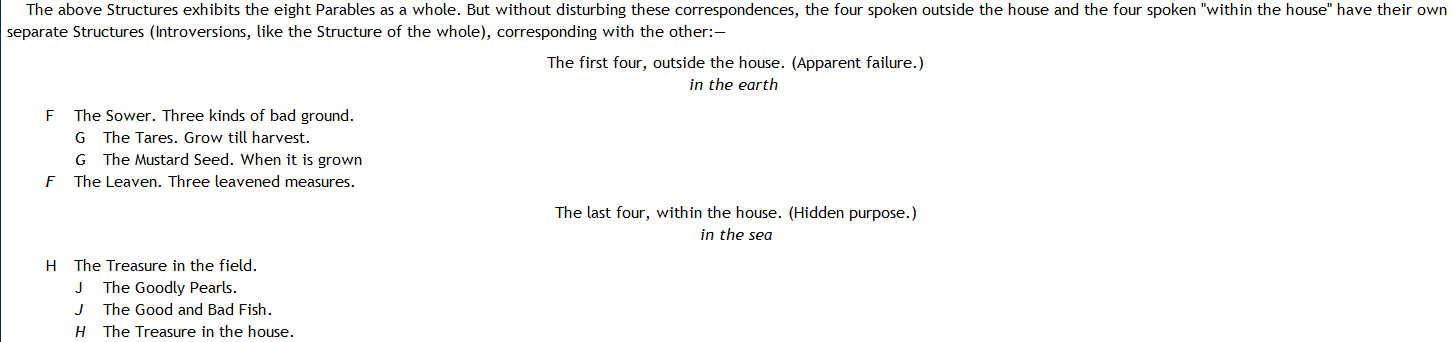
The Four Parables outside the house, spoken to the multitudes, seem therefore to call for an exoteric interpretation; while the four spoken within the house call for an esoteric interpretation.
In this case, the first four would find their interpretation in the three proclamations of John the Baptist, the Lord Jesus, and “them that heard Him” (see Ap. 95); the Leaven and the Tares showing the
secret cause of the failure which led to the postponement of the Kingdom, while the Mustard Tree would exhibit the external consequences.
The latter four would find their interpretation in “the secrets of the kingdom of heavens” (Ap. 114), showing that notwithstanding the apparent (outward) failure, God, all the while, has His hidden
purpose concerning the Remnant, His peculiar treasure hidden: the earthly calling, in the field (which is the world), and “the heavenly calling”, “in the house”; and the end of the age would exhibit the
one “pearl of great price”: the Remnant, according to the Election of Grace, on the one hand, and the “good and bad” receiving their awards, on the other.
Appendix 146
“THE FOUNDATION OF THE WORLD”
To arrive at the true meaning of this expression, we must note there are two words translated “foundation” in the New Testament: (1)
themelios
, and (2)
katabole
.
The Noun, themelios, occurs in Lk 6:48,49; 14:29. Ac 16:26. Ro 15:20. 1 Co 3:10,11,12. Eph 2:20. 1 Ti 6:19. 2 Ti 2:19. Heb 6:1; 11:10. Rv 21:14,19. It is never used of the world (kosmos) or the earth (ge).
The corresponding Verb (themeliou) occurs in Mt 7:25. Lk 6:48. Eph 3:17. Col 1:23. Heb 1:10 and 1 Pe 5:10. The verb is only once used of the earth (ge). Heb 1:10. A comparison of all these passages will
show that these are proper and regular terms for the English words “to found”, and “foundation”.
The Noun, katabole, occurs in Mt 13:35; 25:34. Lk 11:50. Jn 17:24. Eph 1:4. Heb 4:3; 9:26; 11:11. 1 Pe 1:20. Rv 13:8; 17:8; and the corresponding Verb (kataballo) occurs in 2 Co 4:9. Heb 6:1; and Rv
12:10. A comparison of all these passages (especially 2 Co 4:9, and Rv 12:10) will show that kataballo and katabole are not the proper terms for founding and foundation, but the correct meaning is casting
down, or overthrow.
Consistency, therefore, calls for the same translation in Heb 6:1, where, instead of “not laying again”, the rendering should be “not casting down”. That is to say, the foundation already laid, of
repentance, &c., was not to be cast down or overthrown, but was to be left — and progress made unto the perfection. Accordingly, the Noun katabole, derived from, and cognate with the Verb, ought to
be translated “disruption”, or “ruin”.
The remarkable thing is that in all occurrences (except Heb 11:11) the word is connected with “the world” (Gr. kosmos. Ap. 129. 1), and therefore the expression should be rendered “the disruption (or
ruin) of the world”, clearly referring to the condition indicated in Ge 1:2, and described in 2 Pe 3:5,6. For the earth was not created tohu (Isa 45:18), but became so, as stated in the Hebrew of Ge 1:2 and
confirmed by 2 Pe 3:6, where “the world that then was by the word of God” (Ge 1:1), perished, and “the heavens and the earth which are now, by the same word “were created (Ge 2:4), and are “kept in
store, reserved unto fire against the day of judgment” (2 Pe 3:7) which shall usher in the “new heavens and the new earth” of 2 Pe 3:13.
“The disruption of the world” is an event forming a great dividing line in the dispensations of the ages. In Ge 1:1 we have the founding of the world (Heb 1:10 = themeliou), but in Ge 1:2 we have its
overthrow.
This is confirmed by a further remarkable fact, that the phrase, which occurs ten times, is associated with the Preposition apo = from (Ap. 104. iv) seven times, and with pros = before (Ap. 104. xiv)
three times. The former refers to the kingdom and is connected with the “counsels” of God; the latter refers to the Mystery (or Secret. See Ap. 192) and is connected with the “purpose” of God (See Jn
17:24. Eph 1:4. 1 Pe 1:20).
Ample New Testament testimony is thus given to the profoundly significant fact recorded in Ge 1:2, that “the earth became tohu and bohu (i.e. waste and desolate); and darkness was on the face of the
deep”, before the creation of “the heavens and the earth which are now” (2 Pe 3:7).
Appendix 147 “THOU ART PETER” (Mt 16:18).
As explained in the notes, the two Greek words petros and petra are quite distinct, the former being masculine gender, and the latter feminine. The latter denotes a rock or cliff, in situ, firm and immovable. The former denotes a fragment of it, which one traveler may move with his foot in one direction and another may throw in another. This former word petros is the Greek translation kephas, a stone, which was Peter’s name in Aramaic, as was his appellative “Barjona” (Jn 1:42). See Ap. 94. III. 3.
It is remarkable that there is only one other instance (Lk 22:34) in which our Lord addressed him as “Peter”; but, in all other cases, by his fore-name “Simon”, reminding him of what he was before his call, and of the characteristics of his human nature. In that other instance it is used in connection with the coming exhibition of his weakness, in the prediction of his denial of the Lord.
There is thus a special significance in the use of the word “Peter” in Mt 16:18. It was the name connected with his commission and apostleship; another commission being about to be committed to him. It was not Peter, the man, who would be the foundation, for, as we have said, petra is feminine, and must refer to a feminine noun expressed or implied. that noun could hardly be any other than homologia, which means a confession; and it was Peter’s confession that was the one subject of the Father’s revelation and the Son’s confirmation.
Moreover, in 1 Co 3:11 it has once for all been declared by the Holy Spirit that “OTHER foundation can no man lay than that IS LAID, which is JESUS CHRIST”. The earliest known reference to Mt 16:18 is found in ORIGEN’S Commentary (A.D. 186-253), which is older than any extant Greek manuscript. He says:
“If we also say the same as Peter, ‘Thou art the Christ, the Son of the living God’, not by the instruction of flesh and blood, but by the illumination of the heavenly Father in our hearts, we ourselves become the same thing as Peter.
“If you should think that the whole church was built by God only on that one, Peter, what will you say of John … or each of the apostles?” (*1)
This is conclusive as to the interpretation. But there are other and later references to these words by AUGUSTINE (A.D. 378), and JEROME (A.D. 305), alike older than any Greek MSS. now extant. JEROME wrote thus in his exposition (Benedictine ed.):
“And I tell thee, that thou has said to Me, ‘Thou art the Christ’, &c., and I tell thee that thou art Peter, and on this rock, &c.” (*2)
AUGUSTINE wrote in his Retractationes (Benedictine ed., vol. i, p. 33):
“I have somewhere said, concerning the apostle Peter, that the Church was founded on him, as a petra, or rock; but I know that I have since very often explained what our Lord said to signify on Him Whom Peter confessed; but between these two opinions, let the reader choose that which is the more probable.” (*3)
In AUGUSTINE’S Sermon In die Pentecostis (Benedictine ed., tom. v. p. 1097; also Pusey’s Translation, Sermons on the New Testament, vol. i. p. 215), he explains the reason for this retractation in a paraphrastic citation of the whole context:—
“When our Lord had asked His disciples who men said that He was, and when, in reporting the opinions of others, they had said that some said He was John, some Elijah, others Jeremiah or one of the prophets, He said to them: ‘But ye, Who do ye say that I am?’ Peter (one alone for the rest, one for all) answered, ‘Thou art the Christ, the Son of the living God.’ This, most excellently, most truly spoken, was deservedly rewarded with this reply: ‘Blessed art thou, Simon Bar-Jonah, because flesh and blood revealed not this to thee, but My Father Who is in heaven; and I tell thee that thou hast said’: (hast said, observe, hast made confession unto Me: receive therefore the benediction): ‘and I tell thee that thou art Peter; and on this rock I will build My church.'” (*4)
Some have conjectured from these words “tu dixisti” (thou hast said it) that AUGUSTINE and JEROME must have had in the MSS. from which they translated six letters, which they divided into two words “SU EIPS” (*5), taking EIPS as an abbreviation of EIPAS ( = thou hast said). There must have been another division of the same six letters into three words, which was current even then, for both these Fathers add “SU EI PETROS” = thou art Peter; taking the same “PS” as an abbreviation of PETROS.
It is evident, however, that these Fathers give only a paraphrase; and do not profess to be giving an exact quotation. One thing, however, is certain, and that is our only point in this Appendix, viz. that the earliest references made to this passage disclaim all idea of its having any reference to the apostle Peter, but only to HIM Who was the subject of Peter’s confession.
(*1) ei de epi ton hena ekeinon Petron nomizeis hupo tou Theou okiodomeisthai ten pasan ekklesian monon, ti oun phesais peri Ioannou, tou tes brontes, e hekastou ton apostolon.
(*2) “Quid est quod ait? Et ego dico tibi tu mihi dixisti (tu es Christus filius Dei vivi); et ego dico tibi quia TU mihi dexisti (tu es Christus filius Dei vivi); et ego dico tibi (non sermone casso et nullum habenti opus, sed dico tibi, quia meum dixisse, fecisse est) quia tu es Petrus; et super hanc petram aedificabo ecclesiam meam.”
(*3) “Dixi in quodam loco de apostolo Petro, quod in illo, quasi in petra, fundata sit ecclesia; sed scio me postea saepissime sic exposuisse quod a Domino dictum est, ut super hunc intelligetur quem confessus est Petrus: horum autem duarum sententiarum quae sit probabilior, eligat lector.” (Italics, ours.)
(*4) “Cum interrogasset ipse Dominus discipulos suos, quis ab hominibus diceretur, et aliorum opiniones recolendo dixissent; quod alii eum dicerent Ioannem, alii Eliam, alii Ieremiam, aut unum ex prophetic, ait illis, ‘Vos autem quem Me esse dictis?’ Et Petrus, unus pro ceteris, unus pro omnibus, ‘Tu es, inquit, Christus filius Dei vivi.’ Hoc, optime, veracissime, merito tale responsum accipere meruit: ‘Beatus es, Simon Bar Ionae, quia non tibi revelavit caro et sanguis, sed Pater Meus qui in coelis est: et Ego dico tibi, quia tu dixisti’: Mihi dixisti audi; dedisti confessionem. Recipe benedictionem ergo: ‘Et dico tibi, Tu es Petrus — et super hanc petram aedificabo ecclesiam Meam'”.
(*5) It will be seen from Ap. 94. V. i. 3 that in the Greek manuscripts there was no division between the letters or words until the ninth century.
Appendix 148
“THE THIRD DAY.”
In the first mention of His sufferings (Mt 16:21) the Lord mentions the fact that He would be “raised again the third day”. In Jn 2:19 He had already mentioned “three days” as the time after which He would raise up “the Temple of His body”. The expression occurs eleven times with reference to His resurrection (Mt 16:21; 17:23; 20:19. Mk 9:31; 10:34. Lk 9:22; 18:33; 24:7,46. Ac 10:40. 1 Co 15:4.).
We have the expression “after three days” in Mk 8:31, used of the same event. This shows that the expression “three days and three nights” of Mt 12:40 must include “three days” and the three preceding “nights”. While it is true that a “third day” may be a part of three days, including two nights; yet “after three days”, and “three nights and three days” cannot possibly be so reckoned. This full period admits of the Lord’s resurrection on the third of the three days, each being preceded by a night, as shown in Ap. 144 and 156. But, why this particular period? Why not two, or four, or any other number of days? Why “three” and no more nor less?
1. We notice that the man who contracted defilement through contact with a dead body was to purify himself on the third day (Nu 19:11,12).
2. The flesh of the peace offering was not to be kept beyond the third day, but was then to be burnt (Lev 7:17,18) as unfit for food.
3. John Lightfoot (1602-75) quotes a Talmudic tradition that the mourning for the dead culminated on “the third day”, because the spirit was not supposed to have finally departed till then (Works, Pitman’s ed., vol. xii. pp. 351-353).
4. Herodotus testifies that embalmment did not take place until after three days (Herod. ii. 86-89).
5. The Jews did not accept evidence as to the identification of a dead body after three days.
This period seems, therefore, to have been chosen by the Lord (i.e. Jehovah, in the type of Jonah) to associate the fact of resurrection with the certainty of death, so as to preclude all doubt that death had actually taken place, and shut out all suggestion that it might have been a trance, or a mere case of resuscitation. The fact that Lazarus had been dead “four days already” was urged by Martha as a proof that Lazarus was dead, for “by this time he stinketh” (Jn 11:17,39).
We have to remember that corruption takes place very quickly in the East, so that “the third day” was the proverbial evidence as to the certainty that death had taken place, leaving no hope.
Appendix 149
THE TRANSFIGURATION (Mt 17:1-8. Mk 9:2-8. Lk 9:28-36)
It has been said that “to most ordinary men the Transfiguration seemed to promise much and yield little”; but, by a careful comparison of Scripture with Scripture we shall find some of what it promises so much, and receive much of what it seems to yield so little.
1. The event is recorded in three out of the four Gospels. It is therefore of great importance.
2. It is dated in all three accounts, and is therefore of particular importance. It took place “about six days” (exclusive reckoning), or “about eight days” (Lk 9:28, inclusive reckoning) from the Lord’s prediction.
3. The event from which it is dated, in all three Gospels, is the Lord’s first mention of His sufferings, and rejection (Mt 16:21. Mk 8:31. Lk 9:22). It must therefore have some close connexion with this (*1).
4. What this connection is may be seen from the fact that, in the O.T., while the “glory” is often mentioned without the “sufferings” (Isa 11; 32; 35; 40; 60, &c.), the “sufferings” are never mentioned apart from the “glory”. See Ap. 71.
5. It is so here; for in each account the Lord goes on to mention His future coming “in the glory of His Father”; and this is followed by an exhibition of that “glory”, and a typical foreshadowing of that “coming” (2 Pe 1:16-18) on “the holy mount”.
6. The Transfiguration took place “as He prayed”; and there are only two subjects recorded concerning which He prayed: the sufferings (Mt 26:39,42,44) and the glory (Jn 17:1,5,24).
7. It was on “the holy mount” that he “received from God the Father honour and glory” (time kai doxa, 2 Pe 1:17), and was crowned with glory and honour, for the suffering of death” (Gr. doxa kai time, Heb 2:9). In these passages the reference is to Ex 28:2, where the High Priest at his consecration for the office of high priest was clothed with garments, specially made under Divine direction, and these were “for glory and for beauty”. In the Greek of the Sept. we have the same two words (time kai doxa).
8. These garments were made by those who were “wise hearted”, whom Jehovah said He had “filled with the spirit of wisdom that they may make Aaron’s garments to consecrate him, that he may minister unto Me in the priest’s office” (Ex 28:3). These latter words are repeated in v.4, in order to emphasize the Divine object. This tells us assuredly that the Transfiguration was the consecration of our Lord for His special office of High Priest and for His priestly work, of which Aaron was the type.
9. This is confirmed by what appears to be the special Divine formula of consecration: (1) In Mt 3:17, &c. “This is My beloved Son”, at His Baptism, for His office of Prophet (at the commencement of His Ministry); (2) In Mt 17:5 “This is My beloved Son” at His Transfiguration, for His office of High Priest (Heb 5:5-10): and (3) at His Resurrection, “Thou art My Son; this day have I begotten Thee”, i.e. brought Thee to birth. Gr. gegenneka, as in Ac 13:33 and Ps 2:7 (Sept.).
10. At His resurrection His sufferings were over; and nothing further was needed before He should “enter into His glory” according to Lk 24:26. there was nothing to hinder that glory which He had then “received” from being “beheld” by those whom He had loved (Jn 17:24). The sufferings had first to be accomplished; but, this having been done, the glory of His kingdom and His glorious reign would have followed the proclamation of that kingdom by Peter in Ac 3:18-26. It was, as we know, rejected: in Jerusalem, the capital of the land (Ac 6:9-7:60), and afterward in Rome, the capital of the dispersion (Ac 28:17-28). Hence, He must come again, and when He again bringeth the First-begotten into the world, the Father will say “Thou art My Son”, and “let all the angels of God worship Him” (Heb 1:5,6).
(*1) This is doubtless the reason why it finds no place in John’s Gospel; for, like the Temptation, and the Agony, it is not needed in that Gospel for the presentation of the Lord Jesus as God.
Appendix 150
“BELIEVE”: THE USE OF THE WORD IN VARIOUS CONNECTIONS, ETC.
There are two Verbs, two Nouns, and one Adjective to be considered in connection with this subject.
I. VERBS.
1.
pisteuo
= to have faith (pistis) in; hence to believe. Translated “believe”, except in eight instances, see below (iv).
i. Used absolutely: Mt 8:13; 21:22; 24:23,26. Mk 5:36; 9:23,24; 13:21; 15:32; 16:16,17. Lk 1:45; 8:12,13,50; 22:67. Jn 1:7,50; 3:12-18; 4:41,42,48,53; 5:44; 6:36,64; 9:38; 10:25,26; 11:15,40; 12:39,47; 14:29; 16:31; 19:35; 20:8,25,29-31. Ac 2:44; 4:4,32; 5:14; 8:13,37; 11:21; 13:12,39,48; 14:1; 15:5,7; 17:12,34; 18:1-8,27; 19:2,18; 21:20,25; 26:1-27. Ro 1:16; 3:22; 4:11; 10:4,10; 13:11; 15:13. 1 Co 1:21; 3:5; 14:42; 15:2,11. 2 Co 4:13. Gal 3:22. Eph 1:19. 1 Th 1:7; 2:10,13. 2 Th 1:10. 1 Ti 3:16. Heb 4:3. Jas 2:1-19. 1 Pe 2:7. Jude 5.
ii. With dative of person or thing believed: Mt 21:25,32; 27:42. Mk 11:31; 16:13,14. Lk 1:20; 20:5. Jn 2:22; 4:21,50; 5:24,38,46,47; 6:30; 8:31,45,46; 10:37,38; 12:38; 14:11. Ac 8:12; 13:41; 16:34; 18:8; 24:14; 26:27; 27:25. Ro 4:3; 10:16. Gal 3:6. 2 Th 2:11,12. 2 Ti 1:12. Tit 3:8. Jas 2:23. 1 Jn 3:23; 4:1; 5:10.
iii. With direct object of the fact believed, either a Noun in the Acc. Case, or a sentence: Mt 9:28. Mk 11:23,24. Jn 4:21; 6:69; 8:24; 9:18; 10:38; 11:26,27,42; 13:19; 14:10,11; 16:27,30; 17:8,21; 20:31. Ac 8:37; 9:26; 15:11. Ro 6:8; 10:9; 14:2. 1 Co 11:18; 13:7. 1 Th 4:14. Heb 11:6. Jas 2:19. 1 Jn 4:16; 5:1,5.
iv. Translated “commit”: Lk 16:11. Jn 2:24. (both followed by Dative and Accusative); “committed to”, or “put in trust with” (Passive): Ro 3:2. 1 Co 9:17. Gal 2:7. 1 Th 2:4. 1 Ti 1:11. Tit 1:3.
v. With Prepositions:
a. eis (Ap. 104. vi): Mt 18:6. Mk 9:42. Jn 1:12; 2:11,23; 3:15,16,18,36; 4:39; 6:29,35,40,47; 7:5,31,38,39,48; 8:30; 9:35,36; 10:42; 11:25,26,45,48; 12:11,36,37,42,44,46; 14:1,12; 16:9; 17:20. Ac 10:43; 14:23; 19:4. Ro 10:14. Gal 2:16. Php 1:29. 1 Pe 1:8,21. 1 Jn 5:10,13.
b. en (Ap. 104. viii): Mk 1:15. Eph 1:13.
c. epi (Ap. 104. ix):
1. With Dative: Lk 24:25. Ro 4:18; 9:33; 10:11. 1 Ti 1:16. 1 Pe 2:6.2. With Acc.: Ac 9:42; 11:17; 16:31; 22:19. Ro 4:5,24.
d. In two instances, through the object being a Relative Pronoun, and attracted to the case of its antecedent, the Verb is followed by a Genitive: Ro 4:17; 10:14.
There are only 248 occurrences of the Verb pisteuo (of which 99 are found in John’s Gospel), but in two cases besides those noted in iv, it is followed by a direct object of the thing believed, as well as a Dative of the person. These are Jn 4:21; 14:11-, and are therefore noted under both ii and iii.
2.
peitho
, which is found 55 times, means to “persuade”, and is so translated in Mt 27:20; 28:14. Lk 16:31; 20:6. Ac 13:43; 14:19; 8:4; 19:8,26; 21:14; 26:26,28; 28:23. Ro 8:38; 14:14; 15:14. 2 Co 5:11. Gal 1:10. 2 Ti 1:5,12. Heb 6:9; 11:13.
The Passive, “to be persuaded” or the Middle, “to persuade oneself”, is translated “believe” in Ac 17:4; 27:11; 28:24.
“Obey” in Ac 5:36,37. Ro 2:8. Gal 3:1; 5:7. Heb 13:17. Jas 3:3; “agreed” in Ac 5:40; and “yield” in Ac 23:21.
In Ac 12:20, the active is rendered “made … friend”, and in 1 Jn 3:19 “assure”.
peitho has a Middle Perfect, pepoitha, with a reflective sense, “I have persuaded myself”: i.e. “I trust”. This is rendered “trust”, “have confidence”, &c., in Mt 27:34. Mk 10:24. Lk 11:22; 18:9. Ro 2:19. 2 Co 1:9; 2:3; 10:7. Gal 5:10. Php 1:6,14,25; 2:24; 3:3,4. 2 Th 3:4. Phm 21. Heb 2:13; 13:18.
Emphasized>II. NOUNS.
1.
pistis
(*1) = faith. The living, Divinely implanted principle. It connects itself with the second Aorist of peitho (I. 2, above), Gr. epithon, occurs 242 times, and is always translated “faith”, except in Ac 17:31, “assurance”; Tit 2:10, “fidelity”; and Ro 3:26, and Heb 10:39, where “of faith” is rendered “him which believeth”, and “them that believe”.
2.
pepoithesis
= confidence. It is derived from the Middle Perfect of peitho (I. 2, above), which is always to be distinguished from the Passive Perfect (pepeismai). The latter refers to persuasion wrought from without; the former refers to a persuasion realized from within, and this is what pepoithesis seems to always mean. Pistis (No. 1) refers rather to the principle, and pepoithesis refers more to the feeling. It occurs 6 times, and is rendered “confidence” in 2 Co 1:15; 8:22; 10:2. Eph 3:12. Php 3:4; and “trust” in 2 Co 3:4.
III. ADJECTIVE.
pistos occurs 67 times, and is rendered “faithful” 54 times. It is necessary to give the references, as it is the only word so translated. It is translated “sure” in Ac 13:34, “true” in 2 Co 1:18. 1 Ti 3:1, and 10 times “believer”, “he that believeth”, &c.: viz. Jn 20:27. Ac 10:45; 16:1. 2 Co 6:15. 1 Ti 4:3,10,12; 5:16; 6:2.
(*1) The English word “faith” is always the translation of pistis, except in Heb 10:23, where the Greek word is elpis, everywhere else rendered “hope”.
Appendix 151
“EVERLASTING”, “ETERNAL”, “FOR EVER”, ETC.
I. In the Old Testament there are several words and expressions thus translated, the principal of which is
A. Olam. This word is derived from ‘alam (to hide), and means the hidden time or age, like aion (see below II. A), by which the word, or its Adjective aionios, it is generally rendered in the Sept. In Ezr 4 and Da 2-7, the Chaldee form ‘alam is used. There are 448 passages where the word occurs.
i. It is doubled, “from ‘olam to ‘olam” in 11 places, and is translated:—
1. “for ever and ever” in 1 Ch 16:36; 29:10. Ne 9:5. Jer 7:7; 25:5. Da 2:20; 7:18.
2. “from everlasting to everlasting” in Ps 41:13; 90:2; 103:17; 106:48.
ii. It is used in the plural 11 times, and translated:—
1. “for ever” in 1 Ki 8:13. 2 Ch 6:2. Ps 61:4; 77:7.
2. “everlasting” in Ps 145:13 (see marg.). Isa 26:4. (see marg.); 45:17. Da 9:24.
3. “of ancient times or old times” in Ps 77:5. Ecc 1:10.
4. “of old” in Isa 51:9.
iii. It is rendered “for ever” in Ge 3:22; 13:15. Ex 3:15; 12:14,17,24; 14:13; 19:9; 21:6; 27:21; 28:43; 29:28; 30:21; 31:17; 32:13. Lev 6:18,22; 7:34,36; 10:9,15; 16:29,31; 17:7; 23:14,21,31,41; 24:3; 25:46. Nu 10:8; 15:15; 18:8,11,19,23; 19:10. Dt 5:29; 12:28; 13:16; 15:17; 23:3,6; 28:46; 29:29; 32:40. Jos 4:7; 8:28; 14:9. 1 Sa 1:22; 2:30; 3:13,14; 13:13; 20:15,23,42; 27:12. 2 Sa 3:28; 7:13,15,18,24,25,26,29. 1 Ki 1:31; 2:43,45; 9:3,5; 10:9. 2 Ki 5:27; 21:7. 1 Ch 15:2; 16:34,41; 17:12,14,22,24,27; 22:10; 23:13,25; 28:4,7,8; 29:18 2 Ch 2:4; 5:13; 7:3,6,16; 9:8; 13:5; 20:7,21; 30:8; 33:4,7. Ezr 3:11; 9:12. Ne 2:3; 13:1. Job 41:4. Ps 9:7; 12:7; 28:9; 29:10; 30:12; 33:11; 37:18,28; 41:12; 44:8; 45:2; 48:8; 49:8,11; 52:9; 61:7; 66:7; 72:17,19; 73:26; 75:9; 78:69; 79:13; 81:15; 85:5; 89:1,2,4,36,37; 102:12; 103:9; 104:31; 105:8; 106:1; 107:1; 110:4; 111:9; 112:6; 117:2; 118:1,2,3,4,29; 119:89,111,152,160; 125:1,2; 131:3; 135:13; 136; 138:8; 146:6,10. Pr 27:24. Ecc 1:4; 2:16; 3:14; 9:6. Isa 9:7; 32:14,17; 34:10,17; 40:8; 47:7; 51:6,8; 57:16; 59:21; 60:21. Jer 3:5,12; 17:4,25; 31:40; 33:11; 35:6; 49:33; 51:26,62. Lam 3:31; 5:19. Eze 37:25; 43:7,9. Da 2:4,44; 3:9; 4:34; 5:10; 6:6,21,26; 7:18; 12:7. Hos 2:19. Joel 3:20. Ob 10. Jnh 2:6. Mic 2:9; 4:7. Zec 1:5. Mal 1:4.
iv. In conjunction with ‘ad (see below, B) it is rendered:—
1. “for ever and ever” in Ex 15:18. Ps 9:5; 10:16; 21:4; 45:6,17; 48:14; 52:8; 111:8; 119:44; 145:1,2,21; 148:6. Isa 30:8. Da 12:3. Mic 4:5.
2. “for ever” in Ps 104:5.
3. “world without end” in Isa 45:17. (*1)
v. With a negative it is rendered “never” in Jdg 2:1. 2 Sa 12:10. Ps 15:5; 30:6; 31:1; 55:22; 71:1; 119:93. Pr 10:30. Isa 14:20; 25:2; 63:19. Eze 26:21. Da 2:44. Joel 2:26,27.
vi. Rendered “everlasting” in Ge 9:16; 17:7,8,13,19; 21:33; 48:4; 49:26. Ex 40:15. Lev 16:34; 24:8. Nu 25:13. Dt 33:27. 2 Sa 23:5. 1 Ch 16:17. Ps 24:7,9; 93:2; 100:5; 105:10; 112:6; 119:142,144; 139:24. Pr 8:23; 10:25. Isa 24:5; 33:14; 35:10; 40:28; 51:11; 54:8; 55:3,13; 56:5; 60:19,20; 61:7,8; 63:12,16. Jer 10:10; 20:11; 23:40; 31:3; 32:40. Eze 16:60; 37:26. Da 4:3,34; 7:14,27; 12:2. Mic 5:2. Hab 3:6.
vii. Rendered “perpetual” in Ge 9:12. Ex 29:9; 31:16. Lev 3:17; 24:9; 25:34. Nu 19:21. Ps 78:66. Jer 5:22; 18:16; 23:40; 25:9,12; 49:13; 50:5; 51:39,57. Eze 35:5,9; 46:14. Hab 3:6. Zep 2:9.
viii. Rendered “for evermore” in 2 Sa 22:51. 1 Ch 17:14. Ps 18:50; 37:27; 86:12; 89:28,52; 92:8; 106:13; 113:2; 115:18; 121:8; 133:3. Eze 37:26,28.
ix. Rendered “of old” or “ever of old” in Ge 6:4. Dt 32:7. 1 Sa 27:8. Ps 25:6; 119:52. Isa 46:9; 57:11; 63:9,11. Jer 28:8. Lam 3:6. Eze 26:20. Am 9:11. Mic 7:14. Mal 3:4.
x. Rendered “old” or “ancient” in Ezr 4:15,19. Job 22:15. Pr 22:28; 23:10. Isa 44:7; 58:12; 61:4. Jer 5:15; 6:16; 18:15. Eze 25:15; 36:2.
xi. Rendered “of” or “In old time” in Jos 24:2. Jer 2:20. Eze 26:20.
xii. Rendered “alway” or “always” in Ge 6:3. 1 Ch 16:15. Job 7:16. Ps 119:112. Jer 20:17.
xiii. Rendered “ever” in Ps 5:11; 111:5; 119:98. Joel 2:2
xiv. Rendered “any more” in Eze 27:36; 28:19; “long” in Ps.
B. ‘ad from the verb ‘adah (to pass on), as a Noun is used of time past or future. It is also a Preposition or Conjunction, meaning “until” (see Oxford Gesenius, pp. 723, 4). The noun occurs 49 times, 19 of which occurrences are given above (A. iv). The remaining 30 are rendered:
i. “for ever” in Nu 24:20,24. 1 Ch 28:9. Job 19:24. Ps 9:18; 19:9; 21:6; 22:26; 37:29; 61:8; 83:17; 89:29; 92:7; 111:3,10; 112:3,9; 132:14. Pr 12:19; 29:14. Isa 26:4; 64:9; 65:18. Mic 7:18.
ii. “everlasting” in Isa 9:6. Hab 3:6.
iii. “eternity” in Isa 57:15; “evermore” in Ps 132:12; “of old” in Job 20:4; and “perpetually” in Am 1:11.
Other words are: –
C. Nezach, which means “excellence” or “completeness”, and is the word used in the subscription of 55 Psalms for “chief” in “chief Musician”. It is rendered:—
i. “for ever” in 2 Sa 2:26. Job 4:20; 14:20; 20:7; 23:7; 36:7. Ps 13:1; 44:23; 49:9; 52:5; 68:16; 74:1,10,19; 77:8; 79:5; 89:46. Jer 50:39. Lam 5:20. Am 1:11.
ii. “never” (with a negative) in Ps 10:11; 49:19. Isa 13:20. Am 8:7. Hab 1:4.
iii. alway(s) in Ps 9:18; 103:9. Isa 57:16.
iv. “perpetual” in Ps 9:6; 74:3. Jer 15:18.
v. “ever” in Isa 28:28; 33:20; “strength” in 1 Sa 15:29. Lam 3:18; “the end” in Job 34:36. Jer 3:5; “victory” in 1 Ch 29:11. Isa 25:8. “evermore” in Ps 16:11; “constantly” in Pr 21:28 and “for ever and ever” in Isa 34:10. In this last passage it is doubled, lenezach nezahim = completeness of completenesses.
D. Kedem, from the verb kadam, to precede or prevent (2 Sa 22:6, &c.), means that which is before, of time or place; hence often translated the east (Ge 3:24, &c.). It is always used of the past, and is rendered “ever” in Pr 8:23; “eternal” in Dt 33:27; “everlasting” in Hab 1:12; “old” or “ancient” in Dt 33:15. 2 Ki 19:25. Ne 12:46. Ps 44:1; 55:19; 68:33; 74:2,12; 77:5,11; 78:2; 119:152; 143:5. Isa 19:11; 23:7; 37:26; 45:21; 46:10; 51:9. Jer 46:26. Lam 1:7; 2:17; 5:12. Mic 5:2; 7:20; and “past” in Job 29:2.
E. Zmithuth, from zamath (to cut), means “for cutting off”. It occurs only in Lev 25:23 (see marg.), 30, and is rendered “for ever”.
F. Tamid = always, is rendered:— “ever” in Lev 6:13. Ps 25:15; 51:3; “evermore” in Ps 105:4, and (with a negative) “never” in Isa 62:6.
G. Dor = generation, is translated (with a negative) “never” in Ps 10:6, and “for evermore” in Ps 77:8, where the margin in both cases gives “to generation to generation”.
H. Yom = day, occurs nearly 2,500 times. The expression orek yamin, “length of days”, is translated “for ever” in Ps 23:6; 93:5. In both cases the margin gives “to length of days”. Kal yamin, or kal hayyamin, “all days” or “all the days” is translated “for ever” in Ge 43:9; 44:32. Dt 4:40; 18:5. Jos 4:24. 1 Sa 2:32,35; 28:2. 1 Ki 11:39; 12:7. 2 Ch 10:7; 21:7. Jer 31:36; 32:39; 35:19; “ever” in Dt 19:9. 1 Ki 5:1. Ps 37:26; and “evermore” in Dt 28:29. 2 Ki 17:37.
II. In the N.T. the words rendered “for ever”, &c., are the Noun aion, the Adjectives aionios, aidios, akatalutos, and aperantos; the Adverbs aei and pantote, and the adverbial phrase eis to dienekes.
A. Aion, which means “age” (Ap. 129. 2), is found 128 times in 105 passages, in 23 of which it is doubled (see below, ii. 6, 9, 10). It occurs in its simple form 37 times, and with Prepositions 68 times.
i. In its simple form it is rendered:—
1. “age”. Eph 2:7 (pl). Col 1:26 (pl).
2. “course”. Eph 2:2.
3. “world”. Mt 12:32; 13:22,39,40,49; 24:3; 28:20. Mk 4:19; 10:30. Lk 16:8; 18:30; 20:34,35. Ro 12:2. 1 Co 1:20; 2:6,7 (pl), 8; 3:18; 10:11 (pl). 2 Co 4:4. Gal 1:4. Eph 1:21; 6:12. 1 Ti 6:17. 2 Ti 4:10. Tit 2:12. Heb 1:2 (pl); 6:5; 9:26 (pl); 11:3 (pl).
4. “eternal”. Eph 3:11. 1 Ti 1:17 (lit. “of the ages”).
ii. In prepositional phrases:—
1. ap’aionos [from (Ap. 104. iv) an (the) age], rendered “since the world began” in Lk 1:70. Ac 3:21; and “from the beginning of the world” in Ac 15:18.
2. apo ton aionon [from (Ap. 104. iv) the ages], rendered “from the beginning of the world” in Eph 3:9.
3. ek tou ainos [out of (Ap. 104. vii) the age], rendered “since the world began” in Jn 9:32.
4. eis ton ainona [to (Ap. 104. vi) the age], rendered:—
a. “for ever” in Mt 21:19. Mk 11:14. Lk 1:55. Jn 6:51,58; 8:35; 12:34; 14:16. 2 Co 9:9. Heb 5:6; 6:20; 7:17,21. 1 Pe 1:23,25. 2 Pe 2:17 (no Art.). 1 Jn 2:17. 2 Jn 2. Jude 13.
b. “never” (with a negative) in Mk 3:29. Jn 4:14; 8:51,52; 10:28; 11:26; 13:8.
c. “ever” in Heb 7:24.
d. “for evermore” in Heb 7:28.
e. “while the world standeth” in 1 Co 8:13.
5. eis hemeran aionos [to (Ap. 104. vi) day of an age], rendered “for ever” in 2 Pe 3:18.
6. eis ton aiona tou aionos [to (Ap. 104. vi) the age of an age], rendered “for ever and ever” in Heb 1:8.
7. eis tous aionas [to (Ap. 104. vi) the ages], rendered:—
a. “for ever” in Mt 6:13. Lk 1:33. Ro 1:25; 9:5; 11:36; 16:27. Heb 13:8.
b. “for evermore” in 2 Co 11:31.
8. eis pantas tous aionas [to (Ap. 104. vi) all the ages], rendered “ever” in Jude 25.
9. eis tous aionas ton aionon [to (Ap. 104. vi) to the ages of the ages], rendered:—
a. “for ever and ever” in Gal 1:5. Php 4:20. 1 Ti 1:17. 2 Ti 4:18. Heb 13:21. 1 Pe 4:11; 5:11. Rv 1:6; 4:9,10; 5:13,14; 7:12; 10:6; 11:15; 14:11 (no Arts); 15:7; 19:3; 20:10; 22:5.
b. “for evermore” in Rv 1:18.
1. eis pasas tas geneas tou aionos ton aionon [to (Ap. 104. vi) all the generations of the age of ages], rendered “throughout all ages, world without end” in Eph 3:21.
B. Aionios, of or belonging to an age, occurs 71 times, and is rendered:—
i. “eternal” in Mt 19:16; 25:46. Mk 3:29; 10:17,30. Lk 10:25; 18:18. Jn 3:15; 4:36; 5:39; 6:54,68; 10:28; 12:25; 17:2,3. Ac 13:48. Ro 2:7; 5:21; 6:23. 2 Co 4:17,18; 5:1. 1 Ti 6:12,19. 2 Ti 2:10. Tit 1:2; 3:7. Heb 5:9; 6:2; 9:12,14,15. 1 Pe 5:10. 1 Jn 1:2; 2:25; 3:15; 5:11,13,20. Jude 7,21.
ii. “everlasting” in Mt 18:8; 19:29; 25:41,46. Lk 16:9; 18:30. Jn 3:16,36; 4:14; 5:24; 6:27,40,47; 12:50. Ac 13:46. Ro 6:22; 16:26. Gal 6:8. 2 Th 1:9; 2:16. 1 Ti 1:16; 6:16. Heb 13:20. 2 Pe 1:11. Rv 14:6.
iii. “for ever” in Phm 15.
iv. “Before or since the world began”, in the phrases, chronois, aioniois, or pro chronon aionion, (in, or before age-times), strangely rendered in the R.V. “through, or before times eternal”, in Ro 16:25. 2 Ti 1:9. Tit 1:2.
C. Aidios, said to be from aei (see F below), but perhaps from a not and idein to see, = unseen or hidden, occurs twice and is rendered:—
ii. “eternal” in Ro 1:20.
ii. “everlasting” in Jude 6.
D. Akatalutos (indissoluble) occurs once, and is rendered “endless” in Heb 7:16.
E. Aperantos (interminable) occurs once, and is rendered “endless” in 1 Ti 1:4.
F. Aei (always) occurs 8 times, and is rendered:—
i. “ever” in Mk 15:8.
ii. “alway” or “always” in Ac 7:51. 2 Co 4:11; 6:10. Tit 1:12. Heb 3:10. 1 Pe 3:15. 2 Pe 1:12.
G. Pantote (always) occurs 42 times, and is rendered:—
i. “alway” or “always” in Mt 26:11. Mk 14:7. Lk 18:1. Jn 7:6; 8:29; 11:42; 12:8; 18:20. Ro 1:9. 1 Co 1:4; 15:58. 2 Co 2:14; 4:10; 5:6; 9:8. Gal 4:18. Eph 5:20. Php 1:4,20; 2:12; 4:4. Col 1:3; 4:6,12. 1 Th 1:2; 2:16; 3:6. 2 Th 1:3,11; 2:13. Phm 4.
ii. “ever” in Lk 15:31. Jn 18:20. 1 Th 4:17; 5:15. 2 Ti 3:7. Heb 7:25.
iii. “evermore” in Jn 6:34. 1 Th 5:16.
H. Eis to dienekes [to (Ap. 104. vi) that which is continuos] occurs 4 times, rendered:—
i. “continually” in Heb 7:3; 10:1.
ii. “for ever” in Heb 10:12,14.
Appendix 152
THE HEALING OF THE BLIND MEN AT JERICHO.
(Lk 18:35-43. Mk 10:46-52. Mt 20:29-34.)
Commentators and harmonizers agree in treating these three accounts as recording one single miracle. As in other cases, they assume similar discourses, sayings, and miracles to be identical, as though the Lord never repeated a single word or work. (See App. 116, 138, 153, 157, 158, 160, 163.)
The same may be seen in dealing with the healing of the blind men at Jericho. From a comparison of the three Gospels it will be readily seen that four blind men were healed, and that there were three separate miracles on the Lord’s visit to Jericho. The following particulars may be noted and considered:—
I. The Occasion.
1. In the first miracle the Lord was “come nigh unto Jericho”.
2. The second was “as He went out of Jericho”.
3. The third took place “as they departed from”, and had evidently left Jericho.
II. The Blind Men.
1. 1. In the first there was one, unnamed.
2. In the second there was one, named (Bartimaeus).
3. In the third there were two men.
III. The Circumstances.
1. The one man was begging.
2. The second likewise.
3. The two men were not begging, and apparently were simply waiting for the Lord’s passing by.
IV. Their Knowledge.
1. The first man did not know what the crowd meant, and asked.
2. The second (Bartimaeus) heard, but seems to have made no inquiry and at once cried out.
3. The two men also heard, and cried out at once.
V. Their Cry.
1. The first man cried “Jesus, thou Son of David”.
2. The second man cried “Son of David”.
3. The two men cried “O Lord, son of David”.
VI. The Lord’s Action.
1. The Lord “commanded (the first man) to be brought”.
2. He “commanded (the second man) to be called”.
3. He called the two men Himself.
VII. Their Healing.
1. The first desired that he might be able to see (anablepo).
2. The second in like manner.
3. The two men asked that “their eyes might be opened” (anoigo).
VIII. The Lord’s Reply.
1. In the first case, the Lord said: “Receive thy sight, thy faith hath saved thee.”
2. In the second case, the Lord said: “Go thy way, thy faith hath saved thee.”
3. In the third case, the Lord “had compassion on them, and touched their eyes”, saying nothing.
IX. The Result.
1. The first man “followed Him, glorifying God, and all the people gave praise to God.”
2. Bartimaeus “followed Jesus in the way”, apparently in silence.
3. The two men “followed Him”, in silence also.
We thus gather that the first two men were beggars who sat daily at either gate of Jericho: Jericho having at that time some 100,000 people, and doubtless many blind men. In face of this and of the above details, all that a recent commentator has to say is:—
“The variation is undeniable, and the accounts cannot be harmonized at this point. But of course it is quite immaterial… According to Matthew there were two blind men. Calvin therefore suggests that Bartimaeus met Jesus on His entrance to the city, and then went for the other blind man, and that both were healed as Jesus was leaving the city. This is very artificial dealing with the plain narratives. It is better to accept them as varying accounts of one single incident.”
True, we cannot harmonize “one man” and “two men” without abandoning all idea of inspiration. We submit therefore that “it is better” to take all the details as being evidences of the minutest perfection, and avoid both artificial and superficial dealing with the Divine narratives.
Appendix 153
THE TWO ENTRIES INTO JERUSALEM.
Most “Harmonies” assume that because each Gospel records an entry of the Lord into Jerusalem the four accounts must be identical because they are similar; and therefore conclude that because they differ in certain particulars there are “discrepancies”. Whereas, if we treat them in their chronological sequences, and have regard to the antecedent and consequent circumstances, the supposed discrepancies will disappear, and the similar, but diverse, expressions will be seen to be necessary to the different events.
In this present case, one entry (Mt 21:1-9) takes place before the other, which is recorded in Mk 11:1-10, Lk 19:30-34, and Jn 12:12-15.
1. In Matthew the Lord had actually arrived at Bethphage. In Luke He “was come nigh” (engisen); in Mark “they were approaching” (engizousin).
2. In Matthew the village lay just off the road (apenanti); in Luke and Mark it was below them, and opposite (katenanti).
3. In the former, two animals were sent for and used; in the latter, only one.
4. In the former, the prophecy of Zec 9:9, which required the two animals is said to have been fulfilled; in the latter, the prophecy was not said to be fulfilled, and only so much of it is quoted (Jn 12:15) as agrees with it.
5. The former seems to have been unexpected, for “all the city was moved, saying, ‘Who is this?'” (Mt 21:10,11), while, if there was only one entry, the two accounts are inexplicable, seeing that the later and subsequent entry was prepared for: much people in the city “heard that He was coming”, and “went forth to meet Him” (Jn 12:12,13). The latter therefore, was the great formal entry of the Lord, called “the Triumphal Entry”, which took place on what is called “Palm Sunday”.
The significance of the two animals, and the one, seems to be this:-
The first had special reference to the whole work of His mission. He came on the ass with its unbroken colt, the clothes being put some on one and some on the other, and the Lord sitting on “them” — the clothes (not on both beasts). He came to cleanse the Temple, and make His final presentation of the King and the Kingdom. But when He came on the one — an ass’s colt — it was in judgment, to pronounce the doom on the city; and on the nation. When He appears again it will be to a nation which will then say (as the result of Zec 12:10); “Blessed is He that cometh in the name of the Lord” (Mt 23:39).
For the events of the “six days before Passover”, see Ap. 156; and the notes on the various passages.
Appendix 154
“WHAT THINK YE OF CHRIST?” (Mt 22:42).
DIVERS THOUGHTS CONCERNING HIM.
“King of the Jews” (wise men from the east. Mt 2:2).
“Mightier than I” (John Baptist. Mt 3:11).
“Son of God” (demons. Mt 8:29).
“A blasphemer (certain Scribes. Mt 9:3).
“Son of David” (two blind men. Mt 9:27) (a woman of Canaan. Mt 15:22).
“The carpenter’s son” (His fellow countrymen. Mt 13:55).
“John the Baptist” (Herod and others. Mt 14:2; 16:14).
“The Son of God” (they that were in the ship. Mt 14:33).
“Elijah” (some. Mt 16:14).
“Jeremiah” (others. Mt 16:14).
“One of the prophets” (some men. Mt 16:14).
“The Christ, the Son of the living God” (Peter. Mt 16:16).
“The Christ, the Son of God” (Martha. Jn 11:27).
“My beloved Son” (God the Father. Mt 17:5).
“Good Master” (a certain ruler. Mt 19:16).
“The prophet of Nazareth” (the multitude. Mt 21:11).
“The carpenter, son of Mary” (many hearing Him. Mk 6:3).
“Thy salvation … a light … the glory” (Simeon. Lk 2:30,32).
“Joseph’s son” (all in the synagogue. Lk 4:22).
“A great prophet” (all witnessing the raising of the widow’s son. Lk 7:16).
“A righteous man” (the Roman centurion. Lk 23:47).
“A prophet mighty in deed and word” (the two going to Emmaus. Lk 24:19).
“The Lamb of God” (John the Baptist. Jn 1:29).
“The Messias” (Andrew. Jn 1:41).
“The Son of God … the King of Israel” (Nathanael. Jn 1:49).
“A teacher come from God” (Nicodemus. Jn 3:2).
“A prophet” (a woman of Samaria. Jn 4:19).
“Jesus the son of Joseph” (the Jews. Jn 6:42).
“A Samaritan” and having a demon (the Jews. Jn 8:48).
“A prophet” (the blind man. Jn 9:17).
“The King of Israel” (much people. Jn 12:13).
Appendix 155
THE TWO GREAT PROPHECIES OF “THE END OF THE AGE” (Lk 21 and Mt 24. Mk 13.)
The great prophecy recorded in Lk 21 is different both in time, place and subject from that recorded in Mt 24 and Mk 13. The one recorded in Luke was spoken “on one of those days, as He taught the
people in the Temple” (Lk 20:1). For one note of time is in 21:1, “and He looked up and saw the rich men casting their gifts into the Treasury.” So that He was still “in the Temple” when He uttered the
prophecy recorded in Lk 21, for the whole conversation with the disciples follows without a break the Lord’s commendation of the widow.
But with regard to the prophecy recorded in Mt 24, we distinctly read (v. 1) “and Jesus went out and departed from the Temple … and as He sat upon the Mount of Olives, the disciples came to Him
privately” (v. 30). So in Mk 13:1, “He went out of the Temple … and as he sat upon the Mount of Olives, over against the Temple, Peter and James and John and Andrew asked Him privately” (v. 3).
So that we have two great prophecies. One (Luke) spoken in the Temple, the other (Matthew and Mark) spoken later upon the Mount of Olives. As parts of the first are repeated on the second occasion,
we will give the leading points of the three in parallel columns, so that the object of each, and the difference between them, may be clearly seen. They both open with a summary of events which might
have taken place in the lifetime and experience of those who heard the words:—
LUKE 21:8-9
“Take heed that ye be not deceived for may shall come in My name, saying, I am Christ; and the time draweth near: go ye not therefore after them. But when ye shall hear of wars and commotions, be not terrified: for these things must first come to pass; but the end is not by and by (i.e. immediatly, so R.V.).”
FROM THE CROSS ONWARDS.
MATT. 24:4-6
“Take heed that no man deceive you. For many shall come in My name, saying I am Christ; and shall deceive many. And ye shall hear of wars and rumors of war see that ye be not troubled: for all these things must come to pass, but the end is not yet.”
MARK 13:5-7
“Take heed lest any man deceive you. For many shall come in My name, saying, I am Christ; and shall deceive many. And when ye shall hear of wars and rumors of war, be ye not troubled: for such things must needs be; but the end shall not be yet.”
John refers to this first sign in his First Epistle (2:18); but had the nation repented at the proclamation by Peter in Ac 3:18-26, by the Twelve in the Land, by “them that heard Him” (Heb 2:3), and by
Paul in the Synagogues of the Dispersion, “all that the prophets had written” would have been fulfilled.
LUKE 21:10, 11
“Nation shall rise against nation and kingdom against kingdom: and great earthquakes shall be in divers places, and famines, and pestilences, and fearful sights and great signs shall there be from heaven.”
MATT. 24:7,8
“Nation shall rise against nation, and kingdom against kingdom; and there shall be famines, and pestilences, and earthquakes, in divers places. All these are the beginning of sorrows.”
MARK 13:8
“Nation shall rise against nation, and kingdom against kingdom; and there shall be earthquakes in divers places, and there shall be famines and troubles: these are the beginnings of sorrows.”
Now, it will be observed in the Lord’s discourse as recorded in Luke, that, instead of saying “these are the beginnings of sorrows”, and going on with the account of them, He stops short; He goes back;
He introduces a parenthesis detailing and describing events that would take place “BEFORE ALL THESE” beginnings of sorrows. He describes in v. 12,
THE DESTRUCTION OF JERUSALEM.
12. But before all these,
That is to say “BEFORE” the great tribulation, all that is recorded concerning Jerusalem in vv. 12-24 would take place. These are the closing words:—
24. “And they shall fall by the edge of the sword, and shall be led away captive into all nations: and Jerusalem shall be trodden down of the Gentiles, until the times of the Gentiles be fulfilled.”
Now, in the discourse recorded in Mt 24, instead of going back to speak of the condition of Jerusalem before and until the beginning of the great Tribulation; having said “All these are the beginning of
sorrows”, He goes on to describe the sorrows, or birth-pangs of the Tribulation (Mt 24:9-28. Mk 13:9-23), and He continues the prophecy concerning these sorrows up to the moment of His appearing in the
clouds of heaven. While, in the discourse recorded in Lk 21, having gone back, and described what should take place “before all these” beginnings of sorrows, the Lord does not speak further of the great
Tribulation, but takes it up at the end, and, as in Matthew and Mark, speaks concerning
HIS COMING IN THE CLOUDS OF HEAVEN
(of course, in Luke the words are slightly different from those in Matthew and Mark):—
LUKE 21:25-27
“And there shall be signs in the sun, and in the moon, and in the stars; and upon the earth distress of nations, with perplexity; the sea and the waves roaring; men’s hearts failing them for fear, and for looking after those things which are coming on the earth; for the powers of the heavens shall be shaken. And then shall they see the Son of man coming in a cloud with power and great glory.”
MATT. 24:29, 30
“Immediately after the tribulation of those days (*1) shall the sun be darkened, and the moon shall not give her light, and the stars shall fall from heaven, and the powers of the heavens shall be shaken: and then shall appear the sign of the Son of man in heaven: and then shall all the tribes of the earth mourn, and they shall see the Son of man coming in the clouds of heaven with power and great glory.”
MARK 13:24-26
“But in those days, after that tribulation, the sun shall be darkened, and the moon shall not give her light, and the stars of heaven shall fall, and the powers that are in heaven shall be shaken, and then shall they see the Son of man coming in the clouds with great power and glory.”
The first prophecy, in the Temple (Lk 21), was uttered in answer to two questions: (1) “When shall these things be?” and (2) “What sign shall there be when these things shall come to pass?” The answer
to (1) is given in vv. 8-24, and the answer to (2) in vv. 25-28.
The second prophecy, on the Mount of Olives (Mt 24 and Mk 13), was uttered in answer to three distinct questions: (1) “When shall these things be?” (2) “What shall be the sign of Thy coming?” and (3)
“And [what shall be the sign] of the end of the age?” The answer to (1) was given in Mt 24:4-14. Mk 13:5-13. The answer to (2) was given in Mt 24:15-27. Mk 13:14-23; and to (3) in Mt 24:29-31 and Mk
13:24-27 (and in Lk 21:25-28). And then both prophecies conclude with the Parable of the Fig tree, and the final solemn assurance:—
“Verily I say unto you, This generation shall by no means (See Ap. 105. III) pass, till all these things may be fulfilled” (*2) (Mt 24:34. Mk 13:30. Lk 21:32.)
This latter is the last of four equally impressive statements: Mt 10:23; 16:28; 23:39; 24:34. Each of these consists of two clauses, the former of which contains the strongest negative that could possibly
have been used (see Ap. 105. III); and should be rendered “by no means”, or “in no wise”, as it is often rendered elsewhere; while in the latter clause the verb is in the subjunctive mood with or without
the Greek Particle “an”, which (though it cannot be represented in translation) makes the clause hypothetical and dependent on some condition expressed or implied. This condition was, in each of these
four passages, the repentance of the nation, in response to the appeal of “the other servants” of Mt 22:4, as recorded in Ac 3:18-26 and elsewhere, culminating in Ac 28:17-29.
The conclusion of both prophecies thus consists of an assured certainty, with a definite contingency, or uncertainty which was not fulfilled. Had the nation repented, then Jesus Christ would have been
“sent”, and “the restoration of all things which God had spoken by all His holy prophets since the world began” would have taken place, in accordance with God’s Divine assurance given by Peter in Ac
3:18-26; but the condition of national repentance (Lev 26:40-42; Hos 14:1-4, &c.) was not fulfilled; hence that generation passed away; and both prophecies (with all the others) are now postponed. The
first sign of all did (and will again) take place – the rising of the “many Antichrists”, whereby John could say they knew that it was “the last hour” before “the end of that age” (1 Jn 2:18).
(*1) Leaving no space, therefore, for a millennium of peace between the great Tribulation and the appearance of the Lord in glory; proving that the second coming must be pre-millennial.
(*2) In all three passages the verb is genetai = may arise, or may have come to pass: not pleroo = be entirely fulfilled or finished, as in Lk 21:24. This was so in both cases.
Appendix 156
“SIX DAYS BEFORE THE PASSOVER” (Jn 12:1).
We are furnished by Scripture with certain facts and fixed points which, taken together, enable us (1) to determine the events which filled up the days of “the last week” of our Lord’s life on earth; (2)
to fix the day of His crucifixion; and (3) to ascertain the duration of the time He remained in the tomb.
The difficulties connected with these three have arisen (1) from not having noted these fixed points; (2) from the fact of Gentiles’ not having been conversant with the law concerning the three great
feasts of the LORD; and (3) from not having reckoned the days as commencing (some six hours before our own) and running from sunset to sunset, instead of from midnight to midnight.
To remove these difficulties, we must note:—
I. That the first day of each of the three feasts, Passover, Pentecost, and Tabernacles, was “a holy convocation”, a “sabbath” on which no servile work was to be done. See Lev 23:7,24,35. Cp. Ex
12:16.
“That Sabbath” and the “high day” of Jn 19:31, was the “holy convocation”, the first day of the feast, which quite overshadowed the ordinary weekly sabbath.
It was called by the Jews Yom tov ( = Good day), and this is the greeting on that day throughout Jewry down to the present time.
This great sabbath, having been mistaken from the earliest times for the weekly sabbath, has led to all the confusion.
II. This has naturally caused the further difficulty as to the Lord’s statement that “even as Jonah was in the belly of the fish three days and three nights, so shall the Son of man be in the heart of the
earth three days and three nights” (Mt 12:40). Now, while it is quite correct to speak according to Hebrew idiom of “three days” or “three years”, while they are only parts of three days or three years, yet
that idiom does not apply in a case like this, where “three nights” are mentioned in addition to “three days”. It will be noted that the Lord not only definitely states this, but repeats the full phraseology,
so that we may not mistake it. See the subject fully discussed in Ap. 144.
III. We have therefore the following facts furnished for our sure guidance:
1. The “high day” of Jn 19:31 was the first day of the feast.
2. The “first day of the feast” was on the 15 th day of Nisan.
3. The 15 th day of Nisan, commenced at sunset on what we should call the 14 th.
4. “Six days before the passover” (Jn 12:1) takes us back to the 9 th day of Nisan.
5. “After two days is the passover” (Mt 26:2. Mk 14:1) takes us to the 13 th day of Nisan.
6. “The first day of the week”, the day of the resurrection (Mt 28:1, &c.), was from our Saturday sunset to our Sunday sunset. This fixes the days of the week, just as the above fix the days of
the month, for:
7. Reckoning back from this, “three days and three nights” (Mt 12:40), we arrive at the day of the burial, which must have been before sunset, on the 14 th of Nisan; i.e. before our Wednesday
sunset.
8. This makes the sixth day before the passover (the 9 th day of Nisan) to be our Thursday sunset to Friday sunset.
Therefore Wednesday, Nisan 14 th (commencing on the Tuesday at sunset), was “the preparation day”, on which the crucifixion took place: for all four Gospels definitely say that this was the day on
which the Lord was buried (before our Wednesday sunset), “because it was the preparation [day]” the bodies should not remain upon the cross on the sabbath day, “for that sabbath day was a high day”,
and, therefore, not the ordinary seventh day, or weekly sabbath. See Jn 19:31
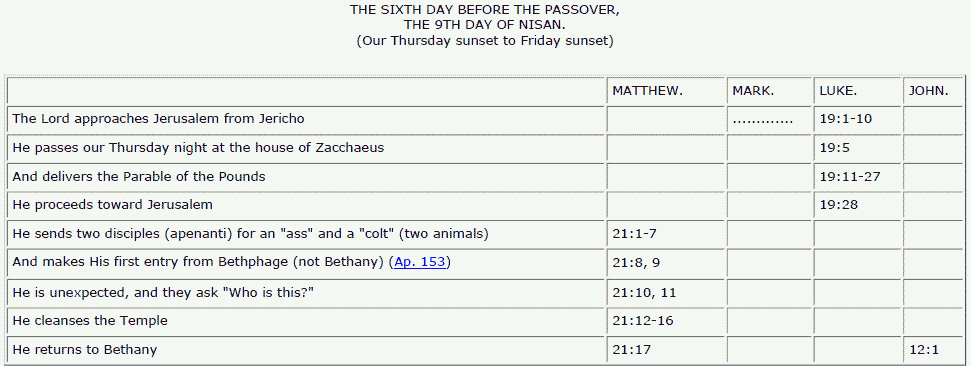
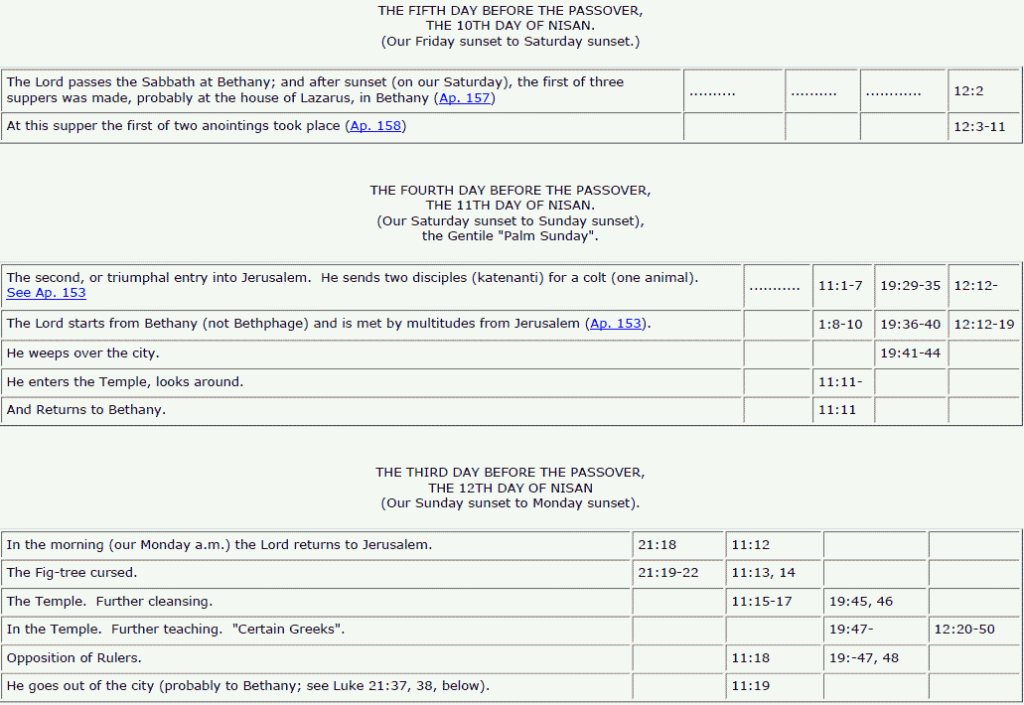
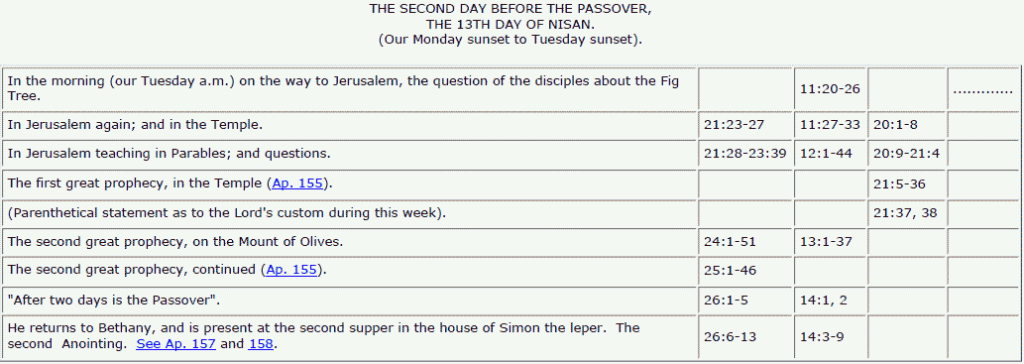
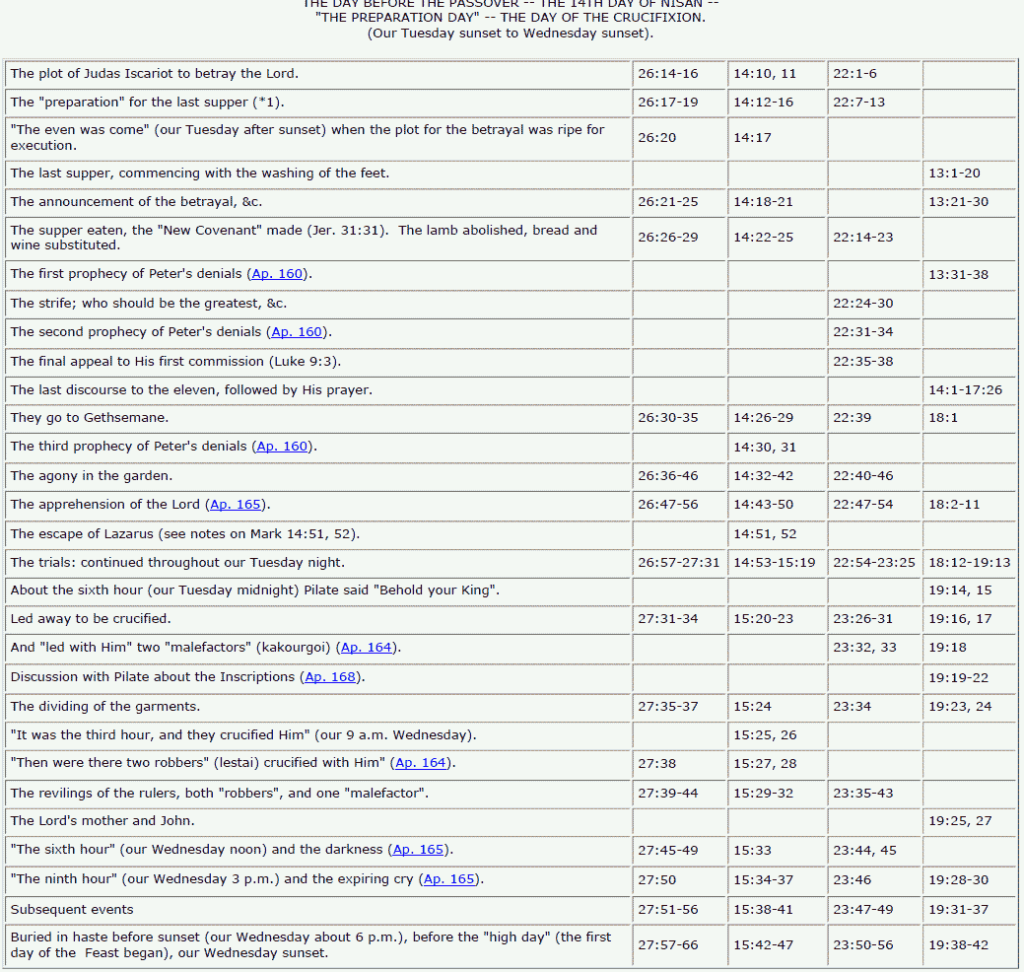
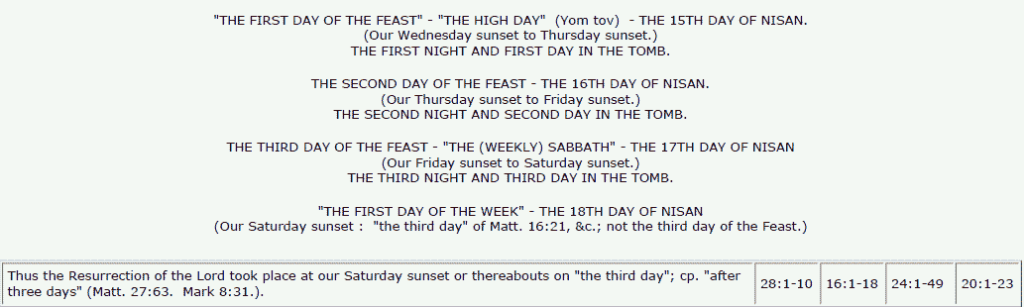
[For the sequence of events connected with and following the Resurrection, see Ap. 166.]
It will be seen from the above that we have neither power nor authority to alter or shift any day or date; or to change the order or position of any of the events recorded in the Holy Writ. Each day is
marked by a return to Bethany during the last week (up to the Preparation Day); and each day is filled with the recorded events.
It follows, therefore, that the Lord was crucified on our Wednesday; was buried on that day before sunset; and remained “three days and three nights” in the tomb, as foretold by Him in Mt 12:40; rising
from the dead on “the third day”, “the first day of the week”. The fixed days and dates, at either end, hold the whole period as in a vice, and place the whole subject on a sure foundation.
(*1) The words in Mk 14:12 and Lk 22:7 refer to “the first day of unleavened bread”, which was the 14 th day of Nisan, and therefore “the preparation day”. That is why the Lord goes on to tell
the two disciples to go and make preparation for the Passover.
Appendix 157
THE THREE SUPPERS.
That there were three suppers, and not only two, at the close of our Lord’s ministry will be clear from a careful comparison of the three Scriptures.
1. There was the supper recorded in Jn 12:1-9. This was probably in the house of Lazarus (*1), and, being “six days before the Passover”, must have taken place on the Friday evening, on the Lord’s
return from His first entry into Jerusalem from Bethphage (see Ap. 153).
Having slept there on the Friday night and spent the last Sabbath in retirement there, this first supper was made after the Sabbath had ended at 6 p.m. At this supper there was an anointing of the Lord
by Mary (see Ap. 158).
2. The second supper, recorded in Mt 26:6-13, took place “two days before the Passover” at the house of Simon the leper, which was also in Bethany. See Mk 14:1-9. At this supper there was also an
anointing by a woman unknown (See Ap. 158).
3. The supper recorded in Jn 13:1-20 is the same as that recorded in Mt 26:20, Mk 14:17, and Lk 22:14. It was “the last supper”, “the hour was come”, and when supper was begun, or going on (not
“ended”; see note on John 13:2), the Lord first washed the disciples’ feet; and later, the events took place as recorded in all four Gospels. John’s Gospel adds some antecedents; but gives the same
consequence.
The rendering of genomenou in Jn 13:2, by “ended” instead of by “taking place”, or “beginning”, has been the cause of much confusion.
(*1) For all the family were present; and “Martha served” (cp. Lk 10:40-42).
Appendix 158
THE TWO ANOINTINGS.
There can be no doubt that, during the last week, the Lord was anointed on two separate occasions.
1. The former is recorded in Jn 12:3-8, “six days before the Passover”, in the house of Lazarus, at Bethany. (see Ap. 157, and note above). The latter is recorded in Mt 26:7-13, and Mk 14:3-9, “two days before the Passover”, in the house of Simon the leper, also in Bethany. Thus the times and places distinct.
2. In the former case it was “a pound of ointment” that was used (Jn 12:3). In the latter case it was an alabaster vessel (Mt 26:7).
3. In the former case it was “the feet” of the Lord that were anointed (Jn 21:3). In the latter case it was His “head” (Mt 26:7)
4. In the former case the term used is “anointed” (Jn 12:3). In the latter case the term is “poured” (Mt 26:7. Mk 14:3)
5. In the former case it was Judas who asked the question why it was not sold, &c., as there was plenty of time to do so during the six days (Jn 12:4). In the latter it was the disciples who “had indignation” (Mt 26:8) “among themselves” (Mk 14:4); and their words (not necessarily spoken aloud to all) seem to refer to what Judas had said before.
6. In the former the Lord directs the ointment to be reserved for His burial; and not sold (Jn 12:4). In the latter He declared that it had been kept for that purpose (Mt 26:12. Mk 14:8)
7. In the former case the Lord said, “Let her alone,” in order that she may keep it (Jn 12:7). In the latter He declared that she had well used it (Mt 26:10-13).
8. In the former case the woman is named “Mary” (Jn 21:3). In the latter case the woman is unnamed.
9. Thus on each occasion both the antecedents and consequence are different. Instead of wondering that there should be two anointings the wonder should be that there were only two, seeing that examples are so easily followed.
Appendix 159 “THIS IS MY BODY” (Mt 26:26).
A figure of speech consists of a word of words used out of the ordinary sense, or order; just as we call a person dressed out of the ordinary manner or fashion a “figure”: both attract our attention; and, in the case of words, the one and only object is in order to call a reader’s attention to what is thus emphasized. For examples see the notes on Matt 16:6; where, had the Lord said “the doctrine of the Pharisees is like leaven”, that would have been the Fig. Simile (Ap. 6). Had He said “the doctrine of the Pharisees is leaven”, the Fig. in this case would have been Metaphor (Ap. 6); by which, instead of saying one thing is like another, it is carried over (as the word Metaphor means), and states that the one thing is the other.
But in Mt 16:6, the Lord used another Figure altogether, viz. Hypocatastasis (from hupo = under (Ap. 104. xviii), kata = down (Ap. 104. x), and stasis = a stationing), which means putting one of the two words (which are necessary in the case of Simile and Metaphor) down underneath, i.e. out of sight, and thus implying it. He said, “beware of the leaven”, thus implying the word “doctrine”, which He really meant; and, by thus attracting the disciples’ attention to His words, thereby emphasized them.
In these three Figures we have a Positive, Comparative, and Superlative emphasis. The essence of Simile is resemblance; the essence of Metaphor is representation (as in the case of a portrait, which is representation of some person); the essence of Hypocatastasis is implication, where only one word is mentioned and another is implied. Through non-acquaintance with Figures of Speech every Figure is to-day called a “Metaphor”. But this is not the case. A Metaphor is a special Figure different and distinct from all others.
“This is My body” is the Figure Metaphor; and the Figure lies in the Verb “IS”, which, as in this case always means “represents”, and must always be so expressed. It can never mean “is changed into”. Hence in the Figure Metaphor, the Verb “represents” can always be substituted for “is”. For example:
· “The field is (or represents) the world” (Mt 13:38).
· “The good seed are (represent) the sons of the kingdom” (Mt 13:38).
· “The reapers are (represent) angels” (Mt 13:39).
· “The odors are (represent) the prayers of the saints” (Rv 5:8).
· “The seven heads are (represent) seven mountains” (Rv 17:9).
· “This cup is (represents) the new covenant” (1 Co 11:25).
· “The cup of blessing which we bless, is it not (does it not represent) the blood of Christ?” (1 Co 10:16).
Furthermore, it is a fundamental law in Greek grammar, without exception, that the Article, Pronoun, and Adjective must agree in gender with the Noun to which they refer. For example, in Mt 16:18, the Pronoun “this” is Feminine, and thus agrees with petra, which is also Feminine, and not with petros (Peter) which is Masculine. See note, and Ap. 147.
So here: the Pronoun “this” is Neuter, and cannot agree with artos ( = bread) because artos is Masculine. It must refer to what is Neuter; and this could only be the whole act of breaking the bread, which would be Neuter also; or to klasma, the broken piece (which is also Neuter). In like manner, when He said (in v. 28) “this is my blood of the New Covenant”; “this”, being Neuter, refers to poterion ( = cup) (*1) and not to oinos ( = wine), which is Masculine, and means :– “This [cup] represents My blood of the New Covenant, which is poured out for many, for remission of sins”.
For, what was the Lord doing? He was making the New Covenant foretold in Jer 31:31-34. If it were not made then, it can never be made at all (see Ap. 95), for no more has He blood to shed (Lk 24:39). Now, “blood” was shed, and sacrificially used, only in connection with two things, making of a covenant, and the making of atonement. In the former, the victim which made or ratified the covenant was slain and the body divided in two, the parties to the covenant passing between (see notes on Gen 15:9-18. Jer 34:18. Gal 3:20. and Ap. 95). As long as the victim (the covenant maker) was alive the covenant could have no force. See notes on Heb 9:16-22.
At the last supper this New Covenant was made; and Peter’s proclamation in Ac 2:38; 3:19-26; 5:31; and Paul’s in 13:38; 17:30; 20:21; 26:20; were based upon it. Messiah had to be “cut off”, that the Scriptures might be fulfilled (Ac 3:18). But that having been accomplished, and the sufferings having been endured, nothing stood in the way of the glory which should follow. “Repent ye THEREFORE and turn [to the Lord] that your sins may be blotted out”, &c. The New Covenant which had been made had provided for that, as the Lord had said in Mt 26:28, “for the remission of sins”.
In that last supper the Lord was not instituting anything with a view to the Secret (the “Mystery” to be yet revealed in the Prison Epistles); but was substituting bread and wine for the Paschal Lamb (the type being exhausted in the Antitype), because of the new meaning which the Passover should henceforth convey. It was to be the Memorial, not of the Exodus from Egypt, but of the Exodus which the Lord afterward accomplished in Jerusalem (Lk 9:31), according to the New Covenant made by His death.
(*1) Poterion being put by Metonymy (of Adjunct), Ap. 6, for the contents, for the “cup” itself could not be swallowed.
Appendix 160 THE DENIALS OF PETER.
There are several facts that have to be noticed before we can arrive at a clear understanding of all the denials recorded by Peter by the four evangelists:—
I. We have to note that the fact that Peter would deny His Lord was foretold in three distinct prophecies uttered on three separate occasions and differing both as to the occasion and as to particulars.
1. The first was in the upper chamber, recorded in Jn 13:38. It was absolute as to the fact, general as to the day, but particular as to the number of denials: “a cock shall by no means crow [from this time forth] until thou hast denied Me thrice” (see Ap. 156).
2. The second was in the upper chamber, recorded by Lk 22:34. It was after the “strife”, and immediately before leaving the room. It was absolute as to the fact but particular as to the day and the number of denials: “a cock shall not crow this day, before thou wilt thrice deny that thou knowest Me” (see Ap. 156).
3. The third was after the Lord had left the city and immediately before entering the garden of Gethsemane. It is recorded in Mk 14:30, and was particular in every detail: “Verily I say unto thee that (hoti) thou (added by all the texts) this day, in this night, before a cock crow twice, thrice thou wilt deny Me”. Cp. the fulfillment, and see Ap. 156.
This last prophecy furnishes the key to the whole problem. For, note: –
a. that a cock was to crow twice, andb. that Peter would deny thrice;
i.e. before each of the two cockcrowings Peter would thrice deny His Lord. This is confirmed by the repetition in the fulfillment (Mk 14:72). Thus, there would be six denials in all; three before each cockcrowing. Note that the word “cock” has no Article in any of the four records: in each case it is not “the”, but “a cockcrowing”.
II. Consonant with these data, we have the remarkable fact that Matthew, Luke and John each record three denials, and one concluding cockcrowing. Mark also records three denials, but mentions the two cockcrowings. Consequently, in the four Gospels there are no less than twelve denials mentioned. And the questions are, which of these are duplicates, and which are the resulting six required by the Lord’s third prophecy in Mk 14:30?
III. If we note accurately the marks of time in each Gospel, the place and the persons addressing Peter, every condition required by each of the Greek words employed is fully and perfectly satisfied, without a shadow or suggestion of “discrepancy”.
i. The First Series of Three.
1. The First Denial, Jn 18:17. Place: the door (thura) without. Time: entering. The questioner: the porteress (Gr. thuroros).
2. The Second Denial, Mt 26:70 (Mk 14:68). Place: the hall (aule). Time: sitting. Questioner: a certain maid. Lk 22:56-58 combines the same place and time, with the same maid, and another (heteros, masc.).
3. The Third Denial, Mt 26:71. Place: the gateway or porch (pulon). Time: an interval of an hour. Jn 18:25,26 combines the same place and time, with another maid and bystanders, one of them being a relative of Malchus.
A COCK CREW. (Mk 14:68. Jn 18:27)
ii. The Second Series of Three.
1. The First Denial, Mk 14:63. Place: “beneath in the hall”. Time: shortly after. Questioner: the maid again.
2. The Second Denial, Mt 26:73 (Mk 14:70). Place: the gate (pulon). Time: shortly after. Questioners: the bystanders.
3. The Third Denial (Lk 22:59,60). Place: the midst of the hall (aule; v. 55). Time: “an hour after” (v. 59). Questioner: a certain one (masc.).
A COCK CREW. (Mt 26:74. Mk 14:72. Lk 22:61)
IV. We thus have a combined record in which there remains no difficulty, while each word retains its own true grammatical sense.
Appendix 161
THE PURCHASE OF “THE POTTER’S FIELD” (Mt 27:6-8 and Ac 1:18,19) AND THE FULFILLMENT OF THE PROPHECY (Mt 27:9,10)
There are two difficulties connected with these scriptures:
I. The two purchases recorded in Mt 27:6-8, and Ac 1:18,19, respectively; and
II. The fulfillment of the prophecy connected with the former purchase (Mt 27:9,10).
I. THE TWO PURCHASES.
For there were two. One by “the chief priests”, recorded in Mt 27:6; and the other by Judas Iscariot recorded in Ac 1:18. The proofs are as follows: –
1. The purchase of Judas was made some time before that of the chief priests; for there would have been no time to arrange and carry this out between the betrayal and the condemnation. The purchase of the chief priests was made after Judas had returned the money.
2. What the chief priests bought was “a field” (Gr. agros). What Judas had acquired (see 3, below) was what in English we call a “Place” (Gr. chorion = a farm, or small property.) The two are quite distinct, and the difference is preserved both in the Greek text and in the Syriac version (See note 3, p. 136).
3. The verbs also are different. In Mt 27:7 the verb is agorazo = to buy in the open market (from agora = a market place); while in Ac 1:18, the verb is ktaomai = to acquire possession of (See Lk 18:12; 21:19; Ac 22:28), and is rendered “provide” in Mt 10:9. Its noun, ktema = a possession (Occ. Mt 19:22. Mk 10:22. Ac 2:45; 5:1).
4. How and when Judas had become possessed of this “place” we are not told in so many words; but we are left in no doubt, from the plain statement in Jn 12:6 that “he was a thief, and had the bag”. The “place” was bought with this stolen money, “the reward (or wages) of iniquity”. This is a Hebrew idiom (like our Eng. “money ill-got”), used for money obtained by unrighteousness (Ap. 128. VII. 1; cp. Nu 22:7. 2 Pe 2:15). This stolen money is wrongly assumed to be the same as the “thirty pieces of silver”.
5. The two places had different names. The “field” purchased by the chief priests was originally known as “the potter’s field”, but was afterward called “agros haimatos” = the field of blood; i.e. a field bought with the price of blood (“blood” being put by the Fig. Metonymy (of the Subject), Ap. 6, for murder or blood-guiltiness). The “possession” which Judas had acquired bore an Aramaic name, “Hakal dema” (see Ap. 94. (III.) 3, p. 135), which is transliterated Akeldama, or according to some Akeldamach, or Hacheldamach = “place” (Gr. chorion) of blood”: a similar meaning but from a different reason: viz. Judas’ suicide. It is thus shown that there is no discrepancy between Mt 27:58 and Ac 1:18,19.
II. THE FULFILLMENT OF THE PROPHECY. (Mt 27:9,10)
Many solutions have been proposed to meet the two difficulties connected with Mt 27:9,10.
i. As to the first difficulty, the words quoted from Jeremiah are not found in his written prophecy: and it has been suggested
1. That “Matthew quoted from memory” (Augustine and others).
2. That the passage was originally in Jeremiah, but the Jews cut it out (Eusebius and others); though no evidence for this is produced.
3. That it was contained in another writing by Jeremiah, which is now lost (Origen and others).
4. That Jeremiah is put for the whole body of the prophets (Bishop Lightfoot and others), though no such words can be found in the other prophets.
5. That it was “a slip of the pen” on the part of Matthew (Dean Alford).
6. That the mistake was allowed by the Holy Spirit on purpose that we may not trouble ourselves as to who the writers were, but receive all prophecy as direct from God, Who spake by them (Bishop Wordsworth).
7. That some annotator wrote “Jeremiah” in the margin and it “crept” into the text (Smith’s Bible Dictionary).
These suggestions only create difficulties much more grave than the one which they attempt to remove. But all of them are met and answered by the simple fact that Matthew does not say it was written by Jeremiah, but that it was “spoken” by him.
This makes all the difference: for some prophecies were spoken (and not written), some were written (and not spoken), while others were both spoken and written.
Of course, by the Fig. Metonymy (of cause, Ap. 6), one may be said to “say” what he has written; but we need not go out of our way to use this figure, if by so doing we create the very difficulty we are seeking to solve. There is all the difference in the world between to rhethen ( = that which was spoken), and ho gegraptai ( = that which stands written).
ii. As to the second difficulty: that the prophecy attributed to Jeremiah is really written in Zec 11:10-13, it is created by the suggestion contained in the margin of the Authorized Version. That this cannot be the solution may be shown from the following reasons:—
1. Zec 11:10-13 contains no reference either to a “field” or to its purchase. Indeed, the word “field” (shadah) does not occur in the whole of Zechariah except in 10:1, which has nothing to do with the subject at all.
2. As to the “thirty pieces of silver”, Zechariah speaks of them with approval, while in Matthew they are not so spoken of. “A goodly price” (‘eder hayekar) denotes amplitude, sufficiency, while the Verb yakar means to be priced, prized, precious and there is not the slightest evidence that Zechariah spoke of the amount as being paltry, or that the offer of it was, in any sense and insult. But this latter is the sense in Mt 27:9,10.
3. The givers were “the poor of the flock”. This enhanced the value. “The worth of the price” was accepted as “goodly” on that account, as in Mk 12:43,44. 2 Co 8:12.
4. The waiting of “the poor of the flock” was not hostile, but friendly, as in Pr 27:18. Out of above 450 occurrences of the Heb. shamar, less than fourteen are in a hostile sense.
5. In the disposal of the silver, the sense of the Verb “cast” is to be determined by the context (not by the Verb itself). In Zec 11, the context shows it to be in a good sense, as in Ex 15:25. 1 Ki 19:19. 2 Ki 2:21; 4:41; 6:6. 2 Ch 24:10,11.
6. The “potter” is the fashioner and his work was not necessarily confined to fashioning “clay”, but it extended to metals. Cp. Ge 2:7,8. Ps 33:15; 94:9. Isa 43:1,6,10,21; 44:2,9-12,21,24; 45:6,7; 54:16,17. Out of the sixty-two occurrences of the Verb (yazar), more than three-fouths have nothing whatever to do with the work of a “potter”
7. A “potter” in connection with the Temple, or its service, is unknown to fact, or to Scriptures.
8. The material, “silver”, would be useless to a “potter” but necessary to a fashioner of metallic vessels, or for the payment of artizans who wrought them (2 Ki 12:11-16; 22:4-7. 2 Ch 24:11-13). One might as well cast clay to a silversmith as silver to a potter.
9. The prophecy of Zechariah is rich in reference to metals; and only the books of Numbers (31:22) and Ezekiel name as many. In Zechariah we find six named: Gold, six times (4:2, 12; 6:11; 13:9; 14:14). Fine gold, once (9:3). Silver, six times, (6:11; 9:3; 11:12, 13; 13:9; 14:14). Brass, once (6:1, marg.). Lead, twice (5:7, 8). Tin, once (4:10, marg.). Seventeen references in all.
10. Zechariah is full of refs to what the prophet saw and said but there are only two refs. to what he did; and both of these have references to “silver” (6:11; 11:13).
11. The Septuagint, and its revision by Symmachus, read “cast them (i.e. the thirty pieces of silver) into the furnace (Gr. eis to choneuterion), showing that, before Matthew was written, yotzer was interpreted as referring not to a “potter” but to a fashioner of metals.
12. The persons are also different. In Matthew we have “they took”, “they gave”, “the price of him”; in Zechariah we read “I took”, “I cast”, “I was valued”.
13. In Matthew the money was given “for the field”, and in Zechariah it was cast “unto the fashioner”
14. Matthew names three parties as being concerned in the transaction; Zechariah names only one.
15. Matthew not only quotes Jeremiah’s spoken words, but names him as the speaker. This is in keeping with Mt 2:17,18. Jeremiah is likewise named in Mt 16:14; but nowhere else in all the New Test.
iii. The conclusion. From all this we gather that the passage in Matthew (27:9, 10) cannot have any reference to Zec 11:10-13.
1. If Jeremiah’s spoken words have anything to do with what is recorded in Jer 32:6-9,43,44, then in the reference to them other words are interjected by way of parenthetical explanation. These are not to be confused with the quoted words. They may be combined thus: –
“Then was fulfilled that which was SPOKEN by Jeremiah the prophet saying; ‘And they took the thirty pieces of silver [the price of him who was priced, whom they of the sons of Israel did price], and they gave them for the potter’s field, as the LORD appointed me.'”
Thus Matthew quotes that which was “SPOKEN” by Jeremiah the prophet and combines with the actual quotation a parenthetical reference to the price at which the prophet Zechariah had been priced.
2. Had the sum of money been twenty pieces of silver instead of thirty, a similar remark might well have been interjected thus: -“Then was fulfilled that which was SPOKEN by Jeremiah the prophet saying; ‘And they took the twenty pieces of silver [the price of him whom his brethren sold into Egypt], and they gave them for the potter’s field'”, &c.
3. Or, had the reference been to the compensation for an injury done to another man’s servant, as in Ex 21:32, a similar parenthetical remark might have been introduced thus: –
“Then was fulfilled that which was SPOKEN by Jeremiah the prophet, saying: ‘And they took the thirty pieces of silver [the price given in Israel to the master whose servant had been injured by an ox], and they gave them for the potter’s field'”, &c.
A designed parenthetical insertion by the inspired Evangelist of a reference to Zechariah, in a direct quotation from the prophet Jeremiah, is very different from a “mistake” or “a slip of the pen”, “a lapse of memory” or a “corruption of the text”, which need an apology. The quotation itself, as well as the parenthetical reference are both similarly exact.
Appendix 162
THE CROSS AND THE CRUCIFIXION
In the Greek N.T. two words are used for “the cross”, on which the Lord was put to death.
1. The word stauros; which denotes and upright pale or stake, to which the criminals were nailed for execution.
2. The word xulon, which generally denotes a piece of a dead log of wood or timber, for fuel or for any other purpose. It is not like dendron, which is used of a living, or green tree, as in Mt 21:8. Rv 7:1,3; 8:7; 9:4, &c.
As this latter word xulon is used for the former stauros, it shows us that the meaning of each is exactly the same. The verb stauros means to drive stakes (*1). Our English word “cross” is the translation of the Latin crux; but the Greek stauros no more means a crux than the word “stick” means a “crutch”. Homer uses the word stauros of an ordinary pole or stake, or a single piece of timber (*2). And this is the meaning and usage of the word throughout the Greek classics (*3).
It never means two pieces of timber placed across one another at any angle, but always of one piece alone. Hence the use of the word xulon (No. 2, above) in connection with the manner of our Lord’s death, and rendered “tree” in Ac 5:30; 10:39; 13:29. Gal 3:13. 1 Pe 2:24. This is preserved in our old Eng. name rood, or rod. See the Encycl. Brit., 11 th (Camb.) ed., vol. 7, p. 505 d.
There is nothing in the Greek of the N.T. even to imply two pieces of timber.

The evidence is the same as to the pre-Christian (phallic) symbol in Asia, Africa, and Egypt, whether we consult Nineveh by Sir A. H. Layard (ii. 213), or Manners and Customs of the Ancient Egyptians, by Sir J. Gardner Wilkinson, iii. pp. 24, 26, 43, 44, 46, 52, 82, 136. Dr Schliemann gives the same evidence in his Ilios (1880), recording his discoveries on the site of prehistoric Troy. See pp. 337 ,350, 353, 521, 523. Dr Max Ohnefalsch-Richter gives the same evidence from Cyprus; and these are “the oldest extant Phoenician inscriptions”; see his Kypos, the Bible, and Homer: Oriental Civilization, Art, and Religion in Ancient Times, Plates XIX, XXV, XXVI, XXX, XXXI, XXXII, XL, LVIII, LXIX, &c.
The Catacombs in Rome bear the same testimony: “Christ” is never represented there as “hanging on a cross”, and the cross itself is only portrayed in a veiled and hesitating manner. In the Egyptian churches the cross was a pagan symbol of life, borrowed by the Christians, and interpreted in the pagan manner. See the Encycl. Brit. 11 th (Camb.) ed., vol. 14, p. 273. In his Letters from Rome Dean Burgon says: “I question whether a cross occurs on any Christian monument of the first four centuries”.
In Mrs. Jameson’s famous History of our Lord as Exemplified in Works of Art, she says (vol. ii. p. 315): “It must be owned that ancient objects of art, as far as hitherto known, afford no corroboration of the use of the cross in the simple transverse form familiar to us, at any period preceding, or even closely succeeding, the time of Chrysostom”; and Chrysostom wrote half a century after Constantine!
“The Invention of the Cross” by Helena the mother of Constantine (in 326), though it means her finding of the cross, may or may not be true; but the “invention” of it in pre-Christian times, and the “invention” of its use in later times, are truths of which we need to be reminded in the present day. The evidence is thus complete, that the Lord was put to death upon an upright stake, and not on two pieces of timber placed at any angle.
(*1) There are two compounds of it used: sustauroo = to put any one thus to death with another (Mt 27:44. Mk 15:32. Jn 19:32. Ro 6:6. Gal 2:20); and anastauroo = to raise up and fix upon the stake again (Heb 6:6). Another word used is equally significant: porspegnumi = to fix or fasten anything (Ac 2:23).
(*2) Iliad xxiv. 453. Odyssey xiv. 11. (*3) e.g. Thucydides iv. 90. Xenophon, Anabasis v. 2. 21. (*4) Other coins with this symbol were struck by Augustus, also by Hadrian and other Roman emperors. See Early Christian Numismatics, by C. W. King, M.A.
Appendix 163
THE INSCRIPTIONS ON THE CROSS
Each of the four Gospels gives a different wording of these inscriptions:
1. Mt 27:37: “This is Jesus, the King of the Jews.”
2. Mk 15:26: “The King of the Jews”
3. Lk 23:28: “This is the King of the Jews.”
4. Jn 19:19: “Jesus of Nazareth, the King of the Jews.”
Here again the difficulty is created by assuming that these similar but differing records are identical, without noticing the exact words which are written. It is universally assumed that there was only one, and then follow the efforts to explain the alleged “discrepancies” between the different versions of it.
If we note carefully what is actually said all will be clear.
I. Mk 15:26 can be dismissed; for he does not say anything about a “title” (Gr. titlos, Jn 19:19) being put on the cross or anywhere else, which any one had seen. It is a question of the Lord’s “accusation” or “indictment”, or the ground or cause of His condemnation as claiming to be “the King of the Jews”.
II. Jn 19:19 speaks of a “title” written by Pilate, before it left Pilate’s presence; for no one suggests that Pilate went to the scene of the execution and wrote anything there. In Pilate’s writing the three languages were in this order: (1) Hebrew (2) Greek and (3) Latin (cp. IV. below). And it was read after the cross had been set up. This was one which gave rise to the argument between the Chief Priests and Pilate (Jn 19:21,22); and this argument took place before the parting of the garments (vv 23, 24).
III. The inscription in Mt 27:37 was the result of that discussion; for another “title” was brought and was “set up over his head”, after they had “parted His garments”, and having sat down, they watched Him there (vv. 35, 36). As there could hardly have been two titles at the same time, the former must have been then taken down and the other substituted. We are not told how long the argument lasted or when it ceased, or what was the final result of it.
IV. A further result is seen in Lk 23:38; for another was brought much later, close upon “the sixth hour” (v. 44), when the darkness fell. It was written with the languages in a different order: (1) Greek (2) Latin, and (3) Hebrew (v. 38). (But see the texts.) It was put up “over Him” (Gr. ep’ auto, v. 38), “after the revilings of the People” (cp. vv. 35-37, with v. 38); whereas Matthew’s (No. III) was set up before the revilings (cp. Mt 27:37 with v. 39).
The result is that: –
1. Mark’s was only His indictment.
2. John’s was the first written by Pilate himself (or by his order), in (1) Hebrew, (2) Greek, and (3) Latin, and was put on the cross before it left Pilate’s presence.
3. Matthew’s was the second, substituted for the first, in consequence of the arguments which took place, and was set up “over His head” after the garments had been divided, and before the revilings.
4. Luke’s was the third (and last), put up “over Him”, after the revilings (Lk 23:35), and was seen just before the darkness of the “sixth hour” (v. 41). This was written in three languages, but in a different order: (1) Greek, (2) Latin, and (3) Hebrew (v. 38). Not in Hebrew, and Greek, and Latin as in No. II in Jn 19:19.
Thus, such differences as these are marks of Divine accuracy; and instead of being sources of difficulties, become, when rightly divided, the means of their removal.
Appendix 164
THE “OTHERS” CRUCIFIED WITH THE LORD (Mt 27:38 and Lk 23:32).
Mislead by tradition and the ignorance of Scripture on the part of medieval painters, it is the general belief that only two were crucified with the Lord. But Scripture does not say so. It states that there were two “thieves” (Gr. lestai = robbers, Mt 27:38. Mk 15:27); and that there were two “malefactors” (Gr. kakouryoi, Lk 23:32).
It is also recorded that both the robbers reviled Him (Mt 27:44. Mk 15:32); while in Lk 23:39 only one of the malefactors “railed on Him”, and “the other rebuked him” for so doing (v. 40). If there were only two, this is a real discrepancy; and there is another, for the two malefactors were “led with Him to be put to death” (Lk 23:32), and when they were come to Calvary, “they” then and there “crucified Him and the malefactors, one on the right hand and the other on the left” (v. 33).
But the other discrepancy is according to Matthew, that after the parting of the garments, and after “sitting down they watched Him there”, that “THEN” were there two robbers crucified with Him, one on the right hand and the other on the left” (Mt 27:38. Mk 15:27). The two malefactors had already been “led with Him” and were therefore crucified “with Him”, and before the two robbers were brought.
The first two (malefactors) who were “led with Him” were placed one on either side. When the other two (robbers) were brought, much later, they were also similarly placed; so that there were two (one of each) on either side, and the Lord in the midst. The malefactors were therefore the nearer, and being on the inside they could speak to each other better, and the one with the Lord, as recorded (Lk 23:39-43).
John’s record confirms this, for he speaks only of place, and not of time. He speaks, generally of the fact: “where they crucified Him, and with Him others, two on this side, and that side, and Jesus in the midst” (Jn 19:8). In Rv 22:2 we have the same expression in the Greek (enteuthen kai enteuthen), which is accurately rendered “on either side”. So it should be rendered here: “and with Him others, on either side”.
But John further states (19:32, 33): “then came the soldiers and brake the legs of the first, and of the other which was crucified with Him. But when they came (Gr. = having come) to Jesus, and saw that He was dead already, they brake not His legs.” Had there been only two (one on either side) the soldiers would not have come to the Lord, but would have passed Him, and then turned back again. But they came to Him after they had broken the legs of the first two.
There are two words used of the “other” and “others” in Jn 19:32 and Lk 23:32 (See Ap. 124. 1). In the former passage we read, “they brake the legs of the first and of the other.” Here the Greek is allos which is the other (the second) of the two when there are more (see Mt 10:23; 25:16,17,20; 27:61; 28:1. Jn 18:15,16; 20:2,4,8. and Rv 17:10).
In the latter passage (Lk 23:32) the word is heteros = different (See Ap. 124. 2): “and others also, two were being led with Him.” These were different (*1) from Him with Whom they were led, not different from one another; for they were “in the same condemnation”, and “justly”, while He had “done nothing amiss” (vv. 40, 41).
From this evidence, therefore, it is clear that there were four “others” crucified with the Lord; and thus, on the one hand, there are no “discrepancies”, as alleged; while, on the other hand, every word and every expression, in the Greek, gets (and gives) its own exact value, and its full significance.
To show that we are not without evidence, even from tradition, we may state that there is a “Calvary” to be seen at Ploubezere near Lannion, in the Cotes-du-Nord, Brittany, known as Les Cinq Croix (“The Five Crosses”). There is a high cross in the center, with four lower ones, two on either side. There may be other instances of which we have not heard.
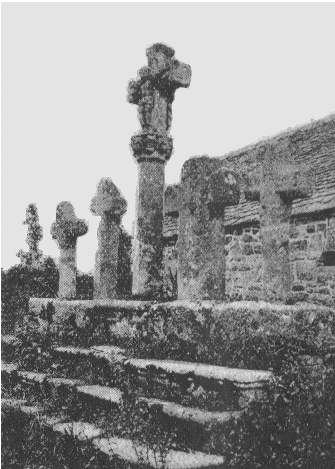
“In the Roman Catholic church … the altar slab or “table” alone is consecrated, and in sign of this are cut in its upper surface five Greek crosses, one in the center and one in each corner … but the history of the origin and development of this practice is not fully worked out” (Encycl. Brit., 11 th (Cambridge) ed., vol. i, pp. 762, 763). This practice may possibly be explained by the subject of this Appendix.
(*1) Cp. Mt 6:21,24; 8:21; 11:3. Lk 5:7; 6:6; 7:41; 9:56; 14:31; 16:13,18; 17:34,35; 18:10; 23:40.
Appendix 165
THE HOURS OF THE LORD’S LAST DAY
The Diagram below shows the 24 hours of the “Preparation Day”, i.e. the day before the Passover (Jn 19:14, &c.). The Four Gospels agree in stating that the Lord was laid in the Sepulcher on the Preparation Day, which was Nisan 14 th, immediately before “the High Sabbath”, Nisan 15 th (Mt 27:62. Mk 15:42. Lk 23:54. Jn 19:31,42). Therefore He must have been crucified on Wednesday, 14 th of Nisan (see Ap. 144, 156, 166).
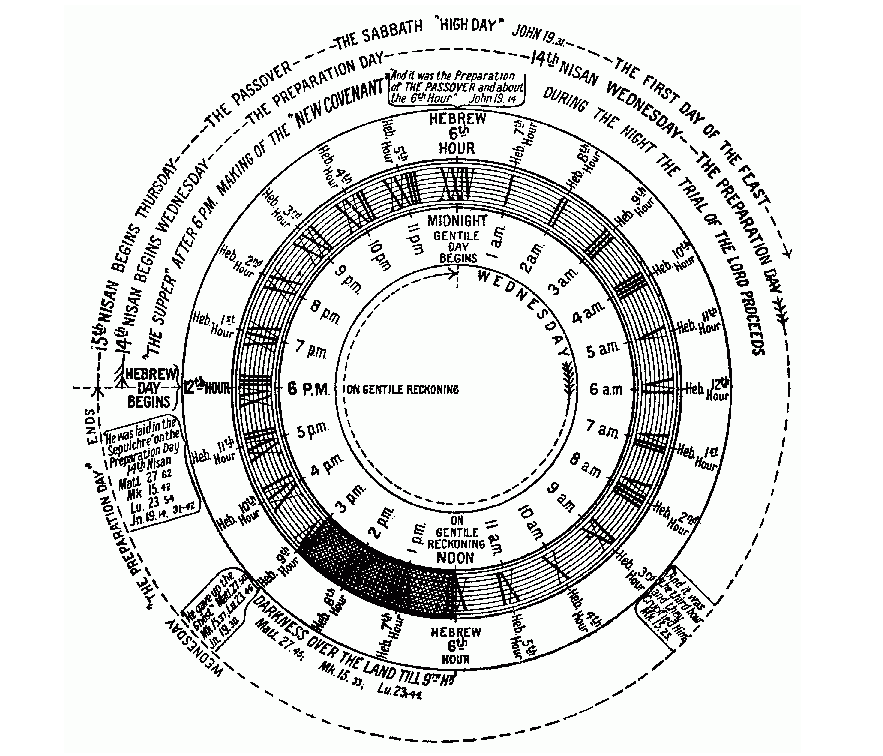
As shown above, the 14 th of Nisan, which was the “Preparation Day”, began at sunset on our Tuesday (Gentile reckoning). “The sixth hour” of Jn 19:14 is the sixth hour of the night, and therefore
corresponds to midnight, at which, according to Gentile reckoning, Wednesday began.
The Roman numerals on the dial plate show the 24 hours of the complete Gentile day. And on either side of the dial are shown the Hebrew “hours” corresponding to the Gentile hours a.m. and p.m.
The twenty-four hours were divided into the twelve hours of the night (reckoned from sunset), and “twelve hours in the day” (reckoned from sunrise. See Jn 11:9). Hence “the sixth hour” of Jn 19:14
was our midnight; “the third hour” of Mk 15:25 was our 9 a.m.; “the sixth hour” of Mt 27:45; Mk 15:33; Lk 23:44; was our noon and the “ninth hour” of Mt 27:45,46; Mk 15:33.34; Lk 23:44; was our 3 p.m.
Appendix 166
THE SEQUENCE OF EVENTS FOLLOWING THE LORD’S RESURRECTION
The order of these events in the Four Gospels is partly independent and partly supplementary, taking up the narrative at different points of time. They may be set out as follows:—
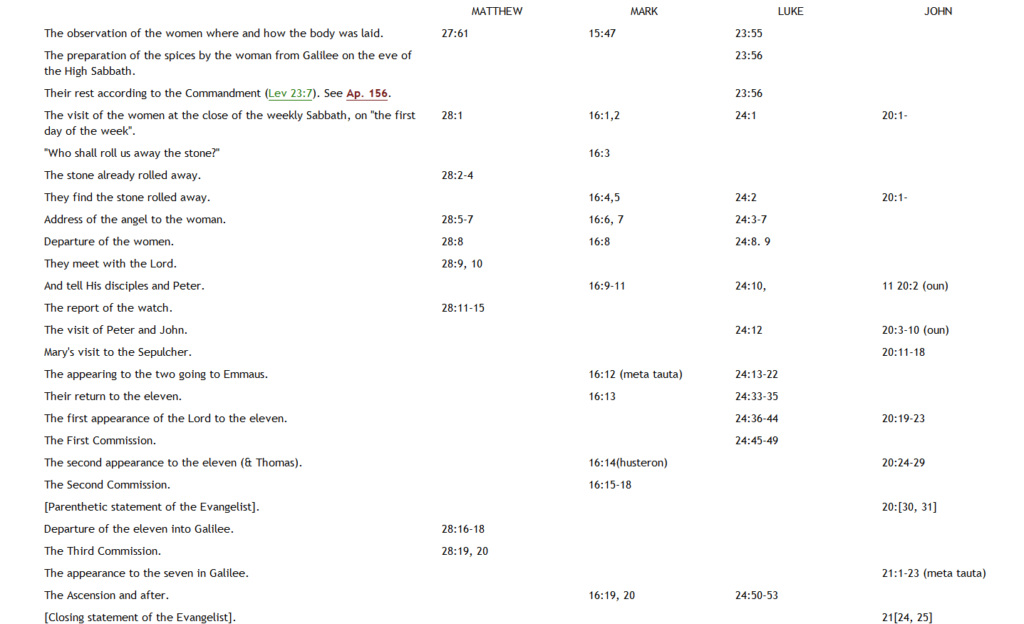
Appendix 167
THE THREE COMMISSIONS
It will be seen from Ap. 166 that there were three separate Commissions given to the Eleven Apostles, at different times, on distinctly specified occasions and in varying words.
The first is recorded in Lk 24:47. This was given in Jerusalem on the evening of the day of the resurrection. It was given, not to the Eleven only, but also to “them that were with them.” (v. 33). The
commission was the continuation of His own ministry and that of John the Baptist (Mt 22:1-10). They were all to proclaim “repentance and remission of sins”. The New Covenant had been made, in virtue of
which this message of pardon could be declared. (Mt 26:26
29. Mk 14:22-25. Lk 22:14-23. Ac 3:19), first in Jerusalem, and then to all nations. This was done by Peter (Ac 2:38; 3:19, &c.).
The second is recorded in Mk 16:15-18, and was given when the Lord appeared to the Eleven as they sat at meat; and it was carried out by “them that heard Him”, as foretold in Mt 22:4-7, and fulfilled in
Mk 16:20, as confirmed in Heb 2:3,4. The Acts of the Apostles is the inspired history of the fulfillment of this commission, so far as it is necessary for our instruction. It was given for the personal ministry
of the Apostles, to be fulfilled by them before the destruction of the Temple and of Jerusalem.
The third is recorded in Mt 28:19,20, and was given on a mountain in Galilee (Ap. 169). It was the proclamation of the King, who had left Jerusalem, according to the Parable (Lk 19:12), until He returns
in power to set up His kingdom (26:64). It is the summons to the Gentile nations to submit to the Lord Jesus, as the King of Israel, according to Ps 2:10-12. It is the proclamation of “the Gospel of the
Kingdom” (Ap. 140. II) for a witness to all nations, immediately before the end of the age (Mt 24:14. Rv 14:6). It is still wholly future in its application, and proclaims the judgment on the Gentiles for the
final deliverance of Israel, according to Ps 2:9, when verse 6 shall be fulfilled.
Appendix 168
THE LAST TWELVE VERSES OF MARK’S GOSPEL.
Most modern critics are agreed that the last twelve verses of Mk 16 are not an integral part of his Gospel. The are omitted by T [A]; not by the Syr. Ap. 94. V.
I. As To MANUSCRIPTS, there are none older than the fourth century, and the oldest two uncial MSS. (B and a, see Ap. 94. V.) are without those twelve verses. Of all the others (consisting of some
eighteen uncials and some six hundred cursive MSS. which contain the Gospel of Mark) there is not one which leaves out these twelve verses.
II. As to the Versions:—
1. THE SYRIAC. The oldest is the Syriac in its various forms: the “Peshitto” (cent. 2), and the “Curetonian Syriac” (cent. 3). Both are older than any Greek MS. in existence, and both contain these
twelve verses. So with the “Philoxenian” (cent. 5) and the “Jerusalem” (cent. 5). See note (*3) on page 136 Ap. 94.
2. THE LATIN VERSIONS. JEROME (A.D. 382), who had access to Greek MSS. older than any now extant, includes these twelve verses; but this Version (known as the Vulgate) was only a revision of
the VETUS ITALA, which is believed to belong to cent. 2, and contains these verses.
3. THE GOTHIC VERSION (A.D. 350) contains them.
4. THE EGYPTIAN VERSIONS: the Memphitic (or Lower Egyptian, less properly called “COPTIC”), belonging to cent. 4 or 5, contains them; as does the “THEBAIC” (or Upper Egyptian, less properly
called the “SAHIDIC”), belonging to cent. 3.
5. THE ARMENIAN (cent. 5), the ETHIOPIC (cent. 4-7), and the GEORGIAN (cent. 6) also bear witness to the genuineness of these verses.
III. THE FATHERS. Whatever may be their value (or otherwise )as to doctrine and interpretation yet, in determining actual words or their form, or sequence their evidence, even by an allusion, as to
whether a verse or verses existed or not in their day, is more valuable than even manuscripts or Versions. There are nearly a hundred ecclesiastical writers older than the oldest of our Greek codices; while
between A.D. 300 and A.D. 600 there are about two hundred more, and they all refer to these twelve verses.
· PAPIAS (about A.D. 100) refers to v. 18 (as stated by Eusebius, Hist. Ecc. iii. 39).
· JUSTIN MARTYR (A.D. 151) quotes v. 20 (Apol. I. c. 45).
· IRENAEUS (A.D. 180) quotes and remarks on v. 19 (Adv. Haer. lib. iii. c. x.).
· HIPPOLYTUS (A.D. 190-227) quotes vv. 17-19 (Lagarde’s ed., 1858, 74).
· VINCENTIUS (A.D. 256) quoted two verses at the seventh Council of Carthage, held under CYPRIAN.
· The ACTA PILATI (cent. 2) quotes vv. 15, 16, 17, 18 (Tischendorf’s ed., 1852, pp. 243, 351).
· The APOSTOLICAL CONSTITUTIONS (cent. 3 or 4) quotes vv. 16, 17,
18.
· EUSEBIUS (A.D. 325) discusses these verses, as quoted by MARINUS from a lost part of his History.
· APHRAARTES (A.D. 337), a Syrian bishop, quoted vv. 16-18 in his first Homily (Dr. Wright’s ed., 1869, i. p. 21).
· AMBROSE (A.D. 374-97), Archbishop of Milan, freely quotes vv. 15 (four times), 16, 17, 18 (three times), and v. 20 (once).
· CHRYSOSTOM (A.D. 400) refers to v. 9; and states that vv. 19, 20 are “the end of the Gospel”.
· JEROME (b. 331, d. 420) includes these twelve verses in his Latin translation, besides quoting vv. 9 and 14 in his other writings.
· AUGUSTINE (fl. A.D. 395-430) more than quotes them. He discusses them as being the work of the Evangelist MARK, and says that they were publicly read in the churches.
· NESTORIUS (cent. 5) quotes v. 20 and
· CYRIL OF ALEXANDRIA (A.D. 430) accepts the quotation.
· VICTOR OF ANTIOCH (A.D. 425) confutes the opinion of Eusebius, by referring to very many MSS. which he had seen, and so had satisfied himself that the last twelve verses were recorded in
them.
IV. We should like to add our own judgment as to the root cause of the doubts which have gathered round these verses. They contain the promise of the Lord, of which we read the fulfillment in Heb
2:4. The testimony of “them that heard Him” was to be the confirmation of His own teaching when on earth: “God also bearing them witness, both with signs and wonders and divers miracles, and gifts of
pneuma hagion (i.e. spiritual gifts. See Ap. 101. II. 14), according to His own will.”
The Acts of the Apostles records the fulfillment of the Lord’s promise in Mk 16:17,18; and in the last chapter we find a culminating exhibition of “the Lord’s working with them” (vv. 3, 5, 8, 9). But
already in 1 Co 13:8-13, it was revealed that a time was then approaching when all these spiritual gifts should be “done away”. That time coincided with the close of that dispensation, by the destruction of
Jerusalem; when they that heard the Lord could no longer add their confirmation to the Lord’s teaching, and there was nothing for God to bear witness to. For nearly a hundred years (*1) after the
destruction of Jerusalem there is a complete blank in ecclesiastical history, and a complete silence of Christian speakers and writers (*2). So far from the Churches of the present day being the
continuation of Apostolic times, “organized religion”, as we see it to-day, was the work of a subsequent and quite an independent generation.
When later transcribers of the Greek manuscripts came to the last twelve verses of Mark, and saw no trace of such spiritual gifts in existence, they concluded that there must be something doubtful
about the genuineness of the verses. Hence some may have marked them as doubtful, some as spurious, while others omitted them altogether.
A phenomenon of quite an opposite kind is witnessed in the present day. Some [believers in these twelve verses], earnest in their desire to serve the Lord, but not “rightly dividing the Word of truth” as
to the dispensations, look around, and not seeing these spiritual gifts in operation, determine to have them (!) and are led into all sorts of more than doubtful means in their desire to obtain them. The
resulting “confusion” shows that God is “not the author” of such a movement (see 1 Co 14:31-33).
(*1) See Col. 1, opposite.
(*2) Except the Didache, or Teaching of the Twelve, which is supposed to be about the middle of the second century, but which shows how soon the corruption of New Testament “Christianity”
had set in.
Appendix 169
GALILEE.
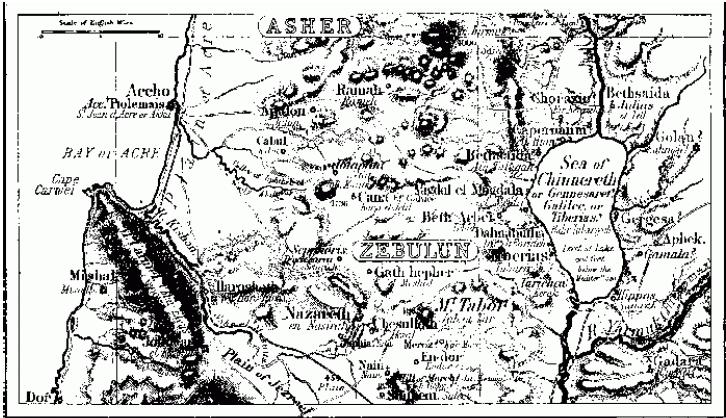
Appendix 170
THE SYNONYMOUS WORDS FOR “LIFE”.
There are three principal words translated “LIFE”. Their shades of meaning are to be distinguished as follows: –
1. zoe = life in all its manifestations; from the life of God down to the lowest vegetable. It is life in activity, and thus especially is the opposite of death. It involves resurrection life and eternal
life; and hence, as such, is the “gift of God” (Ro 6:23. 1 Jn 5:12). For the same reason its verb zao is frequently used of, and put for, resurrection life (Mt 9:18. Mk 16:11. Lk 24:5,23. Jn 11:25,26. Ac
1:3; 9:41; 25:19. Ro 6:10; 14:9. 2 Co 13:4. Rv 1:18; 2:8; 13:14; 20:4,5).
2. bios = life, as lived, manner of life; life as led, &c.; zoe being life as one experiences it; bios as others see it. This is used therefore, only of mankind, who not only live but lead lives. Hence the
differences between ZO-ology and BIO-graphy. Zoe is life in its principle; bios is life in its manifestations (Lk 8:14). Bios is also put by Fig. Metonymy (of Adjunct.), Ap. 6, for livelihood, or that
which supports animal life (Lk 8:43). It occurs eleven times (Mk 12:44. Lk 8:14,43; 15:12,30; 21:4. 1 Ti 2:2. 2 Ti 2:4. 1 Pe 4:3. 1 Jn 2:16; 3:17).
3. psuche = the breath of animal life; one of the manifestations of zoe, common to all living animals. In one passage (Isa 10:18, the Heb. nepesh (Ap. 13), Gr. psuche) is applied to vegetable life. It
is used of the living individual as such. For its various renderings and usages, see Ap. 110.
Appendix 171
THE SYNONYMOUS WORDS FOR “SLEEP”.
There are two words rendered “Sleep”: –
1. katheudo = to compose one’s self for sleep. Occurs twenty-two times; never used of death.
2. koimaomai = to fall asleep (unintentionally). Hence this latter is used of death, as it is involuntary while katheudo is voluntary. See this difference illustrated in 1 Th 4:14 (where it is koimaomai),
and 5:6,7,10 (where it is katheudo). Occurs eighteen times; always of death, save Mt 28:13. Lk 22:45. Jn 11:12. Ac 12:6.
Appendix 172
THE SYNONYMOUS WORDS FOR “POWER”, ETC.
1. dunamis = inherent power; the power of reproducing itself: from which we have Eng. dynamics, dynamo, &c. See Ac 1:8.
2. kratos = strength (as exerted); power put forth with effect and in government: from which we have the Eng. theocracy, government by God; aristocracy, government by the best; democracy,
government by the people. The Greek enkrateia = mastery over one’s self = self control, or having one’s self reined in (from krateia, a rein). This (i.e. enkrateia) is the only word rendered
“temperance”, and occurs only in Ac 24:25. Gal 5:23. 2 Pe 1:6.
3. ischus = strength (as an endowment), physical strength possessed. See, e.g. Mk 12:30.
4. energeia = energy; strength (No. 3 above) put forth from within in effectual operations. See, e.g. 2 Th 2:9.
5. exousia = authority. or, delegated power; the liberty and right to put forth power. See, e.g. Jn 1:12.
6. arche = beginning; then, the chief rule or ruler. See Lk 12:11 (magistrates).
Appendix 173
“TO-DAY” (Lk 23:43).
The interpretation of this verse depends entirely on punctuation, which rests wholly on human authority, the Greek manuscripts having no punctuation of any kind till the ninth century, and then it is only
a dot (in the middle of the line) separating each word. See Ap. 94.V. i..3.
The Verb “to say”, when followed by hoti, introduces the ipsissima verba of what is said; and answers to our quotation marks. So here (in Lk 23:43), in the absence of hoti = “that”, there may be a
doubt as to the actual words included in the dependent clause. But the doubt is resolved (1) by the common Hebrew idiom, “I say unto thee this day”, which is constantly used for very solemn emphasis
(See note on Deut 4:26); as well as (2) by the usage observable in other passages where the verb is connected with the Gr. semeron = to-day.
1. With
hoti
: —
· Mk 14:30: “Verily I say unto thee, that (hoti) ‘this day … thou shalt deny me thrice.’ “
· Lk 4:21: “And He began to say unto them, that (hoti) ‘This day is this scripture fulfilled in your ears.’ “
· Lk 5:26: “Saying (hoti =that), ‘We have seen strange things to-day.’ “
· Lk 19:9: “Jesus said unto him that (hoti), this day is salvation come into this house.’ “
For other examples of the verb “to say”, followed by hoti, but not connected with semeron (to-day), see Mt 14:26; 16:18; 21:3; 26:34; 27:47; Mk 1:40; 6:14,15,18,35; 9:26; 14:25. Lk 4:24,41; 15:27; 17:10;
19:7.
2. Without
hoti
:—
On the other hand, in the absence of hoti (= that), the relation of the word “today” must be determined by the context.
Lk 22:34: “And He said, ‘I tell thee, Peter, in no wise shall a cock crow today before thou shalt thrice deny that thou knowest Me.’ ” Here the word “today” is connected with the verb “crow”, because
the context requires it. Compare Heb 4:7.
It is the same in Lk 23:43: “And Jesus said to him, ‘Verily I say unto thee today [or this day (*1), when, though they were about to die, this man had expressed so great faith in Messiah’s coming Kingdom,
and therefore in the Lord’s resurrection to be its King — now, under such solemn circumstances] thou shalt be, with Me, in Paradise.’ ” For when Messiah shall reign His Kingdom will convert the promised
land into a Paradise. Read Isa 35, and see Note on Eccl 2:5.
We must notice also the Article before “Paradise”. It is “THE Paradise”, viz. the paradise of which the prophets tell in such glowing language, when the Lord shall come in His Kingdom. See Ps 67:4,6;
72:6,7,16,17. Isa 4:2; 30:23,24; 35:1,2,5,6; 41:18,20. Jer 31:5,12. Eze 34:25-27; 36:29,30; 47:8,9,12. Hos 2:18,21,22. Joel 3:18. Am 9:13-15. Zec 8:12.
It has no connexion with Babylonian, Jewish and Romish tradition, but is a direct answer to the malefactor’s prayer. His prayer referred to the Lord’s coming and His Kingdom; and, if the Lord’s answer
was direct, the promise must have referred to that coming and to that Kingdom, and not to anything that was to happen on that day on which the words were being spoken.
It is alleged that the Lord’s promise was a reply to the man’s thought; but this is an assumption for which no justification can be found. Moreover, how can we know what his thought was, except by the
words he uttered? The Lewis Codex of the Syrian N.T. reads in v. 39: “save Thyself and us to-day”. So the Lord’s word “to-day” may have reference to the revilings of the one, as well as to the request of
the other.
(*1) It is rendered “to-day” eighteen times in the Gospels, Hebrews and James; but “this day” twenty-three times (five times in Matthew; once in Mark; four times in Luke; nine times in Acts;
once in Romans; twice in 2 Corinthians; and once in Hebrews).
Appendix 174
THE SYNONYMOUS WORDS FOR “SEND”, “SENT”, ETC
1. apostello = to send forth or off, or away from (as a messenger, or with a commission), the sender remaining behind (*1); implying authority on the part of the sender. Hence used of prophets; and
the Noun “apostle”, denotes one thus sent.
2. exapostello = to send off, or away out of (the place where one is); implying the same mission and authority. No. 1, with the Prep. ek prefixed. See Ap. 104. vii.
3. sunapostello = to send off together (or in conjunction) with another. No. 1, with sun (Ap. 104. xvi) prefixed. Occurs only in 2 Co 12:18.
4. pempo = to send (esp. with an escort), the sender accompanying those sent (*2). See Lk 7:3 (where No. 1, above, is used), and v. 6 (where pempo is used).
5. anapempo = to send up (as to a judge for trial); or to send back, remit (as in Lk 23:11); or to send again.
6. ekpempo = to send out from, send out. No. 4 with ek (Ap. 104. vii) prefixed. Occ. only in Ac 13:4; 17:10.
7. metapempo = to send for, so as to be with one’s self. No. 4 with meta (Ap. 104. xi) prefixed. Occurs only (except once) in Middle Voice. Ac 10:5,22,29; 11:13; 24:24,26; 25:3. See Passive Voice,
Ac 10:29-.
8. sumpempo = to send in company with. No. 4, with sun (Ap. 104. xvi) prefixed. Occ. only in 2 Co 8:18,22.
9. ballo = to throw, to cast (the context determining the nature or degree of force exercised). Cp. Mt 10:34.
10. ekballo = to throw or cast out of, or from No. 9, with ek (Ap. 104. vii) prefixed. Cp. Mt 12:20.
11. apoluo = to loosen off from, let loose from, release, let go away. Cp. Mt 15:23.
12. aphiemi = to send off or away from one’s self (in any manner); hence, to dismiss. Cp. Mt 13:36.
13. apotassomai = to withdraw from by taking formal leave of; to bid farewell or say “adieu” to: as Elisha did from Elijah (Josephus, Ant. viii. 13:7). Cp. Mk 6:46. Lk 9:61; 14:33. Ac 18:18,21. 2 Co
2:13.
14. bruo = to emit, or send forth abundantly (as a fountain). Occurs only in Jas 3:11.
(*1) See Jn 20:22: “as the Father hath sent (No. 1) Me, even so send I (No. 4) you.”
(*2) See note above, where pempo is thus emphasized.
Appendix 175
THE SYNONYMOUS WORDS FOR “TRUE”.
1. alethes = true (*1) (as contrasted with what is false). Hence, used of God (Jn 3:33) in that He cannot lie (see also Jn 5:31; 8:13). The opposite of a lie. Gr. apseudes. Tit 1:2. Cp. Jn 4:18. 1 Jn
2:27.
2. alethinos = very (*1). Fr. veritable: i.e. genuine, real, substantial, as contrasted with that which is fictitious, unreal, shadowy, or symbolical. Hence, alethinos is that which has truth for its base
and is all that it claims to be (Jn 6:32; 15:1). See 1 Th 1:9. Heb 8:2; 9:24.
3. gnesios = legitimate. Spoken of children. Occ. only in Php 4:3. 1 Ti 1:2 Tit 1:4. With Art. = sincerity (2 Co 8:8). The Adverb gnesios = naturally, occ. only in Php 2:20.
4. pistos = faithful. A verbal Adj., from peitho = to persuade, and Pass. to be persuaded and convinced. Hence, believing, faithful, trustworthy. Transl. “true” in 2 Co 1:18. 1 Ti 3:1 See Ap. 150. III.
(*1) See notes on the Structure of the Gospel of John.
Appendix 176
THE EIGHT “SIGNS” IN JOHN’S GOSPEL.
Miracles are spoken of in the New Testament under three names:—
1. dunamis = power. In the singular, power in the abstract; but in the plural it = mighty works, i.e. the manifestations of power. (See Ap. 172. 1.) The word occurs 38 times in three of the four
Gospels: 13 times in Matthew, and is rendered “power”, or “powers” 5 times; “mighty works” 6 times; “wonderful works” once (7:22), and once “ability” (25:15). It occurs ten times in Mark; and is
rendered “virtue” once (5:30); “mighty works” 3 times; “power, or “powers” 5 times; and “miracle” once (9:39). In Luke it occurs 15 times, and is rendered “power” or “powers”, 11 times; “virtue”
twice; “mighty works” twice. In John it does not occur at all.
2. teras = a wonder. This word has regard to the effect produced on those who witnessed the mighty work. It is always translated “wonder”, and occurs three times in three of the Gospels: viz. Mt
24:24. Mk 13:22. Jn 4:48. Outside of the Gospels it occurs in Ac 2:19,22,43; 4:30; 5:12; 6:8; 7:36; 14:3; 15:12. Ro 15:19. 2 Co 12:12. 2 Th 2:9. Heb 2:4. It does not occur in Luke’s Gospel; and only
once in Matthew, Mark and John. The rendering “miracle” should be confined to this word, teras.
3. semeion = a sign. This word has regard to the significance of the work wrought, whether in itself, or in the reason, object, design, and teaching intended to be conveyed by it. It occurs in the
Gospels 48 times, viz.: 13 times in Matt.; 7 times in Mark; 11 times in Luke; and is rendered “miracle” only once (23:8). In John it occurs 17 times, and is quite wrongly rendered “miracle” 13 times,
and “sign” only 4 times. No other word is used for a “miracle” in John, except in 4:48 (see 2 above). The English word “miracle” is from the Latin word miraculum, which means “a wonder”, and
should therefore be confined to the rendering of teras (No. 2) above, and not used for either dunamis (No. 1), or semeion (No. 3).
All three of the above words occur in one verse (Heb 2:4): “God also bearing [them] witness by signs (semeion), both with wonders (teras) and various mighty works (dumanis), and distributions of
pneuma hagion (See Ap. 101. II. 14), according to His own will”. John does not use the first of these words (dunamis) at all. He uses the second (teras) only once (4:48).
In all the other passages he uses the third (semeion), and this 17 times. It is rendered “miracle” in all but four passages (2:18; 4:48; 6:30; 20:30, where it is correctly rendered “sign”). It should, of course,
have been rendered “sign” throughout, because it has regard to that which is signified by the work wrought. Out of all the miracles wrought by out Lord, John records only eight; and these are all “signs”,
not “wonders” or “mighty works”.
The number (eight) is Divinely ordered. Of the first we read, “This beginning of the signs” (2:11); and of the second, “This is again a second sign” (4:54). We are thus invited to continue and carry out this
important enumeration to the completion of the eighth. Hence these eight (For the significance of the enumeration of the eight signs as a whole, see the Conclusion) have been Divinely selected only on
account of their special signification.
It is ours to study them with the view of finding out what it is that is signified by them. For this purpose they are set out on page 194, according to their Structure; for, like all the other words and
works of God, their order is perfect as well as all else connected with them. They are at once seen to be arranged as an Introversion. This tells us that the historical order in which they were wrought must
have had regard also to the literary order in which they are recorded.
The Introversion shows that the first corresponds with the eighth; the second corresponds with the seventh; the third with the sixth; and the fourth with the fifth. Thus there are four pairs; the latter
sign and signification in each pair is always an advance on the former: so that, while the former deals with what is preliminary and partial, it leads up to the latter corresponding sign, which is permanent
and final.
THE SIGNIFICATION.
We are now in a position to examine these eight “signs” more minutely; and are able, at once, to see that the points which correspond are intended to emphasize the signification of each.
Two things stand out most clearly: they all manifest ISRAEL’S need, and condition of helplessness and death; and MESSIAH’S glory, and His ability to meet that need and restore Israel’s lost condition.
We need not go outside these to learn the signification of these “signs”. All else must be by way of application and not interpretation. Messiah was baptized and anointed by the Holy Ghost “that He
might be manifested unto Israel” (Jn 1:31). The first sign is called “the beginning”, and the next is called the “second”, to intimate to us that we are to continue the enumeration, and thus be led on to
emphasize the signification of each. It “manifested forth His glory”. This is the signification of the whole eight.
THE FIRST (A) AND THE EIGHTH (A).
The Marriage in Cana (2:1-11), and the Draught of Fishes (21:1-14).
The signification is the same in each case, as to Messiah. In the first He “manifested forth His glory” (2:11); in the eighth He “manifested Himself” (21:14, note the same word in each): as to Israel, it was
to manifest the depth of the nation’s destitution. He alone could supply that need by becoming “the glory of His People Israel” (Lk 2:32). Apart from Messiah, Israel could have no joy, no supplies, no
blessing, no glory.
The first sign signified that need: “they have no wine” (2:3), while the last signified that with all their toil they had “caught nothing”, and had “no meat”; but it signified also that Messiah could supply
both the one and the other –sustenance and joy.
Religion with all its punctilious observances could not supply either. Religion grossly corrupted (cp. Isa 1:22), was in full evidence: the “waterpots” and “the purifying of the Jews” only manifested the
truth of the inspired indictment of Isa 1:10-23; while the next recorded event (Jn 2:13-16) manifested that they were destitute of all idea of true worship of Jehovah.
The discourses which followed carried the signification further, and showed that this spiritual destitution could be remedied only by the Divine gifts; yea, in spiritual regeneration and resurrection.
Nicodemus, who was attracted by the signs (3:2), sought their signification, and was taught the need of spiritual birth from Eze 36:24-32. The word “must” of 3:7 and 3:14 enforced and explained it; while
the gift of God (v. 16) was the only answer to his question “How?”
From Jerusalem and a ruler He goes to Samaria (4:4), like Peter in a later day (Ac 8:14-25); and again shows to a Samaritan woman, the need of spiritual worship, enforcing it by the same “must” (4:24);
and answering her question “How?” by the same “gift of God” (4:10).
When Messiah gives joy to the nation, it will be filled “up to the brim” (2:7. Cp. Isa 9:2-7. Jn 21:11); and when He fills the Land with restored Israel in resurrection, it will be to the last one (Eze
37:12-14). For in the eighth sign Messiah was the Caller, signifying that He will be the Gatherer (Jer 31:10); while the seven disciples (Jn 21:2. Ap. 10) signify the spiritual perfection with which Israel will
be gathered, yea, “one by one” (Isa 27:12) to the last one (“153 “). For “though Israel be sifted among the nations, as corn is sifted in a sieve, yet shall not the least grain fall upon the earth.” (Am 9:9).
THE SECOND (B) AND THE SEVENTH (B).
The Ruler’s Son (4:46-50), and the Sisters’ Brother (11:1-44).
If in the first and eighth the signification was national destitution of all good, in the second and seventh it is destitution of national life. The “sign” in each case was connected with death; and, as in all
the other pairs, the latter is an advance upon the former: so here, the son being on the point of death (4:47) in the death chamber, the brother is actually dead and in the tomb. The signification being
that in the former which took place during the first period of our Lord’s ministry, which was the proclamation of the kingdom, the nation was at the point of death, though not actually dead (see Ap.
119): but in the latter case the “sign” was given in the third period when the King had been already rejected (10:39; 11:8, 53; 12:10), and national life was in God’s sight practically dead.
The nation’s only hope was in Messiah, the great Life-giver. He would raise it again from the dead, according to Eze 37. There is a reference here to Hos 13:14. Can there be a reference also in the
“two days” (4:43 and 11:6) to Hos 6:1-3?
THE THIRD (C) AND THE SIXTH (C).
The Impotent Man (5), and the Man born Blind (9).
In both these two “signs” the condition of Israel is “manifested” in another phrase, as being of long standing and hopelessness (5:5; 9:1); and Messiah is manifested in His grace as the only Helper and
Healer. In both cases, Messiah is the Seeker (5:6; 9:1), and takes the initiative; while in both the preceding pairs He was the One Who was sought.
Both “signs” were manifested in Jerusalem (5:1 and 8:50 with 9:1), and thus have special reference to Government and its seat. Both are associated with a pool (5:2 and 9:7, 11), and may signify that
Pool of spiritual cleansing which in a future day is yet to be “opened to the house of David and to the inhabitants of Jerusalem for sin and for uncleanness” (Zec 13:1). In connection with this it is significant
that these two “signs” are the only two out of all the eight that have any reference to sin (5:14 and 9:2, 24, 25, 34), as the second and seventh are the only two connected with death.
Sin had been the cause, in the case of Israel, both of impotence and the blindness. (*1). It was the cause of Israel’s thirty-eight years’ typical and helpless wandering (Ap. 50. VII; cp. 2 and 3) before the
nation entered into rest; as it was the cause of the suffering of this impotent man, before he met with the great and only Giver of Rest. This rest is emphasized by the reference to a “Sabbath-Day” (5:9
and 9:14) and by the “sign” that Messiah (the true Joshua) can alone lead them into that true rest and sabbath-keeping that yet remains for Jehovah’s People (Heb 4:4-10).
Messiah is Himself not only the Seeker (5:6; and 9:1), but He is also the Finder (5:14 and 9:35). The double reference to Moses’ words (5:45,46 and 9:28,29), and to the Father’s works (5:17 and 9:4), are
both “signs” also, full of the utmost significance as deepening the sin of Israel, and enhancing the grace of God Who had raised up Messiah as th 1000 e Prophet, like unto Moses (Dt 18:15-19), and sent His
Son to seek and to find and to save that which was lost (Lk 19:9,10).
THE FOURTH (D) AND THE FIFTH (D).
The Feeding of the Five Thousand (6:1-14), and the Walking on the Sea (6:15-21).
These are the two central “signs”, and are emphasized by being the only “signs” which are recorded in the other three Gospels; thus implying that all four Gospels are needed in order to give us their full
signification. Both “signs” are followed by the Lord’s own signification in the discourses which manifested the special glory of His Deity. The two “signs” are connected together by the parenthesis of 6:23,
which shows that the signification is one, manifesting Messiah as Divine; in the former, as the Creator and the only Supplier of all His People’s needs; temporal as in 6:6-13, and spiritual as in 6:32-51; in
the latter, as the Creator and Lord of the elements.
The discourse which follows is to signify the enormity of the sin of His rejection, as shown in 7:1, 11, 12, 25, 30, 32, 43, 44, 45; as the second and seventh are the only two connected with death. Thus,
these two central “signs” manifest the two central truths which are common to all the four Gospels: viz., the glory of the Messiah and His rejection by the nation. They were connected by His departing
from them, and going up into a mountain (6:3 and 6:15), signifying that He was about to depart from them, until His return from heaven on the repentance of the nation.
CONCLUSION.
As to the eight “signs” as a whole, they are divided into seven and one; the seven taking place during the ministry of our Lord; and the one (the eighth) after His resurrection; the number eight being
symbolical of that fact, the Resurrection having taken place on the eighth day (see Ap. 10). The seven are divided into two, three, and two; the first two occurred in the first period of His ministry,
which was the proclamation of the Kingdom (see Ap. 119).
The next three (the third, fourth, and fifth) during the second period of His ministry, which was the manifestation of His Person as Jehovah-Ropheka, the Healer of His People; Jehovah-Ro’i, and
Jehovah-Jireh, the Supplier of all His People’s needs; and Jehovah the Creator of heaven and earth, the sea and all that in them is.
The next two (the sixth and seventh) occurred during the third period of His ministry, the period of His rejection, manifesting the enormity of their sin, in the rejection of Him Who is the Restorer of
His People’s sight, and the Lord and Giver of life. Both were parabolic and prophetic with reference to His rejection.
The eighth stands out alone, in this connection; occurring as it does in the Post-resurrection period, and referring to the future gathering of Israel by the rejected Messiah, Who is seen as the Seeker,
the Finder, and the Gatherer of His scattered People, Israel.
(*1) See v. 2 which shows that they believed the Babylonian “tradition” of reincarnation.
THE EIGHT “SIGNS”
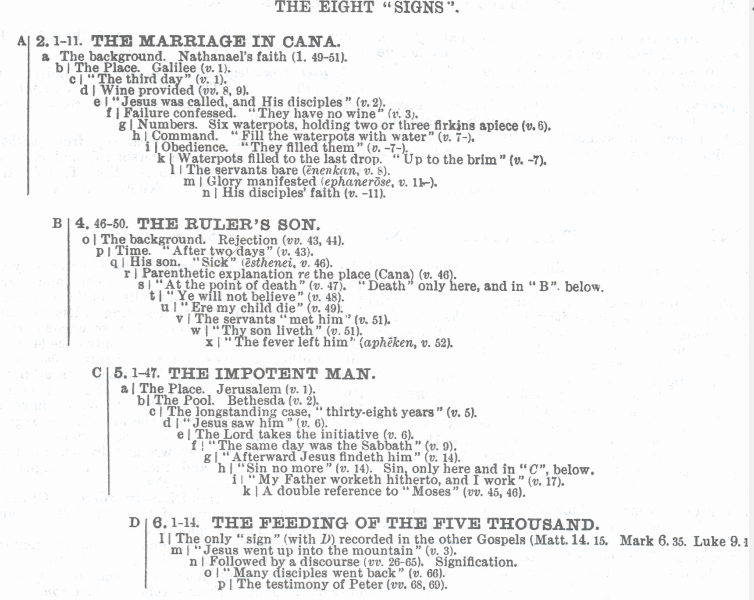
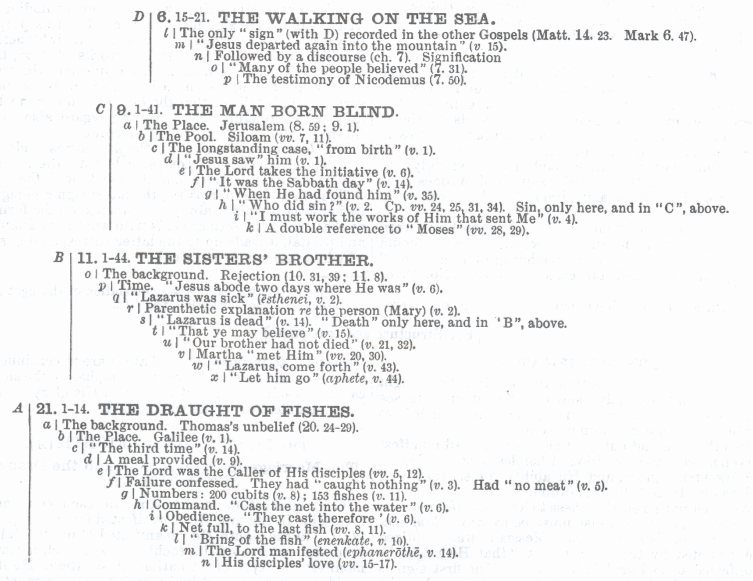
Appendix 177
THE SYNONYMOUS WORDS FOR “JUDGMENT”.
1. aistesis = perception. Occurs only in Php 1:9, where A.V. reads “sense” in the margin and R.V. reads “discernment”.
2. gnome, from ginosko (Ap. 132, ii) = opinion, the result of knowledge. Occurs nine times: translated “purposed” in Ac 20:3; “judgment” in 1 Co 1:10; 7:25,40; “advice” in 2 Co 8:10; “mind” in Phm 14;
Rv 17:13; “will” in Rv 17:17; and (with a verb) “agree” in Rv 17:17.
3. dikatoma = that which is deemed right or just (dikaios). Occurs ten times: translated “judgment” in Ro 1:32; Rv 15:4; elsewhere “ordinance”, righteousness”, and once “justification” (Ro 5:16)
4. dike = right, as established custom or usage, hence a suit at law, penalty, vengeance. Occurs four times: translated “judgment” in Ac 25:15; “vengeance” in Ac 28:4; Jude 7; and “punished” in 2 Th
1:9 (see R. V.)
5. hemera = day, rendered “judgment” in 1 Co 4:3 (see A.V. marg.).
6. krima = This and the two following words are akin to the verb krino (Ap. 122. 1). Krima occurs twenty-eight times, and is rendered “judgment”, “damnation”, or “condemnation”, save in Lk 24:20;
1 Co 6:7; and Rv 18:20, where see notes.
7. krisis = a separating, a judgment, especially of judicial proceedings. Our English word “crisis” means a turning point. The word occurs forty-eight times: translated “damnation” (Mt 23:33; Mk 3:29;
Jn 5:29), “condemnation” (Jn 3:19; 5:24), “accusation” (2 Pe 2:11; Jude 9), and everywhere else “judgment”.
8. kriterion = the place, or means of judgment. It occurs three times (1 Co 6:2,4; Jas 2:6) This word we have also adopted into the English language as a “standard” for judging.
Appendix 178
THE SYNONYMOUS WORDS FOR “RAISE”, “RESURRECTION”, ETC.
There are eight verbs and three nouns to be noticed in this connection.
I. VERBS.
1. anistemi (ana, Ap. 104. i, histemi) is either transitive or intransitive, according to the tense, &c., and means to make to stand up, i.e. to raise up, or to rise up, arise, rise again. It occurs 111
times, thirty-five of which refer to resurrection. See (e.g.) Mt 17:9; 20:19; Jn 6:39,40,44,54.
2. exanistemi. No. 1 with ek (Ap. 104. vii) prefixed. Not used of resurrection. Occurs only in Mk 12:19. Lk 20:28. Ac 15:5.
3. epanistamai is middle voice of No. 1 with epi (Ap. 104. ix) prefixed. Not used of resurrection. Occurs only in Mt 10:21. Mk 13:12.
4. egeiro = to rouse up from sleep. Pass., to awake. Occurs 141 times, of which seventy refer to resurrection. See (e.g.) Mt 10:8; 27:63,64; Lk 20:37; 24:6,34; Jn 12:1,9,17; Eph 1:20; 5:14, &c.
5. diegeiro. No. 4, with dia (Ap. 104. v) prefixed = to rouse thoroughly. Not used of resurrection. Occurs only in Mt 1:24; Mk 4:38,39; Lk 8:24; Jn 6:18; 2 Pe 1:13; 3:1 (stir up).
6. exegeiro. No. 4 with ek (Ap. 104. vii) prefixed. Occurs only in Ro 9:17; 1 Co 6:14.
7. epegeiro = No. 4 with epi (Ap. 104. ix) prefixed. Occurs only in Ac 13:50; 14:2.
8. sunegeiro = No. 4 with sun (Ap. 104. xvi) prefixed. Occurs only in Eph 2:6; Col 2:12; 3:1
II. NOUNS.
1. anastasis = Cp. I. 1. Occurs forty-two times. Always transl. resurrection, except Lk 2:34.
2. exanastasis = No. 1, with ek prefixed. Occurs only in Php 3:11.
3. egersis = Cp. I. 4. Occurs only in Mt 27:53.
Appendix 179
I. PARALLEL DATINGS OF THE TIMES OF OUR LORD.
II. DATES OF “THE BEGETTING” AND THE NATIVITY, ETC.
III. “THE COURSE OF ABIA”.
A.M. = Anno Mundi; that is to say, in the year of the world.
B.C. = Before Christ. Reckoned as from 4004 A.M.
A.C. = Anno Christi; that is to say, in the year of Christ. Reckoned from the Nativity, in 4000 A.M. and 749-750 A.U.C.
A.U.C. = Anno Urbis Conditoe; that is to say; the year in which the City (Rome) was founded.
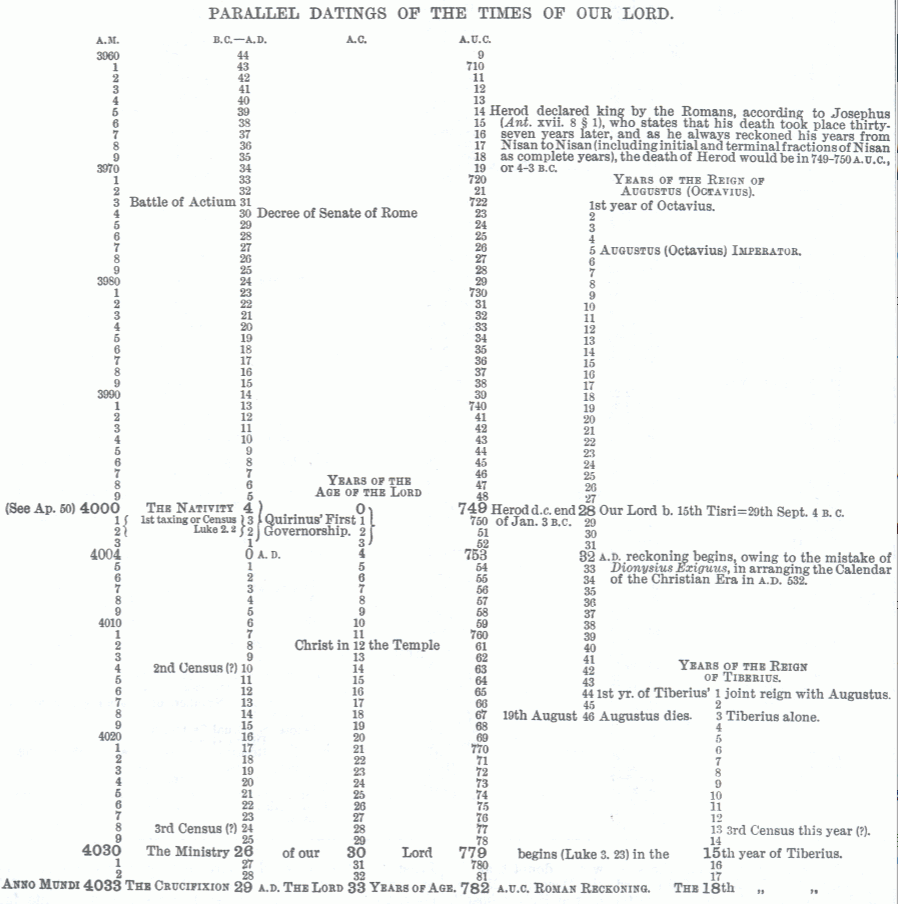
1. ZUMPT fixes Quirinus’ (Cyrenius’) First Govenorship as 4 B.C. to 1 B.C. Justin Martyr thrice says that our Lord was born under Quirinus (Apol.1.XXXIV, p.37; XLVI, p. 46; Dial. LXXVIII, p. 195. Clark’s ed.).
2. According to some, Augustus died August 19, A.D. 14. Therefore if Tiberius’ co-regnancy was for two years before Augustus’ death his first year was 765 A.U.C. = 12 A.D. His fifteenth year consequently was A.U.C. 779 = 26 A.D. = 4030 A.M. and A.C. 30. for our Lord was thirty years of age when He begun His Ministry (Lk 3:23). Clement of Alexandria gives the years of Augustus’ reign as being 43-46, according to different reckonings in his day.
3. According to Clement of Alexandria (c. A.D. 190-220) “Our Lord was born in the twenty-eighth year when first the census was taken every fourteen years, then the next would fall in A.D. 10, and the succeeding one would have been due A.D.24.
II. DATES OF “THE BEGETTING” (he gennesis, Mt 1:18,20 (see Revised Version marg.). Jn 1:14) OF OUR LORD AND HIS BIRTH. (Lk 2:7. Jn 1:14.)
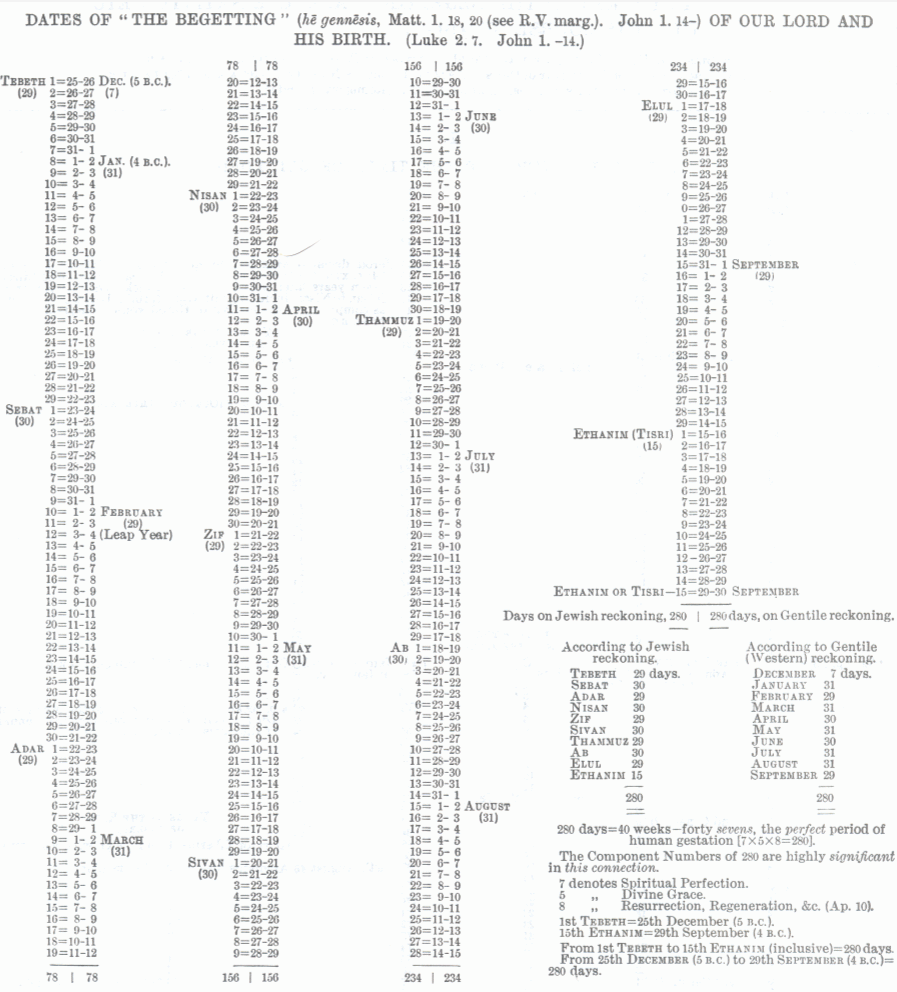
1. It thus appears without the shadow of a doubt that the day assigned the the Birth of the Lord, viz. December 25, was the day on which He was “begotten of the Holy Ghost”, i.e. by pneuma hagion = divine power (Mt 1:18,20 marg.), and His birth took place on the 15 th of Ethanim, September 29, in the year following, thus making beautifully clear the meaning of Jn 1:14, “The Word became flesh” (Mt 1:18,20) on the 1 st Tebeth or December 25 (5 B.C.), “and tabernacled (Gr. eskeno-sen) with us”, on 15 th of Ethanim or September 29 (4 B.C.). The 15 th of Ethanim (or Tisri) was the first day of the Feast of Tabernacles. The circumcision therefore took place on the eighth day of the Feast = 22 nd Ethanim = October 6-7 (Lev 23:33-34). So that these two momentous events fall into their proper place and order, and the real reason is made clear why the 25 th of December is associated with our Lord and was set apart by the Apostolic Church to commemorate the stupendous event of the “Word becoming flesh” – and not, as we have for so long been led to suppose, the commemoration of a pagan festival.
2. An overwhelmingly strong argument in favor of the correctness of this view lies in the fact that the date of “the Festival of Michael and All Angels” has been from very early times the 29 th day of September, on Gentile (Western) reckoning. But “the Church” even then had lost sight of the reason why this date rather than any other in the Calendar should be so indissolubly associated with the great Angelic Festival.
The following expresses the almost universal knowledge or rather want of knowledge of “Christendom” on the subject: “We pass on now to consider, in the third place, the commemoration of September 29, the festival of Michaelmas, par excellence. It does not appear at all certain what was the original special idea of the commemoration of this day” (Smith’s Dict. of Chr. Antiqq. (1893), vol. ii, p. 1177 (3) ).
A reference, however, to the Table and statements above, makes the “original special idea ” why the Festival of “Michael and All Angels” is held on September 29 abundantly clear. Our Lord was born on that day, the first day of the “Feast of Tabernacles” (Lev 23:39). This was on the fifteenth day of the seventh Jewish month called Tisri, or Ethanim (Ap. 51. 5), corresponding to our September 29 (of the year 4 B.C.) The “Begetting” (gennesis) Day of the Lord was announced by the Angel Gabriel. See notes on Dan 8:16 and Lk 1:19. The “Birth” Day, by “(the) Angel of the Lord”, unnamed in either Matthew and Luke.
That this Angelic Being was “Michael the Archangel (of Jude 9), and Mika’el hassar haggadol – “Michael the Great Prince”- of Da 12:1, seems clear for the following reason: If, “when again (yet future) He bringeth the First-begotten into the world, He saith, Let all the Angels of God worship Him” (Heb 1:6; quoting Ps 97:6) – then this must include the great Archangel Michael himself. By parity of reasoning, on the First “bringing” into the world of the only begotten Son, the Archangel must have been present. And the tremendous announcement to the shepherds, that the Prince of Peace (Isa 9:6) was on earth in the person of the Babe of Bethlehem, must therefore have been made by the same head of the heavenly host (Lk 2:9-14). In mundane affairs, announcements of supremest importance (of kings, &c.) are invariably conveyed through the most exalted personage in the realm. The point need not be labored.
3. The fact of the Birth of our Lord having been revealed to the shepherds by the Archangel Michael on the 15 th of Tisri (or Ethanim), corresponding to September 29, 4 B.C. – the first day of the Feast of Tabernacles – must have been known to believers in the Apostolic Age. But “the mystery of iniquity” which was “already working” in Paul’s day (2 Th 2:7) quickly enshrouded this and the other great fact of the day of the Lord’s “begetting” on the first day of the Jewish month Tebeth (corresponding to December 25, 5 B.C.) – as well as other events connected with His sojourn on earth, (*1) – in a rising mist of obscurity in which they have ever since been lost.
The earliest allusion to December 25 (modern reckoning) as the date for the Nativity is found in the Stromata of Clement of Alexandria, about the beginning of the third century A.D. (See note 3 p. 197). (*2)
That “Christmas” was a pagan festival long before the time of our Lord is beyond doubt. In Egypt Horus (or Harpocrates (*3), the son of Isis (Queen of Heaven), was born about the time of winter solstice. (*4) By the time of the early part of the fourth century A.D., the real reason for observing Christmas as the date for the miraculous “begetting” of Mt 1:18 and “the Word becoming flesh” of Jn 1:14 had been lost sight of. The policy of Constantine, and his Edict of Milan, by establishing universal freedom of religion furthered this. When many of the followers of the old pagan systems – the vast majority of the empire, it must be remembered – adopted the Christian religion as a cult, which Constantine had made fashionable, and the “Church” became the Church of the Roman Empire, they brought in with them, among a number of other things emanating from Egypt and Babylon, the various Festival Days of the old “religions”. Thus “Christmas Day, ” the birthday of the Egyptian Horus (Osiris), became gradually substituted for the real Natalis Domini of our blessed Savior, viz. September 29, or Michaelmas Day.
4. If however, we realize that the center of gravity, so to speak, of what we call the Incarnation if the Incarnation itself- the wondrous fact of the Divine “begetting”, when “the Word became flesh” (see notes on Matt 1:18 and John 1:14) – and that this is to be associated with December 25, instead of March – as for 1,600 years Christendom has been led to believe – then, “Christmas” will be seen in quite another light, and many who have hitherto been troubled with scruples concerning the day being, as they have been taught, the anniversary of a Pagan festival, will be enabled to worship on that Day without alloy of doubt, as the time when the stupendous miracle which is the foundation stone of the Christian faith, came to pass.
The “Annunciation” by the Angel Gabriel marked the gennesis of Mt 1:18, and the first words of Jn 1:14. The announcement to the shepherds by the Archangel Michael marked the Birth of our Lord. Jn 1:14 is read as though “the Word became flesh (R.V.) and dwelt among us “, were one and the same thing, whereas they are two clauses.
The paragraph should read thus:
“And the Word became flesh;
(Gr. ho logos sarz egeneto.)And tabernacled with (or among) us.”
(Gr. kai eskenosen en hemin).
The word tabernacled here (preserved in R.V. marg.) receives beautiful significance from the knowledge that “the Lord of glory” was “found in fashion as a man”, and thus tabernacling in human flesh. And in turn it shows in equally beautiful significance that our Lord was born on the first day of the great Jewish Feast of Tabernacles, viz. the 15 th of Tisri, corresponding to September 29, 4 B.C. (modern reckoning). The Circumcision of our Lord took place therefore on the eighth day, the last day of the Feast, the “Great Day of the Feast” of Jn 7.37 (“Tabernacles” had eight days. The Feast of Unleavened Bread had seven days and Pentecost one. See Lev 23)
5. The main arguments against the Nativity having taken place in December may be set forth very simply:
i. The extreme improbability, amounting almost to impossibility, that Mary, under such circumstances, could have undertaken a journey of about 70 miles (as the crow flies), through a hill district averaging some 3,000 feet above sea-level, in the depth of winter:
ii. Shepherds and their flocks would not be found “abiding” (Gr. agrauleo) in the open fields at night in December (Tebeth), for the paramount reason that there would be no pasturage at that time. It was the custom then (as now) to withdraw the flocks during the month Marchesvan (Oct.-Nov.) (**1) from the open districts and house them for the winter.
iii. The Roman authorities in imposing such a “census taking” for the hated and unpopular “foreign” tax would not have enforced the imperial decree (Lk 2:1) at the most inconvenient and inclement season of the year, by compelling the people to enroll themselves at their respective “cities” in December. In such a case they would naturally choose the “line” of least resistance” and select a time of year that would cause least friction, and interference with the habits and pursuits of the Jewish people. This would be in the autumn, when the agricultural round of the year was complete, and the people generally more or less at liberty to take advantage, as we know many did, of the opportunity of “going up” to Jerusalem for the “Feast of Tabernacles” (cp. Jn 7:8-10, &c), the crowning Feast of the Jewish year.
To take advantage of such a time would be to the Romans the simplest and most natural policy, whereas to attempt to enforce the Edict of Registration for the purpose of Imperial taxation in the depth of winter,- when traveling for such a purpose would have been deeply resented, and perhaps have brought about a revolt,- would never have been attempted by such an astute ruler as Augustus.
6. With regard to the other two “Quarter Days”, June 24, March 25, these are both associated with the miraculous (Lk 1:7) “conception” and birth of the Forerunner, as December 25 and September 29 are with our Lord’s miraculous “Begetting” and Birth; and are therefore connected with “the Course of Abiah.”
(*1) Notably the day of the crucifixion, &c. (see Ap. 156,165).
(*2) His statements are, however, very vague, and he mentions several dates claimed by others as correct.
(*3) Osiris reincarnated.
(*4) See Wilkinson’s Ancient Egyptians, Vol. III, p.79 (Birch’s ed.).
(**1) It is true that the Lebanon shepherds are in the habit of keeping their flocks alive during the winter months, by cutting down branches of trees in the forests in that district, to feed the sheep on the leaves and twigs, when in autumn the pastures are dried up, and in winter, when snow covers the ground. (cp. Land and Book, p.204), but there is no evidence that the Bethlehem district was afforested in this manner.
III. “THE COURSE OF ABIA” (Lk 1:5).
This was the eighth of the priestly courses of ministration in the Temple (1 Ch 24:10), and occurred, as did the others, twice in the year. The “Courses” were changed every week, beginning each with a Sabbath. The reckoning commenced on the 22 nd day of Tisri or Ethanim (Ap. 51. 5). This was the eighth and last day of the Feast of Tabernacles = the “Great Day of the Feast” (Jn 7:37), and was a Sabbath (Lev 23:39) The first course fell by lot to Jehoiarib, and the eighth to Abia or Abijah (1 Ch 24:10). Bearing in mind that all the courses served together at the three Great Feasts, the dates for the two yearly “ministrations” of Abiah will be seen to fall as follows:
The first (*1) ministration was from 12 – 18 Chisleu = December 6 – 12.
The second ministration was from 12 -18 Sivan = June 13 – 19.
The announcement therefore to Zacharias in the Temple as to the conception of John the Baptist took place between 12 – 18 SIVAN (June 13 -19), in the year 5 B.C. After finishing his “ministration”, the aged priest “departed to his own house” (Lk 1:23) which was in a city (*2) in “the hill country” of Juda (verse 39).
The day following the end of the “Course of Abia” being a Sabbath (Sivan 19), he would not be able to leave Jerusalem before the 20 th. The thirty miles journey would probably occupy, for an old man, a couple of days at least. He would therefore arrive at his house on the 21 st or 22 nd. This leaves ample time for the miraculous “conception” of Elizabeth to take place on or about the 23 rd of Sivan (*3) – which would correspond to June 23 -24 of that year. The fact of the conception and it’s date would necessarily be known at the time and afterwards, and hence the 23 rd of SIVAN would henceforth be associated with the conception of John the Baptist as the 1 st of TEBETH would be with that of our Lord.
But the same influences that speedily obscured and presently obliterated the real dates of our Lord’s “Begetting” and Birth, were also at work with regard to those of the Forerunner, and with the same results. As soon as the true Birth day of Christ had been shifted from its proper date, viz. the 15 th of Tisri (September 29), and a Festival Day from the Pagan Calendars substituted for it (viz. December 25), then everything else had to be altered too.
Hence “Lady Day” in association with March 25 (new style) became necessarily connected with the Annunciation. And June 24 made its appearance as it still is in our Calendar, as the date of “the Nativity of John the Baptist”, instead of, as it really is, the date of his miraculous conception. The Four “Quarter Days” may therefore be set forth thus: first in the chronological order of the events with which they are associated, viz.:

or, placing the two sets together naturally:—

Our Lord, etc.\ – APPENDIXES\Appendix 179 A: Map Illustrating the Missionary Journeys and Last Voyage of the Apostle Paul\
(*1) Reckoning of course from Ethanim or Tisri – the First month of the civil year. The sacred year was six months later, and began on 1 st Nisan.
(*2) The “city” is not named (possibly Juttah, some 30 miles to the south of Jerusalem).
(*3) The conception of John the Baptist was, in view of Lk 1:7, as miraculous as that of Isaac; but it is not necessary to insist upon the complete period of forty sevens (p.198) in the case of Elizabeth. Therefore the birth of the Forerunner may have been three or four days short of the full two hundred and eighty days, – as indicated in the above table.
Appendix 179 A
MAP ILLUSTRATING THE MISSIONARY JOURNEYS AND LAST VOYAGE OF THE APOSTLE PAUL
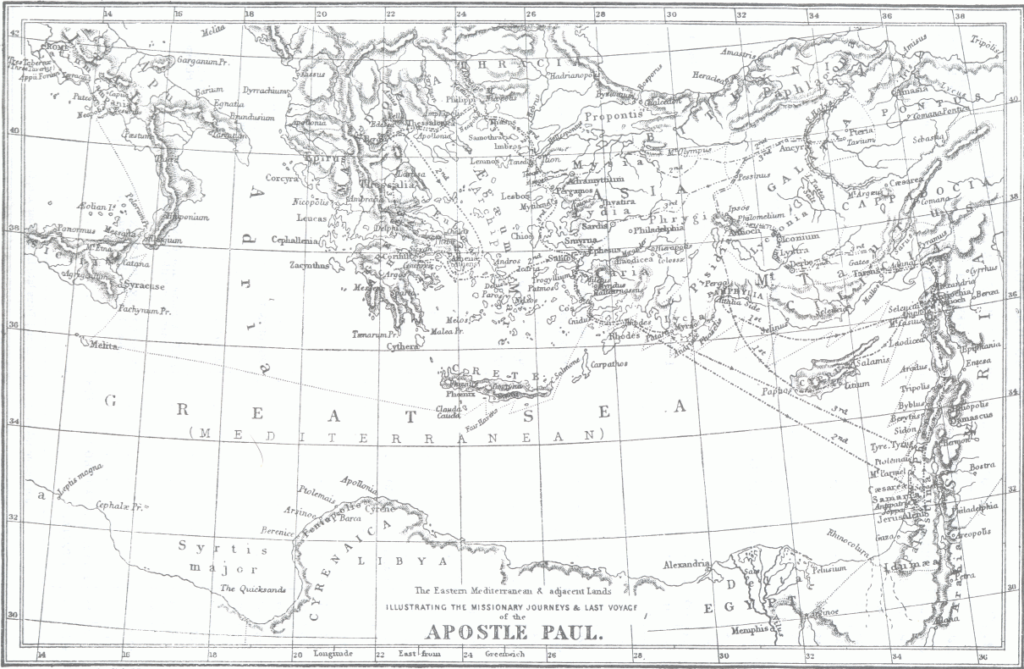
Appendix 180:
Chronology, etc. of the “Acts” Period
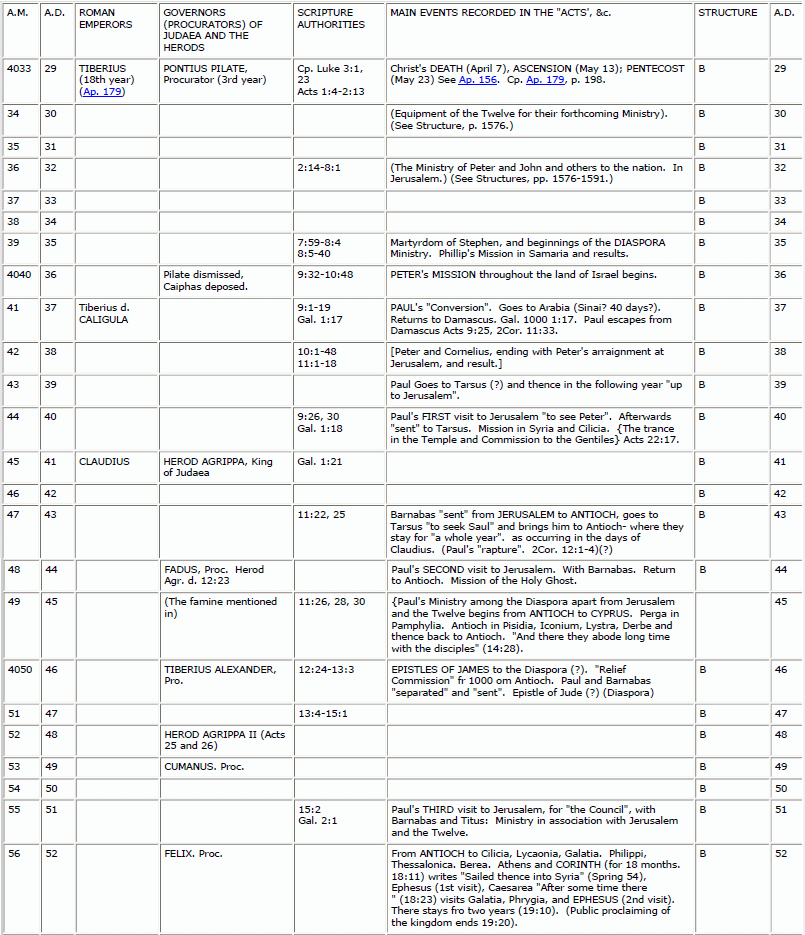
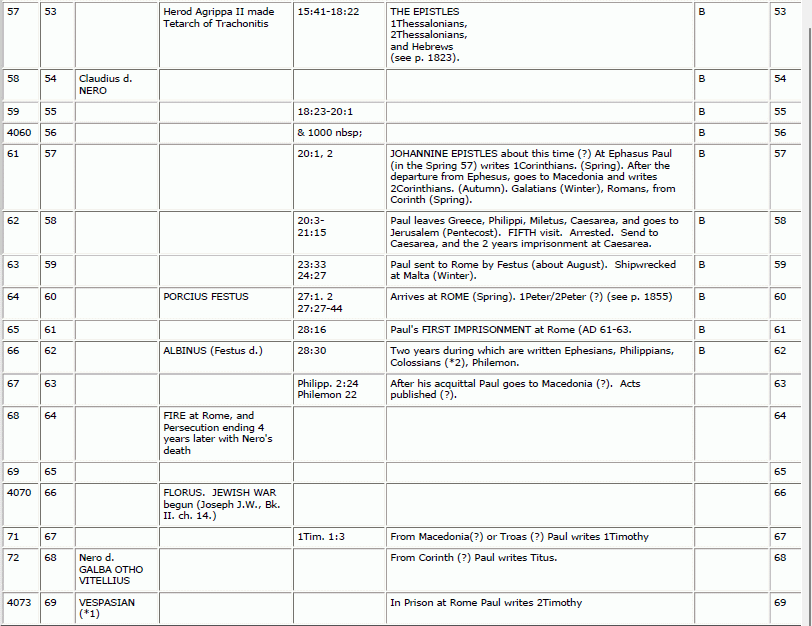
(*1) Jerusalem taken by Vespasian and Titus late in the year A.D. 69. (*2) The Chronological order according to Lightfoot, Biblical Essays (p. 222), is Philipp., Coloss., Ephes.
Appendix 181
THE DISPENSATIONAL POSITION OF THE BOOK OF THE “ACTS”
1. The original title of the Book was probably simply “Acts” (praxeis), as in Codex Sinaiticus (a), and there is no reason to doubt that it owes its human authorship to Luke, “the beloved physician” (Col 4:14). Tradition from very early times ascribes it to him. Eusebius (fl. A. D. 300) in his Ecclesiastical History says, “Luke … a physician has left us two inspired books … one of these is his gospel … The other is his acts of the apostles which he composed not from what he had heard from others (like his gospel), but from what he had seen himself” (Bk. III, ch. 4).
2. The Book is a record of the “Acts” of the Holy Spirit through “witnesses chosen before of God” (10:41) during the period of the final offer to the children of Israel of national restoration and blessing, on condition of national repentance and obedience. In the O.T. the offer was made by the Fathers, as Jehovah, through the prophets (Heb 1:1), and was rejected (cp. Zec 7:12-14; &c). In the Gospels the offer was renewed in and by the Son, and was again rejected (Mt 23:37-39; &c). “Acts” records the third and final presentation by the HOLY SPIRIT, and its final rejection by the Nation (28:25-28; Ro 11:25, &c). Of these “chosen witnesses” no mention is made of “works” done by any save those through Peter and John of the Twelve, and later those through Paul.
3. The Structure (p. 1575) shows that the Book consists of two main divisions (cp. the Structures of Isaiah, Jeremiah, Ezekiel, &c), each being divided in beautiful correspondence (see detail Structures). The FIRST portion, consisting of the first twelve chapters (after the introduction 1:1-5), concerns the “witness” (1:8) of the apostles in Jerusalem, Judaea, and Samaria (Ap. 180). Peter, the apostle of “the circumcision” (Gal 2:7), is the central figure, and this section ends with his imprisonment at Jerusalem (A. D. 44).
The SECOND division, i.e. the last sixteen chapters, carries on the “witnessing” “unto the uttermost part of the earth” (cp. 1:8; Col 1:23), Paul being the chief personage (Gal 2:7). This division terminates with his imprisonment at Rome in A. D. 61 (Ap. 180). “Acts” was most probably published towards the end of that imprisonment, i.e. A. D. 62-63.
The period covered by the entire Book is therefore as follows:
i. From Pentecost A. D. 29 to Passover (12:3, 4) A. D. 44;
ii. From Pentecost (?) A. D. 46 to A. D. 61.
Consecutively, from A. D. 29 to A. D. 61 = 32 years (4 x 8 = 32. Ap. 10). This must not be confounded with the whole period between the Crucifixion, the climax of the national rejection of the Lord as Messiah, and the destruction of Jerusalem by Titus, viz. from A. D. 29 to A. D. 69; that is, 40 years (Ap. 10).
4. The DISPENSATIONAL TEACHING of “ACTS” is of profoundest import, and is significantly set forth by the Structures; cp. also Ap. 180. In the earlier section, the “witnessing” of the Twelve, as recorded from 2:5 to the end of chap. 12, was to “Jews and proselytes” (2:10) alone; “unto you (Jews) first (3:26), &c. Their subject was that Jesus (“the Nazarene”) is the Messiah; cp. 2:31, 36; 3:18, 20; 4:10, 26; 5:42; 8:5, 37 (see Note); 9:20, 22.
At Damascus, after his “Conversion”, Saul (Paul) “preached (kerusso, Ap. 121. 1) Jesus (see Note on 9:20) in the synagogues, that He is the Son of God”, and proved “that this is very Christ”, i.e. Jesus as the Messiah. There was no proclamation to Gentiles as such (see 11:3). The preaching of the Word was to the Jews only (11:9), f5 a and to the Gentile proselytes, that the crucified “Nazarene”, Jesus, was in truth the Messiah (see Note on 10:48). The duration of this witnessing was about 15 years; see above and Ap. 180.
The second part of “Acts” records the apostleship of Paul, and his “witnessing”, which was to Jews and Gentiles alike. He was the “chosen vessel” separated by the Holy Spirit “to bear My Name before Gentiles and Kings, and sons of Israel” (huion te Israel, 9:15). His subject was “Jesus and the resurrection” (17:18). Not, be it marked, Jesus as Messiah, but Jesus (Saviour-God), raised from among the dead, and made the federal head of a new race of beings by resurrection, as announced in Ps 2:7, with which comp. 13:32-39, and see Notes. This “witnessing” lasted the 15-16 years (see 3 above) of the labors of Paul and those associated with him till the imprisonment in A. D. 61. And to the Jew was given priority of hearing the message (13:5, 14, 42, 43; 14:1; 17:1, 10, 17; 18:4, 7, 19, 26; 19:8).
5. Throughout the whole period of the “Acts”, the witnessing was accompanied by the miraculous gifts promised (Mk 16:17,18). Cp. 3:7, 8; 5:5, 10, 15, 16; 6:8; 19:6, 12; 20:9-12; 28:3-6, 8, 9. At the close these gifts ceased, as is plain from the significance of Php 2:26 (A. D. 62); 1 Ti 5:23 (A. D. 67); 2 Ti 4:20 (A. D. 68). See Ap. 180. Thenceforward, the privilege of proclaiming and “witnessing” (Isa 48:10; 44:8, &c) was taken from the Jew, and “the salvation of God” (see Note on Isa 49:6) was “sent (*1) to the Gentiles” (28:28). The proclamation is now by witnesses taken out from among “all the Gentiles upon whom My Name is called” (15:17), including of course the Jewish members of “the body”.
6. Having now before us all the “sequence of fact” (cp. also the Structure, p. 1575, and Ap. 180), we can trace “the progress of doctrine”, the development of dispensational teaching in Acts, as well as in the complementary “Church” Epistles of Paul, and the limitations of the strictly Hebrew Epistles (Ap. 180, and Introd. Notes to each). Our Lord’s words in Jn 16:12,13, are precious, and they are precise (see Note in loc.).
The Gospels record what the Lord “began to do and teach” (1:1); after His resurrection He continued “speaking of the things pertaining to the Kingdom” (Ap. 112); and after His Ascension the teaching is carried on by the Holy Spirit, the Spirit of the truth (Jn 14:16,17,26; 15:26), Who was to guide (lead on) into “all the truth” (see Notes, Jn 16.12,13).
During the “Acts” period, believers were guided into much truth, truth in advance of what had previously been revealed. They were instructed in much that they had been unable “to bear” before the coming of the Holy Spirit to instruct them. But not even yet had they been guided into “all the truth”. This was reserved, and not permitted to be revealed, until the public proclaiming of “the kingdom” had ended, after the close of the “Acts”. (see Notes on the Epp., specially Ephesians, Philippians, Colossians.)
Then it was, at the commencement of this present interim period during which “blindness in part is happened to Israel” (Ro 11:25), that “the church which is His body” (Eph 1:22,23) began to be formed “to the praise of the glory of His grace” (Eph 1:6, and Note on 15:14). As above stated, and as the facts show, this church did not begin at Pentecost as is so commonly taught and believed.
(*1) Sent = sent away; Gr. apostello. Implying the mission or commission employed, and the power and authority backing it. (Ap. 174. 1).
Appendix 182
THE LORD’S BRETHREN
According to Mt 13:55, the Lord had four brothers (i.e. half-brothers, as we say), James, Joses, Simon and Judas. He had at least three sisters also – “and His sisters, are they not all with us?” Had there been but two, the word all would have been both.
The Lord is called mary’s “firstborn” (Mt 1:25 and Lk 2:7), and the natural inference is that Mary had other children. The word prototokos is used only in these two passages and in Ro 8:29; Col 1:15,18; Heb 1:6; 11:28; 12:23 (pl.); Rv 1:5, so that the meaning is easily ascertained. Had He been her only son, the word would have been monogenes, which occurs in Lk 7:12; 8:42; 9:38, of human parentage; and of the Lord, as the only begotten of the Father, in Jn 1:14,18; 3:16,18; 1 Jn 4:9. In Heb 11:17 it is used of Isaac, Abraham’s only son according to the promise.
In Ps 69, a Psalm with many predictive allusions to the Lord’s earthly life (see Note on Title), verse 8 reads, “I am become a stranger unto my brethren, and an alien unto my mother’s children”. The Gospel history records His brethren in association with His mother. After the miracle at Cana, which they probably witnessed, we are told that “He went down to Capernaum, He, and His mother, and His brethren, and His disciples” (Jn 2:12).
Later on they exhibit a spirit of opposition or jealousy, for while He is speaking to the people, His brethren, accompanied by His mother, sought Him, apparently to hinder His work (Mt 12:46,47; Mk 3:31,32; Lk 8:19,20). In Mk 3:21 we read, “When His friends heard of it, they went out to lay hold on Him; for they said, He is beside Himself”. The expression “His friends” (margin “kinsmen”) is hoi par autou, “those beside Him “, and it denotes a relationship so close as to identify them with the “brethren” of v. 31. Again (Jn 7:3-10), they showed lack of sympathy with His work, and the reason is given in v. 5, “For neither did His brethren believe in Him”.
They are not seen again till, after His resurrection, they are gathered in the upper room with the apostles, and with His mother and theirs (Ac 1:14). Their unbelief had gone. James had become a servant to the Lord Jesus Christ (Jas 1:1), through the appearance to him of the risen Savior (1 Co 15:7), and, shortly, is a “pillar” of the church in Jerusalem (Ac 12:17; 15:13-21; 21:18; Gal 1:19; 2:9,12). The other brethren seem to have joined in the witness by itinerating; see 1 Co 9:5.
The natural meaning of the term “His brethren”, in the Scripture record, would never have been challenged, but for the desire, when corruption crept into the churches (Ac 20:29,30), of raising Mary from the position of “handmaid of the Lord” (Lk 1:38) to the exalted one of Theotokos, mother of God, whence it was an easy step to investing her with divine honors, as being herself a goddess. And thus the way was cleared for identifying her with the great goddess of Paganism, who is the mother of a divine son, and who is yet a virgin, a deity best known by the appellation she bore in Egypt, Isis, the mother of Horus.
So it was put forth that Mary had no children other than the Lord, and that His brethren and sisters were either the children of Joseph by a former wife, or the Lord’s cousins, the children of Mary, the wife of Cleophas. Those who maintained the former opinion asserted that Joseph was an old man when he married Mary. Of this there is not the least hint in the Gospel records. If he had older children, the right of the Lord Jesus to the throne of David would be invalidated, for the two genealogies in Mt 1 and Lk 3 show that the regal rights were united in Joseph and Mary (Ap. 99).
With reference to Jerome’s “cousin” theory, it may be stated that the word “brother” is used in Scripture, (1) in the sense of blood-relationship, as children of the same parent or parents; (2) in the wider sense of descent from a common ancestor, e.g. Ac 7:23,25, where Abraham is the forefather; (3) in a still wider signification of fellow-man (Mt 7:3-5; 18:15); (4) to express spiritual relationship (Mt 23:8; 28:10; Ac 9:17; Ro 8:29; Heb 2:11). In the passages where His brethren are referred to, viz. Mt 12:46,47; 13:55; Mk 3:31; Lk 8:19; Jn 7:3,5,10; Ac 1:14; 1 Co 9:5; Gal 1:19, only the first meaning can apply.
Had they been cousins, the term would have been sungenes which is used in Mk 6:4; Lk 1:36,58; 2:44; 14:12; 21:16; Jn 18:26; Ac 10:24; Ro 9:3; 16:7,11,21, and is translated “kin”, “kinsman” or “kinsfolk”, except in Lk 1:36,58, where it is rendered “cousin”. The Scriptures distinguish “kinsman” from “brother”; see Lk 14:12; 21:16. Only in Ro 9:3 are the two words in apposition, and there “brother” is used in the sense of fellow-Israelite (No. 2). “Brother”, therefore, when used in N.T. in any sense other than that of No. 2 or of No. 3, must be restricted to signification No. 1.
Appendix 183
“THIS IS THAT” (Ac 2:16).
1. “This is that which was spoken by the prophet Joel.” there is nothing in the words to tell us what is “this” and what is “that”. The word “this” is emphatic and the word “But”, with which Peter’s argument begins, sets what follows in contrast. This shows that the quotation was used to rebut the charge of drunkenness (v. 13)
So far from these signs and wonders being a proof that “these men” were drunken, “this”, said the apostle is “that” (same kind of thing) which Joel prophesied would take place “in the last days”. Peter does not say these were the last days, but this (that follows) is what Joel says of those days. He does not say “then was fulfilled”, nor “as it is written”, but merely calls attention to what the prophet said of similar scenes yet future.
Therefore to understand what Peter really meant by “this is that”, we must turn to the prophecy of Joel. And in order to understand that prophecy, we must see exactly what it is about.
Is it about the Christian Dispensation? or The Dispensation of judgment which is to follow it? or Is it about the Jew and the Gentile? or Is it about the church of God?
2. The Structure on p. 1224 gives the scope of Joel as a whole, while that on p. 1227 gives that of the last member B (p. 1224) in which occur the “signs” to which Peter points in connection with “this is that”. From this it will be seen that the prophecy of Joel links up with the last clause of the “song of Moses” in Dt 32:43 (see Rv 15:3), which ends
“And (He) will be merciful unto His Land and to His People.”
So Joel 2:18 begins:
“Then will Jehovah be jealous for His Land, and pity His People.”
“THIS”, therefore is “THAT”. It is the subject-matter and remote context of Ac 2:16. It concerns Jehovah’s Land and Jehovah’s People, and has consequently nothing to do with the church of this Dispensation. Peter calls “the house of Israel” (v. 36) to the very repentance spoken of in the call to repentance of Joel (1:14 – 2:17; see A, Structure, p. 1224).
3 But the key to the correct understanding of Peter’s quotation lies in the word “afterward” of Joel 2:28. The question is, after what? This we can learn only from Joel himself. Peter does not explain it, nor can we understand it from Peter’s words alone.
The Structure (p. 1227) shows us that the whole subject of 2:18 – 3:21 is, –evil removed from the Land and the People, and blessing bestowed on both; and these are set forth alternately. In 2:28, 29 we have spiritual blessings connected with the temporal of the previous verses, introduced thus:
“And it shall come to pass AFTERWARD, that I will pour out My spirit upon all flesh,” &c.
After what? The answer is AFTER the temporal blessings of vv. 23-27. It is important to note that the temporal precede the spiritual blessings. The holy spirit was not poured out on all flesh at Pentecost: only on some of those present. None of the great signs in the heavens and on the earth had been shown. No deliverance took place in Jerusalem: both Land and People were still under the Roman yoke.
4. Thus, from a careful study of the two passages, it will be seen that there is a wide divergence between the statements of apostle and prophet on the one hand, and the general belief of Christendom, which the majority hold so tenaciously, not to say acrimoniously, that “the church” was formed at Pentecost (see App. 181 and 186), on the other.
a. There can be no mistake about the meaning of Joel’s word “afterward”. It is not the simple Heb. word ‘ahar = after (cp. Ge 5:4, &c.).
b. It is therefore certain that the word “this” in Ac 2:16 refers to what follows, and not to what precedes; to the future events predicted by Joel, and not to those then taking place in Jerusalem.
c. As Joel speaks of no gift of tongues, “this” cannot refer to these Pentecostal tongues, the outstanding cause of all the wonder and excitement.
d. None of the things detailed in vv. 17, 19 came to pass. “This” therefore could not be the fulfillment of Joel’s prediction, as the “pouring out” was only on the apostles and those associated with them.
5. To sum up: As we have seen, there is in Ac 2:16 no fulfillment of Joel’s prophecy either expressed or implied, and Peter’s argument narrows down to this, viz. that a charge of drunkenness can no more be sustained against “these” than it can be against those in the yet future scenes spoken of by Joel, when the wondrous spiritual blessings will be poured out on all flesh AFTER THAT, i.e. after all the temporal blessings spoken of have been bestowed upon Israel’s Land and Israel’s People.
Appendix 184
SYNONYMOUS WORDS FOR “GRACE”, ETC
There are three nouns, two verbs, and one adjective, to be noticed here.
I. NOUNS.
1.
charis
= free, undeserved favor; occ. 156 times, rendered “grace” 130 times; “favor” 6 times; “thank”, “thankworthy”, &c., twelve times; “a pleasure” twice and “acceptable”, “benefit”, “gift”, “gracious”, “joy”, and “liberality”, once each. It is not found in Matthew or Mark. In Luke it occurs eight times, rendered “grace”, “gracious”, “favor”, and “thank”. John uses it four times in 1:14,16,17. It occurs sixteen times in Acts, 110 times in Paul’s epp., sixteen times in those of James, Peter, John, and Jude; and twice in the Revelation, at the beginning and the end of that book of judgment (1:4; 22:21).
2.
charisma
= a gift of grace, a free gift. Occ. seventeen times, always of God’s gifts. Rendered “gift” except in Ro 5:15,16, where it is “free gift”.
3.
euprepeia
= Only in Jas 1:11, meaning beauty of form, or appearance.
II. VERBS.
1.
charizomai
= give as an act of grace; hence, forgive. Occ. twenty-three times, twelve being rendered “forgive”. In the Gospels, only in Lk 7:21 (give), v. 42 (frankly forgive), v. 43 (forgive); four times in Acts (3:14, granted; 25:11, 16, deliver; 27:24, give), and sixteen times in Paul’s epistles: rend. forgive, save Ro 8:32. 1 Co 2:12. Gal 3:18. Php 1:29; 2:9. Phm 22.
2.
charitoo
= treat with grace. Only in Lk 1:28 (highly favored) and Eph 1:6 (make accepted).
III. ADJECTIVE.
1.
chrestos
= useful, serviceable, from chraomai, to use. Occ. seven times; “gracious” in 1 Pe 2:3; “easy”, Mt 11:30; “better”, Lk 5.39; “kind”, Lk 6:35; Eph 4:32; “goodness”, Ro 2:4; “good”, 1 Co 15:33.
a. chrestotes (the noun) occ. ten times, and is transl. “goodness”, “kindness”, &c.
Appendix 185
THE FORMULAE OF BAPTISM IN ACTS AND THE EPISTLES
(In relation to Mt 28:19,20.)
1. To some, perplexity, and even distress, is caused by the apparent neglect of the disciples to carry out the Lord’s command in Mt 28:19,20, with regard to the formula of baptism. They read the express words of the risen Lord in the Gospel: then, turning to Acts and onwards, they find no single instance of, or reference to, baptism in which the Triune name of Father, Son, and Holy Spirit is employed.
2. On the contrary, from the very first, only ten days after the injunction had been given, Peter is found (Ac 2:38) commanding all his hearers including those of the dispersion (the diaspora) to be baptized in (the texts, except T, read en, not epi, nor eis as in Mt 28:19) the name of Jesus Christ. Ac 8:16 (eis); 10:48 (en); 19:5 (eis), are in accord, the formula being in or into the name of the Lord, or the Lord Jesus. In the last case, whether this refers to those who heard John or Paul, or whether the baptism was that of John or Paul, the formula is the same. Ro 6:3, –“as many of us as were baptized into (eis) Christ Jesus”. 1 Co 1:13,15; here baptism “in (eis) the name of Paul” is clearly contrasted with baptism in the name of the Lord Jesus, or Christ Jesus, which must have been used as to Crispus, Gaius, and Stephanas.
3. In all the other places where the act of baptism is mentioned, directly or indirectly, the formula by implication is the same. These are: Ac 8:38; 9:18 (and 22:16); 16:15,33; 18:8. Yet on the other hand there stands the definite command in Mt 28:19,20, as to the discipling of THE NATIONS into (eis) the Triune name of the Father, Son, and Holy Spirit.
4. The “difficulty” is created by non-observance of the injunction in 2 Ti 2:15 as to “rightly dividing the word of truth”. It comes by mixing up and thus confusing the “mystery” (Ap. 193) concerning the church of God during the “times of the Gentiles” with the ordinances and observances of the “times” of Messiah (Isa 33:6), with which the command in Mt 28:19,20 has clearly to do, as the discipling of the nations AS NATIONS, is expressly declared. It is the commission of the Jewish ministry at the end of this age. There is nothing corresponding to this form of baptism in any of the foregoing passages (2), all of which are connected with individuals or families. Inasmuch as the mystery is the great secret which was “kept secret since the world began” (Ro 16:25; cp. Eph 3:9; Col 1:26), it follows logically that it must not be read into the Gospels.
5. The “discipling” work of Mt 28:19,20 is national work: its object — to bring all nations into blessing with Israel. It has nothing to do with the present dispensation and the “one baptism” (Eph 4:5) of this dispensation. Mt 28:19,20 takes up the proclamation of the kingdom, left uncompleted in Mt 10:5-15, after the church has been called on high. Therefore, the baptism “in” or “into” the name of the Lord Jesus in Acts, &c, was the continuation of John’s baptism for a while, i.e. during the transitional period of Acts (see App. 180, 181) until the mystery was openly revealed and fully proclaimed (see Longer Note, p. 1694). Then, the baptism of Eph 4:5 supervened and still maintains.
6. To hold, as some do, that the disciples had “forgotten”, or were “ignorant of”, or else “ignored” the express command of the Lord, is to charge those spirit endowed men with either incompetence or insubordination! Peter and John and the rest must have known well the meaning and future reference of Mt 28:19,20; and they knew of John’s baptism also: but until “led on” into more of “all the truth”, by the Holy Spirit, and until the revelation of the secret concerning the church which is His body was declared, they continued to baptize, as John had done, into the name of the Lord Jesus.
7. This explanation does no violence to the Word of God. It does not impugn the intelligence or bona fides of the disciples. It leaves each of the several Scriptures unscathed and in its proper place, and each as being absolute truth. What it really “touches” is tradition only and the teaching based thereon.
Appendix 186
CHURCH (Gr. EKKLESIA).
1. The Greek word
ekklesia
means assembly, or a gathering of called-out ones. It is used seventy times in the Septuagint for the Hebrew kahal (from which latter we have our word call), rendered in Sept. by sunagoge and ekklesia. (*1) This latter word occ. in N.T. 115 times (36 in plural), and is always transl. “church” except in Ac 19:32,39,41 (assembly).
2. kahal is used (1) of Israel as a People called out from the rest of the nations (Ge 28:3); (2) of the tribal council of Simeon and Levi, those called out from each tribe (Ge 49:6); (3) of an assembly of Israelites called out for worship or any other purpose (Dt 18:16; 31:30. Jos 8:35. Jdg 21:8); (4) any assembly of worshippers as a congregation (Ps 22:22,25. Ekklesia in Mt 16:18; 18:17. 1 Co 14:19,35, &c.); (5) the equivalent ekklesia of separate assemblies in different localities (Ac 5:11; 8:3. 1 Co 4:17, &c.); (6) of the guild or “union” of Ephesian craftsmen (Ac 19:32,41), and v. 39 (the lawful assembly). Finally, the special Pauline usage of ekklesia differs from all these. Other assemblies consisted of called-out ones from Jews, or from Gentiles (Ac 18:22), but this new body is of called-out ones from both.
3. Our word “church” (*2) has an equally varied usage. It is used (1) of any congregation; (2) of a particular church (England, or Rome, &c); (3) of the ministry of a church; (4) of the building in which the congregation assembles; (5) of Church as distinct from Chapel; (6) of the church as distinct from the world, and lastly, it is used in the Pauline sense, of the body of Christ.
4. It is of profound importance to distinguish the usage of the word in each case, else we may be reading “the church which was in the wilderness” into the Prison Epistles, although we are expressly told that there is neither Jew nor Gentile in the “church which is His body”. And when our Lord said “On this rock I will build my church” (Mt 16:18), those who heard His words could not connect them with the “mystery” which was “hid in God” and had not then been made known to the sons of men. Confusion follows our reading what refers to Israel in the past or the future into the present dispensation. Readers are referred to the various notes in the connexions.
5. The word where qualified by other terms occurs thus:—
· Church of God; Ac 20:28. 1 Co 1:2; 10:32; 11:16 (pl.), 22; 15:9. 2 Co 1:1. Gal 1:13. 1 Th 2:14 (pl.). 2 Th 1:4 (pl). 1 Ti 3:5,15 (c. of the living God).
· Churches of Christ; Ro 16:16.
· Church in .. house; Ro 16:5. 1 Co 16:19. Col 4:15. Phm 2.
· Churches of the Gentiles; Ro 16:4.
· Churches of Galatia; 1 Co 16:1. Gal 1:2. Of Asia; 1 Co 16:19. Of Macedonia; 2 Co 8:1. Of Judaea; Gal 1:22. Of the Laodiceans; Col 4:16. Of the Thessalonians; 1 Th 1:1; 2 Th 1:1.
· Church of the firstborn (pl); Heb 12:23.
· Church in Ephesus, Smyrna, &c. Rv 2 and 3; and
· Churches; Rv 22:16.
(*1) kahal occurs in the Old Testament 123 times; congregation eighty-six, assembly seventeen, company seventeen, and multitude three times. The Sept. uses sunagoge and ekklesia as practically synonymous terms. But the sunagoge concerns the bringing together of the members of an existing society or body excluding all others, whereas the ekklesia calls and invites all men, including outsiders everywhere, to join it.&nb 172 sp; Sunagoge being permanently associated with Jewish worship, was dropped by the early Christians in favor of ekklesia as of wider import.
(*2) Is derived from the Gr. kuriakos, of or belonging to the Lord, house (Gr. oikos) being understood. It comes to us through A.S. circe (Scottish kirk).
Appendix 187
THE BURYING OF THE PATRIARCHS (Ac 7:15,16).
It is recorded that there were two distinct purchases by Abraham and Jacob for the purpose of burying their dead: one a field with a cave (Machpelah) at the end of it, which was bought by Abraham of Ephron the Hittite for 400 shekels of silver (Ge 23:16-18); the other, “a parcel of a field” which was bought by Jacob of the sons of Hamor, the father of Shechem, for 100 pieces of money (Ge 33:18,19).
In the former were buried Sarah (Ge 23:19), Abraham (Ge 25:9), Isaac (Ge 49:31), Rebekah and Leah (Ge 49:31), and Jacob (Ge 50:12,13). In the latter were buried Joseph (Jos 24:32), and the other sons of Jacob who died in Egypt (Ac 7:16).
In Ac 7:16 Stephen referred to these events, well known to his hearers who were seeking his life. These found nothing to stumble at in his statement that Abraham bought the sepulcher of the sons of Emmor (the father) (*1) of Sychem, whereas Ge 33:18,19 states that Jacob was the buyer of “a parcel of a field” from the sons of Hamor in Shechem.
The explanation probably is simple, — Abraham was a rich man: rich men often buy, if they can, “parcels” of land for some reason or other: why should not Abraham have had a second place of sepulture assured, if he so desired?
As the Hittites were eager to oblige the rich and powerful sojourner among them, in the matter of Machpelah, as we know; so he would have little difficulty in buying the parcel at Sychem from the original holders in his time. Between Abraham’s death and the appearance of Jacob at Sychem, eighty-five years had passed (Ap. 50, pp. 51, 52). Jacob was a keen man of business, but during his long absence “abroad” the title may have lapsed, or become obscure. Hence, when he desired to resume possession of a piece of family property, so to speak, he had to pay something by way of forfeit to make good his claim. The comparatively small sum recorded strengthens this suggestion. Modern instances are familiar to us. There is no reason why it should not be so in this case. And have we never heard of two family burying -places? So here, Jacob was buried in the one, Machpelah; Joseph and his brethren in the other at Sychem.
(*1) Almost all the texts read en = in, instead of tou = the father of.
Appendix 188
“ANOTHER KING” (Ac 7:17,18).
(Being supplemental to Ap. 37.)
Discoveries of late years have thrown much light on ancient Egyptian life and history, as touched upon in the Bible. But so many unsolved problems and “debated questions” remain as to the dynasties and individual kings, that it is not yet possible to give any reliable “table” such as that referred to in Ap. 37. Nevertheless, we are now able to accept definite conclusions as to the Pharaoh of the Exodus of whom Stephen spoke:
“The People grew and multiplied in Egypt, till another king arose, which knew not Joseph.”
How this could be has long been a difficulty with many, but discoveries in Egypt have removed it. If we read this passage accurately in the original we notice that the word for another is heteros, which means another of a different kind; and not allos which means another of the same kind. (*1) (See Ap. 124. 1 and 2.)
The word points, therefore, to the fact that it was not another king of the same dynasty, but one of a different dynasty altogether, and this agrees with Ex 1:8. The Sept. there uses heteros for the Hebrew word hadash (“new”); and aneste for the Heb. word kum (“arose”), which means to stand up and, in some connexions, occupy the place of (or instead of) another. (See the kindred Chaldee word in Da 2:31,39,44; 3:24. For meaning of hadash see Dt 32:17, and cp. Jdg 5:8.)
Josephus says, “the crown being come into another family” (Ant. ii. 9. 1). The discoveries now made in Egypt prove that this was the case. The mummy of this very Pharaoh is to be seen to-day in the Museum at Bulak, and it is clear that this Rameses was the Pharaoh of the Oppression. (*2) He was an Assyrian, and every feature of his face is seen to be quite different from the features of the Pharaoh who preceded him.
Now we can comprehend Isa 52:4 which has so puzzled the commentators, who were unable to understand why the two oppressions, in Egypt and by Assyria (centuries apart), should be mentioned together in the same sentence, as though they were almost contemporary. There was no oppression (on the lines of Egypt) in Assyria. The discoveries in Egypt thus independently and entirely confirm the perfect accuracy of the Divine words in showing that this was so, for in Isa 52:4 we read:
“Thus saith Adonai Jehovah, My People went down aforetime into Egypt to sojourn there; And the Assyrian oppressed them without cause.” Cp. Jer 50:17.
(*1) The force of these may be seen in Mt 2:12: “another way” (allos). Mt 4:21: “other two brethren” (allos). Gal 1:6,7: “a different (heteros) gospel, which is not another” (allos). Mt 6:24 R.V.: “hate the one and love the other” (heteros). Mt 11:3: “do we look for another” (heteros). Heb 7:11: “another priest” (heteros).
(*2) While Meneptah, his son, was the Pharaoh of the Exodus.
Appendix 189
APOSTLES: ELDERS: PROPHETS
1. APOSTLES. In the Gospels the word apostolos (sing. and pl) occurs only nine times as compared with sixty-nine in Acts and the Epistles, and three in Revelation. In Matthew, Mark, Luke and Acts (except 14:4, 14) the term is used of the Twelve chosen and commissioned by the Lord (Mt 11:1; Lk 6:13) during His earthly ministry. From this office Judas fell, his place being filled later by Matthias (Ac 1:26). In the Epistles and Revelation the context shows where the Twelve are meant.
The one occurrence in John’s Gospel is in 13:16, where it is used in the general sense of one sent forth (on some special message or errand). He Who is called the Apostle (Heb 3:1) is so constantly (presented in that Gospel as the One sent of the Father (see notes on John 14:24 John 17:3) that other messengers are lost sight of.
Besides the Twelve there were others appointed by the Lord after His Ascension (Eph 4:11. Cp. 1 Co 12:28). Such were Paul and Barnabas, first called so in Ac 14:4,14; Andronicus and Junias (Ro 16:7). Paul nineteen times calls himself and apostle, and argues his claim in 1 Co 9 and 2 Co 12. See also 1 Th 1:1; 2:6, where Paul associates Silvanus and Timothy with himself. Twice the word apostolos (besides Jn 13:16 referred to above) is translated “messenger”, in 2 Co 8:23. Php 2:25. See notes there.
2. ELDERS. “Elders” is frequently met with in the O.T. as indicating an official position, e.g. elders of the tribes, elders of the cities, elders of the Midian, &c. In the Gospels and Acts the term generally refers to the Sanhedrin. The name seems to have been taken over into the Christian Church to describe the members of the Council at Jerusalem other than the apostles (Ac 11:30; 15:2-23), and then similar officers were appointed in local churches (Ac 14:23; 20:17. Tit 1:5).
That these were identical with the “overseers” of Ac 20:28 (Gr. episkopoi, rendered “bishop” in Php 1:1. 1 Ti 3:2. Tit 1:7. 1 Pe 2:25) is clear from comparison with Ac 20:17. 1 Ti 5:17. Tit 1:5,7. 1 Pe 5:1,2 (see notes). There were thus “business” elders and “preaching” elders. Peter and John both call themselves elders (1 Pe 5:1. 2 Jn 1. 3 Jn 1).
3. PROPHETS. A prophet was one who spoke for God (see Ap. 49), and this applies to those of the New Testament as well as those of the Old. It did not necessarily mean that he foretold the future, though sometimes that was done, as in the case of Agabus (Ac 11:28; 21:10). Prophecy was one of the gifts of the Spirit, and its chief design was to comfort, exhort (Ac 15:32), and testify from the Scriptures for the edification of believers. Prophets are included in the gifts of 1 Co 12:28. Eph 4:11, and directions for the orderly exercise of their gifts are given in 1 Co 14.
Besides Ac 13:1, where it is impossible to distinguish between the five persons mentioned as prophets and teachers (two of them being called apostles also in the next chapter), — Judas and Silas also are called prophets in 15:32.
Appendix 190
SYNONYMOUS WORDS FOR “SERVANT”, “SERVE”, ETC.
I.
1. diakonos is a servant as seen in activity (cp. dioko, to pursue). It occurs eight times in the Gospels (not in Luke); is twice transl. “minister” (Mt 20:26. Mk 10:43); six times “servant”. The other twenty-two occurrences are in Paul’s epistles; transl. “minister”, except in Ro 16:1 (“servant”), and Php 1:1. 1 Ti 3:8,12 (“deacon”). It is not found in Acts where the institution of the so-called deacon is recorded.
2. doulos = slave, bond-servant. There are seventy-three occ. in the Gospels, three in Acts, thirty in Paul’s epistles, five in the epistles of James, 1 and 2 Peter, and Jude, and fourteen in the Revelation. It is translated “servant”, except in 1 Co 12:13. Gal 3:28. Eph 6:8. Col 3:11. Rv 6:15; 13:16; 19:18, where the rendering is “bond” or “bondman”. The fem. doule occ. Lk 1:38,48. Ac 2:18; transl. “handmaiden”; doulon, “servant”, occ. only in Ro 6:19.
3. huperetes means an under-rower, and is used, generally, for one in a subordinate capacity. It is transl. “officer” eleven times, “minister” five times, and “servant” four times.
4. leitourgos = one who serves an office. In the O.T. used of the priests and Levites. In N.T., of God’s ministers, except Php 2:25 (of Epaphroditus). It occurs five times.
5. misthios and misthotos mean hired servants (from misthos, pay). Occ. Lk 15:17,19. Mk 1:20. Jn 10:12,13.
6. oiketes is a household servant (oikos, a house), and is so rendered in Ac 10:7. Occ. Lk 16:13. Ro 14:4. 1 Pe 2:18; “servant”.
7. pais (Ap. 108. iv) means a boy, and then, like Latin puer, French garcon, and Eng. boy, it means a servant. Rendered “servant” eleven times, and should also be so transl. Ac 3:13,26; 4:27,30.
7. therapon is an attendant, one who performs services voluntarily, whether freeman or slave. Occ. only Heb 3:5.
II.
1. diakonia is the service rendered by a diakonos. Occ. once in the Gospels (Lk 10:40); eight times in Acts; twenty-four times in Paul’s epistles, and once in the Revelation: rendered “ministry”, “ministration”, &c., save Ac 11:29, where it is “relief”, the result of service, and Ro 11:13 (office).
2. douleia. Occ. five times, always transl. “bondage”.
3. latreia. Occ five times, transl. “service”, or “divine service”.
4. leitourgia. Occ. six times; transl. “ministration” (Lk 1:23), “service” (2 Co 9:12; Php 2:17,30), and “ministry” (Heb 8:6; 9:21). From this comes Eng. “liturgy”.
III.
1. diakoneo. Occurs thirty-seven times, and is transl. “serve”, “minister”, &c. and twice “use the office of a deacon” (1 Ti 3:10,13).
2. douleuo = to serve as a bondman. It occurs twenty-five times; transl. “serve”, “do service”, except Jn 8:33; Ac 7:7; Gal 4:9,25; “be in bondage”.
3. douloo is to enslave. Occ. eight times, twice in the active sense, Ac 7:6; 1 Co 9:19; elsewhere in the passive (Ro 6:18,22. 1 Co 7:15. Gal 4:2. Tit 2:3. 2 Pe 2:19).
4. hupereteo. (Cp. I. 3, above.) Occurs only in Ac 13:36; 20:34; 24:23.
5. latreuo. (Cp. II. 3, above.) Occ. twenty-one times, always referring to the worship of God, save in Ac 7:24. Transl. “serve”, or “do the service”, seventeen times, and “worship” four times.
6. leitourgeo. (Cp. I. 4; II. 4 above.) Occ. three times; Ac 13:2. Ro 15:27. Heb 10:11, rendered “minister”.
Appendix 191
“JUST”, “JUSTIFY”, ETC.
1. dikaios = just, righteous. From dike, right (see Ap. 177. 4). Occ. eighty times; forty transl. “righteous”; thirty-three “just”; five times “right”; and thrice “meet”. In two places (Ro 3:8. Heb 2:2)
“just” is the rendering of endikos. No other word in N.T. for “just”, or “righteous”.
2. dikaioo is to set forth as righteous, to justify. Occ. forty times, of which fifteen are in Romans. Always rendered “justify”, except Ro 6:7 (“freed”), and Rv 22:11 (“be righteous”). The participle is
transl. “justifier” in Ro 3:26.
3. dikaiosune = righteousness. Occ. ninety-two times, of which thirty-six are in Romans. Always transl. “righteousness”. Other words to which the same transl. is given are dikaioma (see below), and
euthutes, which latter occ. only in Heb 1:8.
4. dikaioma is a righteous ordinance, a decree (of acquittal). See Ap. 177. 4. Rendered “righteousness” in Ro 2:26; 5:18; 8:4. Rv 19:8; and “ordinance” in Lk 1:6. Heb 9:1,10: “judgment”, Ro 1:32. Rv
15:4: “justification”, Ro 5:16.
5. dikaiosis = justification. Occ. only in Ro 4:25; 5:18. The only other word rendered “justification” is dikaioma (see 4), in Ro 5:16.
Appendix 192
THE PAULINE EPISTLES
A. THE CHRONOLOGICAL ORDER. (BEING SUPPLEMENTAL TO AP. 180.)
B. THE CANONICAL ORDER OF THE “CHURCH” EPISTLES.
A. THE CHRONOLOGICAL ORDER.
1 st Group
The seven earlier Letters.
2nd Group PHILIPPIANS (1)
The Prison Letters.
I THESSALONIANS
II THESSALONIANS
HEBREWS
I CORINTHIANS
II CORINTHIANS
GALATIANS
ROMANS
PHILIPPIANS (1)
PHILEMON
COLOSSIANS (2)
EPHESIANS (3)
See Ap. 180 and Introductory Notes to each Epistle.
See Ap. 180 and Introductory Notes to each Epistle.
[The Hiatus between the second and third groups. Paul’s movements during some four years after his release from imprisonment (A.D. 63) are shrouded in obscurity. There is no Divine record.
Various hints may, however, be gathered from Php 2:24. Phm 22. 1 Ti 4:13. 2 Ti 1:15,18; 4:10,13,20. Tit 1:5; 3:12 as to a journey or journeys in Asia and Europe, including most probably visits to
Colosse and Ephesus, and possibly Dalmatia (Illyricum) and Spain.
Whether the desire to visit Spain (Ro 15:24,28) was ever fulfilled is purely conjectural, notwithstanding a statement of Clement of Rome (Clement of Php 4:3 ?), A.D. 91-100, in an “Epistle to
Corinthians”, that Paul “went to the end of the west”.
Some take this to refer to Spain (and Gaul), but there is no proof; and that an inscription found in Spain recording that some “new superstition” was “got rid of” refers to Paul and his labors
there, is not at all convincing. On the other hand, the significant absence of any mention or hint of such a visit in the three closing epistles — 1 Timothy, Titus and 2 Timothy –can neither be
overlooked nor explained away.
The notion that Clement’s words “end of the west” cover a visit to the British Isles may be dismissed in Bishop Lightfoot’s words as “possessing neither evidence nor probability”.]
3 rd Group
Pastoral Letters.
I TIMOTHY TITUS
II TIMOTHY
See Ap. 180 and Introductory Notes to each Epistle.
1. From the foregoing it will be seen that the number seven (Ap. 10) is apparent in the grouping of the Pauline Epistles as a whole. It is equally noticeable in the canonical order of the Church Epistles
(see B below). They divide into three groups, numbering together fourteen (two sevens) separate letters. The first group consists of the seven earlier epistles. (4) The second and third form another seven
(4 + 3. See B. 1).
2. It may be noted (among other things) that the seventh in this order (Romans) and the fourteenth (II Timothy) give the two unique and terrible lists of the condition and state of “the habitable world”
preceding, and at the time of, the Lord’s Coming at first, and preceding His Return (see notes; Ro 1 and 2 Ti 3). By careful study of the above table of Chronological Order, together with Ap. 180, the
student will be able to elucidate for himself interesting and important problems connected with the period concerned.
B. THE CANONICAL ORDER OF THE “CHURCH” EPISTLES.
A | ROMANS (Doctrine and Instruction).
B | I and II CORINTHIANS (Reproof).
C | GALATIANS (Correction).
A | EPHESIANS (Doctrine and Instruction).
B | PHILIPPIANS (Reproof).
C | COLOSSIANS (Correction).
A | I and II THESSALONIANS (Doctrine and Instruction). (Note. For the details of this Interrelation see P. 1660.)
(1), (2), (3) Order according to Bishop Lightfoot.
(4) Including Hebrews. The restoration of this Epistle to its proper chronological position affords a strong argument in favor of its Pauline authorship (see Introductory Notes), as without it the
number of letters written by Paul would be thirteen, and this particular number (see Ap. 10) is inconceivable in such a connection.
1. Seven churches are addressed as such by the Holy Spirit. Seven is the number of spiritual perfection, the same number as the Lord Himself addresses later to the assemblies (Rv 2 and 3) from the
glory. In these Epistles we have the perfect embodiment of the Spirit’s teaching for the churches. They contain “all the truth” (Jn 16:13) into which the Spirit of the Truth was to guide the Lord’s people.
They contain the things which the Lord could not speak on earth, for the time for it was not then. They contain the “things of Mine which He shall take and shall show unto you”. The number of these
Epistles, seven, is perfect. Their order also is perfect.
2. THAT THIS ORDER IS NOT CHRONOLOGICAL BUT TOPICAL and didactic is made clear beyond all question by the fact that the Holy Spirit has placed the Epistles written first of all (Thess.) seventh and
last in the list. The question whether the order in which the Holy Spirit has presented these Epistles is the order in which we find them in our Bibles must, therefore, be answered by the teaching of the
Spirit Himself as unfolded to us in His own Divinely perfect arrangement which strives to evolve a doctrinal system according to the chronological sequence usually accepted.
Although the chronological sequence of the Epistles has its own wonderful lesson to impart (see A. 2 above), as we trace in order the gradual unfolding of the teachings of the Spirit in connection with
“the progress of doctrine”, from Pentecost to Paul’s imprisonment, yet these other teachings are fully presented to us by our Divine Guide in the experimental order in which the Epistles to the seven
churches are sent out.
In all the hundreds of Greek manuscripts of the N.T. the order of these Epistles never varies. The general order of the books of the N.T. takes the form of groups, viz. (1) the four Gospels; (2) Acts; (3)
the so-called “general” Epistles; (4) the Pauline Epistles, and (5) the Apocalypse (Ap. 95). But while the order of these five groups varies in some of the manuscripts, and the Pauline Epistles vary in their
position with respect to the other four groups, and while the Pauline Epistles themselves vary in their order (e.g. Hebrews in some cases following Thessalonians, see p. 1823, 5 (e), the order of these
seven Church Epistles is invariably the same.
3. It is ignorance of this Divinely given standard that results in the deplorable attempts to “square” the teachings of our Lord in the Gospels, which concern the kingdom of heaven (Ap. 114) and the
Jewish Polity, with the teaching of Paul the apostle and bondservant of Jesus Christ in the Church Epistles. And so, when it is found that they cannot be “squared”, we have the unseemly utterances and
procedure of those who throw over the “Pauline doctrine”, as they term it, in favor of “the teaching of Jesus”, with contemptuous references to “the Hellenistic tendencies of Paul’s mind”, &c.; and such
statements as “the Master’s words must be preferred to a disciple’s; “we must get back to Jesus”, and so on. All of which and similar utterances make abundantly clear the fact that the Divine teaching of the
Holy Spirit, in fulfillment of the promise of the Lord in Jn 16:13, is not only overlooked or not understood by some, but is deliberately ignored and rejected by others who employ them. Any Christian who
does not give earnest heed to what has been written specially for his instruction is liable thus to be led away. Every word of Scripture is for him and his learning, but not every word is about him. But
these Epistles are all about him and about the special position in which he finds himself placed with reference to the Jew and the Gentile; the old creation and the new; the “flesh” and the “spirit”; and all
the various phenomena which he finds in his experience.
4. In connection with the order in which these “church” Epistles came to us, we notice first of all that they are grouped in two divisions of three and four (see above, B). Three stand out distinct from
all the others as being treatises rather than epistles, and as containing so much more doctrinal matter (*1) as compared with that which is epistolary. This will be seen from the detail Structure (p. 1600)
which gives the contents of each. These three are Romans, Ephesians, and Thessalonians. And the four are placed between these three in two pairs, each pair containing respectively reproof and
correction, in contrast to the other three, which contain doctrine and instruction (according to 2 Ti 3:16).
ROMANS comes first as containing the primaries of Christian education (see Introductory Notes, p. 1661). It starts by showing Man (Gentile and Jew alike) as utterly ruined and helpless, lost and ungodly
sinners; how the saved sinner has died together with Christ, and together with His is risen to “newness of life”; made a son and heir of God in Him.
EPHESIANS takes up from this point, beginning not with Man, but with God. It reveals to us the knowledge of God and of His purposes in Christ. The heading up of all things IN Christ in “a dispensation of
the fulness of times” (1:10), and the formation of a joint-body of Jews and Gentiles as a “church” (Ap. 186), by which God’s manifold (“variegated”) wisdom may be made known “unto principalities and
powers in the heavenlies” (3:10).
THESSALONIANS written first of all the Epistles, are placed in this connection last of all by the Holy Spirit. Herein is given the special revelation concerning the return of the Lord Jesus Christ. They stand
last and alone, being followed by no other Church Epistle. If we have “ears to hear”, this fact proclaims that, —
5. It is useless to teach Christians the truths connected with the Lord’s Coming until they have learned the truths in the other Epistles. Until they know and understand from Romans what they are by
nature, and what God has made them to be IN Christ Jesus, — sons and heirs, joint-heirs with Christ (Ro 8:17); until they know and understand that even now God has “blessed them with all spiritual
blessing in the heaven – lies IN Christ” (Eph 1:3), they have no place for, and no understanding of, the truths concerning His return from heaven. (*2)
To sum up: — The saved sinner is shown
IN ROMANS, as dead and risen with Christ:
IN EPHESIANS, as seated in the heavenlies IN Christ:
IN THESSALONIANS, in glory for ever with Christ.
(*1) Lightfoot (Biblical Essays, p. 388) says of Romans and Ephesians “Both alike partake of the character rather of a formal treatise than of a familiar letter.”
(*2) The Introductory Notes and Structure in each case show the scope of the Epistle and its teaching.
Appendix 193
THE “MYSTERY”.
The English word “mystery” is a transliteration of the Greek word musterion, (*0) which means a sacred secret. It occurs in the Septuagint Version (280 B.C.) nine times as the equivalent for the Chaldee
raz in the Chaldee portion of “Daniel”, which means to conceal; hence, something concealed that can be revealed, viz. in Da 2:18,19,27,28,29,30,47, and 4:9.
It occurs frequently in the Apocryphal books; which, though of no use for establishing doctrine, are of great value in determining the meaning of Biblical usage of Greek words. In these books musterion
always means the secret of friends, or of a king, &c. (*1) See Tbt 12:7,11. Jdth 2:2. Wisd 2:22 (transl. “mystery”); 14:23. Ecc 22:22; 27:16, 17, 21. 2 Mac 13:21. (R.V.). The passage in Judith is remarkable:
for Nabuchodonosor calls his captains and great men together just before entering on a campaign and “communicated with them his secret counsel”, lit. “the mystery of his will”. This is exactly the same
usage as in Eph 1:9, except that the Gr. word for will or counsel is different. (*2)
By the end of the second century A.D. it was used interchangeably with tupos (= type), sunbolon (= symbol), and parabole (= parable). When we find the Greek word musterion rendered sacramentum in
the Latin Vulgate of Eph 5:32, it is clear that it was used as meaning a secret sign or symbol, and not in the modern meaning put upon the word “Sacrament”, i.e. “holy mysteries”.
It is evident to all that God has made known His will “at sundry times and in divers manners” (Heb 1:1,2). He also kept certain things secret, and revealed them from time to time according to His
purposes and counsels. Hence the word musterion is connected with several concealed or secret things in the New Testament.
1. It was used of the secrets of the kingdom: which had been concealed, until the Lord revealed them to His disciples (not to the People) in Mt 13:10,11. It had not before been known that the kingdom
would be rejected, and that there would be a long interval between that rejection and its being set up in glory. This was concealed even from the prophets who foretold it (1 Pe 1:10-12).
2. In Ro 11 it is used in connection with the duration of Israel’s blindness.
That blindness itself was not a secret, for it had been foretold in Isa 6:9,
10. But the duration of the blindness was kept a “secret” from Isaiah and only revealed through Paul (Ro 11:25).
3. It was used of a fact connection with resurrection, which had never before been made known to the sons of men. The Lord had spoken of it to Martha (Jn 11:25,26), but though she believe it, she
did not understand that to those who should be alive and remain to His Coming the Lord would be “the life”, and they would “never die” (v. 26). The Thessalonians who “received the word” were not left in
ignorance of it (1 Th 4:13), for the Lord’s words in Jn 11:25,26 were explained to them. But in 1 Co 15:51 the secret was fully and plainly shown; and it was that “we shall not all sleep”. Up to that moment
the universal belief had been that we must all die (cp. Heb 9:27). thenceforward it was revealed and made known for faith that all would not die, but that those who are alive and remain (lit. remain
over) unto the Lord’s Coming will not die at all (see note 1 Th 4:15, and cp. Php 3:14).
4. Side by side with these Divine secrets there was the secret of the [foretold] lawlessness (2 Th 2:7 cp. Da 12:4). It was already working during the dispensation covered by “Acts”; and had the nation
repented at the call of those “other servants” of Mt 22:4 (Ac 2:38; 3:12-26; &c), those secret counsels of “the lawless one” and “the transgressors” would have “come to the full” (Da 8:23). But now they are
postponed and in abeyance until the appointed time.
5. But “the great secret” which concerns us to-day was not revealed until after the close of that dispensation covered by “Acts”. (see Ac 28:17-31 and App. 180 and 181).
Paul was not commissioned to put in writing the “purpose” of God which was “before the overthrow of the world” (Ap. 146), until that dispensation was ended. What this “great secret” was can only be
learned fully from the Prison Epistles. There alone can we find the things which had been concealed and kept secret “since the world began” (Ro 16:25); “which in other ages was not made known unto the
sons of men” (Eph 3:5); “which from the beginning of the world hath been hid in God” (Eph 3:9); “which hath been hid from ages and from generations, but now is made manifest” (Col 1:26), where “now”
(Gr. nun) with the pret. = just now, recently.
The special scriptures which describe this secret are the postscript of Ro 16:25,26. Eph 3:1-12. Col 1:24-27. The mention of “the mystery” in Ro 16:25,26 has perplexed many, because the revelation of it
is specifically propounded in the Epistle to the Ephesians.
Hence it has been suggested that the Epistle originally ended at Ro 16:24 with the Benediction (or even at v. 20 (see the marginal notes in the R.V.,) and that the ascription (vv. 25-27) was added by the
apostle after he reached Rome (1) in order to complete the structure by making it correspond with the ascription in ch. 11:33-36; and (2) to complete the Epanodos or Introversion and thus to contrast
“God’s gospel”, which was revealed of old by the prophets of the Old Testament and never hidden (1:2, 3) with the mystery which was always hidden and never revealed or even mentioned until 16:25-27.
See Longer Note p. 1694.
In any case, while there is no doubt about the general order of the Epistles, the actual dates are conjectural, and rest only upon individual opinions as to the internal evidence (Ap. 180). And, after all,
Ro 16:25-27 is not the revelation of the mystery as given in the Prison Epistles, but an ascription of glory to Him Who had at length made it manifest by prophetic writings (not “the writings of the
prophets”, for it is the adjective “prophetic”, not the noun “prophecy” as in 2 Pe 1:20). Romans and Ephesians are thus brought together as two central Epistles of the chronological groups: the one ending
one group, and the other beginning the next, both being treatises rather than epistles, and both having Paul for their sole author, while in all the other Epistles he has others associated with him.
As to the great secret itself, it is certain that it cannot refer to the blessing of Gentiles in connection with Israel. This is perfectly clear from the fact that that was never a secret. Both blessings were
made known at the very same time (Ge 12:3); and this well known fact is constantly referred to in the Old Testament. See Ge 22:18; 26:4; &c. Dt 32:8. Ps 18:49; 67:1,2; 72:17; 117:1. Isa 11:10; 49:6. Lk
2:32. Ro 15:8-12. But the secret revealed in the Prison Epistles was never the subject of previous revelation.
In Eph 3:5 it is stated to be “now revealed”. This cannot mean that it had been revealed before, but not in the same manner as “now”; because it is stated that it had never been revealed at all. It
concerns Gentiles; and it was “revealed unto His holy apostles (*3) and prophets by the Spirit”, that the Gentiles should be joint-heirs, and a joint-body, (*4) and [joint] partakers of the promise in Christ
through the gospel (see Notes on Eph 3:5 Eph 3:6). We cannot know the whole purpose of God in keeping this concealed all through the ages; but one thing we can clearly see, viz. that had God made it
known before, Israel would of necessity have had an excuse for rejecting the Messiah and His kingdom.
As to ourselves, the question of “who is in the secret?” does not arise. For we are not to suppose that all who do not know of it are “lost”. One thing we know, and that is: it is made known for “the
obedience of faith”, or for “faithobedience” (Ro 16.26). It is a subsequent revelation; and the question is, do we believe it and obey it by acting according to it?
Abraham had several Divine revelations made to him. From his call in Ge 11 he was a “righteous” man. In ch. 12 he believed God concerning His promises of the future. In ch. 13 he believed God
concerning the promise of the Land. But in ch. 15 God made a further revelation concerning the see which He would give him; and it is written, “Abraham believed in the Lord, and it was counted (or
imputed) unto him for righteousness”. Even so with ourselves and the subsequent revelation of the mystery in the Prison Epistles. Let us believe it, and we may be sure that it will be counted unto us for
something, for some blessing, which those who refuse to believe it will lose.
(*0) It is from mueo = to initiate or admit to secrets; and mustes was used of the person so initiated.
(*1) In subsequent Revisions of the Sept., Theodotion (A.D. 160) uses it for the Heb. sod (Job 15:8. Ps 25:14. Pr 20:19). See notes in loc.
(*2) In Jdth 2:2 it is boule (Ap. 102. 4) while in Eph 1:9 it is thelema (Ap. 102. 2).
(*3) These were not those of the Old Testament dispensation, but were the subjects of a promise by the Lord Himself in Mt 23:34. Lk 11:49, which was fulfilled in Eph 4:8,11. See the notes on
these passages and Ap. 189.
(*4) Greek sussomos, a remarkable word occurring only here in the N.T.
Appendix 194
“THE SPIRITS IN PRISON” (1 Pe 3:19).
A correct understanding of this passage may be obtained by noting the following facts:
1. Men are never spoken of in Scripture as “spirits”. Man has a spirit, but he is not “a spirit”, for a spirit hath not flesh and bones”. In this life man has “flesh and blood”, a “natural” (or psychical) body. At
death this spirit “returns to God Who gave it” (Ps 31:5. Ecc 12:7. Lk 23:46. Ac 7:59). In resurrection “God giveth it a body as it hath pleased Him” (1 Co 15:38). This is no longer a “natural” (or psychical)
body, but a “spiritual body” (1 Co 15:44).
2. Angels are “spirits”, and are so called (Heb 1:7,14).
3. In 2 Pe 2:4 we read of “the angels that sinned”; and in 1 Pe 3:19,20 of spirits “which sometime were disobedient … in the days of Noah”. In 2 Pe 2:4 we are further told that the fallen angels are
reserved unto judgment, and delivered into chains (i.e. bondage or “prison”). Cp. Jude 6.
4. The cause of their fall and the nature of their sin are particularly set forth by the Holy Spirit in Jude 6,7.
a. They “left their own habitation”.
b. This “habitation” is called (in Greek) oiketerion, which occurs again only in 2 Co 5:2, where it is called our “house” (i.e. body) with which we earnestly long to be “clothed upon”; referring to
the “change” which shall take place in resurrection. This is the spiritual resurrection body of 1 Co 15:44.
c. This spiritual body (or oiketerion) is what the angels “left” (whatever that may mean, and this we do not know). The word rendered “left”, here, is peculiar. It is apoleipo = to leave behind,
as in 2 Ti 4:13,20, where Paul uses it of “the cloke” and the “parchments” which he left behind at Troas, and of Trophimus whom he left behind at Miletum. Occ. Heb 4:6,9; 10:26. Jude 6.
d. They “kept not their first estate (arche)” in which they were placed when they were created.
e. The nature of their sin is clearly stated. The sin of “Sodom and Gomorrha” is declared to be “in like manner” to that of the angels; and what that sin was is described as “giving themselves
over to fornication, and going after strange flesh” (Jude 6,7). The word “strange” here denotes other, i.e. different (Gr. heteros = different in kind. See Ap. 124. 2) What this could be, and
how it could be, we are not told. We are not asked to understand it, but to believe it. (see further in App. 23 and 25).
5. In Ge 6:1,2,4 we have the historical record, which is referred to in the Epistles of Peter and Jude. There these “angels” are called “the sons of God”. This expression in the Old Testament is used
always of “angels”, because they were not “begotten”, but created, as Adam was created, and he is so called in Lk 3:38 (cp. Ge 5:1). It is used of angels eight times: Ge 6:2, (*1) 4. Job 1:6; 2:1; 38:7. Ps
29:1 (R.V.m.); and Da 3:25. In this last passage there is no article, and it does not mean “the Son of God”, but “a son of God”, i.e. an angel who was sent into the furnace (Da 3:28), as one was into the den
of lions (Da 6:22). In one passage (Hos 1:10) the English expression is used of men, but there the Hebrew is different, and it refers only to what men should be “called”, not to what they were.
6. Returning to 1 Pe 3:19, the expression “the spirits in prison” cannot be understood apart frOm the whole context. The passage commences with the word “For” (v. 17), and is introduced as the reason
why “it is better, if the will of God should (so) will, to suffer for well-doing, than for evil-doing. FOR (v. 18) Christ also suffered for sins once (Gr. hapax) – a Just One for unjust ones – in order that He
might bring us to God, having been put to death indeed as to [His] flesh, but made alive as to [His] spirit.” This can refer only to His spiritual resurrection body (1 Co 15:45). In death His body was put in
the grave (or sepulcher, i.e. Hades), Ac 2:31; but His spirit was “commended to God”. Not until His spirit was reunited to the body in resurrection could He go elsewhere. And then He went not to
“Gehenna”, or back to Hades but to Tartarus (2 Pe 2:4. See Ap. 131. III), where “the angels who sinned” had been “delivered into chains”. To these He proclaimed His victory.
7. The word rendered “preached” is not the usual word euangelizo (Ap. 121. 4), but the emphatic word kerusso (Ap. 121. 1); which means to proclaim as a herald. Even so Christ heralded His victory
over death, and the proclamation of this reached to the utmost bounds of creation.
It was “better” THEREFORE to suffer for well doing than for evil doing. He had suffered for well doing. He suffered, but He had a glorious triumph. “Therefore” (runs the exhortation), “if ye suffer for
righteousness’ sake, happy are ye” (vs. 14), and it concludes “Forasmuch then as Christ suffered on our behalf as to the flesh, arm yourselves likewise with the same mind; for He that hath suffered in the
flesh hath done with sin; no longer to live [our] remaining time according to men’s lusts, but for God’s will… For to this end, to those also who are now dead, were the glad tidings announced, that though
(Gr. men) they might be judged according [to the will of] (*2) men, in [the] flesh, yet (Gr. de) they might live [again] according to [the will of] God, in [the] spirit”: i.e. in resurrection (1 Pe 4:1,2,6).
The above is suggested as the interpretation of the expression “the in-prison spirits”, in the light of the whole of the nearer and remoter contexts.
(*1) In the first passage (Ge 6:2) the Alexandrine MS of the Septuagint has “angels” (not “sons”), showing how it was then understood.
(*2) For the supply of this ellipsis see Ro 8:27,28, and cp. 1 Pe 4:19.
Appendix 195
THE DIFFERENT AGES AND DISPENSATIONS OF GOD’S DEALINGS WITH MEN
1. God has spoken at “sundry times” as well as “in divers manners” (Heb 1:1). The time when He spoke to “the fathers” is distinguished from the time in which He has “spoken to us”. The time in which
He spake by the prophets “stands in contrast with the time in which He spake by (His) Son”. And the “time past” is obviously distinguished from “these last days” (Heb 1:2). To “rightly divide the word of
truth” (2 Ti 2:15) it is essential to regard the times in which the words were spoken, as well as the times to which they refer.
Three Greek words in the New Testament call for careful consideration. These are:
1. chronos, time, duration unlimited unless defined; occ. fifty-three times and is translated “time” in thirty-two;
2. kairos, a certain limited and definite portion of chronos, the right time or season; occ. eighty-seven times;, and is rendered “time” in sixty-five passages, “season” in fifteen;
3. oikonomia, meaning lit. administration of a household (Eng., economy, including the idea of stewardship); occ. eight times, trans. “dispensation” four, “stewardship” three, “edifying” once
(1 Ti 1:4), which the R.V. rightly corrects to “dispensation”, making five occ. in all of that English term.
A dispensation, administration, or arrangement, during a portion of chronos may, or may not, be equal to kairos, according as the context determines. Nothing but confusion can arise from reading into
one dispensation that which relates to another. To connect with God said and did in one dispensation with another, in which His administration was on an altogether different principle, is to ensure error.
And finally, to take doctrine of late revelation and read it into the time when it was “hidden” leads to disaster.
The nations, Israel the Chosen Nation, and the church (Ap. 186) are each dealt with in distinct “times” and on distinct principles, and the doctrine relating to each must be kept distinct. When our Lord
speaks (Lk 21:24) of “the times (kairos) of the Gentiles”, the implication is that there are times of the Jews (under Messiah, Isa 33:6, &c.), whatever be the contrasted elements. So that what is recorded
as connected with the times of the Jews is not necessarily applicable to the times of the Gentiles.
The present administration of God is in grace, not in law, judgment, or glory, and belongs to the “dispensation” (oikonomia) of the Mystery (Ap. 193), that secret “which hath been hid from ages and from
generations, but now is made manifest to His saints” (Col 1:26), that secret “which in other ages was not made known unto the sons of men” (Eph 3:5). Hid in God from the beginning of the world (see Eph
3:9), it was kept secret since the world began (see Ro 16:25).
There is no authority for taking enactments Divinely fitted for the times of the Jews and transferring them to the present dispensation of God in grace. Similarly, the endeavor to read the precepts of
the “Sermon on the Mount” (Mt 5-7), which are the laws of the kingdom of heaven (see Ap. 114), into such church epistles as Ephesians, Philippians, Colossians, not only obscures the truth, but antagonizes
one part of Scripture with another.
2. THE SEVEN TIMES OR DISPENSATIONS
In the Bible seven distinct administrations are set before us. Each has its own beginning and ending; each is characterized by certain distinctive principles of God’s dealings; each ends in a crisis or
judgment peculiar to itself, save No. 7, which is without end. These may be tabulated thus:
1. The Edenic state of innocence. End — the expulsion from Eden.
2. The period “without law” (the times of ignorance, Ac 17:30). End — The Flood, and the judgment on Babel.
3. The era under law. End – The rejection of Israel.
4. The period of grace. End – The “day of the Lord”.
5. The epoch of judgment. End – The destruction of Antichrist.
6. The millennial age. End – The destruction of Satan, and the judgment of the great white throne.
7. The eternal state of glory. No End
All seven dispensations exhibit differing characteristics which call for the close attention of the Bible student.
3. THE TIMES OF THE GENTILES.
While the seven dispensations above specified are the main divisions of the long period of the Divine dealings, there is still another dispensation referred to as “the times of the Gentiles” (Lk 21:24), a
dispensation which overlaps two of the above divisions. These times began when Jerusalem passed under the power of Babylon (477 B.C. See Ap. 50, p. 60, and Ap. 180), and continue while Jerusalem is
“trodden down of the Gentiles” (Lk 21:24). These “times” are referred to in Ro 11:25, which has no reference to the completion of “the church”, as is so generally believed, but relates to the fullness, or
filling up, of the times of the Gentiles, the word “Gentiles” being put for the times which they fill up.
4. THE PARENTHESIS OF THE PRESENT DISPENSATION.
In the Nazareth Synagogue (Lk 4:16-20) our Lord stood up and read from the book of the prophet Isaiah. After reading the first verse and part of the second (of ch. 61), He closed the book. Why stop
there? Because the next sentence belonged, and still belongs, to a future dispensation. The acceptable “year of the Lord” had come, but “the day of vengeance of our God” has not even yet appeared. Thus
did the Lord divide two dispensations. There is no mark in the Hebrew text of Isa 61:2 to indicate any break, yet an interval of nearly 2,000 years separates the two clauses quoted. In this interval comes
the whole of the present church dispensation, following on the years after Israel’s final rejection (Ac 28:25-28). See Ap. 180, 181.
Appendix 196
“RECONCILE”, “RECONCILIATION”
1. The word “reconcile”, which our translators adopted from the Vulgate, is simply the transliteration of the Latin reconcilio, to bring together again, to reunite or re-connect. The verb to reconcile,
and its noun reconciliation, have, however, come to possess now merely the idea of friendship after estrangement.
2. The Greek words in the N.T. are as follow:
a. allasso, to change, to make other (allos) than it is. Occ. Ac 6:14. Ro 1:23. 1 Co 15:51,52. Gal 4:20. Heb 1:12. Always rendered “change”.
b. diallassomai (passive), dia (Ap. 104. v) and allasso, to be changed or altered mutually (the force of dia) from one condition to another. Occ. Mt 5:24.
c. katallasso, kata (Ap. 104. x) and allasso, to change or exchange something (anything) arbitrarily; not as (b) by mutual consent, but as proceeding from one (the kata, implying from above).
Occ. Ro 5:10. 1 Co 7:11. 2 Co 5:18,19,20; and its noun.
katallage, is a change or exchange for something else. Occ. Ro 5:11 (atonement); 11:15. 2 Co 5:18,19.
d. apokatallasso; intensive form of katallasso, the apo (Ap. 104. iv) indicating that whatever is intended by (c) is done completely and inviolably. Occ. only in the Prison Epistles, Eph 2:16. Col
1:20,21.
e. hilaskomai. Occ. Lk 18:13. Heb 2:17 (see notes in loc.) As this word means to expiate, or make atonement for sins, and is confined to mediatorial aspects and offerings, it need not here be
discussed.
3. We now refer to the occ. in the connection:
a. diallassomai, Mt 5:24, where is found the basic explanation of the meaning usually understood by “be reconciled”, &c.; i.e. the change of feelings and relationships of estranged relatives; a
mutual change of feelings between equals (a man and his “brother”).
b. katallasso. Ro 5:10, &c. Here is the proper meaning of the Greek word, as clothed in its correspondent Latin dress, viz. re-united or reconnected to God. Emphasized by the last clause,
“having been reconciled” (re-connected). Vital union restored by re-connection.
Ro 11:15, “the reconciling”. The meaning is unmistakable; the re-connection of “a world” is the antithesis to the “casting away” of Israel.
1 Co 7:10,11, “be reconciled”; i.e. connected again with her husband. Here also the antithesis is plain.
2 Co 5:18,19,20. These verses paraphrased read, — “… God, Who re-connected (or re-united) us again to Himself, by means of Christ, and having given to us the ministry of the re-connection
(re-uniting) a world to Himself, not reckoning (imputing) their transgressions to them; and having laid upon us (the responsibility or burden of) the message of the re-connection. On Christ’s
behalf therefore we are ambassadors … be ye re-connected (united again) to God.” We see here, revealed in simple majesty, the sovereign grace of God in providing by virtue of “the
precious blood of Christ” a means whereby the rebellious creature can be restored to the favor of the justly alienated Creator. It is not an entreaty to “forgive” and “forget” everything on
man’s side, but a command to return to God by means of the new connection, and by that means alone, viz. the new and living Way which God Himself provided through the death and
resurrection of His Son (Ac 17:30,31. Heb 10:19,20).
c. apokatallasso. Occ. Eph 2:16. Col 1:20,21. In each case the force of apo prefixed to katallasso suggests and emphasizes the perfection of the re-connection. So that on God’s side all is
complete. Here again the graciousness of God is manifest. Who MADE PEACE by virtue of the blood of Christ, and thus gave access by means of Him “by one Spirit unto the Father”, to
those who were far off and to those who were nigh.
(NOTE. In addition to the occ. of the Gr. words referred to in Section 2 above, the texts read sunalloasso in Ac 7.20 – see note there. This word is No. 2(a) above with Gr. sun (Ap. 104. xvi)
and bears less forcible signification than does sunelauno in its primary meaning.)
Appendix 197
THE REVELATION
A. | The King and the Kingdom, (See Ap. 95. II and Ap. 198) in promise and prophecy (the Old Testament):
B. | The King presented, proclaimed, and rejected (the four Gospels):
C. | Transitional. The kingdom again offered and rejected (Acts and the earlier Epistles. See Ap. 180 and 181):
B. | The King exalted and made Head over all things to “the church which is His body”. The “mystery” (the later Pauline Epistles. See Ap. 193). The kingdom in abeyance (Heb 2:8).
A. | The King and the kingdom unveiled. The King enthroned. The kingdom set up. Promise and prophecy fulfilled (The Revelation).
1. The Lord Jesus Christ is the one great Subject of the Word of God (cp. Lk 24:27; Jn 5:39), being the promised “Seed” of the woman (Ge 3:15). He is therefore the Master-key to the Divine revelation
of the Word. The whole Bible is about Him directly or indirectly, and as everything centers in and around Him, apart from Him it cannot be understood.
This is set forth in the foregoing Structure, from which we see that Genesis and Revelation, “the first” and “the last” books of the Bible, are inseparably linked together. Genesis is “the beginning” and
Revelation the ending of the written Word, even as the Lord, the Incarnate Word, spake of Himself (cp. 21:6; 22:13). Revelation is the complement of Genesis. Either without the other would be
unintelligible. Ge 1-2 finds its correspondence in Rv 21-22 (see Ap. 198).
Without the first chapters of Genesis, Revelation would be an insoluble riddle, as indeed it is to those who treat the record of the “Creation” and the “Fall” as “myths” (See 2 Ti 4:4). Without the last
chapters of the Revelation “the Book” would be a hopeless and heart-breaking record of the failure and doom of the Adamic race.
The Bible may be likened to a beautiful and complex girdle or belt, with a corresponding connecting clasp at each end, one the complement of the other. Do away with either, the girdle is useless as a
girdle. So here, Genesis and Revelation are the two clasps of the Divine Word, which link together and enclose between them in “perfection of beauty” and harmony the whole of the Scriptures in which
God has been pleased to reveal His “Eternal Purpose” (Ap. 198).
2. ITS SCOPE, &c. The key to unlock the meaning and scope of the book is found in 1:10. “The Lord’s day” = THE DAY OF THE LORD (Jehovah). (See Isa 2:12) John was not in “a state of spiritual
exaltation” on any particular Sunday at Patmos, as the result of which “he saw visions and dreamed dreams”. But as we are told, “I came to be (or found myself) by the Spirit in the day of the Lord” (cp. Eze
1:1; 8:3, &c.). He is then shown, and both sees and hears (22:8), the things he records.
“The day of the Lord” being yet future, it follows that the whole book must concern the things belonging to “that day”, and consequently is wholly prophecy. Though partial adumbrations of judgment
may be traced in connection with affairs of past history, yet the significant, solemn warning here (1:10) that the “judgments” in Revelation relate to the day of the Lord, “the day of vengeance” (cp. Isa
61:2; 63:4, &c.), makes it clear that the book concerns the future, and the day of the unveiling (the Apocalypse) of the great “King of kings and Lord of lords” (see Ap. 198).
Its scope is further shown by its place in the Canon. The order of the separate books of the N.T. varies, but they are always formed in four groups that never vary chronologically. (See Ap. 95. II.)
The Gospels contain the prophecies of the great tribulation: Revelation describes it. Between, come the Scriptures of the intermediate period, Acts and the Epistles. Chronologically and canonically,
Revelation follows after the Epistles, though logically in God’s purpose (Eph 3:11) it follows the Gospels. Therefore we see the scope embraces the wind-up of all the affairs of time; it records the end of
prophecy, the end of “the secret of God” (10:7), the end of all “enmity towards God”, and the dawn of the “ages of the ages”.
3. ITS HEBREW CHARACTER. The language of the book is Greek ” its thoughts and idioms are Hebrew. This links it with the O.T., and shows that its great purpose is to declare God’s final dealings with
the Jew and the Gentile as such; and that “the church of God” of the Pauline Epistles and this dispensation (Ap. 195) has no place in Revelation (other than in association with its glorified Head). See Ap.
193. All the imagery of the book, Temple, Tabernacle. &c., belongs to Israel.
Again, in Matthew (the Hebrew Gospel) are some 92 quotations from and references to the O.T. In Hebrews there are 102. In Revelation are found no fewer than 285. This emphatically stamps its close
connection with the O.T. and Israel; and it equally stamps the latest utterances of “modern scholarship”, viz. that “whatever view may be taken of the indebtedness to Jewish sources, there can be no
doubt that he (the writer) has produced a book which taken as a whole is profoundly Christian”, as being the dicta of men who, wittingly or unwittingly, are blind to this fundamental fact of Revelation.
THE TITLES OF CHRIST further attest its Hebrew character:
i. “The Son of Man” (1:13; 14:14). Never found in the Pauline Epistles to the “churches”. See Ap. 98. xvi and Ap. 99.
ii. “The Almighty” (1:8; &c.). See Ap. 98. iv.
iii. “The Lord God” (3:8 and see 22:6). Cp. this title with Ge 2:4-3:24 in connexion with “paradise”.
iv. “The First and the Last” (1:11,17; 2:8; 22:13). Never associated with “the church which is His body”.
v. “The Prince of the kings of the earth” (1:5). Never used in connexion with “the church”.
vi. “Who is to come” (=The Coming One), 1:4, &c. Occ sixteen times in the Gospels, Acts, Hebrews (10:37); three times in Revelation, and nowhere else.
vii. “The Living One” (1:18). A title only found in Daniel (4:34; 12:7) and six times in this book. Thus linking Daniel and Revelation in a very special manner.
4. THE “BRIDE” AND THE “WIFE” of 21:9 must not be confused with the “wife” of 19:7. The latter is Israel called out from among the nations for blessing in “the Land”; the earthly consort of “the Great
King” (cp. Ps 45; Jer 3:14). This “wife” (19:7) is connected with the Millennial Jerusalem which, with the rest of the earth “that now” is, will pass away and give place to the new earth with the new
Jerusalem, succeeding and replacing the former. “The bride, the Lamb’s wife” of 21:9, is still of Israel, but the Israel of the “heavenly calling” (Heb 3:1): all those connected with the “heavenly country” and
“the city with the foundations” for which they “looked” (Heb 11:13-16); the “Jerusalem above” of Gal 4:26. Hence the significance of the term “bride” (numphe) in 21:9.
The Israel of 19:7 is not spoken of as bride (numphe), because she has become wife (gune). Cp. the “married to you” = am become your husband (consummation), of Jer 3:14, and see the Note there
relating to the “restoration” time. Here (21:9) the term “bride” indicates clearly that the betrothal has taken place and that the marriage will be consummated when the bride shall have come down out of
heaven. John sees her coming down (pres. part.), 21:10.
The loose way in which we speak of a “bride” as not only a contracting party at the time of the marriage ceremony, but also of her after she has become wife (gune), is responsible for much confusion
as to the “wife” of 19:7 and the bride-wife of 21:9. Strictly speaking, “bride” is to be applied only to a betrothed virgin (Gr. parthenos = Heb. hethulah), when the marriage (legal) ceremony takes place.
Directly after, she ceases to be “bride”, and has become (legally) “wife”, although from the forensic point of view consummation of the marriage may be delayed (cp. Mt 1:25, and see the Note there).
According to the Mosaic Law, a betrothed maid (Heb. bethulah) was legally a wife (‘ishshah), (cp. Mt 1:18,20 with Dt 22:23,24); hence Joseph’s trouble and temptation (see Mt 1:20). A careful study of
the terms in Mt 1:18-25 will afford a clue to a clearer understanding of the terms “bride” and the two “wives” of Rv 19:7; 21:9 than volumes of commentary.
If the earthly millennial metropolis is real, so is this also, for both are spoken of in the same terms. And if the laying of “thy stones with fair colors” and “thy foundations with sapphires” (Isa 54:11) is
spoken of the day when God is to be called “the God of the whole earth” (see v. 5), it must refer to the time of Isa 65:17; 66:22 and Rv 21:1. Moreover, laying foundations implies a solid substratum on
which to lay them, i.e. earth. Foundations are of no use to a city “suspended” in the air!
The same argument applies also to the “tree of life” and the “water of life”. If the “river” and “trees for meat” of Eze 47:1-12 are real and literal, so also are the “tree” and the “water” of life here. Again,
both are spoken of in identical terms. There is no more room for “imagery” in the one case than the other. The “tree of life” lost in the paradise of Genesis is here seen restored to the whole earth in the
day when “the God of the whole earth” will “tabernacle” with men, – (and be) “their God” (Rv 21:3). There is no place for “symbolism” in either case.
5. The more important Figs. of Speech are noted. These will supply helpful keys where the symbolism is not Divinely explained or indicated, and will enable the student to judge whether Revelation is
purely Johannine “symbolic imagery”, as some affirm, and a “legitimate appeal to Christian imagination”; or whether the book is, as it claims to be, a deliberate setting forth proleptically of the actual
scenes and events with which God declares that His purposes concerning the heaven and the earth shall be consummated.
6. NUMBERS hold a prominent and significant place in Revelation. These in order are: – 2 (occ. eleven times); 3 (eleven); 3 1/2 (twice); 4 (thirty); 5 (three); 6 (twice, including 13:18); 7 (fifty-four); 10
(nine); 12 (twentytwo); 24 (seven); 42 (twice); 144 (four); 666 (once); 1,000 (nine); 1260 (twice); 1,600 (once); 7,000 (once); 12,000 (thirteen); 144,000 (three); 100,000,000 (once, 5:11); 200,000,000
(once 9:16). Twenty-one in all (3 x 7 = 21. See Ap. 10).
Seven is thus seen to be the predominant number, occurring fifty-four times (3 x 3 x 3 x 2 = 54. Ap. 10). Twelve comes next – twenty-two occ. Seven, ten, and twelve, with their multiples, run
throughout the book. In the Notes attention is called to other numbers of great significance. The student will thus be enabled to work out for himself many problems connected with the question of
number in Scripture. Some examples are here given of word occurrences.
· 6 times; Babulon, basanismos, (torment), theion (brimstone):
· 7 times; abussos (bottomlesspit), axios (worthy), basileuo (reign), etoimazo (make ready), makarios (blessed), propheteia (prophecy), semeion (sign, &c.), hupomene (patience), charagma
(mark), Christos:
· 8 times; Amen, thusiasterion (alter), planao (deceive), Satanas, sphragizo (seal), stephanos (crown), nux (night):
· 9 times; deka(ten), kainos(new), krino (judge), marturia (testimony), pantokrator (Almighty), polemos (battle, &c.):
· 10 times; alethinos (true), eikon (image), thumos (wrath), keras (horn), prosopon (face), hora (hour), salpizo (to sound):
· 12 times; dunamis (strength), phiale (vial):
· 14 times; aster (star), Iesous, doulos (servant); &c.
The word arnion (lamb) occ. 29 times (“the Lamb” 28 = 4 sevens: the other occ. 13:11). Elsewhere only in Jn 21:15. hagios (holy) occ. 26 times according to the texts, which omit 15:3 and 22:6, and add
22:21; otherwise 27 times (3 x 9 or 3 x 3 x 3): doxa (glory) occ. 17 times (10 + 7): eulogia (blessing and ascription) 3 times; ethnos (nations) 23 times; nikao (overcome) 17 times: drakon (dragon) 13 times:
plege (plague, &c.) occ. 16 times (4 x 4).
Phrases occ. frequently, e.g. (i) he that hath an ear 7 times; if any man hath an ear occ. once: (ii) third part, 16 times: (iii) the kings of the earth, 9 times.
7. CONCLUSION. The “tree of life” (22:2) and the “water of life” (vv. 1, 17) are seen to be the great central subjects of the new earth. No longer will there be any “curse” (v. 3). In place of the “Fall” we
have restoration. Instead of expulsion — “lest he put forth his hand, and take also of the tree of life, and eat, and live for ever” (Ge 3:22) — is the gracious invitation to those who “have right to the tree
of life” (v. 22), “Come, whosoever desireth, and let him take the water of life freely” (v. 17).
8. The Benediction (22:21) not only completes the correspondence of the Structure (p. 1883), but appropriately closes the whole of the Book of God. “Grace and truth came by Jesus Christ” (Jn 1:17). In
this dispensation all is of grace. Grace now, glory hereafter (cp. Ps 84:11). In the time coming, with which Revelation is concerned, grace will be given to “endure to the end” (Mt 24:13) to all who come
“out of the great tribulation” (7:14); to all slain under antichrist “for the Word of God” (6:9); and to all who “have the testimony of Jesus Christ” (12:17). “Grace, grace.” ALL IS OF GRACE !
Appendix 198
THE ETERNAL PURPOSE (Eph 3:11)
THE DISPENSATIONAL PLAN OF THE BIBLE.
A. THE PRIMAL CREATION. HEAVENS AND EARTH. “The world (Gr. kosmos) that then was.” Ge 1:1,2-. 2 Pe 3:6.
B. SATAN’S FIRST REBELLION. The earth became waste and a ruin (Heb. tohu va bohu). Ge 1:2-. God created it not a ruin (Isa 45:18, Heb. tohu) nor waste (“confusion”).
C. THE EARTH RESTORED AND BLESSED. “The heavens and the earth which are now.” Ge 1:2-2:3. 2 Pe 3:7.
D. SATAN ENTERS AND THE CONSEQUENCE. Ge 3.
E. MANKIND DEALT WITH AS A WHOLE. Ge 4:1-11:26.
F. THE CHOSEN NATION CALLED AND BLESSED. Ge 11:27-Mal 4:6. (Jehovah and His kingdom rejected. Israel scattered.)
G. THE FIRST ADVENT. (Mic 5:2. Zec 9:9). The Four Gospels (Ro 15:8). The King and the kingdom proclaimed and rejected, and the King crucified.
H. THE KINGDOM RE-PROCLAIMED. Ac 3:19,20, &c. The church of God called and taken out, Ac 13 and on, and earlier Pauline Epistles. The kingdom again rejected and
Israel again scattered.
H. THE KINGDOM POSTPONED AND IN ABEYANCE. “Not yet” (Heb 2:8). The later, or Prison Epistles (Pauline). The MYSTERY revealed and proclaimed. Eph 3:2-11. Col 1:25;
2:2,3. 1 Ti 3:16. THE NEW HOPE. Php 3:11,14. Tit 2:13. “The church which is His body “called, and taken up. Php 3:11,14.
G. THE SECOND ADVENT. “The first resurrection.” The kingdom established. The King enthroned. “The day of the Lord.” Mt 24; 25:31. Lk 19:11-27. Isa 2:11-19. Joel 2; &c.
F. THE CHOSEN NATION RECALLED AND BLESSED. Ro 11:11-36. Ac 15:16. Isa 60; 61; 62. Jer 30; 31. Zec 12:13,14; &c.
E. MANKIND DEALT WITH AS A WHOLE. Joel 3:2. Mt 25:31-46. Ac 15:17. Ro 15:8-12. Rv 4-19.
D. SATAN BOUND AND THE CONSEQUENCES. Rv 20:1-3.
C. THE EARTH RESTORED AND BLESSED. Rv 20:4-6. Isa 35; &c. The Millennium.
B. SATAN’S FINAL REBELLION. Rv 20:7-10. Followed by the second resurrection and the judgment of the “great white throne”. The destruction of “all things that offend”. Rv 20:11-15.
A. THE NEW HEAVEN AND THE NEW EARTH. The day of God. Rv 21; 22. 2 Pe 3:12,13. Isa 65:17; 66:22.
1. The above Structure shows the respective dispensations in which God has been and is dealing with the Jew, the Gentile, and the church of God. (1 Co 10:32) The “church which is His body” occupies
the central position, and its present standing is seen to be separated from its future destiny and hope. The two rebellions of Satan also are seen to be in direct correspondence; suggesting the necessity
why he must be loosed, and the loosing, for a little season (Rv 20:3,7).
2. All things were created by Him “Who is before all things and by Whom all things consist” (lit. hang together, Col 1:17); Who is now “upholding all things by the word of His power” (Heb 1:3). The
Structure shows in almost pictorial form the great lesson that God sets before us from Genesis to Revelation, viz. that no created being can stand (upright) apart from Christ the Creator. Hence the
necessity for a “new heaven and a new earth” wherein abideth righteousness, inhabited by a “new creation” of beings who have by grace been made “partakers of the Divine nature” (2 Pe 1:4).
3. Further, it will be seen that it is not God’s purpose to bring in the new heaven and new earth by means of the “church”. The new creation will be full of physical marvels, brought about by physical
means and not “spiritual agencies”. These means and their results are set before us in Revelation. Well may we exclaim with Paul, –
“O the depth of the riches both of the wisdom and knowledge of God! How unsearchable are His judgments and His ways past finding out! For who hath known the mind of
the Lord? Or who hath been His counselor? Or who hath first given to Him, and it shall be recompensed unto him again? For of Him, and through Him, and to Him, are all
things: to WHOM BE GLORY FOR EVER. AMEN.”
(from E. W. Bullinger’s Companion Bible: Notes and Appendices. Biblesoft Formatted Electronic Database Copyright © 2014 by Biblesoft, Inc. All rights reserved.)